Titanic's latest images show full impact of decay on famous ship

Photos reveal the effects of the slow decay on the Titanic's bow
- Published
The Titanic's bow, at the front of the ship, was once a key feature of the wreck - making it recognisable as the famous ship.
But new photos, taken on an expedition this summer, show the feature looking very different.
A large section of the ship's railing has now detached and is now lying on the sea floor.
These latest images show how the wreck is changing and rotting away over more than 100 years on the sea bed.
Read more about the Titanic:
Guide: How did the Titanic sink?
- Published10 April 2012
Pictures: The Titanic's fateful voyage
- Published11 April 2012
100 years since Titanic set sail. Video, 00:02:00
- Published10 April 2012

Can you spot the difference between these photos of the Titanic's bow?
The expedition team believe the section of the railing, measuring around 4.5m (14.7ft) long, fell off during the last 2 years.
However, it is not the only part of the ship slowly being lost to the sea.
The Titanic, which lies 3,800m under water, is being eaten away by microbes, creating stalactites (a mineral formation) of rust called rusticles.
Tomasina Ray, director of collections at RMS Titanic Inc, said:
“It's just another reminder of the deterioration that's happening every day. People ask all the time: ‘How long is Titanic going to be there?’ We just don't know but we're watching it in real time.”

You can see where the railings of the Titanic's bow have fallen away, and the rusticles forming on the ship itself.
This expedition to the boat, by RMS Titanic Inc, took place during July and August.
Two remotely operated vehicles (ROVs) took more than two million images and recorded 24 hours of high definition footage of the wreck on the sea floor.
The company is now looking through all the footage to catalogue the finds.
They plan is to eventually create a highly detailed 3D scan of the wreck - like this one, created previously.
More images will be revealed over the next few months.
When did the Titanic sink?

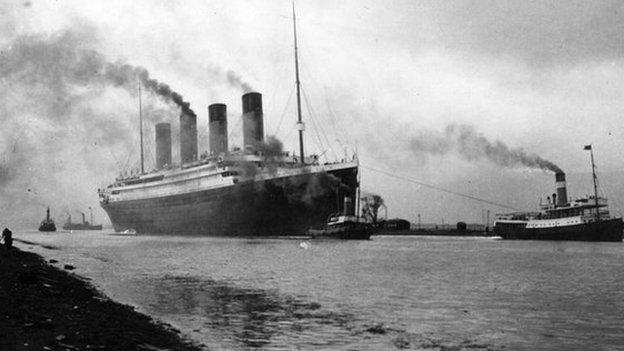
RMS Titanic in April 1912
The Titanic is one of the best known ships in the world.
Built in Belfast between 1909 and 1911, it was the biggest boat ever made at the time.
Some people even described it as "unsinkable".
The ship's first and last voyage was in 1912, with the Titanic scheduled to sail from Southampton in England to New York City in the United States.
However, the boat never reached the destination as it hit an iceberg which tore a hole along the side of its metal hull, during its maiden voyage.
How did the Titanic sink?

There should have been enough spaces for 1,000 passengers on the lifeboats
After the ship hit the iceberg thousands of tonnes of sea water started pouring in through the holes in its side.
As the ship filled with water, Captain Edward Smith ordered for the lifeboats to be lowered and for women and children to have the first seats.
There should have been enough spaces for 1,000 passengers (not enough for all the people on board) but some of the boats departed before they were full.
Seven hundred passengers were rescued, but more than 1,500 passengers died.
You can read about the timeline of the Titanic here.
Where is the wreck of the Titanic?
Titanic: Video from 1986 shows wreckage after first discovery
Many attempts to find the wreckage were made for decades before it was eventually located in 1985 by ocean explorers.
The Titanic was found 2.5 miles (4km) deep, 370 miles (595km) off the coast of Canada.
The ship is believed to have split in two as it sank, with front and back resting more than 600 metres apart on the ocean floor.
The wreck has been explored many times and some artefacts have been brought back to the surface to be kept in museums.
The sinking of the Titanic has continued to fascinate historians and enthusiasts with several books, films and documentaries dedicated to the event.
Discover more:
- Published15 March 2024
- Published13 November 2023
- Published18 February 2024