
Since the Gherkin pierced London's skyline in 2003, a number of architectural delicacies have popped up around the capital. Prince Charles once likened the capital to an "absurdist picnic table", but has it really started to resemble a giant's feast?
"The Gherkin really started the trend," says Peter Rees, ex-chief planner of the City of London and professor at UCL's Bartlett School of Architecture.
It is not the first building to earn a nickname inspired by items usually found in the kitchen pantry. Indeed, Prince Charles also dubbed the 309m-high Shard an "enormous salt cellar".
With work having resumed on the Can of Ham in January and the Cucumber on its way, BBC News explores some of the capital's most high-profile morsels.

The Gherkin

The Gherkin, built in 2003, started the nicknaming trend
So what came first - the building or the name?
"The Gherkin is circular so wind can flow around it more easily. It's smaller at the top so the closer you get to it, the less oppressive it gets. And it's tapered at the bottom to maximise the amount of space there.
"When you put those practical considerations together, you get an iconic shape," says Prof Rees.
But the shape of the building - real name 30 St Mary Axe - drew jeers and taunts from some, external after its completion in late 2003.
"They called it the 'Erotic Gherkin' and it was meant to be offensive, but it caught people's attention," he says.
"One year, just before Christmas, there was a laser light show that lit it up like a Christmas tree. When the public saw it, they fell in love with the shape."
The Prawn

At its completion in 2007, the Willis Building was the fourth tallest building in the City
Officially called the Willis Building, the tower's design was influenced by "overlapping curved shells". It is now popularly known as the Prawn - a name architects Foster + Partners refuse to use.
"The name was not given by us, nor was our intention to design a building which resembles a prawn," a spokeswoman said.
The Pringle

The Olympic Velodrome, known as the Pringle, has a curved roof to deflect sunlight and collect rainwater
Another London gem is the Olympic Velodrome, nicknamed the Pringle. Its curved roof, designed to reduce hot air inside and collect rainwater, reminded journalists of the famous snack.
"It's funny how the 'Pringle' nickname for the building has stuck," the BBC's Adrian Warner has said.
"People will start rewriting history and claiming they came up with it."
The Salt Cellar

The Prince of Wales calls the Shard an "enormous salt cellar"
"We already have a giant gherkin in the City, now it looks as if we are going to have an enormous salt cellar as well," the Prince of Wales said in 2003.
The name didn't stick - nowadays the skyscraper in London Bridge - the UK's tallest - is much better known as the Shard.
The Cheesegrater

The 225m Cheesegrater has a sloped face to avoid blocking views of St Paul's
Prof Rees laughs as he remembers the Leadenhall Building being dubbed the Cheesegrater. "I take credit for this one," he says.
"When I first saw a model of the building, I told Richard Rogers [the architect] I could imagine his wife Ruth, who owns a restaurant, using it to grate parmesan on pasta. I don't think he was too happy, but it stuck."
The skyscraper has a distinctive wedge shape to protect views of St Paul's Cathedral and horizontal fins to cut out the sun's glare.
The Cucumber

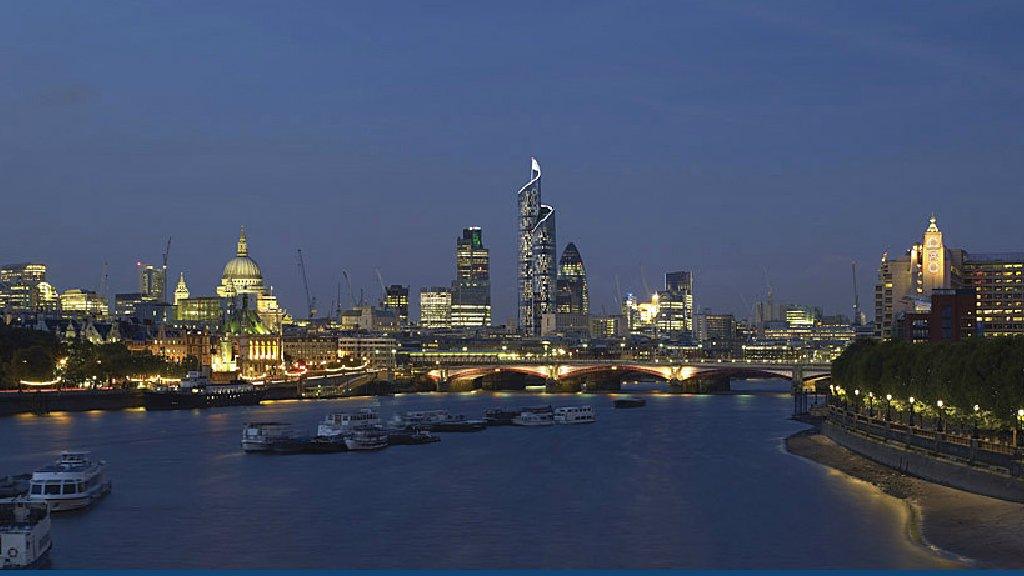
The Cucumber is set to be the tallest building in Westminster, with 42 storeys
The cylindrical residential tower, officially known as 1 Merchant's Square, is set to shoot up in the near future, although construction and completion dates are not confirmed.
Architect Robin Partington, who also worked on the Gherkin, said: "Nicknames can often reinforce the identity and branding of the building, but can conflict with the corporate vision."
Can of Ham

The Can of Ham was designed with energy efficiency - not picnic food - in mind
A squat, tubby tower is soon to take its place on London's dining table.
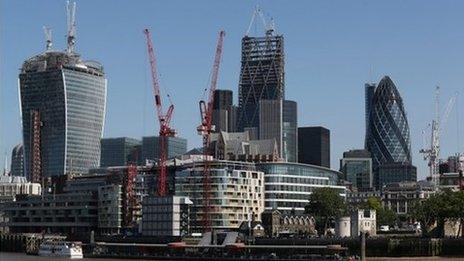
Nicknamed the Can of Ham, the 24-storey office block - real names 60-70 St Mary's Axe - was granted planning permission seven years ago, but construction was put on hold and resumed in 2015. It is set to be completed in 2018.
Waffle and Club Sandwich?

One Undershaft (left) could be called the Waffle and 22 Bishopsgate (right) has been called the Club Sandwich
Two new substantial skyscrapers have been planned for London's skyline.
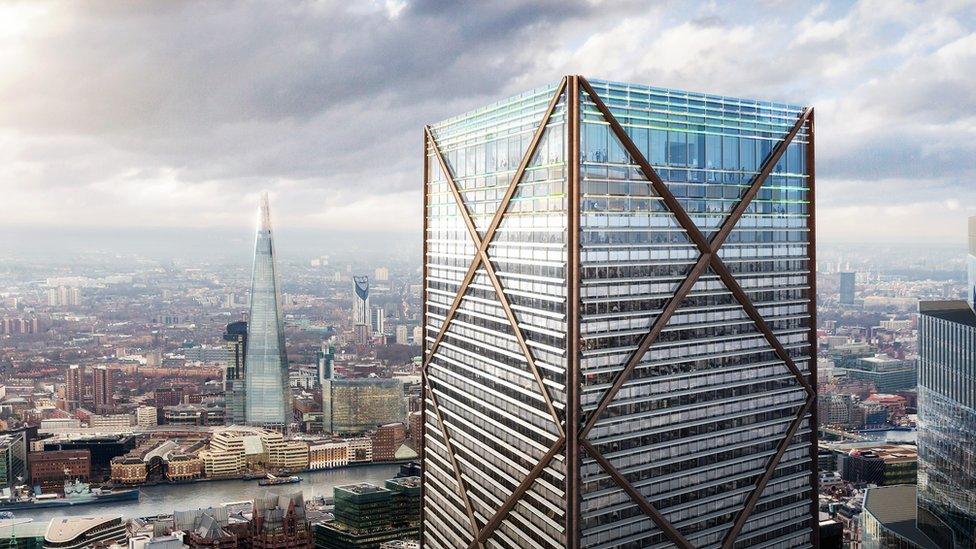
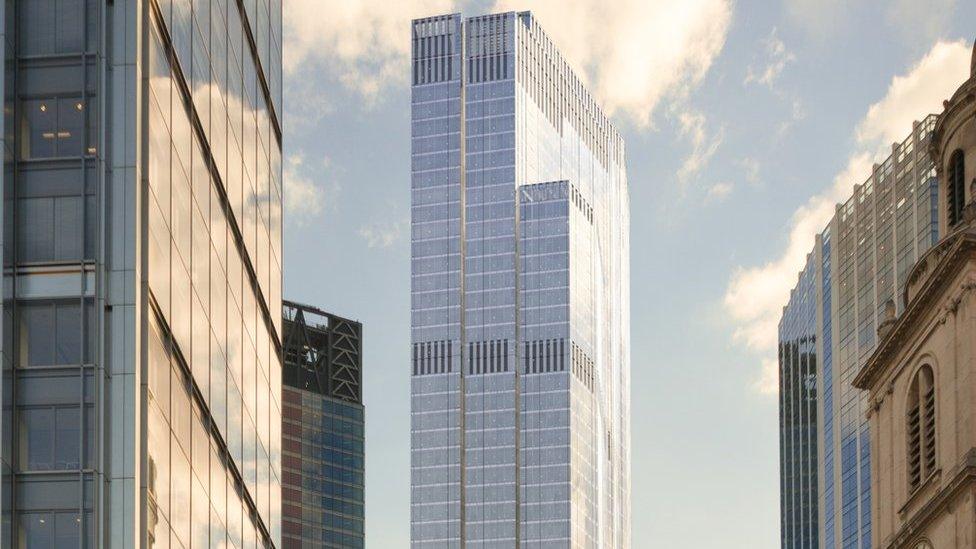
One Undershaft, which might be as tall as the Shard, could become known as "the Waffle", Prof Rees jokes.
And a new tower at 22 Bishopsgate has already been called the Club Sandwich, he says.
London's food buildings fad: A timeline

2003: Gherkin - 30 St Mary Axe
2007: Prawn - Willis Building
2011: Pringle - Lee Valley VeloPark
2012: Salt Cellar - The Shard
2014: Cheesegrater - Leadenhall Building
2018: Can of Ham - 60-70 St Mary's Axe
Unconfirmed: Cucumber - 1 Merchant Square
'Liquorice allsorts'
Appetising architecture
309m
height of the Salt Cellar (Shard)
224m
height of the Cheesegrater
6,000 capacity of the Pringle
178m circumference of the Gherkin at its widest point
222 apartments to be built in the Cucumber
Not everyone is a fan of the move towards bold architecture.
Architect Barbara Weiss, who campaigns to protect London's skyline, argues that the trend in iconic buildings is "unhealthy" for the capital.
"Since the Gherkin, a burst of commercial buildings stands in place of civic monuments," she says.
"It's just glorifying money and it's unhealthy to society, politics, the economy. They stand up as ghettos in the air, especially the residential towers for the extremely wealthy."
The obsession with iconic buildings is not just limited to towers, Ms Weiss says. She compares London's architecture a to a "pack of liquorice allsorts" with all the buildings "trying to be such different shapes and sizes".
Ham, cheese and pickles. Welcome to the London lunchbox.
- Published10 December 2015
- Published10 December 2015
- Published24 July 2014

- Published25 December 2013
- Published19 November 2012
- Published7 December 2010


