Summary

  • Donald Trump says he will extend the ceasefire with Iran until talks between the two countries have progressed

  • The US president says the blockade of Iranian ports will also continue until Tehran presents a "unified proposal"

  • The status of the US-Iran talks had been unclear with the current ceasefire previously due to expire this week

  • Vice President JD Vance did not depart for Islamabad as expected on Tuesday, remaining in Washington

  • Iran too had not decided whether to send a delegation to Pakistan for talks with the US talks, a foreign ministry spokesperson told the BBC

  • With this ceasefire extension, Trump has bought himself more time and indicates he is increasingly interested in ending this conflict, our Washington correspondent writes

  1. Oil prices volatile but back below $100 for nowpublished at 21:46 BST

    It has been an unsettled day for oil prices during all the twists and turns over talks between the US and Iran.

    Earlier, Brent crude surged by more than 5% to over $100 a barrel.

    Following Trump's announcement about extending the ceasefire, it is now back to $98.97.

    However, that is still ahead of where prices opened earlier and 35% higher than the end of February before the war began.


  2. Analysis

    Trump buys himself more timepublished at 21:38 BST

    Daniel Bush
    Washington correspondent

    President Donald Trump has decided to buy himself more time with Iran.

    Trump's announcement Tuesday that he was extending the ceasefire with Iran postponed the deadline he set for Tehran to reach a deal or else face a resumption of the war on Wednesday.

    In extending the truce Trump opted not to make good - for now - on his threats to restart a punishing air campaign against Tehran. But it also ensured that he'll be forced to make that choice again sometime in the coming days or weeks.

    When that might be is unclear. Trump did not specify on Tuesday exactly how long the new ceasefire extension will last - only that he was giving Iran more time to offer a "unified proposal" to end the war.

    It marked the second time in two weeks that Trump backed off from threats to escalate the war - a sign he seems increasingly interested in winding down the conflict.

  3. Analysis

    With ceasefire extension, Trump seeks more flexibilitypublished at 21:28 BST

    Bernd Debusmann Jr
    White House reporter

    Donald Trump's Truth Social post announcing that the ceasefire has been extended is revelatory, and is the clearest glimpse we have had today at the administration's current thinking on the possibility of talks.

    For one, Trump's post lays out that, in his view, it is unclear what exactly the Iranian proposal is, and who in the Tehran government is actually in charge.

    This is a continuation of something Trump says often - that Iran's leadership has been decimated, and that internal communications and deliberations are chaotic.

    His announcement also stops short of a full-scale return to hostilities, which would be complicated for the president politically in the US and economically with regards to oil prices.

    Notably, he has not offered a timeline, and has eliminated any ticking clock to come up with a solution - a strategy that theoretically gives him much more flexibility.

    The blockade on Iranian ports, however, remains. Iran views this as an act of war, and that is likely to remain an impediment to any negotiations going forward. It could choose to escalate, or to continue a "cold" war, of sorts, in the Persian Gulf and Strait of Hormuz.

  4. Trump says he will extend ceasefire with Iran and continue blockadepublished at 21:15 BST
    Breaking

    President Donald Trump says the US will extend the ceasefire with Iran, at the request of Pakistan, and continue the blockade of Iranian ports.

    Here is his statement on social media:

    Based on the fact that the Government of Iran is seriously fractured, not unexpectedly so and, upon the request of Field Marshal Asim Munir, and Prime Minister Shehbaz Sharif, of Pakistan, we have been asked to hold our Attack on the Country of Iran until such time as their leaders and representatives can come up with a unified proposal. I have therefore directed our Military to continue the Blockade and, in all other respects, remain ready and able, and will therefore extend the Ceasefire until such time as their proposal is submitted, and discussions are concluded, one way or the other.

  5. Hezbollah says it attacked Israel in response to ceasefire violationspublished at 20:51 BST

    Hezbollah says it has fired rockets at northern Israel in response to ceasefire violations from the Israeli military.

    In a post on Telegram earlier this evening, the Israel Defense Forces (IDF) said Hezbollah had fired several rockets at its forces operating in southern Lebanon.

    Israel's military added that it attacked the launcher from which the rockets were fired.

    Israel's ambassador to the US, Yechiel Leiter, says Hezbollah is violating the ceasefire agreement, adding, "We will defend ourselves against those who seek to maim, kill and prevent peace".

  6. Witkoff and Kushner seen at White House as US media reports Vance trip is on holdpublished at 20:26 BST

    Bernd Debusmann Jr
    White House reporter

    The situation with regards to talks in Islamabad clearly remains very fluid, and very chaotic.

    About 45 minutes ago, special envoy Steve Witkoff and the president's son-in-law and advisor, Jared Kushner, were spotted by TV cameras outside entering the White House.

    This is notable. We already know that Vice President JD Vance is holding meetings upstairs. He, along with Witkoff and Kushner, were confirmed earlier this week by the White House as all being on the team headed to Islamabad for any potential talks.

    The defence secretary, Pete Hegseth, was also seen entering the building, as was Secretary of State Marco Rubio.

    Both the White House and the vice president's office have been notably silent today, with little in the way of confirmation or any official indication of when that trip will happen, and even if.

    Citing anonymous sources, several US media outlets have reported that the trip is, for now, on hold, although it's unclear if that's a result of a lack of Iranian commitment to attend, or a dispute over terms.

    At 16:00 ET (21:00 GMT), President Trump is expected to speak at an unrelated event in the state dining room of the White House. He may, as he has in the past, deliver a brief update on the Iran situation at the start.

  7. IRGC threatens oil production in Middle East if attack originates from southern neighbourspublished at 20:13 BST

    Iran IRGC (Islamic Revolutionary Guard Corps) Aerospace Commander Majid Mousavi has threatened Iran’s southern neighbours in a message published by Iranian outlets today.

    “Iran’s southern neighbours should know that if their lands and facilities are used by enemies to carry out aggression against the Iranian nation, they will have to bid farewell to oil production in the Middle East", he said.

    Mousavi has also said that “if, from this point onwards, the enemy makes the slightest misstep” and attacks Iran, then “wherever you [Iranians] say will become our target".

  8. Tehran has received signs that US is ready to end Iranian port blockage, ambassador sayspublished at 20:05 BST

    Nada Tawfik
    Reporting from New York

    At the United Nations in New York, Iran’s UN Ambassador Amir Saeid Iravani has just told a few of us that Tehran has received some signs that the US is ready to end their blockade.

    He says when that happens, the next round of negotiations will take place in Islamabad.

    I asked him about JD Vance’s trip being “on hold,” but he said he had no information on that and reiterated it was a condition for Iran that the US lifts its blockade on the Strait of Hormuz before any talks can resume.

    He said if the US wants a political solution, they are ready, if they want war then Iran is also ready.

  9. Iran's foreign minister accuses US of breaching ceasefirepublished at 19:57 BST

    Seyed Abbas Araghchi, Iran's foreign minister, says the US blockade of Iranian ports "is an act of war and thus a violation of the ceasefire".

    In a post on X, he says that "striking a commercial vessel and taking its crew hostage is an even greater violation" - on Sunday the US intercepted an Iranian-flagged cargo ship in the Gulf as part of its naval blockade, Donald Trump said.

    Araghchi adds that Iran knows "how to defend its interests and how to resists bullying".

    The US and Iran's temporary ceasefire expires on Wednesday, with further peace discussions yet to take place after the first round failed.

    The foreign minister has not specified whether Iran will participate in the next round of talks in Islamabad or not.

  10. Lebanon needs €500m for humanitarian crisis, PM sayspublished at 19:48 BST

    Lebanese Prime Minister Nawaf Salam is participating in a press conference with French President Emmanuel Macron today to discuss the ceasefire between Israel and Lebanon.

    Salam says his country needs €500m "to address the humanitarian crisis over the next six months". The contributions Lebanon has gathered so far only cover a part of its needs, he adds.

    Since hostilities first broke out in March between Israel and the Iran-backed militia Hezbollah in southern Lebanon, world leaders have been warning of a growing humanitarian crisis there.

    According to Lebanon's health ministry, more than 2,200 people have been killed and more than 7,500 injured since the conflict began. UNICEF estimates that over a million Lebanese residents have been displaced.

  11. Iran negotiators work under supreme leader’s ‘direction’ - senior Iranian officialpublished at 19:24 BST

    Ghoncheh Habibiazad
    Senior reporter, BBC Persian

    Elias Hazrati, a senior Iranian government communications official, says Iranian negotiators “make decisions collectively and carry out their duties under the direction” of Iran’s Supreme Leader, Mojtaba Khamenei.

    Since his succession to the position of his father in early March, Mojtaba Khamenei is yet to be seen in public or in recent videos and photos.

    So far, all we’ve seen have been written messages attributed to him on Iranian outlets.

    Based on the written messages, Mojtaba Khamenei has not explicitly mentioned the negotiations, although in some of the messages attributed to him, he has criticised the US.

    In a message attributed to him published on 18 April, Khamenei praised Iran’s army for fighting “two armies at the vanguard of the front of the non-believers and [global] arrogance”, referring to the US and Israel.

    We’re still yet to see whether Iran’s delegates will participate in the talks with the US in Islamabad or not.

  12. Confusion in Washington about Vance's trip to Islamabadpublished at 18:53 BST

    Bernd Debusmann Jr
    White House reporter

    It's been another confusing day in Washington, where it remains unclear when - and if - Vice President JD Vance and the rest of the US negotiating team will head to Islamabad for talks with their Iranian counterparts.

    In the last half hour or so, the New York Times reported, citing an anonymous source familar with the situation, that the trip has been postponed after Iran failed to respond to the US negotiating position.

    The BBC has contacted the White House for comment on whether the team is expected is to depart later or whether the trip postponed indefinitely.

    What we can say with certainty, however, is that JD Vance is not on his way, or even at the airport.

    It has been confirmed to multiple news outlets by administration staff that Vance is participating in policy meetings here at the White House. Journalists outside doing TV appearances also spotted his motorcade arriving a short while ago.

    There is also considerable confusion regarding when, exactly, the ceasefire expires. Pakistan and Iran say it ends at midnight tonight, but it's unclear if the US has put a specific time stamp on its expiration - Trump only having said it expires on Wednesday evening.

    It's entirely possible that any official comment that the ceasefire has been extended will come through Truth Social - or when strikes are reported in Iran.

  13. Israeli army says Hezbollah fired rockets at its forces in Lebanonpublished at 18:34 BST

    Israel's military says Hezbollah has fired several rockets at its forces operating in southern Lebanon.

    The Israel Defense Forces (IDF) says it attacked the launcher from which the rockets were fired. Hezbollah is yet to comment.

    In an update earlier this evening via Telegram, the IDF said its military and air force killed "terrorists" who crossed the defence line in the Al-Qsair area of Lebanon on Monday and Tuesday, which it said violated its ceasefire agreement.

    Israel and Lebanon are currently in a 10-day ceasefire after six weeks of conflict between Hezbollah and Israel. Lebanese and Israeli representatives are scheduled to meet for a second round of talks on Thursday - according to a US official.

  14. Analysis

    What has Trump said about the Iran deal?published at 18:12 BST

    Carrie Davies
    Reporting from Islamabad

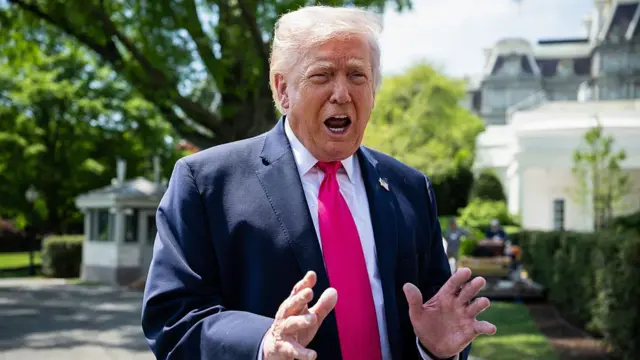
    US President Donald Trump speaks to members of the media on the South Lawn of the White House before boarding Marine One in Washington, DC, US, on Thursday, April 16, 2026.Image source, Bloomberg via Getty Images

    Social media has played a major role for both sides during this conflict. First, let’s look at the posts from President Trump.

    Trump has used his platform Truth Social to issue threats, hurl insults, write announcements and make positive noises about a deal, sometimes all in the same message.

    12 April - After Vice-President Vance left Islamabad without a deal on 12 April, the president said that "the meeting went well, most points were agreed to", apart from on nuclear weapons - "the only point that really mattered".

    As a result, he said the US would begin a blockade. Any Iranian vessel that fires on the US he said would be "BLOWN TO HELL!" and the US was "LOCKED AND LOADED".

    As the week continued, the president added to his criticism of Iran. But the optimism for a deal continued.

    17 April - Trump said Iran had announced the Strait of Hormuz was "FULLY OPEN AND READY FOR FULL PASSAGE”.

    By later that day, he had posted that “Iran has agreed to never close the Strait of Hormuz again. It will no longer be used as a weapon against the World!” But two days later, that changed.

    19 April - “Iran decided to fire bullets yesterday in the Strait of Hormuz — A Total Violation of our Ceasefire Agreement!” The president posted on 19 April, saying that Iran had announced they were closing the strait

    “We are offering a very fair and reasonable DEAL, and I hope they take it because, if they don’t, the United States is going to knock out every single Power Plant, and every single Bridge, in Iran. NO MORE MR. NICE GUY!”

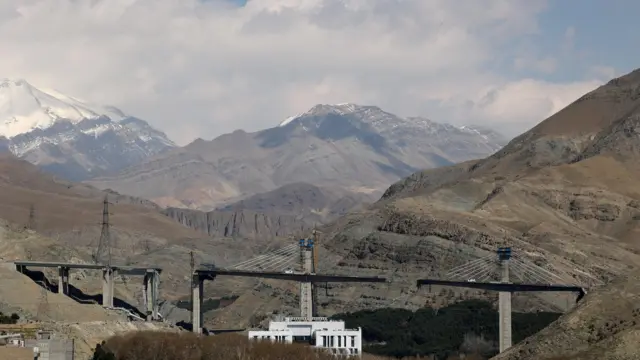
    The B1 bridge damaged by a strike, as the U.S.-Israeli conflict with Iran continues, in Karaj, Iran, April 3, 2026.Image source, Reuters
    Image caption,

    At the start of April, a US strike hit Iran's B1 bridge - a recently-constructed overpass that connected the city of Karaj to the capital Tehran

    He also announced that his delegation would be in Islamabad on Monday night. By Tuesday afternoon in Islamabad, no delegation has yet arrived. Yet the president has continued to sound optimistic about a deal.

    It’s difficult to know how this series of carrots, sticks, self-praise and insults will be read by the Iranian delegation; negotiators from their side too have posted rebukes and their positions online and there will be some recognition that both the US and Iran will be often thinking of their own domestic audiences in their public messages.

    Yet there is little trust between the two sides with a risk of miscalculation.

    Rarely has such delicate diplomacy been conducted with the backdrop of such instantaneous and volatile public messaging.

  15. Future of peace talks up in the airpublished at 17:50 BST

    Azadeh Moshiri
    Reporting from Islamabad

    Iran's delegation was ready to come to the negotiating table but "everything changed" the moment the United States fired on an Iranian-flagged cargo ship, according to an Iranian source.

    This attack in the Gulf of Oman came just days before a second round of peace talks was expected in Islamabad.

    The White House may have thought it would add pressure on Iranians at the negotiating table, but instead neither delegation is in Islamabad and Iran's military has vowed to retaliate.

    Even before this episode, weeks of war and brute force did not yield the immediate political and military concessions the United States had expected.

    In a social media post, Pakistan's information minister has now acknowledged mediators are still trying to convince Iran to participate in a second round of talks.

    After days of wondering whether both delegations will fly to Islamabad, it's now clear the future of peace talks is up in the air.

  16. 'For a lot of people... there's nothing to go back to': BBC reports from southern Lebanonpublished at 17:22 BST

    Hugo Bachega
    Middle East correspondent in Lebanon

    At a village about 10 minutes from what the Israeli military calls the "yellow line", the BBC's Middle East correspondent Hugo Bachega sees first hand some of the destruction caused by recent fighting.

    Almost everything has been destroyed in some areas, he says. But with the ceasefire in Lebanon, some families displaced by the war have been starting to return their homes.

    However, for many people, he says there's nothing to go back to.

  17. BBC Verify

    Tracking and satellite imagery shows sanctioned vessels crossed US blockadepublished at 17:02 BST

    By Shruti Menon, Alex Murray and Barbara Metzler

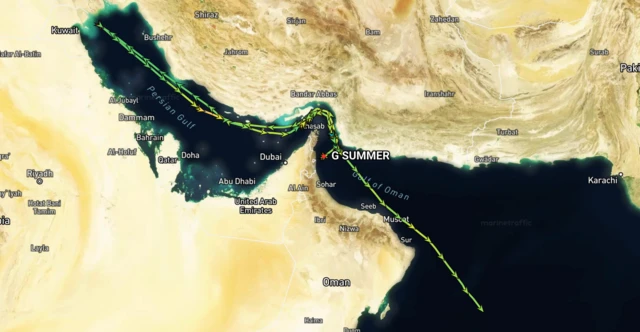
    BBC Verify has identified a tanker laden with cargo, which appears to have crossed the US Navy’s blockade line and sailed east into the Arabian Sea.

    We cannot say from location data on ship tracking website MarineTraffic where exactly G Summer, a US-sanctioned liquified petroleum gas (LPG) tanker, picked up its cargo while it was in the Gulf near Iranian, Iraqi and Kuwaiti waters.

    But its location data shows it has since transited the Strait of Hormuz and sailed into the Gulf of Oman on 19 April. It is unclear where the ship is going as it is currently not transmitting that information.

    Location data monitoring has limitations as ships can turn their trackers off - or attempt to hide their location by broadcasting a false position, known as “spoofing”.

    A marine traffic map of the G Summer's path through the Gulf from near Kuwait, through the Strait of Hormuz and into the Arabian SeaImage source, MarineTraffic

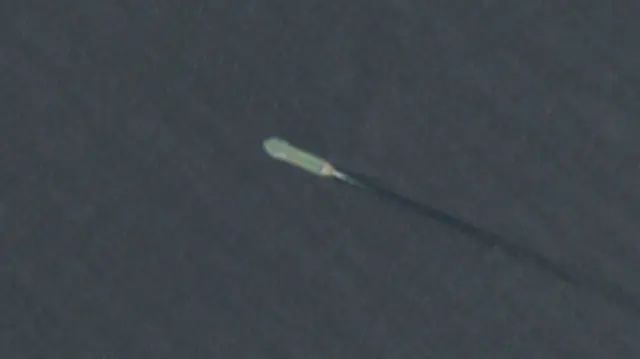
    Analysis of satellite imagery has also identified a vessel that matches the length and colour of the Felicity, a US-sanctioned tanker from the National Iranian Tanker Company, about 150km (93 miles) to the west of the blockade line inside the Gulf of Oman.

    BBC Verify is unable to match the location of the satellite image with ship-tracking data. This suggests a “dark” transit where the ship is not broadcasting its location.

    A satellite photo showing a large green ship sailing in the oceanImage source, Sentinel-2, Copernicus
  18. Analysis

    What little trust there was between the US and Iran has further evaporatedpublished at 16:43 BST

    Frank Gardner
    Security correspondent

    Even if US and Iranian negotiators do eventually sit down in Islamabad, what little trust there was between them has further evaporated in recent days.

    Donald Trump’s naval blockade on Iran’s Gulf ports was intended to put so much economic pressure on Tehran it would concede a deal on America’s terms.

    Instead, it has hardened Iran’s position. It says it shows Washington is not serious about reaching a fair deal.

    The two-week ceasefire is due to run out on Wednesday, with the US President saying it is highly unlikely it will be extended.

    Iran’s parliamentary speaker has hinted at new weapons or tactics it may deploy by warning about preparing what he called "new cards on the battlefield".

  19. Iran undecided on sending delegation to Islamabad, spokesperson tells BBCpublished at 16:12 BST
    Breaking

    Lyse Doucet
    Chief international correspondent, in Iran

    Iranian foreign ministry spokesman, Esmail Baghaei, has told the BBC that a decision has still not yet been made for an Iranian delegation to travel to Islamabad for a new round of talks with the United States this week.

    He expressed concern regarding the US’s naval blockade of its ports and the seizure of an Iranian vessel as well as President Trump’s threats to destroy Iran’s infrastructure.

    “We went to this negotiation with good faith and sense of seriousness, but you have a negotiating party that has shown its lack of seriousness, lack of good faith…They're changing their position frequently, these flip flops, threats of war crimes," Baghaei said.

    But he would not be drawn on what conditions Iran required to return to the negotiating table.

    He added that this was still being discussed.

    The BBC understands that conversations are under way to try to create conditions for the resumption of talks before the ceasefire expires tomorrow.

    • The BBC's chief international correspondent Lyse Doucet is reporting from Tehran on condition that none of her material is used on the BBC's Persian Service. These restrictions apply to all international media organisations operating in Iran
  20. Analysis

    Islamabad formally acknowledges for first time Iran's participation in talks not guaranteedpublished at 16:06 BST

    Azadeh Moshiri
    South Asia correspondent, reporting from Islamabad

    Pakistan, a key mediator, has now publicly acknowledged that the ball is in Iran's court.

    In an update on social media, the minister of information Attaullah Tarar has said Pakistan has made "sincere efforts to convince the Iranian leadership to participate in the second round of talks and these efforts continue".

    After days of waiting to find out whether potential peace talks will happen, this is the first formal acknowledgement by Pakistan that Iran's participation is not guaranteed.