Summary

  1. 'People are more careful about where they spend their money,' says venue ownerpublished at 09:15 BST

    Hannah Mullane
    5 Live Business reporter

    Strong growth in March is another signal that the economy seemed to be holding up well at the start of the Iran war, but we know that some of these rising costs we’ve been seeing take a while to reach the consumer.

    This week I’ve been speaking to hospitality businesses in Liverpool who say they are seeing consumer behaviour change, which is making growth difficult.

    Oliver Clarke, the managing director of Baa Bar Group, which owns a number of late-night venues across the north-west England, tells me getting customers through the door is getting harder.

    "Everyone is getting squeezed with higher bills and it means people are being more careful about where they spend their money," Clarke says.

    He says it is a "race to the bottom" among local venues competing to put on the best deals to get people into his venues.

    As we see petrol prices staying high and the threat of higher food price inflation later this year we could see consumer confidence remain low, even if overall growth at the start of the year has been strong.

    A man in rose-pink shades and a black jacket stands smiling behind a bar.
    Image caption,

    "Everyone is getting squeezed," Oliver Clarke says

  2. Analysis

    Much remains to be tackled to safeguard the economy's futurepublished at 09:05 BST

    Dharshini David
    Deputy economics editor

    These GDP numbers are a glimpse of the past, and may well have been the calm before the storm - the economy is likely to have been buffeted since by the fallout from the war in the Middle East, and now faces the renewed challenges of political uncertainty. And numbers are always prone to revision.

    But they matter - first, as they point to greater resilience in some key sectors, such as some parts of the services and the construction sector, than some had feared. And that always bodes well for profits and hiring.

    Second, as the stronger activity, the greater the tax take tends to be - which is valuable for public finances.

    And third because, in a world of rising costs, they give the Bank of England more scope to raise interest rates - if they fear the inflation outlook is getting too risky.

    But there remains much to be tackled, by whoever is in Number 10 and 11 Downing Street in the coming months, to safeguard the future property.

    Consumer-facing services, such as retail, remain smaller as a sector for example than a few years ago and joblessness, especially among the young, remains a key obstacle to many people feeling better off.

    Navigating the shock waves triggered by a war thousands of miles away will be only part of the challenge.

  3. What do economists make of the latest figures?published at 08:57 BST

    Jemma Crew
    Business reporter

    In the past and not likely to last. That’s certainly what some economists seem to be making of these numbers.

    Fergus Jimenez-England, associate economist at the National Institute of Economic and Social Research, calls the 0.6% growth over the first quarter of the year “relatively strong” but “largely reflects old news”.

    Yael Selfin, Chief Economist at KPMG, says the “strong start” is expected to fade as the impact of the Iran war filters through.

    As Luke Bartholomew, deputy chief economist at Aberdeen Investments puts it, “it is hard to see this mattering very much to markets given how much things have moved on since then in both international and domestic politics”.

    Suren Thiru, chief economist for ICAEW, a body for chartered accountants in England and Wales, sees the first three months as “probably the high point for the economy this year”.

    He adds that a prolonged period of domestic political instability would affect the economy by “further denting confidence and increasing financial market turbulence, likely resulting in notably weaker spending and investment”.

    Remember too, these are official estimates and are often revised by the ONS as more data filters through.

  4. How the economy has grown in the past two yearspublished at 08:39 BST

    Jemma Crew
    Business reporter

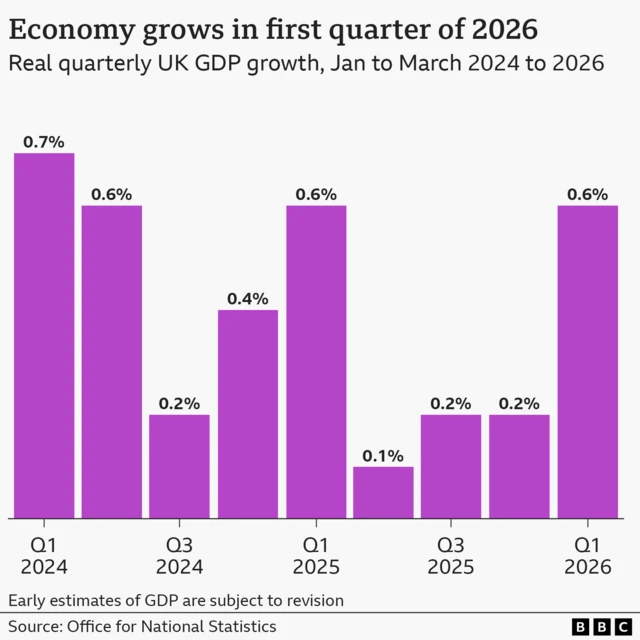
    The economy has grown in every quarter over the past two years, according to the ONS data.

    Today's figures show it grew 0.6% in the first three months of this year. The last quarter where growth was higher than this was two years ago, when the start of 2024 saw 0.7% growth.

    A chart showing GDP growth per quarter, from quarter 1 2024 to quarter 1 2026.
  5. Analysis

    Economic resilience gives hope numbers can defy Iran war forecastspublished at 08:28 BST

    Faisal Islam
    Economics editor

    These are a very solid, and dare I say it, good set of GDP figures in the circumstances, that need to be noted before some inevitable caveats.

    Growth at 0.6% gets us back to normal numbers and exceeds sluggish recent history. It already includes a month of Iran War turmoil in which the UK economy continued to chug along.

    In per capita terms this growth is the strongest quarter for four years. And, importantly, in international terms this is the fastest performance in the quarter of all G7 countries so far, and likely to be top when Japan reports its number, estimated to be 0.4%.

    There is significant underrated resilience in the economy. That will give hope that the numbers can defy some of the forecasts that the Iran War effect will hit the UK hardest. There is little evidence of that so far, but it is early days.

    Later data from last month and this month will show more of a hit from rising market interest rates and the rising cost of living. The baseline however was some rather underrated resilience, though there is a pattern in the data of Q1 starting well and then fading.

    Delivering the strongest set of economic figures in the life of the Government, is quite the backdrop for a leadership challenge.

  6. No drop off in activity yet, says shopping centre bosspublished at 08:13 BST

    Sean Farrington
    Presenter, Today programme business and Wake up to Money

    We've been waiting for a bit more of an insight into how the economy has been getting on after the war in Iran began, and the boss of some of the country's biggest shopping centres says he hasn't seen a drop off in activity since the war started - yet.

    Mark Allan, chief executive of Landsec, told me earlier on the Today Programme that he's seen particularly strong demand in what he called "prime locations" for shops and for offices.

    But does the government have "the right economic plan" as the chancellor has said this morning?

    Allan says longer-term moves to reform planning, and decoupling electricity pricing from gas, are positives - but some of the shorter-term policies, including raising minimum wage and national insurance, are some of the things that get in the way.

  7. Businesses bringing forward activity in anticipation of higher costs from Iran warpublished at 08:10 BST

    Jemma Crew
    Business reporter

    The 0.3% increase to GDP in March was not expected – most economists had been forecasting the economy would shrink.

    Some analysts are suggesting there was an increased amount of activity in some areas in March given the longer-term uncertainty and concerns over supply crunches due to the US-Israel war with Iran.

    The ONS says some businesses it surveyed “cited activity being bought forward in anticipation of increases in costs because of conflict in Iran”.

    These comments were from businesses in manufacturing, car sales, wholesale, and rental and leasing activity.

    But some areas – wholesale, warehousing and support activities for transportation, accommodation, employment agencies and travel agencies – said the conflict had reduced turnovers in March.

  8. Labour leadership 'chaos' is 'destabilising economy', says shadow chancellorpublished at 07:58 BST

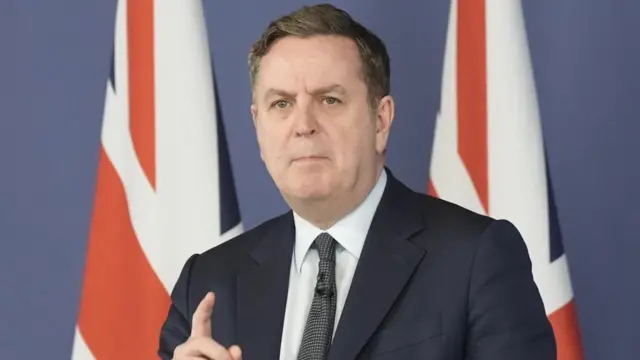
    Mel StrideImage source, PA Media

    Shadow chancellor Mel Stride says "chaos surrounding the Labour leadership is destabilising Britain’s economy".

    “This week, borrowing costs hit their highest level in 30 years as Labour leadership contenders competed to promise even more spending, borrowing and fantasy economics," he says.

    “Only the Conservatives have a serious plan to Get Britain Working Again and to fix the public finances through our Golden Economic Rule.”

  9. Reeves says government has 'right economic plan'published at 07:39 BST

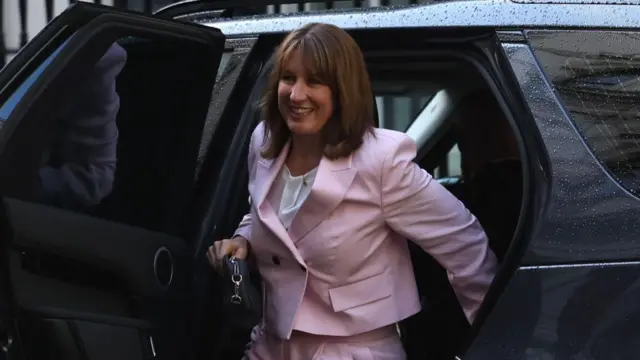
    Rachel Reeves in a pink suit getting out of a taxi in the rainImage source, EPA/ Shutterstock

    Chancellor Rachel Reeves says today's figures show that the UK government has "the right economic plan".

    "The choices I have made as chancellor mean our economy is in a stronger position as we deal with the costs of the war in Iran," she says.

    “Now is not the time to put our economic stability at risk. To do so would leave families and business worse off.

    "Instead, this government is getting on with the job of building an economy that is stronger, more resilient, and prepared for the future."

    The chancellor's comments come amid growing speculation that Prime Minister Keir Starmer could face a leadership challenge as soon as today. You can read all about that in our separate live page.

  10. Analysis

    A robust early year performance - but growth expected to remain weakpublished at 07:27 BST

    Dharshini David
    Deputy economics editor

    After a lacklustre end to 2025, these numbers point to a robust performance earlier in the year as households and businesses started 2026 on a brighter note.

    Growth was led by a rebound in areas such as retail, the wholesale trade and construction, resulting in the strongest expansion of any of the major economies for that quarter. And the expansion continued on into March after the war in the Middle East started, even as energy costs rose.

    While that sign of resilience is encouraging, these numbers are very much a snapshot of the past.

    Analysts expect the economy to have stagnated since, and growth to remain weak over the summer, as confidence has been knocked and higher fuel and other costs eat into profits and incomes - and job creation.

    It may have been a politically turbulent week but the key economic challenge remains the same: boosting growth, at a time when many may not feel living standards are improving fast.

  11. Let's look at those numbers more closelypublished at 07:16 BST

    Jemma Crew
    Business reporter

    In the first three months of the year, economic growth was driven by a 0.8% boost in the key services industry. Services includes areas such as travel, accommodation, retail, hospitality, real estate, finance and entertainment.

    In addition, production output grew by 0.2% and construction output was grew by 0.4%.

    Within services, the largest positive contributions to growth were wholesale and retail trade, with repair of motor vehicles and motorcycles up 2.0%; information and communication (up 1.7%), and professional, scientific and technical activities (up 1.2%).

    Looking at the month of March, services and output both grew - by 0.3% and 1.5% respectively - while production fell by 0.2%.

  12. Economy grew by 0.3% in Marchpublished at 07:03 BST
    Breaking

    The economy grew by 0.3% in March, the ONS data also shows.

    It’s the first full month after the outbreak of the Iran war – on 28 February – that’s covered by the figures.

    Economists had expected it to shrink by 0.1 or 0.2%.

  13. Economy grew by 0.6% in first quarter of the yearpublished at 07:02 BST
    Breaking

    The economy grew by 0.6% in the first quarter of 2026, official figures show.

    Stay with us for more updates and to find out what this means for your money.

  14. 'This is the most difficult period we've had'published at 06:54 BST

    Adam Woods
    Economics producer

    Boston wearing a purple soft play centre branded polo shirt and smiling with his arm around his sister's shoulders. She has long straight blonde hair and is also smiling wearing a red polo shirt with the same branding and a black cardigan
    Image caption,

    Brother and sister Boston and Kennady Mace run the Mace Playce indoor soft play centre in Chelmsford Essex

    We've been in Chelmsford, Essex ahead of this morning's figures to hear how people are feeling about the economy.

    Siblings Kennady and Boston Mace run a play centre and say they've noticed families cutting back spending on birthday parties.

    “We’ve got our own children so we appreciate how expensive a day out can be,” Boston says. “Everything’s going up...we’ve got a limit on what we can charge so the profit margin is getting smaller and smaller."

    Kennady says she has noticed families paying for activities but not food “which is understandable...money’s a lot tighter," she says.

    She and her brother have to balance “keeping everything reasonable” for their customers with ensuring the business is viable, she says.

    Boston says in their 13 years in business they have experienced the Covid pandemic, a fire, a flood and a theft, but “this seems [to be] the most difficult period we’ve had”.

  15. What the most recent data tells uspublished at 06:45 BST

    Jemma Crew
    Business reporter

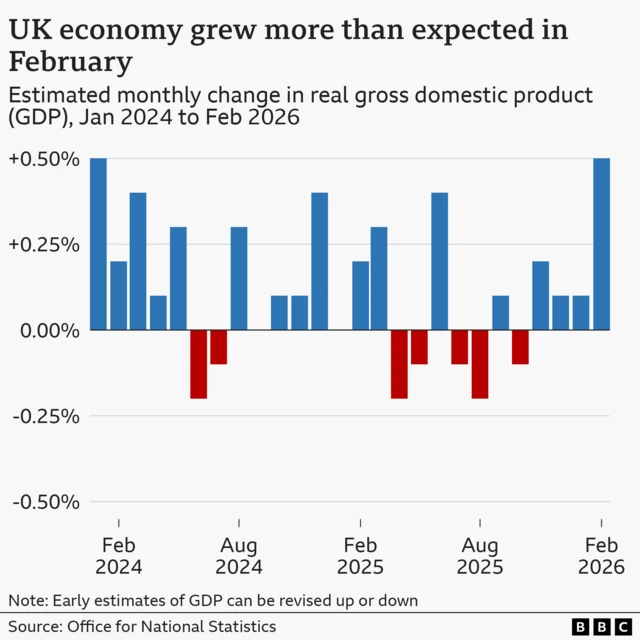
    The UK economy grew faster than expected in February, according to official figures.

    Most economists had forecast a 0.1% increase, but instead there was a 0.5% boost.

    It was the biggest monthly increase in just over two years.

    But the data covers a period before the outbreak of the Iran war, which is having a huge impact on the global economy.

    Deutsche Bank's Sanjay Raja said the actual figure had "smashed expectations" but also warned it would not last.

    The Office for National Statistics (ONS) also revised its estimate for January up to 0.1% - after previously saying the start of the year had seen no growth.

  16. What's going on with the economy?published at 06:35 BST

    When the Labour government took power in July 2024, it said growth was its top priority.

    Across 2025 as a whole, UK GDP was estimated to have increased by 1.4%, up from 1.1% in 2024.

    A bar chart showing the estimated monthly GDP growth of the UK economy, from January 2024 to 2026. The figures are as follows: Jan 2024 (0.5%), Feb 2024 (0.2%), Mar 2024 (0.4%), Apr 2024 (0.1%), May 2024 (0.3%), Jun 2024 (-0.2%), Jul 2024 (-0.1%), Aug 2024 (0.3%), Sep 2024 (0.0%), Oct 2024 (0.1%), Nov 2024 (0.1%), Dec 2024 (0.4%), Jan 2025 (0.0%), Feb 2025 (0.2%), Mar 2025 (0.3%), Apr 2025 (-0.2%), May 2025 (-0.1%), Jun 2025 (0.4%), Jul 2025 (-0.1%), and Aug 2025 (-0.2%), Sep 2025 (0.1%), Oct 2025 (-0.1%), Nov 2025 (0.2%), Dec 2025 (0.1%), Jan 2026 (0.1%), Feb 2026 (0.5%).

    In March, the Office for Budget Responsibility (OBR) - the government's official forecaster - cut its prediction for how much the UK's economy would grow across 2026 from 1.4% to to 1.1%.

    However, this forecast was made before the start of the war in Iran.

    In April, the International Monetary Fund (IMF) said it expected the conflict to hit the UK the hardest of the world's advanced economies. It cut its estimate for UK growth in 2026 from 1.3% to to 0.8%.

  17. What is GDP?published at 06:22 BST

    Today’s figures show how the UK economy is performing, using a measure called Gross Domestic Product (GDP).

    GDP measures the size and health of a country’s economy by assessing how much is produced, spent and earned over a period of time.

    But the measure doesn’t tell the whole story, especially important aspects of people’s living standards or how wealth is shared.

    Generally, economists, politicians, and businesses prefer GDP to grow steadily – as it means people are spending more, more jobs are being created, and more tax is being paid.

    If GDP shrinks for two quarters in a row, this is known as a recession, which can lead to pay freezes and job losses.

  18. Latest figures on health of UK economy about to be releasedpublished at 06:20 BST

    At 07:00 we will find out how the economy performed in the first quarter of this year, as well as the monthly figure for March.

    The quarterly figure is the most significant in giving us a snapshot of what rate the economy was growing or shrinking at the start of the year.

    But March's data is the first look at what impact the war in Iran is having on the UK's finances.

    Economists, including those at the Bank of England, are expecting to see growth of 0.5% between January and March.

    Stay with us for the numbers and expert analysis on what it all means for the economy - and you.