Summary

  1. Trump says he will replace 20% Hormuz toll with Gulf state trade dealspublished at 16:13 BST
    Breaking

    Donald Trump says on Truth Social he has decided to "replace the 20% United States Reimbursement Fee with Trade and Investment Deals that the various Gulf States will be making into the United States".

    "Those Investments will be MASSIVE but, at the same time, extraordinarily good for them, and their future," he writes on the platform.

    We'll bring you further details from his post soon.
  2. Industry making 'hour by hour decisions' on transiting Strait of Hormuz - security expertpublished at 16:00 BST

    Maritime security expert Victoria Mitchell tells the BBC's World At One that the industry is making "hour by hour decisions" on when to transit to ensure safety for cargo, crew and vessels.

    "Whilst it isn't that everything has stopped, certainly this most recent escalation has meant a reduction in the number of transits through the strait," Mitchell of firm Control Risks says.

    With the central route closed, Mitchell says vessel owners will be talking to Iran about using their administered northern route as well as working with Oman and the US for the southern route.

    She says there's "no like for like" alternative to the strait, but some states have some capacity to bypass it by using pipelines like Saudi Arabia's East-West pipeline.

    "These are not able to support the same volume of oil, which was moving through the strait by seaborne routes. And they only allow for the states, Saudi Arabi, and the UAE to be using them because there's limited capacity."

  3. US has been violating the ceasefire deal since day one, says Tehran professorpublished at 15:40 BST

    The US and Iran have returned to "full-blown hostilities", according to Foad Izadi, professor of American studies at the University of Tehran.

    Izadi says the memorandum of understanding (MoU) between the US and Iran was signed in a period of "distress" and that the US started violating the agreement on "day one".

    "Pete Hegseth, the secretary of war, threatened to attack Iran five hours after Trump signed the agreement, which is against article one," Izadi tells the BBC World Service's Newshour.

    "The United States started violating the MoU from day one, until today - when they attacked Iran last night," he says.

    Izadi adds that Iran does not want to control the Srait of Hormuz, but is responding the the US's "illegal attacks" and its blockade of Iranian ports, which Izadi says "is an act of war".

  4. Escalation of rhetoric and pressure around conflict - UK foreign secretarypublished at 15:27 BST

    Yvette Cooper, a woman wearing glasss, looking up, with the Union Jack flag behind her.Image source, Getty Images

    UK Foreign Secretary Yvette Cooper has said she's spoken with US colleagues over the UK's opposition to tolls in the Strait of Hormuz.

    Speaking to the Foreign Affairs Committee, Cooper said the "discussion" took place during the Nato summit last week.

    "We were talking about that we could not end up with tolls and with a system on the Strait of Hormuz that would undermine the freedom of navigation and the law of the sea."

    She added she felt there's currently an "escalation of rhetoric around the conflict itself and the putting on of pressure".

    Cooper also blamed Iran for "an increasing of pressure on all sides" by attacking commercial shipping in the southern shipping route in Omani waters, saying the move "totally undermines the law of the sea".

  5. Iran to loom over Trump's meeting with the Iraqi PMpublished at 15:04 BST

    Bernd Debusmann Jr
    White House reporter

    US President Donald Trump is scheduled to meet with new Iraqi Prime Minister Ali al-Zaidi at the White House in a few hour's time - a meeting in which the issue of Iran is likely to dominate discussions.

    Trump publicly supported al-Zaidi to become Iraq's new PM after months of political deadlock following the country's parliamentary elections last year, and in April posted that his success was the "beginning of a tremendous new chapter" in US-Iraqi relations.

    The US president is likely to use the meeting to push al-Zaidi to move to disarm Iranian-backed and affiliated militia groups.

    While Iraq's government has given non-state armed groups until September to give up their weapons, several of them have said they won't, and experts have warned that government operations against them could lead to fighting.

    According to US officials, these groups have attacked US diplomatic and military personnel and facilities more than 600 times, including drone attacks on the American embassy and military airfields.

    This, in turn, has prompted US retaliatory operations against militia leaders and bases.

  6. Netanyahu warns that Israel's response to any Iranian attacks will be 'much more powerful'published at 14:46 BST

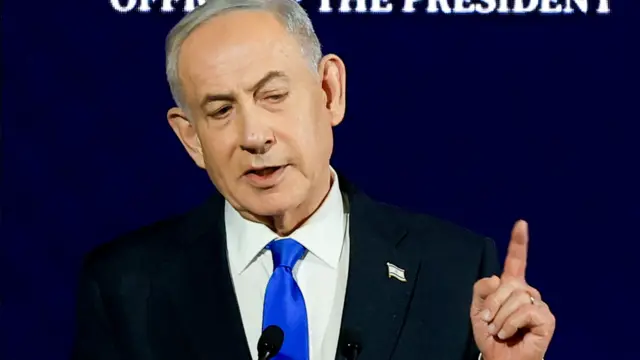
    raeli Prime Minister Benjamin Netanyahu gestures during a ceremony marking the 50th anniversary of Operation Entebbe at the President's Residence in Jerusalem, July 12, 2026Image source, Reuters

    Israel's Prime Minister Benjamin Netanyahu says Israeli retaliation against Iran will be "much more powerful" if it is attacked first.

    "I will say it to the leaders of Iran: Do not count on things remaining quiet if you attack us," he says in a video published on his social media.

    He warns that Israel's response will not be the same at the last time it was attacked by Iran, even though that was "already powerful enough".

    "The days are over when someone strikes us and we don't strike them back twofold," he adds.

    "We did this to the Axis of Evil in Iran, and we will continue to do so to anyone who harms us. That is what we do."

  7. Resumption in hostilities has knock-on financial impactpublished at 14:24 BST

    Nick Edser
    Business reporter

    While higher oil prices might be the most visible impact on the financial markets from the resumption in hostilities in the Middle East, there are other knock-on effects too.

    The cost of borrowing for governments has been rising on worries that higher energy costs will increase inflation, which will lead central banks to raise interest rates to keep price rises under control.

    In the UK, government borrowing costs have risen above 5% for the first time since May.

    The 10-year bond yield - effectively the interest rate charged to the UK government for a 10-year loan - hit 5.04% on Tuesday morning before slipping back. In May, the rate had peaked at 5.17%, which was the highest level since 2008.

    The UK is not alone in seeing higher borrowing costs, as bond yields for other European countries have also risen. However, the UK has often seen a bigger impact than elsewhere, which analysts put down to a more inflation-prone economy, together with speculation earlier this year over the leadership of the government.

    The trend could be a problem for Andy Burnham, who is set to replace Sir Keir Starmer as prime minister on 20 July. Rising yields on bonds mean the government will have to spend more on interest payments.

  8. UK government talking to US about plans to levy toll in Strait of Hormuz - No 10published at 14:01 BST

    The UK government is talking to the Trump administration about its plans to impose 20% tolls on all cargo through the Strait of Hormuz - something the UK is opposed to.

    The prime minister's official spokeswoman says the "priority is stability and a return to the ceasefire between the US and Iran and we continue to work with our allies to support a long-lasting peace deal".

    Toll-free navigation of the vital waterway "must now be restored to begin easing the severe economic impacts" felt across the UK and the world, she adds.

    On whether the UK is making these representations to the Trump administration, the spokesperson says that "it's for the US to set out the exact details of the proposals".

    The government is "in touch with the US as you would expect, as we always are, on official channels, diplomatic channels to find out the intended scope of it and those conversations are happening", she says.

    She adds: "We have always said the Strait of Hormuz should be reopened in line with international law and without tolls or charges that could further disrupt global trade."

  9. Analysis

    Once again, Iran is playing a weak hand surprisingly wellpublished at 13:39 BST

    Frank Gardner
    Security correspondent

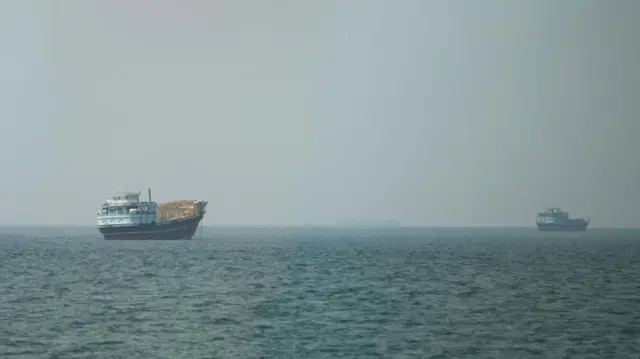
    Vessels at the Strait of Hormuz, as seen from Musandam,Oman, July 13, 2026.Image source, Reuters

    Although totally outmatched by the US militarily, Iran is achieving some strategic advantage over its adversary.

    It’s doing this by yet again making the Strait of Hormuz a dangerous place to transit - unless ships abide by its new rules and sail by the northern route, to be inspected and then possibly having to pay a fee.

    At the same time Iran is meting out nightly punishment to America’s Arab allies in the region for hosting its bases. Iran seems to have no shortage of drones and missiles to fire at them.

    A renewed US naval blockade will hurt Iran’s already struggling economy.

    But Iran knows that a paralysed strait will also impact the rest of the world, with oil price hikes as well as Donald Trump’s fortunes at the mid-term elections in less than four months’ time.

  10. Explosions reported in Iranian cities after tankers struck off Oman - a recappublished at 13:25 BST

    For those just joining us, here's a summary of the latest developments:

    • Explosions have been reported in multiple Iranian cities, including the port city of Bushehr, the site of a civilian nuclear power plant, according to state media outlets
    • Iran says it struck two tankers in the Strait of Hormuz, which the UAE Ministry of Defence has condemned as "brazen", saying an Indian seafarer was killed. Our weapons analyst explains what this means for the battle of control
    • Another tanker operated by Stolt shipping caught fire after it was hit by an "explosion of an unidentified external device" off the coast of Oman. Crew are all safe and accounted for, the firm says
    • Iran and the US continued to exchange strikes overnight, with Iran saying it targeted US military facilities in Bahrain and Jordan. A British expat living in Bahrain tells our security correspondent that strikes there left him "trembling"
    • On Monday Donald Trump announced the US would reinstate a naval blockade of Iranian ports and impose a 20% charge on all cargo shipped through the Strait of Hormuz. Our Chief international correspondent explains why the fee is costly for negotiations
  11. European airlines warned against flying over Gulf states' airspacepublished at 13:05 BST

    Commercial jet aircraft in flight against a blue sky, approaching for landing with its landing gear downImage source, Getty Images

    The European Union Aviation Safety Agency (EASA) is warning airlines against operating within the airspace of Bahrain, Kuwait, Qatar, the UAE, and over the waters of the Gulf of Oman.

    It says "unpredictable military developments, combined with the possible use of missiles, drones, combat aircraft and air-defence systems" within the region have created a "high risk" to flights.

    The latest advisory is valid until 29 July, the EASA says, adding it will closely monitor the situation.

  12. More explosions reported in south-west Iran - state mediapublished at 12:59 BST

    Iranian state media have reported explosions near the city of Mahshahr, as well as Abadan, in south-west Iran.

    Fars news agency cited comments from Valiollah Hayati, the deputy security governor of Khuzestan province.

    Local media earlier reported US strikes hit the port city of Bushehr, which hosts the country's only civilian nuclear power plant.

    Deputy provincial governor Ehsan Jahanian said four points in the city were hit "by enemy projectiles", according to state-run IRNA. Jahanian said the strikes took place "in different areas" of the city.

  13. Some ships will be prepared to take risks, says maritime security expertpublished at 12:40 BST

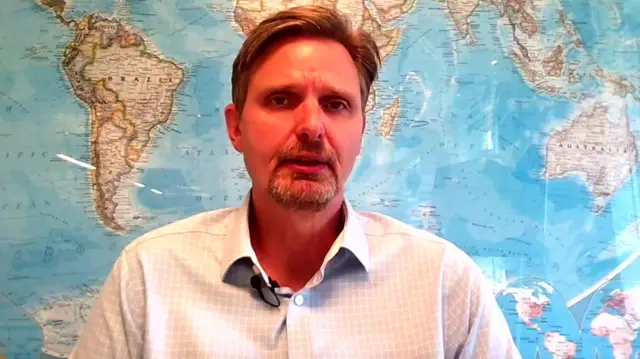
    A man wearing a shirt, with a map of the world behind him.
    Image caption,

    Jakob Larsen was a commander in the Danish Navy and has experience in the Gulf

    Some ships may be prepared to take the risk of going through the Strait of Hormuz "because the rewards are also very high", according to a safety and security expert.

    Jakob Larsen is chief safety and security officer at the Baltic and International Maritime Council and he tells BBC News that security risks for ships "have gone up dramatically".

    But while many owners "are now rethinking their decision to transit the Strait", Larsen - who was also a commander in the Danish Navy and has experience in the Gulf - says some ship bosses and crews will be talking about making the journey.

    "Some crews are willing to take risks because they are also rewarded," he says.

    "At the end of the day, when the risk goes up, there are more and more ships that back down and will decide not to go through."

  14. 'It was so loud I’m still trembling,' says Bahrain residentpublished at 12:21 BST

    Frank Gardner
    Security correspondent

    Two buildings in Bahrain. Smoke rises after a drone was intercepted.Image source, Reuters

    A British expatriate resident in Bahrain has described to me the terror of living through successive nights of Iranian missile and drone attacks, close to residential areas in the tiny Gulf island state.

    He speaks of "huge bangs" and the "closest attack interception yet, a few hundred feet above me with the debris falling in the sea in front of the flats".

    "It was so loud I am still trembling," he says.

    He also describes "a big fireball" as one of the intercepted missiles fell into the sea close to him, and seeing "three cruise missiles heading toward Juffair [the US naval base]".

    The expat says much of the damage to military facilities claimed by Iran is exaggerated, with the majority of Iranian munitions successfully intercepted by Bahrain’s air defence teams.

    But residential apartment blocks have suffered significant blast damage and from falling debris.

    This morning he texted me to say: "Have just been hit by five huge explosions. Had glass from the window blow out and flying glass cut my leg. Just a few pieces. Nothing serious."

  15. From memorandum of understanding to Strait of Hormuz standoff - a timelinepublished at 11:59 BST

    On 17 June, the US and Iran agreed a plan to bring an end to the conflict, with a 14-point agreement that included safe passage through the Strait of Hormuz, an extension to the ceasefire and an end to a naval blockade.

    A lot has changed between then and now, here's a recap:

    • 26 June: The US launches fresh strikes on Iran after Donald Trump accuses the country of a "foolish violation" of its truce, following an attack on a cargo ship in the Strait of Hormuz
    • 7 July: The US launches approximately 80 more strikes at Iran in response to attacks on ships in the Strait of Hormuz, while Iran targets US military sites in Bahrain and Kuwait
    • 8 July: Trump declares the ceasefire with Iran "over", calling the country's leadership as "scum" and "cuckoo" - see clip below
    • 11 July: US Central Command says that during three nights that week US forces struck more than 300 targets to degrade Iran's ability to attack civilian mariners and commercial vessels passing through the strait
    • 12 July: US launches its latest wave of attacks on Iran following further attacks in the strait, Iran retaliates with several strikes at US bases in the region
    • 13 July: Washington says it will reinstate a naval blockade of Iranian ports from 16:00 EST (20:00 GMT / 21:00 BST) on 14 July, as well as imposing a 20% charge on all cargo shipped through the Strait of Hormuz
    • 14 July: The US military says it's carried out another wave of strikes on Iranian military targets overnight, the third consecutive night of strikes in a row. The UAE condemns Iran's latest strikes targeting cargo ships crossing the Strait of Hormuz. Delhi summons Iranian ambassador as Tehran's strikes killed an Indian seafarer and injured others
    Media caption,

    On 8 July President Trump said the ceasefire was over and called Iranian leaders 'scum'

  16. Fire onboard tanker hit by 'unidentified external device' off Omani coastpublished at 11:38 BST

    A tanker struck by an explosion caused by "an unidentified external device" off the coast of Oman has said a fire took hold in the engine room, but no one was hurt in the incident.

    The Stolt Magnesium was passing through the Arabian Sea when it was hit, according to the shipping company.

    "All seafarers of Stolt Magnesium are safe an accounted for. Following the incident the master activated the ship’s emergency response procedures and the crew started fighting the fire on board," it adds.

    Stolt says it has contacted the next of kin of the vessel's crew and "All relevant authorities and parties" have also been informed.

    The company confirmed it was the same vessel referred to in a report received by the UK Maritime Trade Operations (UKMTO), which said a tanker was hit by "an unknown projectile" off the coast of Qalhat in Oman last night.

  17. Analysis

    Tanker strikes show Iran can still launch attacks despite heavy US bombingpublished at 11:21 BST

    Chris Partridge
    BBC News weapons analyst

    Iran's tactic to target ships again, including oil tankers, plays into its larger strategic goal of wanting to maintain control of the Strait of Hormuz.

    These attacks again demonstrate Tehran's ability to launch strikes, despite the sustained and heavy bombing campaign earlier this year by the US and Israel.

    That points to two things. Either the intense bombing effort failed to sufficiently destroy those Iranian weapons, or Iran is somehow now able to replenish its stocks from elsewhere. We don't know.

    What we do know is that there are more targets popping up for the United States to continue to strike - both from the air and, more interestingly, from the sea.

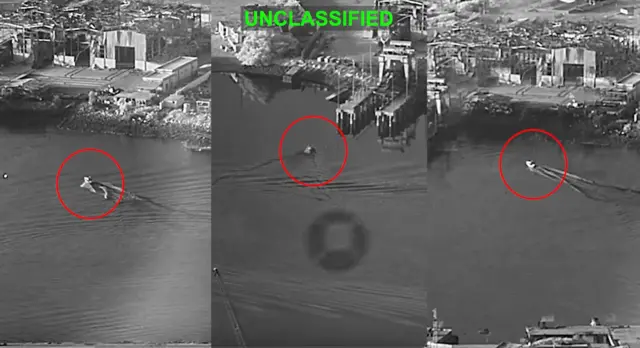
    The United States' use of one-way, uncrewed surface vehicles to attack Bandar Abbas Naval Base reminds us of the use of such technology by Ukraine in its war with Russia, a conflict which has largely rewritten the way that war is fought.

    But, looking further east, it is the law of unintended consequences that has again shown how maintaining leverage over the Strait of Hormuz has proved to be Iran's most effective weapon.

    Still of US sea drones travelling towards Iran's Bandar Abbas Naval Base.Image source, US Central Command
    Image caption,

    The US used one-way attack surface drones to hit Iran's Bandar Abbas Naval Base

  18. Explosions heard in multiple locations - Iranian state mediapublished at 11:10 BST

    Several explosions have been heard near the port city of Bandar Abbas, according to Iranian state media.

    The state-run IRNA has also said four locations were hit by projectiles in the city of Bushehr, with the Fars news agency saying residents have reported hearing multiple explosions.

    We've contacted the US Central Command for comment on this.

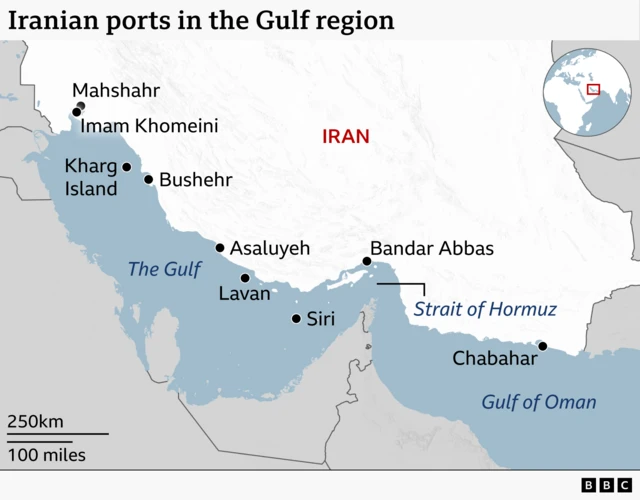
    Map titled “Iranian ports in the Gulf region” showing the southern coastline of Iran along the Persian Gulf and the Gulf of Oman. Labeled Iranian ports include Mahshahr, Imam Khomeini, Kharg Island, Bushehr, Asaluyeh, Lavan, Siri, Bandar Abbas, and Chabahar. The Strait of Hormuz is marked between the Gulf and the Gulf of Oman. Iran is highlighted in light grey, surrounding waters in blue, with a distance scale in kilometers and miles.
  19. India summons Iranian ambassador over attacks that killed Indian crew memberpublished at 10:50 BST

    India's Ministry of External Affairs spokesperson Randhir Jaiswal speaks during an Inter-Ministerial Briefing at the National Media Centre in New DelhiImage source, Hindustan Times via Getty Images
    Image caption,

    India's Ministry of External Affairs spokesperson Randhir Jaiswal

    India's Ministry of External Affairs says one Indian crew member was killed and 10 others were injured in Iranian attacks on two vessels in the Strait of Hormuz.

    Two tankers - named in the statement as the "Al Bahiyah and Mombasa" - carrying a combined 46 crew members, were struck by Iranian cruise missiles off the coast of Oman overnight.

    One of 12 Indian nationals onboard the Al Bahiyah was killed in the attack, while another was injured, according to a statement issued on X by ministry spokesperson Randhir Jaiswal.

    There were 18 Indian nationals onboard the Mombasa, of which nine sustained injuries, including two who are reported to be seriously injured, it adds.

    India's Ministry of External Affairs says it has summoned the deputy ambassador of Iran to lodge "a strong protest against these attacks".

    "We strongly condemn these attacks and acts of violence targeting seafarers and disrupting free and safe navigation through international waterways like the Strait of Hormuz," the statement adds.

  20. Analysis

    Trump's 20% tolls are another curve ball in negotiations over Strait of Hormuzpublished at 10:30 BST

    Lyse Doucet
    Chief international correspondent

    President Trump has thrown another curve ball in saying the US will now start charging tolls of 20% in the Strait of Hormuz.

    Shipping experts say that could double costs through an already all too costly maritime corridor. It also contradicts what the Secretary of State Marco Rubio has repeatedly said is US policy – that no one should charge tolls in what they regard as international waters.

    It’s not clear this is legally, politically, or logistically possible. Iran has swiftly exploited the president’s remark to underline what they see as their right to impose some form of fees.

    The foreign minister Abbas Aragchi posted on social media that “20% is of course too much. We will be fair.” For Tehran, its presence in this strategic strait is non-negotiable.

    Yesterday Iran’s parliament introduced a “Strategic Action” plan to manage the waterway. The hard-line head of the national security committee, Ebrahim Azizi, wrote “we remain steadfast in defending our red lines.”