Trump arrives for state banquetpublished at 10:51 BST
Trump has just arrived back at the Great Hall of the People for a state banquet, Chinese state media reports.
We'll bring you more updates as we get them - stick with us.
President Donald Trump described talks with Xi Jinping as "great", after a nearly two-hour long high-stakes meeting in Beijing
But deep differences remain on tariffs and export controls, our business correspondent writes
Soon after talks began, Beijing released comments by Xi, repeating warnings of potential "conflict" with the US over Taiwan
The self-governed island claimed by Beijing is a major source of US-China tension, alongside tariffs, competition over tech and the Iran war
But Beijing also rolled out the red carpet for Trump: a gun salute, cheering children and a tour of the 15th Century Temple of Heaven with Xi
China has given Trump a grand welcome - in Chinese diplomacy, that is not mere flattery, but carries real weight, writes our China correspondent
The two leaders will meet again this evening at a state banquet
Trump has just arrived back at the Great Hall of the People for a state banquet, Chinese state media reports.
We'll bring you more updates as we get them - stick with us.
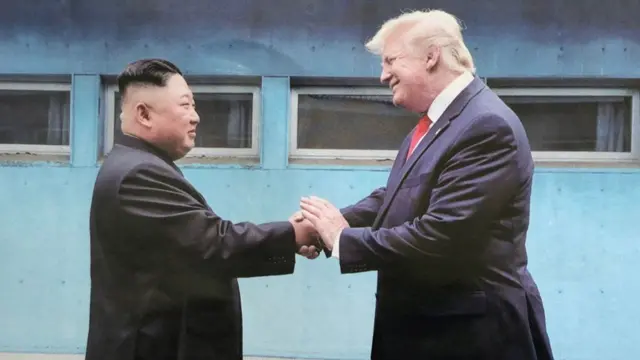 Image source, API/Gamma-Rapho via Getty Images
With Trump in Beijing, will he stop over for a meeting with North Korean leader Kim Jong Un?
It appears that there have been no preparations for such a meeting, but the possibility could not be ruled out, an unnamed South Korean foreign ministry official told South Korean news agency Yonhap.
Trump and Kim last met in 2019 in the Demilitarised Zone separating the two Koreas. That meeting appeared to have been hastily cobbled together at the last minute, after Trump posted on Twitter (now known as X) that he could meet Kim "just to shake his hand and say Hello".
Since then, Trump has signalled interest in seeing the North Korean leader again - a desire he made again last October, ahead of his trip to South Korea.
But while Kim has said that he has a "good memory" of Trump, he also insisted that Pyongyang would only resume talks if Washington stopped insisting on its denuclearisation.
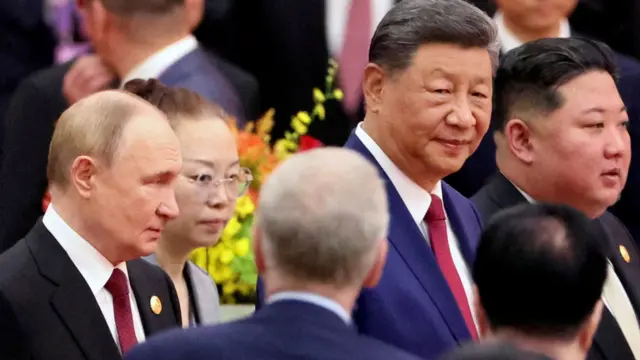 Image source, Reuters
Putin's last visit to China was Septebmer 2025
The Kremlin has just announced that Russian President Vladimir Putin will visit China very soon, according to Russia-backed broadcaster RT.
No date has been given for the visit, but Kremlin spokesperson Dmitry Peskov said that all the preperations have been completed.
Putin's last visit to China was September 2025, when he attended Beijing's grand military parade and a summit.Russian media previously reported that the visit could happen as soon as next week.
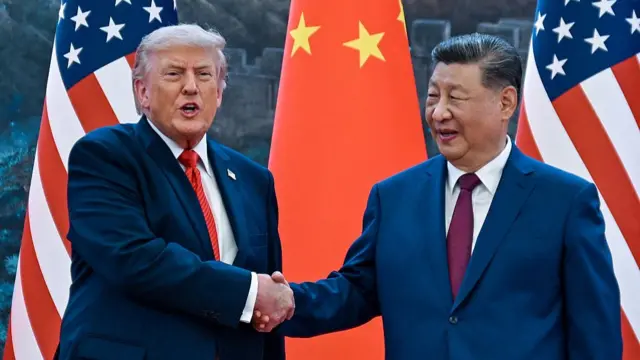 Image source, POOL / AFP via Getty Images
Donald Trump and Xi Jinping had a "good meeting", according to a readout issued by the White House.
The two sides "discussed ways to enhance economic cooperation", including expanding US firms' access to the Chinese market and Chinese investment in US industries, said the statement - adding that leaders from some of the largest US companies joined part of the meeting.
They also talked about the importance of ending the flow of fentanyl precursors into the US..
We earlier reported that China's foreign ministry statement made little mention of the Iran war. According to the White House statement, however, "both countries agreed that Iran can never have a nuclear weapon".
The US statement also said "the two sides agreed that the Strait of Hormuz must remain open to support the free flow of energy".
During the talks, President Xi "expressed interest" in buying more American oil to reduce China's dependence on the Strait of Hormuz, the White House statement said.
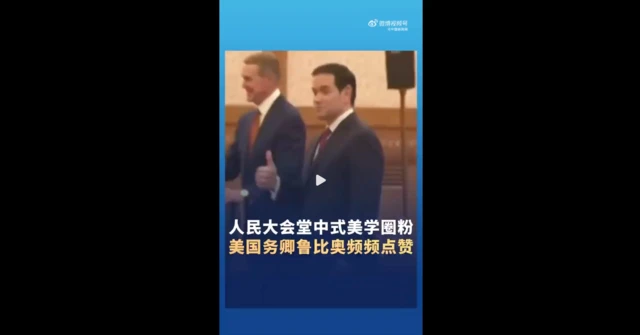 Image source, China News Service/Weibo
For the second day in a row, US Secretary of State Marco Rubio is trending on Chinese social media.
On Weibo, the hashtag "Rubio gives thumb up to Chinese aesthetics" has been gaining traction over the past few hours.
A video from Chinese state media shows the US top diplomat standing in the meeting room at the Great Hall of People. He is seen looking up to the ceiling, giving a thumbs-up, then turning to defence secretary Pete Hegseth and pointing upward.
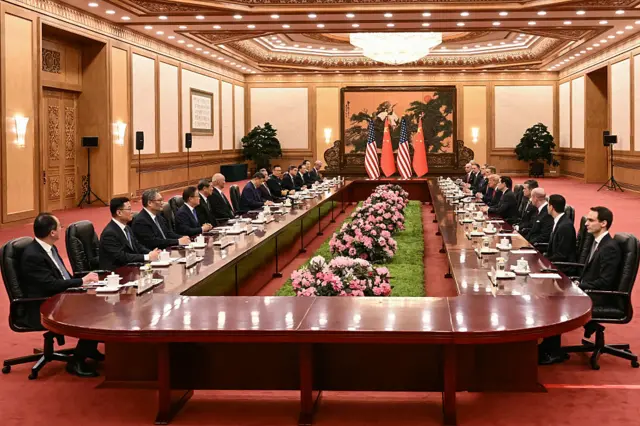 Image source, Getty Images
This morning's bilateral was held at a meeting room at the Great Hall of People
"This must be his first time in China," one comment read.
It is indeed his first visit, at least according to public records. In 2020, when he was a senator, Rubio was slapped with sanctions by Beijing - including an entry ban - over his remarks on Hong Kong and human rights issues in China. China hasn't lifted its sanctions on Rubio since.
But in January 2025, China changed the official translation of Rubio's name.
Two diplomats told news agency AFP that they believed this served as a sort of linguistic loophole, allowing China to bypass its sanctions, which were imposed under the old spelling of his name.
It appears that Tesla CEO Elon Musk has brought his son X Æ A-Xii to Beijing. The pair was spotted walking in the Great Hall of the People.
The 6-year-old, nicknamed X, also made a rare public appearance last year when Musk brought him for a meeting with Trump at the White House.
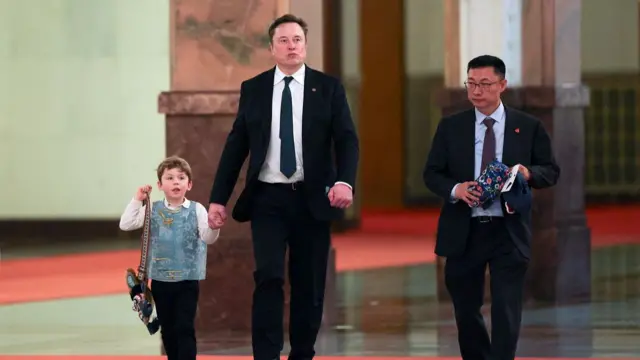 Image source, EPA/Shutterstock
 Laura Bicker
China correspondent
Shortly after the Iran war started, China lowered its annual economic growth target to the lowest level since 1991, even as Beijing continued its rapid development of high-tech and renewables industries.
China may have hoped to export its way out of economic trouble.
But it has spent a year fighting a trade war with the United States, and now faces the prospect of upheaval in the Middle East, which supplies both its major shipping routes and a lot of its energy needs.
The longer the war drags on, the more it could hurt, especially if traffic through the Strait of Hormuz remains blocked.
China is keen to stay out of any conflict, but that does not mean Beijing isn't deeply troubled by what is happening in the Middle East.
The war in Iran, which has triggered a global energy crisis, was expected to loom large over today's talks.
En route to Beijing on Air Force One, US Secretary of State Marco Rubio told Fox News that Washington wanted Beijing to be proactive in resolving the conflict with Iran.
But mention of the topic was mostly absent today, according to China's foreign ministry statement on the Trump-Xi meeting.
The statement dedicated sections to trade and Taiwan, but not Iran - though it mentioned that the two presidents had "exchanged views" on the "Middle East Situation", among other international issues.
The US wants China's help to bring Iran back to the negotiating table, while China has been quietly playing peacemaker behind the scenes without getting entangled in the conflict.
 Tessa Wong
Asia Digital Reporter
While Xi's opening remarks to Trump at the start of their bilateral meeting were friendly enough, behind closed doors the Chinese leader has delivered a punchier message.
China's foreign ministry readout of the meeting states that Xi told Trump the issue of Taiwan was the most important one in their relationship, and that if it was handled "properly" they would enjoy stability.
If not, they would have "clashes and even conflicts, putting the entire relationship in great jeopardy".
“'Taiwan independence' and cross-strait peace are as irreconcilable as fire and water," the statement added, saying the US must "exercise extra caution in handling the Taiwan question".
Such comments are not new: China and Xi himself have issued similar warnings to the US countless times before.
The Chinese government also made this clear earlier this month when Foreign Minister Wang Yi met his US counterpart Marco Rubio.
But it's notable that these warnings are being reiterated months after the US committed to its biggest arms sales to Taiwan.
Xi is underscoring once again that the Taiwan issue is the reddest of red lines, and he wants Trump to prioritise his relationship with China - especially at a time when they are negotiating hard on trade.
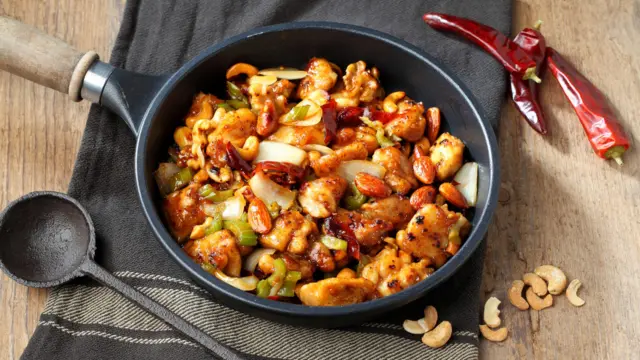 Image source, Getty Images
A file photo of kungpao chicken, cooked with dried chillis and cashew nuts
There has been some fascination around what might be on the menu at tonight's state banquet.
During his last visit in 2017, Trump was served a tailored, multi-course meal that some say was intended to ease American tastes buds to Chinese cuisine.
The dishes included kungpao chicken, creamy seafood chowder and stewed beef steak in tomato sauce - some of which are more familiar to Americans than native Chinese. Trump is known to enjoy his steaks well-done and frequently accompanies them with ketchup.
Trump's predecessors, though, were treated to more adventurous dishes. In 1972, Richard Nixon tried shark's fin soup, Peking duck and a soft-belly eel dish, among other dishes.
The 37th US president impressed his Chinese counterparts with expert chopstick skills, which he reportedly spent hours practising. Nixon's historic visit - and his chopsticks diplomacy - helped thaw tensions between the two countries.
 Tom Bateman
US State Department correspondent, Beijing
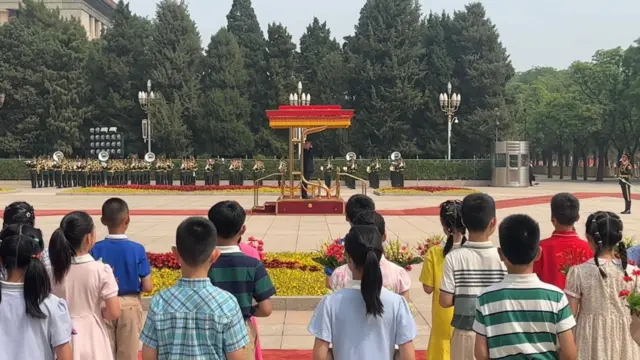
Earlier, I was outside the Great Hall of the People, just metres from Trump as Xi accompanied him along the red carpet towards. Members of the press were standing just behind hundreds of children holding flowers and flags and shouting, “Welcome, welcome!"
The US president looked mightily impressed.
He mouthed some words at the gaggle of youngsters that I couldn’t hear. There were broad smiles and effusive handshakes with Xi, Trump’s poise slow and deliberative as the two men walked to a viewing platform where troops with their weapons stood motionless.
A gun salute was fired to welcome Trump while the military band flawlessly played the US national anthem. I could feel the cannons’ deep, long booms which reverberated across Tiananmen Square. Trump seemed to be soaking up the display of power from a country whose rise is challenging America’s superpower status.
While some previous presidents may have shunned such an image, Trump told Xi of his admiration: “The military, it’s obvious, it couldn’t be better,” he said as their meeting began.
Tariff rates between the US and China have grown increasingly complex over the years, with policy swings and overlapping measures dating back to Trump's first term. Here's where things stand so far:
2018
April 2025
May 2025
October 2025
2026
 Suranjana Tewari
Asia Business Correspondent
The Trump-Xi summit is expected to focus less on major breakthroughs and more on stabilising ties between the world's two largest economies.
Is the meeting likely to yield major trade outcomes? Most analysts say no.
US officials have also said they do not expect China to announce a large-scale investment package in American manufacturing.
One area under discussion is a proposed US-China "Board of Investment" which would provide a framework for future investment opportunities. But officials say a lot of work needs to be done before this can be implemented.
On trade, the most likely outcome is an extension of the existing truce agreed last October, which paused any tariff escalation.
The agreements could also include increased Chinese purchases of US goods and some symbolic investment promises.
But deep differences remain on tariffs, export controls and industrial policy, especially around semiconductors and critical minerals, making a broader agreement unlikely.
Fan Wang
BBC News, Singapore
Since yesterday, Trump's visit has been dominating the attention of Chinese social media users.
Hashtags about this trip have been viewed around 400 million times on Weibo. The grand welcome ceremony and the opening remarks of the bilateral meeting were livestreamed by state media across social platforms, drawing millions of viewers.
These platforms are heavily censored and the authorities play a major role in shaping the course of public discussions, so it doesn't fully reflect what Chinese people are thinking. Most comments shown echo Beijing's stance - that China is demonstrating how a superpower should conduct itself, and that the two countries should work together.
Marco Rubio is one of the talking points. The US state secretary was sanctioned by Beijing in 2020 over his remarks on Hong Kong and China's human rights issue. The sanctions entailed a ban from entering China, but the government has clearly made an exception for this trip.
There is also interest in Trump's business delegation, as well as in smaller details from the bottled water on the meeting table to other symbolic elements of the visit.
Body language is often an indicator of power dynamics between state leaders. In this video, we unpack what Trump's and Xi's body language this morning could reveal.
What might Trump and Xi's body language reveal?
Trump's US delegation to Beijing included many top-rung executives who run businesses tied to some of the most sensitive US‑China economic frictions, such as electric cars and technology.
The White House provided the full list of top executives who attended the ceremony.
More CEOs are expected to join the delegation later in the day.
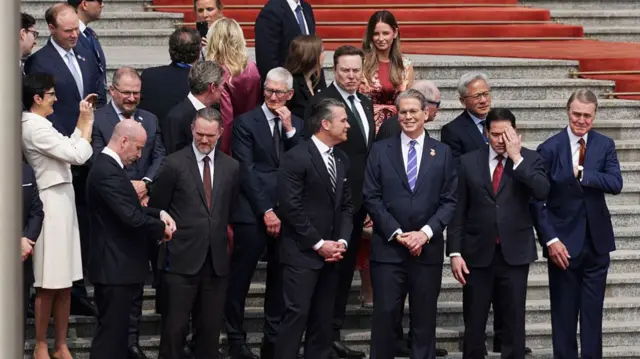 Image source, Getty Images
Members of the US delegation in Beijing
Laura Bicker
China correspondent
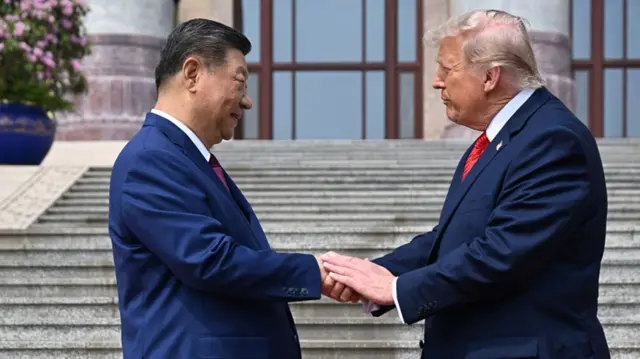 Image source, Getty Images
Donald Trump built up a political brand by talking tough on China.
But today he lavished praise on his host as he sat across from President Xi.“You’re a great leader. I say it to everybody,” he said in what appeared to be unscripted remarks.
Trump appeared to be wowed by the precision of the military honour guard which formed the ceremonial welcome outside the Great Hall of the People.
And Trump enjoyed the adoration of Chinese children waving and cheering - he paused twice to say hello. On his tour of the Temple of Heaven, he remarked that China was beautiful.
The visuals of this visit may be designed to flatter the American president.
But in China’s world of diplomacy this careful choreography, which it knows will be beamed live across US networks, carries real weight.
The spectacle is designed to show that China’s door is open to guests. Xi has rolled out the red carpet for a number of world leaders in recent months, including US allies such as Canada, the UK, and Germany - all eager to do a deal with Beijing.
And now, this grand welcome may lead some to conclude that the balance of power is shifting in China's direction.
Ting Chiang
BBC News Chinese, Taipei
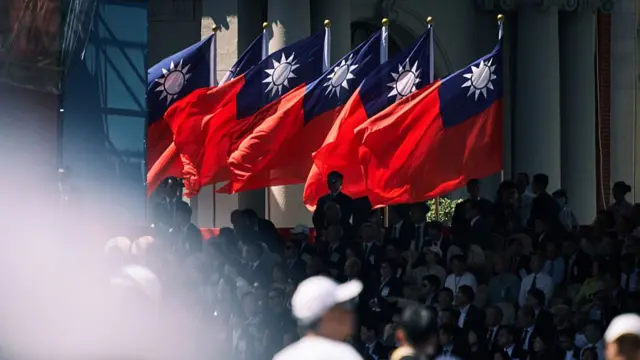 Image source, Bloomberg via Getty Images
Many in Taiwan are worried the US will make compromises to China over the status of the self-governed, democratic island in exchange for business interests after Donald Trump meets Xi Jinping. In April, Taiwan’s Deputy Foreign Minister Francois Wu told Bloomberg: “What we are the most afraid is to put Taiwan on the menu of talks between Xi Jinping and President Trump.”
There has been no indication Trump will change the US's position on Taiwan. But if the US wanted to, it could change its declaratory language to “opposing” instead of “not supporting” Taiwan independence, wrote Patricia M Kim of the Brookings Institution in Washington.
The subtle change would be significant as it would “influence how Beijing calculates risk”.
However, last week Secretary of State Marco Rubio said there should be no "destabilising events" regarding Taiwan in the "mutual interest" of both countries. The US has also reiterated its commitments to Taiwan in recent days.
Laura Bicker
China correspondent
The two leaders talked for two hours, far longer than expected.
President Xi warned Donald Trump that the issue of Taiwan, which Beijing claims as part of its territory, could bring the two countries into conflict. He is pushing for a delay or a reduction in US arms sales to the self-governed island, which Beijing has long claimed.
Donald Trump, on the other hand, has brought with him CEOs of 30 major tech businesses to Beijing in the hope that China will open its doors to more America firms.
After the talks ended, Trump lavished praise on his host as he toured the 15th Century Temple of Heaven where Chinese emperors once prayed for a great harvest.
Trump called Xi a great leader, described the talks as "great", and remarked to reporters that China was beautiful.
China considers Taiwan a breakaway province that will eventually come under its control, and it has not ruled out the use of force to achieve this.
In recent years Beijing has ramped up live-fire military drills, including simulated blockades of ports around the self-ruled island, unsettling Taiwanese authorities.
Washington adheres to the "One China" policy, which recognises Beijing as the sole Chinese government, but it maintains unofficial ties with Taipei. The US is also bound by law to provide Taiwan with the means to defend itself.
Last year, Trump's administration announced the sale of an $11bn weapons package to Taipei, which angered Beijing. Reports say Trump has yet to formally approve the sale, though, and that it will be on the table during his talks with Xi.
