Summary

  • The Israeli military is striking the southern Lebanese city of Tyre - a day after Iran called for attacks on Lebanon to stop

  • Lebanese media report that at least three people have been killed by Israeli strikes in the country's south this morning

  • Israel and Hezbollah are paving the way for more confrontation and not de-escalation, writes our Middle East correspondent

  • On Monday - after Iran and Israel fired at each other for the first time since April - Iran said it would pause, so long as Israel stopped attacking Lebanon

  • Israel says it is targeting Hezbollah in Lebanon, accusing the Iran-backed militia of breaching the ceasefire

  1. Hezbollah claims it targeted Israeli forces advancing in southern Lebanonpublished at 11:23 BST

    Hezbollah claims it fired rockets at advancing Israeli forces in southern Lebanon on Monday night.

    In an update on Telegram, Hezbollah claims Israeli forces were trying to advance from the town of Bayyada towards Bayt al-Sayyad, but were forced to retreat after "successive rocket barrages".

    Israel has not yet commented on any confrontation, but its military is carrying out ground operations in southern Lebanon in what it says is an attempt to stop Hezbollah attacking northern Israel.
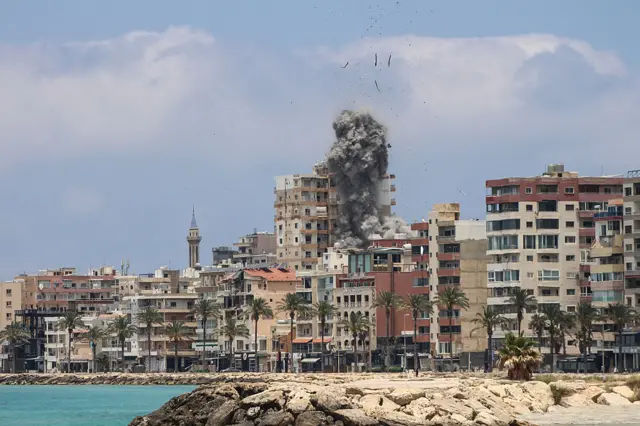

  2. Air strike shown hitting tower block in Tyrepublished at 11:09 BST

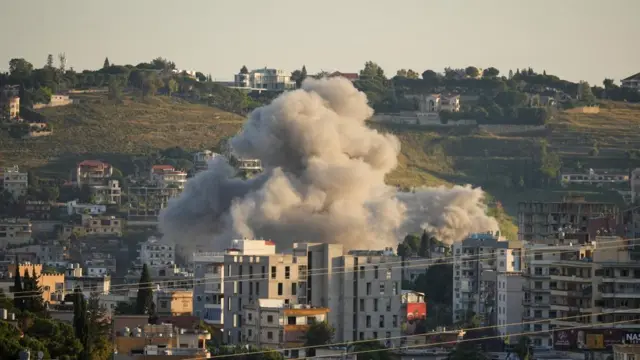
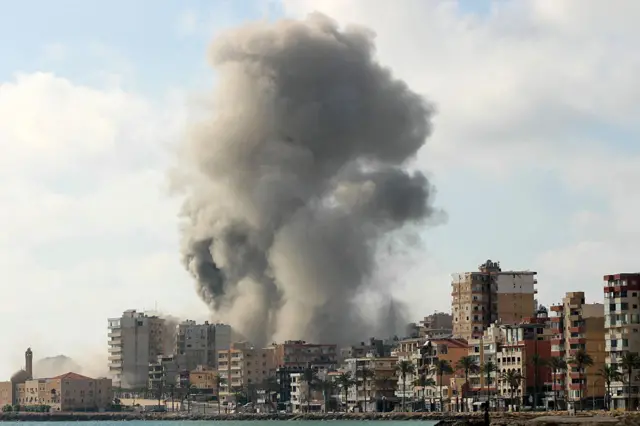
    Smoke rises following an Israeli airstrike in the southern city of Tyre on June 9, 2026. Residents of south Lebanon's Tyre including the Christian quarter fled on June 9, an AFP correspondent said, after Israel's army for the first time warned the entire city to evacuate ahead of strikesImage source, AFP via Getty Images
    Image caption,

    Smoke rises following an Israeli air strike in the southern city of Tyre on Tuesday

    We're now seeing imagery of an air strike hitting the southern Lebanese city of Tyre, while Lebanese media also reports Israel has carried out an attack on the city this morning.

    It comes just hours after the Israeli military told residents to urgently leave their homes in Tyre and the surrounding neighbourhoods and move north of the Zahrani river.

    The state-run National News Agency (NNA) says Israeli warplanes carried out a "heavy airstrike" in Tyre.

    The Israeli Defense Forces is yet to confirm it has carried out strikes in the area.

  3. Analysis

    Israel and Hezbollah pave way for more confrontation - not de-escalationpublished at 10:49 BST

    Hugo Bachega
    Middle East correspondent in Jerusalem

    Israel says its war against the Iranian-backed militia and political party Hezbollah will continue in Lebanon.

    This conflict started when Hezbollah fired rockets into Israel following the killing of the Iranian supreme leader at the start of the US-Israel war against Iran.

    Israel, in response, launched a devastating bombing campaign in Lebanon, killing more than 3,600 people including many civilians, and now occupies a significant part of the south, where entire villages have been destroyed.

    Israel says the goal is to create a security zone along the border, Hezbollah-free, to protect its northern communities from the group’s rockets and drones.

    In Israel, there is public support for the war to continue. But, as Donald Trump has limited Israeli actions in Lebanon to try to defuse tensions, it is not clear what else Israel’s attacks can achieve in significantly degrading Hezbollah.

    The group is isolated domestically but, so far, has rejected calls to disarm. Lebanon’s government says this can only happen through diplomacy and not force.

    With neither side showing indications of being willing to back down, they are paving the way for more confrontation and not de-escalation.

  4. Volatile situation facing southern Lebanon as air strikes continuepublished at 10:33 BST

    Lina Sinjab
    Middle East correspondent, reporting from Beirut

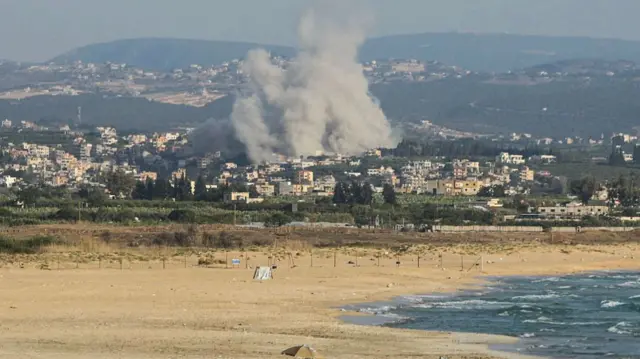
    A photograph taken from the southern city of Tyre shows people sunbathing on the beach as smoke rises from the site of an Israeli airstrike in the village of Deir Qanoun Ras al-Ain on June 8, 2026Image source, Getty Images
    Image caption,

    An Israeli air strike on a village near Tyre, in southern Lebanon, on Monday

    Dahieh in the south of Beirut is for now spared any further attacks after Iran and Israel said they would stop striking each other.

    But the country's south has always been out of any equation, and almost on a daily basis the strikes continue.

    Now, for the first time in this conflict, the evacuation order came to an entire area in the city of Tyre which is a Christian neighbourhood. It shows the violence and aggression on the south is still continuing.

    The Iranians, according to local newspapers and local journalists, want to show the regional powers and the US that they have to be part of the equation and that they still have a say in both Lebanon and in Yemen.

    But the situation in the south of Lebanon is still volatile, with continuing evacuation orders and air strikes.

  5. More towns targeted in southern Lebanon, state media reportspublished at 10:17 BST

    Lebanese media reports air strikes have targeted Srifa and Haris, two towns in the south of the country.

    The National News Agency also reports a drone attack targeted Borj Qalaouiye, which is also in southern Lebanon.

    The Israel Defense Force has not yet confirmed if it launched strikes on those areas.

  6. Fighting continued in Lebanon despite the April ceasefirepublished at 10:09 BST

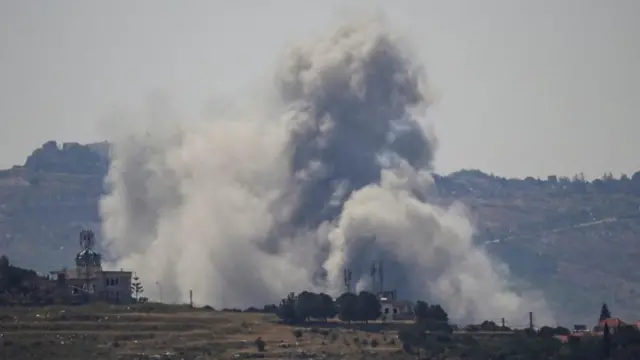
    A plume of grey smoke rises from an area with what appear to be residential buildingsImage source, Reuters
    Image caption,

    Smoke rises from the site of an Israeli strike in southern Lebanon on Saturday

    While Sunday marked the first time since the April ceasefire that Israel and Iran had exchanged fire, Israeli strikes on Lebanon - and Hezbollah attacks on Israel - had continued.

    A US-brokered ceasefire between Israel and Lebanon on 16 April failed to stop the fighting, with both sides blaming the other for repeated violations.

    Hezbollah - an armed group backed by Iran - continued rocket and drone attacks. Israel continued strikes on Lebanon, and expanded a ground offensive in the south of the country - moving beyond its original demarcation line of the Litani River.

    A renewed ceasefire was agreed between Israel and Lebanon earlier this month, with the agreement "contingent on a complete cessation" of attacks by Hezbollah, among other conditions. Both sides have continued strikes since then.

  7. Three killed in Israeli strikes in southern Lebanon - reportspublished at 09:58 BST

    Lebanese media report that at least three people have been killed in Israeli strikes in southern Lebanon this morning.

    The state-run National News Agency (NNA) said first responders recovered the body of one person after several buildings were hit by Israeli air strikes in the eastern al-Massaken al-Shaabiya area of Tyre. The L’Orient Today website reported that two other people were missing.

    NNA said another two people were killed in a pre-dawn Israeli drone attack in the town of Kfar Roummane, which is located in the mountains north-east of Tyre.

    There were also air strikes this morning in the nearby towns of Nabatieh and Kfar Sir, while Jibchit was hit by artillery shells, according to NNA.

    On Monday, Lebanon's health ministry said Israeli strikes in southern Lebanon killed at least 14 people, including seven in Nabatieh district and five in Tyre.

    A cloud of smoke billows over a Lebanese town.Image source, Reuters
    Image caption,

    An Israeli strike on Monday, as seen from the Lebanese town of Nabatieh, where further strikes have been reported today.

  8. Analysis

    Trump is keen for a deal despite Netanyahu's fearspublished at 09:47 BST

    Jeremy Bowen
    International Editor

    Senior Arab sources have told me that a deal is close. But senior Western diplomats have cautioned against what they describe as "optimism bias" among negotiators - in other words, a tendency to view the prospects more positively than the facts may justify.

    What is being discussed is not a peace deal. Rather, it is an agenda for future negotiations covering major issues such as Iran's nuclear programme and a mechanism to reopen the Strait of Hormuz.

    That remains a pressing concern. The strait is still closed, and as the weeks pass the economic consequences are becoming increasingly severe, affecting countries far beyond the region.

    In the United States, motorists are facing higher fuel prices as summer demand rises, something that is a major concern for Donald Trump.

    That helps explain why Trump is now keen to find a negotiated way out of the crisis.

    Israel, however, fears any agreement could end up formalising Iran's strategic gains from the war and implicitly acknowledge a new deterrence balance between Tehran on one side and the US and Israel on the other.

    As for ordinary Iranians who hoped the conflict might bring political change or improve their circumstances, there is little sign of that happening.

  9. 'We have to use sense': Trump tells BBC what he said to Netanyahupublished at 09:40 BST

    Donald Trump spoke to the BBC's North America editor, Sarah Smith, on Monday about the prospect of securing peace in the region.

    Asked how he was able to persuade Israeli Prime Minister Benjamin Netanyahu to stop attacking Iran, Trump responded: "All I did is say, 'We have to use sense'. We're very close to signing a very powerful deal, a very good deal.

    "No nuclear weapons, no nothing. You know, we have to use a lot of common sense. It was fine."

    The president was pressed on Netanyahu's retaliation against Iran's strikes, despite Trump urging Israel not to fire missiles in response.

    "No, no. They had already gone. They had already gone. They were already on their way."

    Speaking about Netanyahu, Trump told the BBC: "If I tell him to do something, he does it."

  10. Lebanese residents evacuate Tyre after Israeli warningpublished at 09:27 BST

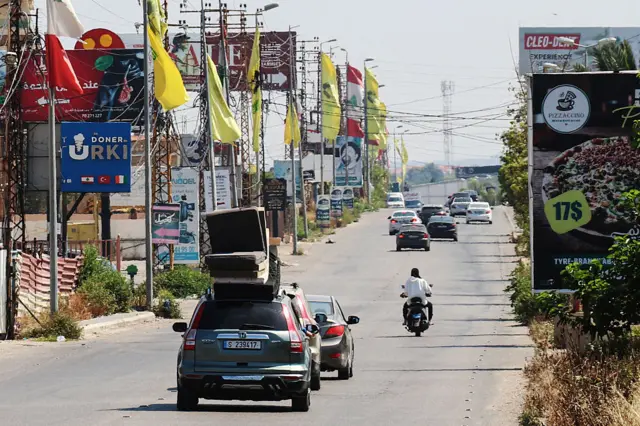
    Vehicles exit Tyre in southern Lebanon on June 9, 2026, after the Israeli army warned the entire city to evacuate ahead of strikes.Image source, Getty Images
    Image caption,

    A car leaving Tyre with mattresses strapped to the roof, earlier this morning

    Civil defence teams are assisting evacuation efforts in the southern Lebanese city of Tyre after the Israel Defense Forces issued an alert for people to leave, the state-run National News Agency reports.

    The outlet reports shelters for displaced residents have reached capacity.

    The Israeli military earlier warned people to evacuate and move north of the Zahrani river.

  11. Analysis

    Tyre alert is a Netanyahu signal to Trumppublished at 09:09 BST

    Jeremy Bowen
    International Editor

    The evacuation warning issued for the southern Lebanese city of Tyre is significant because, for the first time, it includes the city's Christian quarter.

    According to the map published by the Israeli military, the warning covers most of the city.

    Why now? It appears to be a signal from Prime Minister Benjamin Netanyahu and the Israeli military that while Donald Trump may have curtailed further attacks on Beirut, Israel retains the ability to strike southern Lebanon hard.

    Iran continues to insist that developments in Lebanon are linked to any potential agreement in the Gulf.

    Netanyahu has rejected that as an unacceptable equation. But Trump is, in effect, acknowledging the connection because he is keen to secure a deal, reopen the Strait of Hormuz, and then move on to other priorities.

    It is difficult to imagine Israel passively accepting what it sees as a new status quo being created by Iran and its allies. Israel is likely to challenge any suggestion that Iran can deter it militarily.

    What is becoming clear is that this war is reshaping the Middle East - but not in the way Israel and the United States expected when they launched military action against Iran on 28 February.

  12. Iran and Israel say they have halted attacks on one anotherpublished at 09:04 BST

    An Iranian missile flies in the sky over Israel, as seen from Hebron, in the Israeli-occupied West Bank, June 7, 2026.Image source, Reuters

    After exchanging fire on Sunday for the first time since April's truce, Iran and Israel say they have halted attacks on each other after Donald Trump urged both countries to stop "shooting" immediately.

    Israel's Prime Minister Benjamin Netanyahu said in a televised address on Monday his country was holding fire "at the moment". But he stressed that the struggle against Iran and the Iran-backed group Hezbollah in Lebanon was "not finished".

    Meanwhile, Israeli media reported that Tel Aviv was stopping attacks on Iran "at Trump's request", citing a senior Israeli official. Its defence minister Israel Katz said operations would continue in Lebanon.

    Iran's military said it had stopped operations following the delivery of a "painful response" to Israel. It threatened "severe" measures if Israel carried out more strikes, including in Lebanon.

    And Iran's president Masoud Pezeshkian said in a post on X that the country would "not retreat in the face of any threat".

    Separately, Trump said Israel and Iran are looking to do an "immediate ceasefire" and that things should move quickly.

  13. US and Iran in 'final throes' of deal, Trump tells reporterspublished at 08:46 BST

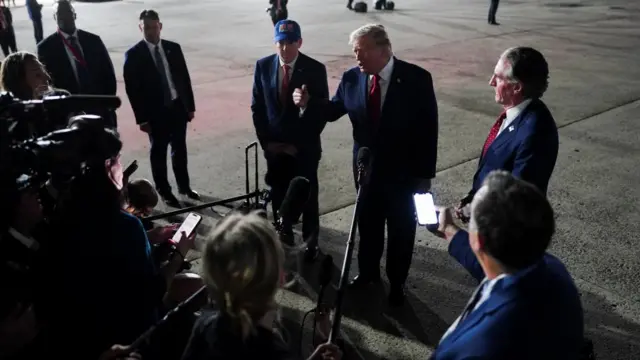
    Donald Trump speaking to members of the media at JFK International Airport.Image source, Reuters

    US President Donald Trump told reporters on Monday night the US and Iran were in the "final throes" of a deal "that will not allow in any way, shape, or form nuclear weapons".

    The president has made similar statements about the proximity of an agreement between the two countries at various points in the conflict since the April ceasefire.

    While speaking to reporters at JFK Airport in New York, Trump said it would be "a very good deal that will not allow in any way, shape, or form nuclear weapons".

    "And the Strait will open up right away - they'll open up immediately upon signing, which could be in two or three days," he said.

    The president said Iran and Israel had agreed to stop fighting and "call it quits" after Israeli PM Benjamin Netanyahu "hit back" at Iran following Sunday's strikes.

    "They're going to leave each other alone for another week or something," he said.

  14. Israeli evacuation order includes Tyre's Christian quarterpublished at 08:30 BST

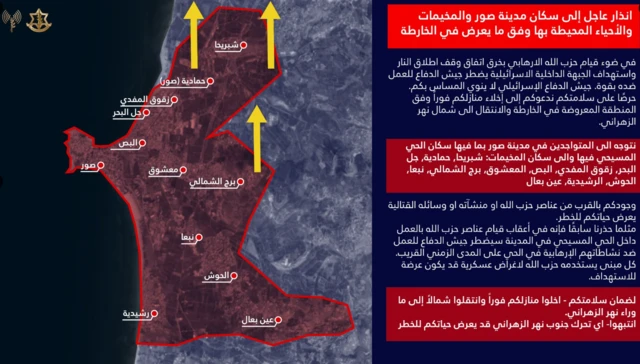
    A map of an evacuation order issued by the Israel Defense Forces in the city of Tyre, southern LebanonImage source, Israel Defense Forces/X

    The Israel Defense Forces (IDF) is telling residents in the city of Tyre in southern Lebanon to urgently leave their homes.

    The military is warning people, including those living in the city's Christian quarter and the surrounding camps, to evacuate and move north of the Zahrani river.

    IDF Arabic-language spokesman Avichay Adraee writes on X that residents' "presence near Hezbollah elements... endangers your lives".

    "Any building used by Hezbollah for military purposes may be subject to targeting," he adds.

    Lebanon's state-run National News Agency has reported artillery shelling this morning on the outskirts of Mansouri and Majdal Zoun in Tyre, but this has not yet been confirmed by the IDF.

  15. Israel issues evacuation order for Lebanese city despite Iran's warning over more strikespublished at 08:19 BST

    Smoke rises from the site of an Israeli airstrike that targeted a neighborhood in the southern Lebanese coastal city of Tyre on June 7, 2026Image source, AFP via Getty Images
    Image caption,

    Smoke rises from the site of an Israeli airstrike in the southern Lebanese coastal city of Tyre on Monday

    The Israel Defense Forces has issued an urgent evacuation order for the city of Tyre in southern Lebanon.

    It comes a day after Iran said it would be stopping strikes on Israel but threatened a "severe" response if the Israel Defense Forces (IDF) continued striking southern Lebanon.

    Israeli PM Benjamin Netanyahu said on Monday that his country would hold off attacking Iran "for now", but warned if "Iran makes the mistake and attacks us again - we will respond forcefully".

    On Sunday, Iran launched a wave of missiles at Israel marking the first since the April ceasefire. Israel retaliated, saying it struck military targets in western and central Iran.

    Donald Trump said on Monday that Israel and Iran must stop "shooting" immediately, and that final negotiations for "peace" were proceeding, "subject to ignorance or stupidity getting in its way".

    We'll bring you the latest developments on this story, including further details on the evacuation order, throughout the day.