Summary

  • Nasa says the Artemis II mission will blast off on Wednesday at 18:22 ET in the first crewed lunar voyage in more than 50 years provided everything goes to plan

  • Jeff Spaulding, test director with the Exploration Ground Systems program, and Mark Burger, launch weather officer, 45th Weather Squadron Cape Canaveral Space Force Station, answered questions from reporters ahead of launch day

  • They say weather conditions are generally favourable for a Wednesday lift off but they are keeping an eye on wind and rain as well as sun activity after a recent solar flare

  • If all goes as scheduled, four astronauts will go on a 10-day journey that circles the Moon - all in a spacecraft the size of a minibus

  • Reid Wiseman, Victor Glover, Christina Koch and Jeremy Hansen are crewing the mission, which will depart from the Kennedy Space Center in Florida

  1. All systems go for the Artemis II launch tomorrowpublished at 19:13 BST 31 March

    Pallab Ghosh
    Science correspondent

    Nasa has had daily briefings in the run up to the launch of Artemis II, and each day the word “ready” has been used with increasing frequency. That's because engineers have done a great job on the rocket’s systems. But there could be a cloud on the horizon – literally.

    It is hard to imagine that the most powerful rocket ever built could be thwarted by a fluffy cloud, but it can, and here is why:

    At today’s briefing, forecasters said the main worry is puffy, cotton wool type clouds called cumulus clouds that can grow tall enough for a rocket to trigger lightning as it flies through it or even close to it.

    On the plus side, there is a gentle breeze which will move any offending cloud out of the way during the two hour launch window.

    Tomorrow offers the best weather of the week, with light showers only a small risk and an 80% chance of acceptable conditions. Saturday is the next best option before things get more hit and miss later on.

    But as for the things Nasa can control, the agency’s test director said countdown and tanking preparations are on track, the crew and the flight teams are in good spirits – and if the clouds behave, Artemis II should get the green light to head for the Moon.

    We’ll be ending our live coverage here, but come back tomorrow for our coverage of Artemis II’s launch day.

  2. How the Artemis II fits into Nasa’s Moon planspublished at 19:07 BST 31 March

    Rebecca Morelle
    Science editor

    The Artemis I mission took place in 2022, and saw Nasa’s mega moon rocket - the Space Launch System - and the Orion capsule fly for the first time on a 25 day mission around the Moon.

    But there were no humans onboard.

    For Artemis II, astronauts are very much at the front and centre of the mission.

    The crew will be the first people to fly in the SLS and Orion as they travel around the Moon. Their mission will last about 10 days.

    The plans for Artemis III have recently been overhauled by Nasa. It was supposed to see astronauts land on the lunar surface and was scheduled for 2028.

    Instead the crew will stay closer to home - and in 2027 they’ll fly on Orion to low-Earth orbit and test docking with a lunar lander.

    Artemis IV and V will now become lunar landing missions - and Nasa says its aiming for both to happen in 2028.

    However this is an ambitious timeline. A lander has to be selected, built and tested, and there are delays with the spacesuit that the future Moonwalkers will wear.

    In later Artemis missions there are plans for a lunar space station called Gateway that will orbit around the Moon, as well as the construction of a Moon base.

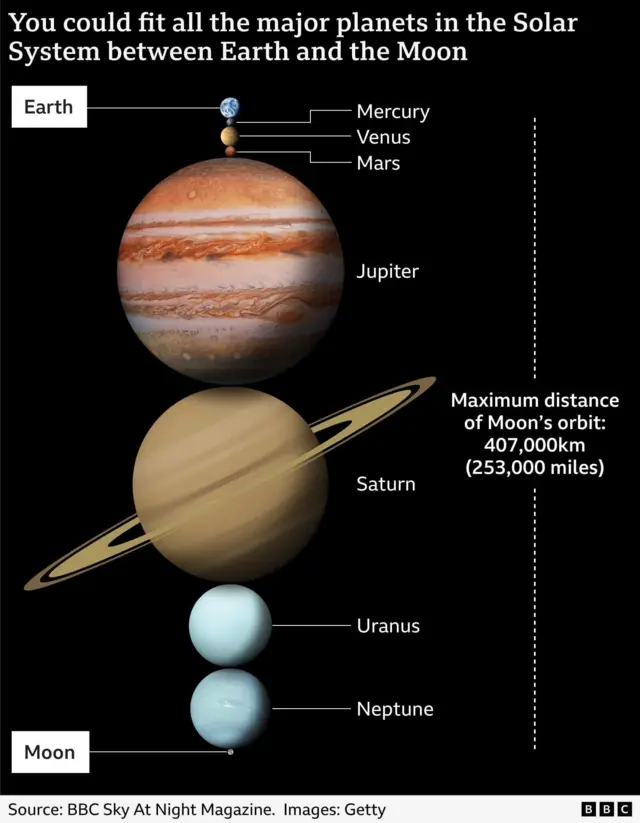
  3. Distance between Earth and The Moonpublished at 19:03 BST 31 March

    Infographic titled “You could fit all the major planets in the Solar System between Earth and the Moon.” The graphic shows Earth at the top and the Moon at the bottom, with all the other planets stacked vertically between them to illustrate their combined width. From top to bottom, the planets shown are Mercury, Venus, Mars, Jupiter, Saturn with its rings, Uranus, and Neptune. A dotted vertical line on the right marks the maximum distance of the Moon’s orbit: 407,000 km (253,000 miles). Labels identify each planet and the Earth–Moon endpoints.
  4. It's a big moment for the Artemis II team, officials saypublished at 19:01 BST 31 March

    Spaulding speaks to how significant this moment is for the Artemis II team.

    Once they get to 10 minutes and counting, it “becomes real” for all the people working on the launch, he says.

    At one minute and counting, he says he thinks for the first time that they’re “making it”.

    One minute out from launch is still dangerous, he notes, but that's when he feels the weight of the moment the most.

    The team then ends the news conference.

  5. Will there be April Fools' Day pranks at Nasa on launch day?published at 18:43 BST 31 March

    Tomorrow is April Fools' Day, a journalist points out, and there is a long history of Nasa team members pulling pranks on each other.

    Jeff Spaulding, test director with the Exploration Ground Systems programme, says he is not aware of any planned pranks on launch day. It gets a giggle out of the crowd in the room.

  6. Conditions could rapidly change during the launch countdownpublished at 18:37 BST 31 March

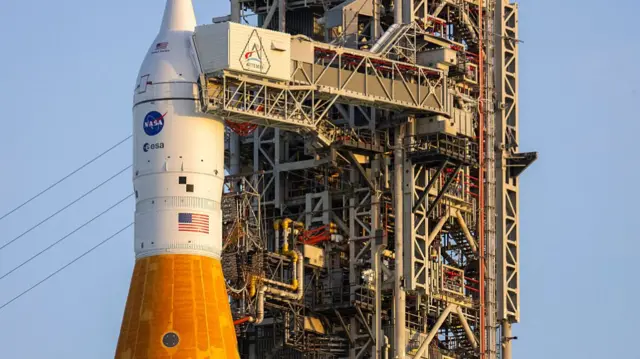
    A close photo of a Nasa rocket ship on its dockImage source, Getty Images

    Wind is another potential problem on launch day, and the team will assess the conditions through a balloon that analyses the wind.

    It's possible the launch will be unacceptable at one point during countdown, but things can change quickly and conditions could return to normal later in the countdown.

    Launch weather officer Mark Burger says they are doing real-time monitoring across multiple methods.

  7. Huge rocket taking Artemis crew into spacepublished at 18:27 BST 31 March

    The Visual Journalism Team
    BBC News

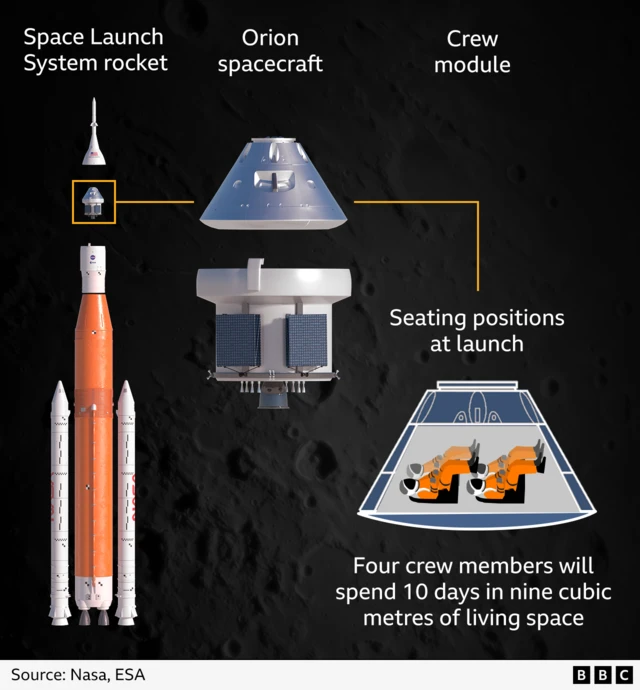
    An illustration showing how the Artemis II astronauts will be arranged in the Orion crew module at launch. The four astronauts sit reclined, in two rows of two, facing up with their backs towards the ground. During the mission the four crew members will spend 10 days in about nine cubic metres of living space. The image shows that the crew module makes up about half of the Orion spacecraft - with the service module being around the same size - and that, on the launchpad, Orion is only a small section of the 98m (320ft) Space Launch System rocket.

    Wednesday's planned launch of the Artemis II will begin the mission on Nasa’s mega moon rocket, the Space Launch System - the most powerful rocket the US space agency has ever built.

    Standing 98m tall (322ft) the SLS has four engines to provide the power to get off the ground. The core stage is essentially a giant fuel tank - containing more than three million litres of liquid hydrogen and liquid oxygen.

    It has flown only once before, launching in 2022 with no astronauts onboard for Artemis I.

    The launch is one of the most dangerous parts of the mission - everything has to go perfectly.

    Its job is to carry the Orion spacecraft - which houses the tiny crew module where the astronauts will spend the next 10 days - in to space.

    But if anything does go wrong during the early stages of the launch, the Launch Abort System, at the very top of the rocket, should propel the astronauts to safety.

  8. Launch expected to go ahead Wednesday as plannedpublished at 18:22 BST 31 March

    There is an 80% chance the launch goes ahead tomorrow, the Nasa officials say, adding that Wednesday looks the most optimal.

    There is a two-hour launch window.

    There are some light showers expected during the day, but they are not expect to be an issue.

  9. Weather looks great for launch, officials saypublished at 18:17 BST 31 March

    Nasa officials show a weather map and some forecasting, saying weather conditions generally look good.

    Some issues for launch day could be winds and rain. The sun has also become more active, the officials say, citing a recent solar flare. They say it is not a concern, but Nasa will monitor for any more flares that may occur.

  10. Officials lay out timing for launch daypublished at 18:12 BST 31 March

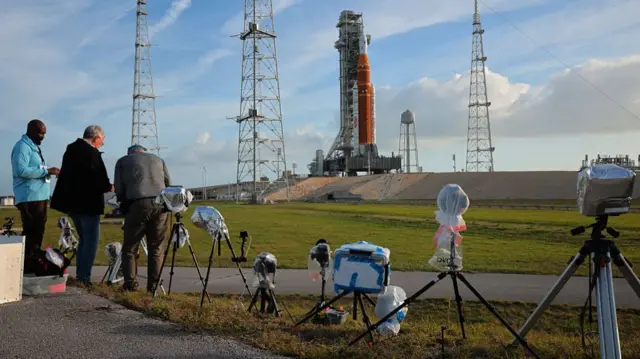
    In the foreground, cameras are set up outside facing a rocket ship in the background. Three men stand on the left near one of the cameras.Image source, Getty Images
    Image caption,

    Nasa makes preparations for tomorrow's launch

    Nasa officials are outlining how Wednesday's launch timeline will work.

    They are going over specific timings like when fuel will be loaded and when astronauts will wake up to make their way to the pad. Everything we have heard so far feels optimistic that the launch will go ahead as scheduled.

    “We're very excited,” the official says.

  11. Long journey to the Moon and backpublished at 18:07 BST 31 March

    BBC Visual Journalism Team

    The Artemis II crew will be the first humans to return to the Moon’s orbit in more than 50 years, and the 10-day journey will take them further from Earth than anyone has been before.

    Although the four astronauts won’t land on our nearest celestial neighbour, they are hoping to bring a new understanding of the lunar environment and the mission will pave the way for a future lunar landing.

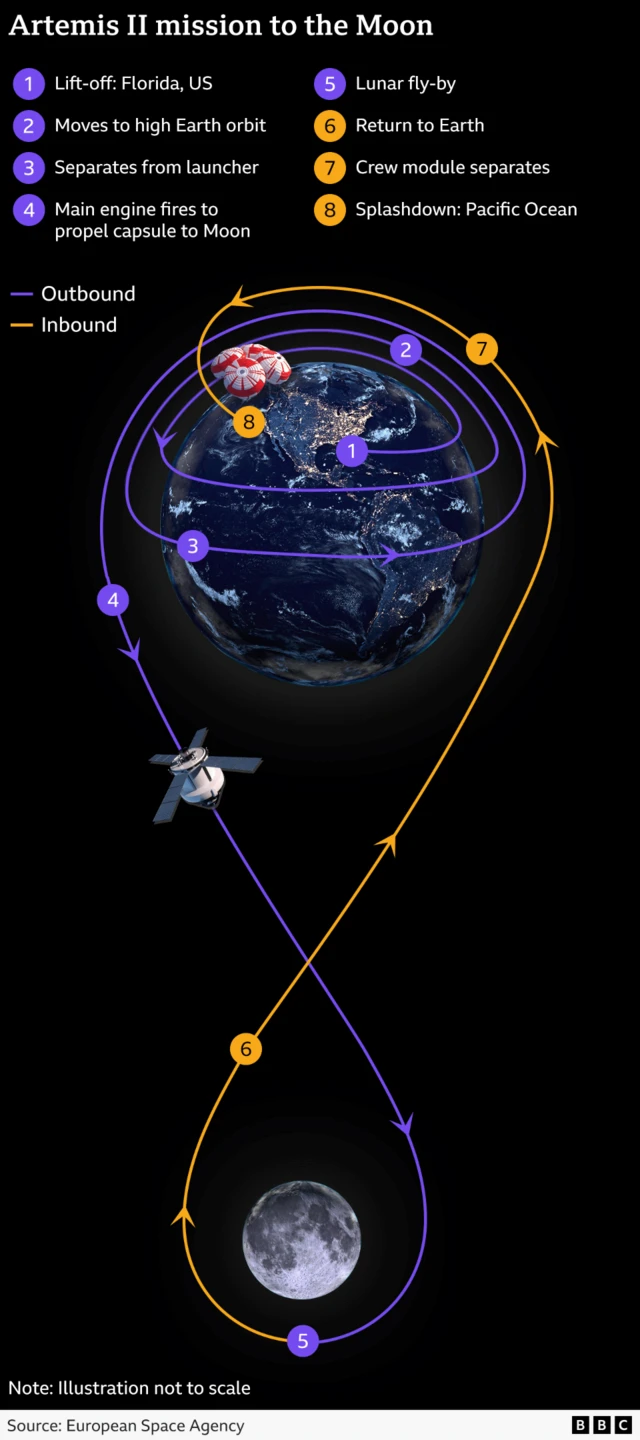
    They take off from Kennedy Space Center in Florida and, once their rocket is about 70,000km (45,000 miles) above the planet, the Orion spacecraft - which houses the crew - will separate from the launcher and orbit the Earth.

    The astronauts must then decide whether to continue the mission - while they are close to Earth, getting back is relatively straightforward if there are any issues that cannot be fixed. If all is well, Orion will fire its main engine to blast free of the Earth’s gravity and set a path to the Moon.

    Graphic showing the Earth and the Moon, with the spacecraft’s figure of eight orbital trajectory highlighted. Specific points are labelled. These are: 1. Lift-off at the Kennedy Space Centre, 2. Orbit around the Earth, 3. Rocket separation, 4. Main engine fires to take spacecraft to the Moon, 5. Lunar fly-by, 6. Return to Earth, 7. Crew module separates, 8. Splashdown in Pacific Ocean
  12. Nasa update beginspublished at 18:02 BST 31 March
    Breaking

    The final Artemis II update from Nasa before Wednesday's scheduled launch has just started.

    You can watch live at the top of this page.

  13. Who are the astronauts?published at 17:57 BST 31 March

    Reid Wiseman, Victor Glover, Christina Koch and Jeremy Hansen are the astronauts who will crew the Artemis II.

    This Flourish post cannot be displayed in your browser. Please enable Javascript or try a different browser.

  14. Watch live as Nasa gives mission update on Artemis IIpublished at 17:52 BST 31 March

    The countdown is on. It's T-minus one day until Artemis II is scheduled to blast off on a mission that will take four astronauts around the Moon for the first time in more than half a century.

    But everything needs to line up for the launch. That's why we are tuning in for what could be one final update from Nasa before lift off.

    How is the weather looking at the Kennedy Space Center in Florida? Is all of the equipment ready? We're about to find out.

    Click watch live at the top of this page to follow along.

    We will bring you a handful of text updates throughout, but this page is mainly for you to watch the stream as Nasa gives its mission update.