Summary

  • The UK's economy grew by 0.4% between April and June, the latest figures show

  • "Services were once again the main driver of growth, while production was broadly unchanged and construction also grew," says ONS director of economic statistics Liz McKeown

  • What is GDP? It measures the economic activity of companies, governments, and people, and affects things like pay increases for workers and how much tax the government can raise to pay for services

  1. Growth was 'relatively robust' in second quarterpublished at 07:05 BST

    Commenting on today's GDP figures, ONS director of economic statistics Liz McKeown says: "Growth slowed in the second quarter of the year, following a strong start to 2026, but remained relatively robust.

    "Services were once again the main driver of growth, while production was broadly unchanged and construction also grew."
  2. Economy grew by 0.3% in Junepublished at 07:01 BST
    Breaking

    GDP rose by 0.3% in June, the latest figures show.

    As a reminder, we also had the second-quarter figure from the Office for National Statistics (ONS) this morning - details on that in our previous post.

  3. UK economy grew by 0.4% in second quarterpublished at 07:00 BST
    Breaking

    The UK economy grew by 0.4% in the second quarter of the year, official figures show.

    Stick with us for analysis, including what this means for you.

  4. Latest GDP figures to be released shortlypublished at 06:57 BST

    In just a few minutes, at 07:00 BST, we'll get the latest GDP figures from the Office for National Statistics (ONS), showing how much the UK economy grew in the second quarter of this year.

    Economists are expecting growth of 0.4% for the three months from April to June.

    Businesses have been finding ways to cope with the effects of the Iran war, with manufacturers stockpiling to mitigate against supply shortages and price rises.

    The period also included political uncertainty in the run-up to Sir Keir Starmer’s resignation as Prime Minister in June and the first of several summer heatwaves in May, putting some industries under pressure.

    We'll bring you the figures - as well as the monthly GDP estimate for June - and analysis shortly. Stay with us.

  5. Businesses 'sit on hands' in second half of each year amid Budget speculation, economist sayspublished at 06:50 BST

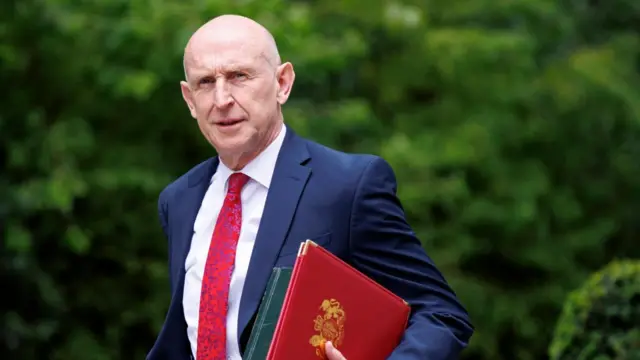
    Britain's Chancellor of the Exchequer John HealeyImage source, EPA
    Image caption,

    John Healey has said his first Budget in October will be "built on fiscal discipline"

    There has been a "very clear seasonal pattern" over the past decade of growth doing well in the first half of the year, before slowing down in the second half, says Simon French, chief economist at Panmure Liberum.

    While it could be a "statistical anomaly", he tells Radio 4's Today programme that events in the second half of the year - including the Budget - cause businesses to "sit on their hands".

    "Every year, speculation over changes in tax and spending have caused a delay in activity," he says.

    This year's Autumn Budget is due on 28 October.

  6. Burnham warned Iran war could hit UK growth next yearpublished at 06:41 BST

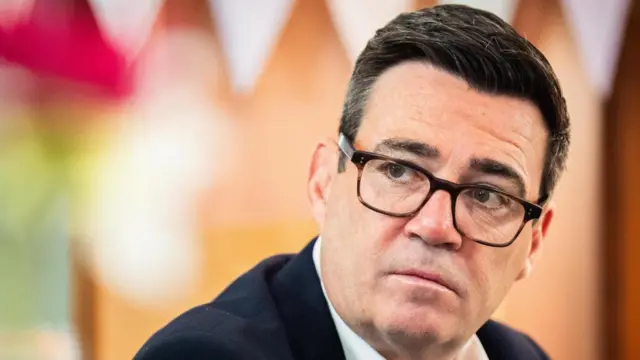
    Close up of PM Andy Burnham in a dark blue suit and white shirt. He appears to be sitting down, his head slightly angled to the rightImage source, PA Media

    Today's figures come at a time of growth concerns as disruption as the Iran war continues.

    Prime Minister Andy Burnham has been warned the UK economy could barely grow next year, if disruption in the Strait of Hormuz continues until the end of 2026.

    Treasury sources have confirmed internal modelling presented to the PM and chancellor - representative of a reasonable worst-case scenario - suggests UK GDP growth could be as low as 0.3% in 2027, as first reported by Bloomberg.

    Under the modelling, inflation would peak at 4.3% in the first three months of next year. It currently stands at 2.6%.

    Government officials say they routinely plan for all possible scenarios.

  7. What do experts expect from the GDP figures?published at 06:30 BST

    The latest GDP figures should show the impact of several things that occurred in the three months to June.

    Economists are expecting growth of 0.4% for that three month period, according to estimates.

    Businesses continued to find ways to cope with the effects of the Iran war, with manufacturers stockpiling to mitigate against supply shortages and price rises.

    But the period also included political uncertainty in the run-up to Sir Keir Starmer’s resignation as prime minister on 22 June.

    The first heatwave also came in May, which put some industries under pressure.

    Monthly GDP is expected to have dipped by 0.1% in June, according to consultancy Pantheon Macroeconomics.

  8. UK economy returned to growth in Maypublished at 06:20 BST

    Nick Edser
    Business reporter

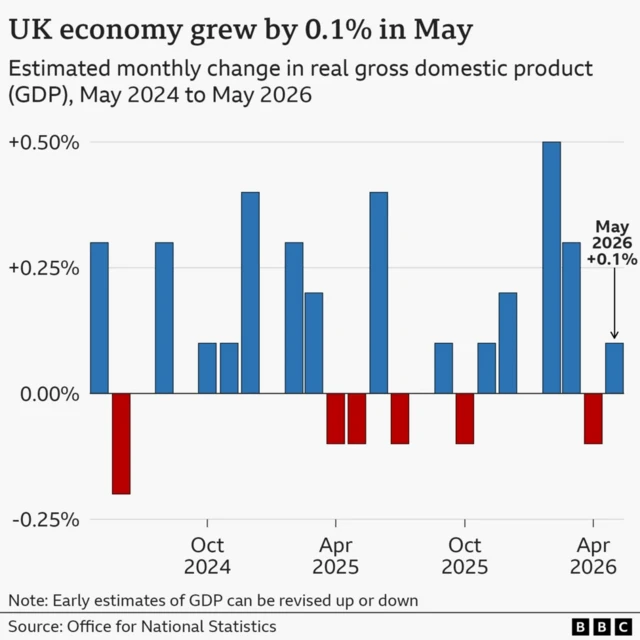
    The UK's economy returned to growth in May, but the expansion was modest as businesses were affected by the impact of the Iran war.

    The economy grew by 0.1%, the Office for National Statistics (ONS) said, driven by expansion in the UK's service sector, although this was offset by falls in the production and construction sectors.

    May's growth comes after a slight contraction in April, and analysts said the latest figures suggested the economy had weathered the rise in energy prices caused by the conflict in the Middle East better than expected.

    However, others noted the UK economy remained "fragile".

    Over the three months to May, the ONS said the economy grew by 0.7% compared with the previous three-month period.

    A bar chart showing the growth of the UK economy. In May 2026, it is estimated to have grown by 0.1%.
  9. A quick guide to GDPpublished at 06:12 BST

    Today’s figures show how the UK economy is performing, using a measure called Gross Domestic Product (GDP).

    What is it?

    GDP measures the economic activity of companies, governments, and people, and affects things like pay increases for workers and how much tax the government can raise to pay for services.

    But the measure doesn’t tell the whole story, especially important aspects of people’s living standards or how wealth is shared.

    What does it show?

    Generally, economists, politicians, and businesses prefer GDP to grow steadily – as it means people are spending more, more jobs are being created, and more tax is being paid.

    If GDP shrinks for two quarters in a row, this is known as a recession, which can lead to pay freezes and job losses.

  10. Latest figures on economic growth to be releasedpublished at 06:07 BST

    The latest figures showing how the UK economy performed are about to be released.

    At 07:00 BST, the Office for National Statistics (ONS) will reveal the Gross Domestic Product figures for April to June 2026.

    Economists are expecting to see growth of 0.4%.

    GDP measures the size and health of a country’s economy by assessing how much is produced, spent and earned over a period of time.

    Stay with us for the latest updates and analysis throughout the morning.