Summary

  • MPs are debating if Keir Starmer should face an inquiry into whether he misled them over the appointment of Lord Mandelson as US ambassador - Henry Zeffman distills the key questions here

  • Tory leader Kemi Badenoch opens the debate by saying it is "very obvious" that Starmer had said things in Parliament that were "not correct" - Labour insists the debate, and the vote to follow, is a "stunt"

  • Earlier, Starmer's former chief of staff Morgan McSweeney gave evidence to MPs - he says he made a "serious mistake" in advising the PM to appoint Mandelson, but that he didn't want vetting to be "cleared at all costs"

  • Describing his relationship with Mandelson, McSweeney says he was a "confidant" - but not a "mentor". He says discovering the closeness of Mandelson's relationship with Jeffrey Epstein was "a knife through my soul"

  • McSweeney resigned in February, saying he took "full responsibility" for advising the PM to appoint Mandelson in 2024

  • Ex-Foreign Office chief Philip Barton also gave evidence - he said he was "worried" Mandelson's links to Epstein "could be a problem" - but that he wasn't consulted on the appointment

  1. Analysis

    An uncomfortable experience for Starmer's former top aide, who largely kept his coolpublished at 13:32 BST

    Brian Wheeler
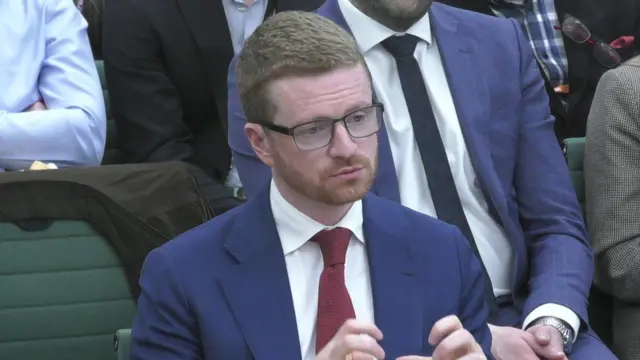
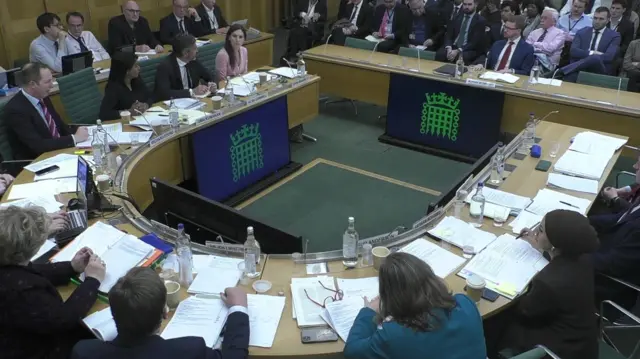
    At the Foreign Affairs Select Committee

    Morgan McSweeney has just reached the end of his evidence session.

    It’s been an uncomfortable experience for him and not just because of the sweltering temperature in the room.

    He largely kept his cool under persistent and detailed questioning from MPs and committee chair Emily Thornberry, who is clearly not buying some of his answers.

    But the former spin doctor showed flashes of irritation at times and got particularly animated when denying he had personally put pressure on officials to get on with Mandelson’s appointment.

    He also seemed particularly keen to knock down claims he swore at civil servants.
  2. McSweeney asked about theft of his government phonepublished at 13:32 BST

    Back at the Foreign Affairs Committee, Morgan McSweeney is asked about his government phone, which he says was stolen last October.

    He says he phoned No 10 and then the police, adding he was "quite surprised" by how "limited" the security was around the telephone of the PM's chief of staff.

    Tory MP John Whittingdale asks McSweeney why he gave the wrong directions to an emergency responder, to which the former aide says he wasn't "clear and coherent" at the time.

    He says any messages from before September concerning Mandelson had already been shared with the government. His phone has not yet been recovered by police, he adds.

    But he also says he had disappearing messages on WhatsApp with "most people", and "probably did" with Mandelson.

  3. A reminder of the three ways Starmer's accused of misleading Commonspublished at 13:21 BST

    Henry Zeffman
    Chief political correspondent

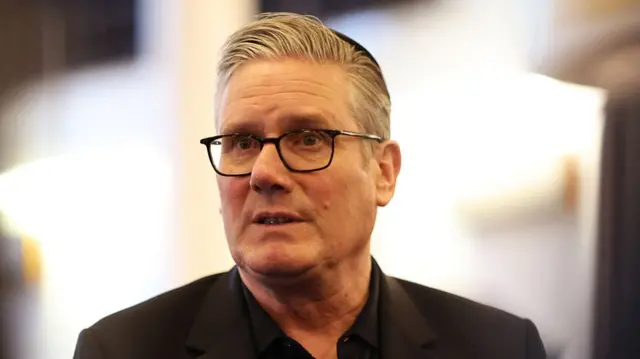
    Keir Starmer talking to a reporter slightly off cameraImage source, Getty Images

    The precise privileges committee motion - being debated now in the Commons - was published overnight.

    It's spearheaded by Kemi Badenoch and the Conservatives, but the motion is also signed by Ed Davey of the Liberal Democrats as well as SNP, DUP and independent MPs.

    The motion identifies three possible areas where the prime minister may have misled the House of Commons.

    The first is in saying on various occasions that “full due process” was followed in Lord Mandelson’s appointment as ambassador to the US.

    The second area of the motion is on the question of pressure, and whether it was applied to the Foreign Office to approve the appointment. Keir Starmer said at PMQs last week that “no pressure existed whatsoever in relation to this case”.

    The third area concerns the PM’s claim in the Commons last week that Mandelson’s position was “subject to developed vetting” - that presumably will be an area where the Conservatives make arguments about the sequencing of vetting, coming as it did after the public announcement that Mandelson would be appointed.

    The government’s defence overall is that this is a "political stunt". But on the specifics, it is likely to be that:

    • Chris Wormald, the former cabinet secretary, said in September that "appropriate processes" had been followed
    • The prime minister was talking about pressure for a specific outcome, which he denies, rather than pressure for a decision to be made quickly, which he does not
    • Even though the vetting outcome is now controversial, it was carried out before Mandelson went out to the US as ambassador

  4. McSweeney: Epstein's violence against women and girls should have been considered morepublished at 13:13 BST

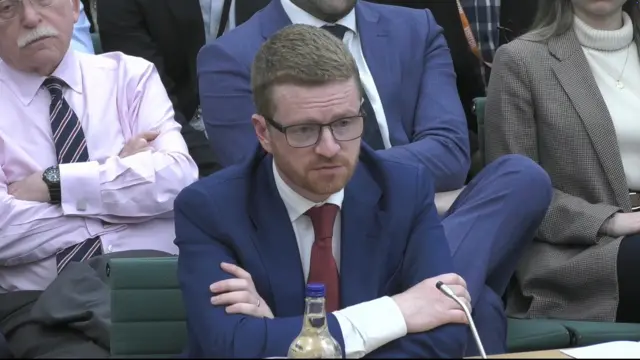
    Morgan McSweeney at the Foreign Affairs Committee, crossing his armsImage source, UK Parliament

    Back at the Foreign Affairs Committee, where Keir Starmer's ex-chief of staff Morgan McSweeney is continuing to give evidence, Labour MP Fleur Anderson asks about dinners Mandelson reportedly held, both at his house and in restaurants.

    McSweeney says he attended two dinners at Mandelson's house in 2024 and had two further dinners with him at restaurants.

    McSweeney says Mandelson did lobby him for the job, but not at any of these events.

    Anderson follows up by asking whether Epstein's known violence against women and girls was downplayed during this time.

    In response, McSweeney says he thinks this should have been brought "a lot more to the fore" and that the prime minister "takes this issue very, very seriously".

  5. Badenoch asks Labour MPs if they'll 'live up to promises they made about standards'published at 13:08 BST

    Conservative leader Kemi Badenoch kicks off the Commons debate by recounting Keir Starmer's appearance at Prime Minister's Questions last week, accusing him of saying Olly Robbins's evidence had "exonerated him".

    Badenoch says the question today is whether the Commons and Labour MPs believe in "full, due process" - and whether Labour MPs have the "integrity" to refer Starmer to the Privileges Committee "knowing what we all know".

    She goes on to quote the ministerial code, accusing Starmer of not following full due process.

    "What kind of people are they [Labour MPs]? Are they people who'll live up to the promises they made about standards, and the rules mattering, or are they people who abandon their promises to be complicit in a cover-up?," she asks rhetorically.

    Badenoch says calling the vote a "stunt", as the PM has described it, is "disrespecting this House and disrespecting the Speaker".

  6. Elsewhere, MPs are debating whether Starmer should be investigated for misleading Parliamentpublished at 12:53 BST

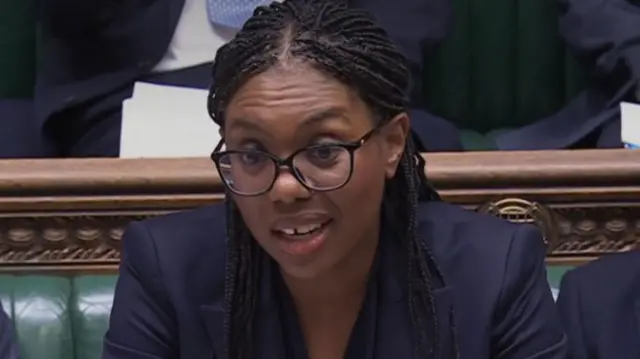
    Kemi BadenochImage source, House of Commons

    We’ve been bringing you updates from the Foreign Affairs Committee, where the prime minister's former chief of staff Morgan McSweeney is giving evidence on Mandelson's appointment.

    Meanwhile, over in the House of Commons, MPs are beginning a debate on whether to launch an inquiry into whether Starmer has misled Parliament.

    The specific question MPs are debating is whether to refer Starmer to the Privileges Committee over statements he has made about Mandelson's appointment.

    The Conservatives have put forward the motion for an investigation, which is backed by the Lib Dems and some other opposition parties. The prime minister denies misleading Parliament, and has called this a "stunt".

    Labour has a big majority in the Commons, so it would take a large number of Starmer's own MPs voting with the opposition for the result to go against him. We'll bring you updates from the debate in this page, and continue to bring you highlights from McSweeney's appearance at the Foreign Affairs Committee, too.

  7. We never asked anyone to lower standards - McSweeneypublished at 12:52 BST

    McSweeney says there is pressure in government every day and that conversations on Lord Mandelson's vetting were taken at pace, but nothing improper was done.

    He tells the committee: "There is a real difference between asking people to act at pace and asking people to lower standards and we never did that."

    The former chief of staff says there could have been two occasions when he spoke to Philip Barton on a wider Zoom call, but the start date of Mandelson as ambassador was not regularly on the agenda.

    McSweeney adds that he did not see anyone in No 10 acting dismissive about vetting or national security at any point.

  8. No all-out advocates for Mandelson appointment, McSweeney sayspublished at 12:41 BST

    It wasn't until September that McSweeney realised he "didn't get the truth" from Mandelson, he says.

    This happened when Bloomberg surfaced files detailing his relationship with Jeffrey Epstein.

    He says he thought Mandelson had been telling the truth throughout the process.

    Liberal Democrat MP Edward Morello then asks McSweeney if there were any all-out advocates for Peter Mandelson to get the ambassador role.

    McSweeney answers no, saying that that is the same for a lot of appointments.

  9. McSweeney pushed for clarity on Doyle's exit from Starmer's top teampublished at 12:40 BST

    Returning to the topic of Matthew Doyle's mooted appointment, McSweeney is asked whether he has heard of the phrase "jobs for the boys".

    McSweeney reiterates that the conversations had were around a "duty of care" for someone who was leaving their role. He adds that the same would be true if it was a woman leaving a senior role.

    Doyle "wasn't promised a job", McSweeney continues, and if he had applied, his application would be considered in the same way as anyone else.

    • For context: Doyle, Starmer's former director of communications, was suspended from the parliamentary Labour Party in February after it was revealed he campaigned for Sean Morton in 2017, after Morton was charged with child sex offences. Doyle apologised, saying it was an "error of judgement". There were subsequent claims that No 10 had considered an ambassadorial job for Doyle, but he said in a statement that he had "never sought" such a role
  10. Conversation turns to mooted Doyle appointment as Foreign Office diplomatpublished at 12:19 BST

    The conversation briefly switches to a discussion of former communications chief Matthew Doyle's mooted appointment as a diplomat in the Foreign Office as he left No 10.

    Why did the prime minister want to keep conversations around this private from then Foreign Secretary David Lammy, McSweeney is asked.

    He replies saying there were "difficult conversations" to be had with Doyle as his time in No 10 came to an end, and he wanted to keep the circle small around possible future opportunities for Doyle "because there was a HR issue".

    "Somebody is leaving their job, you don't want a lot of people knowing it," he explains.

    And if Doyle wanted to work in any of the advertised roles, he'd have had to apply like anybody else anyway, McSweeney adds.

    McSweeney then says he wasn't aware of other conversations between the Foreign Office and No 10 where the foreign secretary had not been informed.

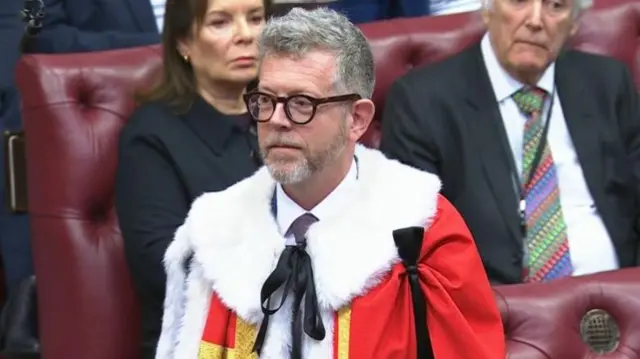
    Matthew Doyle taking his seat in the House of Lords in JanuaryImage source, House of Lords
    Image caption,

    Doyle, Starmer's former director of communications, was suspended from the parliamentary Labour Party in February after it was revealed he campaigned for Sean Morton in 2017, after Morton was charged with child sex offences. Doyle apologised, saying it was an "error of judgement". There were subsequent claims that No 10 had considered an ambassadorial job for Doyle, but he said in a statement that he had "never sought" such a role

  11. 'Starmer didn't know enough because Mandelson wasn't open enough'published at 12:18 BST

    The Foreign Affairs Committee is continuing to question Morgan McSweeney, Starmer's former chief of staff, about the appointment of Lord Mandelson as US ambassador.

    Tory MP Aphra Brandreth pushes McSweeney on something ex-Foreign Office chief Philip Barton told the committee earlier - that there was no plan in place for if Mandelson failed his vetting.

    "I didn't have a contingency plan in place but was always aware that somebody could fail security vetting," McSweeney now says.

    He adds it would have been a "political embarrassment" if Mandelson failed - and the government would probably have asked Karen Pierce (who was doing the job in Washington before Mandelson) to stay on and then "thought of next steps".

    Brandreth then asks whether the PM was in "full knowledge" of all the information when making the appointment, to which McSweeney says "he had all the knowledge that I had" - before insisting Starmer "wasn't aware of enough" because "Mandelson himself wasn't open enough with him".

  12. Analysis

    When did Starmer actually make his Mandelson decision?published at 12:13 BST

    Henry Zeffman
    Chief political correspondent

    Quite an interesting exchange between Morgan McSweeney and the Conservative MP Sir John Whittingdale, there.

    Whittingdale was pushing McSweeney hard on why the documents published by the government so far as part of the "humble address" have not included any records of when the PM actually made the decision to appoint Peter Mandelson as ambassador.

    McSweeney suggested there was an eventual meeting where Starmer, with a close inner team, did make the final decision. But there is no minute or record of that meeting.

    Expect this to form part of Kemi Badenoch’s case in the privileges debate later that, contrary to what Starmer has argued, due process was not followed.

  13. McSweeney says question Mandelson was his 'hero' an exaggerationpublished at 12:13 BST

    Thornberry asks whether McSweeney gave Mandelson the job because he was his "hero".

    McSweeney rejects this, saying that's an "exaggeration" of his relationship with Mandelson, saying his judgement was "always in the national interest" as he thought Mandelson's experience as EU Commissioner would help to get a trade deal with the US.

    He says the first person to put Mandelson's name down for consideration was Mandelson himself. McSweeney then repeats Starmer was "keeping his cards close to his chest" in terms of candidates, particularly before the US presidential election.

    McSweeney thought Mandelson had rebuilt a "reasonable reputation" for himself after his last resignation, and believed his relationship with Epstein was a "passing acquaintance".

    Finding out that Mandelson's relationship with Epstein was more extensive was "like a knife through my soul", McSweeney says.

    "I did not expect that level of connection."

    "I thought he had reestablished himself as a credible, political figure," he says.

  14. Discovering closeness of Mandelson-Epstein relationship was 'knife through my soul' - McSweeneypublished at 12:07 BST

    Chris Mason
    Political editor

    A couple of key quotes from Morgan McSweeney stand out for me so far.

    Firstly, and unsurprisingly, that his enthusiasm for Lord Mandelson being appointed ambassador was "a serious mistake".

    At the heart of his misjudgement, he said, was his understanding at the time that Lord Mandelson’s relationship with Jeffrey Epstein was as "a passing acquaintance" - and when he later discovered it was much closer than that it was like "a knife through my soul".

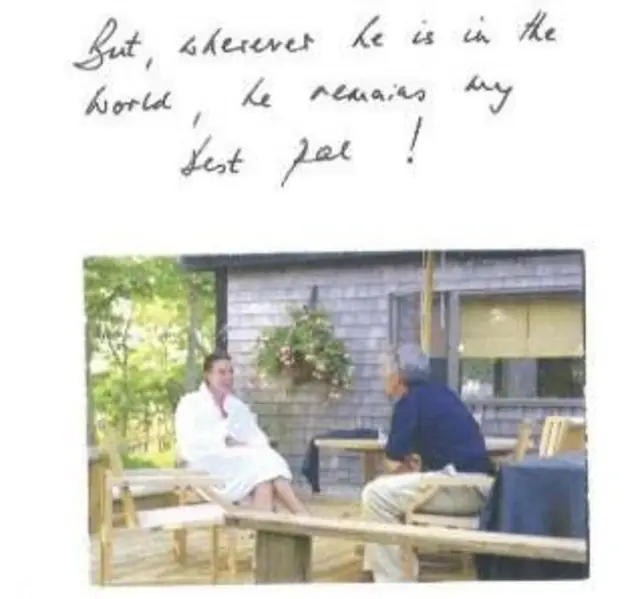
    This image - from Jeffrey Epstein's birthday book in 2003 - was released by the US Committee on Oversight and Government Reform in September last year. It shows Epstein and Mandelson with the hand-written message: "But, wherever he is in the world, he remains my best pal!"Image source, US Committee on Oversight and Government Reform
    Image caption,

    This image - from Jeffrey Epstein's birthday book in 2003 - was released by the US Committee on Oversight and Government Reform in September last year. It shows Epstein and Mandelson with the hand-written message: "But, wherever he is in the world, he remains my best pal!"

  15. Was there an agreement to tell Trump and King that appointment would be dependent on vetting?published at 12:06 BST

    The evidence session now runs through some of the meetings that happened in December 2024 that led up to the announcement that Peter Mandelson had been appointed as US ambassador.

    Was there an agreement to tell the King and the incoming President Trump, in the knowledge that the appointment would be dependent on vetting, Thornberry asks.

    McSweeney says he wasn't involved in any decisions about when to tell the King that Mandelson had been appointed.

    Thornberry interjects to say that it "makes sense" that the appointment could not be made without vetting, but McSweeney explains that it "didn't jump out as a problem" for him at the time, citing his own appointment before he went through the Developed Vetting (DV) process.

    "It didn't occur to me to ask because that's how I saw the practices being put in place," he says - adding that Starmer is right in saying it shouldn't happen, which is why he has taken steps to ensure it doesn't happen in the future.

    McSweeney agrees it would have been "very embarrassing" for a lead candidate to fail the DV process but says if there had been problems, the candidate would have been pulled at that point.

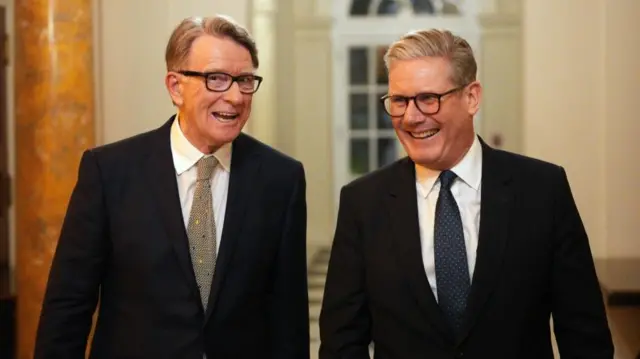
    Lord Mandelson and Keir Starmer, pictured during a welcome reception at the ambassador's residence in Washington DC in February 2025Image source, PA Media
    Image caption,

    Lord Mandelson and Keir Starmer, pictured during a welcome reception at the ambassador's residence in Washington DC in February 2025

  16. Mandelson's experience as EU trade commissioner was key reason to be selected lead candidatepublished at 12:00 BST

    How did McSweeney persuade the PM that Peter Mandelson should be the lead candidate for the role of US ambassador, McSweeney is asked by Thornberry.

    Mandelson's experience as an EU trade commissioner was the key reason, he replies.

    But he's pushed by Thornberry on whether, as a friend of Mandelson’s, it is appropriate to speak to the prime minister during the due diligence process on him.

    McSweeney agrees that in hindsight it would have been much better to have someone else ask the follow-up questions around due diligence.

    "It wasn't my decision,” he stresses. “It was the prime minister's decision" to appoint Mandelson.

  17. McSweeney apologises for his role - but says final decision was Starmer'spublished at 11:53 BST

    Harry Farley
    Political correspondent

    Morgan McSweeney was clear at the outset of his evidence that he advised in favour of Lord Mandelson's appointment and apologised for that.

    But he has stopped short of taking full responsibility.

    McSweeney's said a number of times other senior advisors and ministers were consulted and if it had just been him arguing for Mandelson's appointment, it would not have happened.

    "It wasn't my decision. It was the prime minister's decision," he says.

    McSweeney
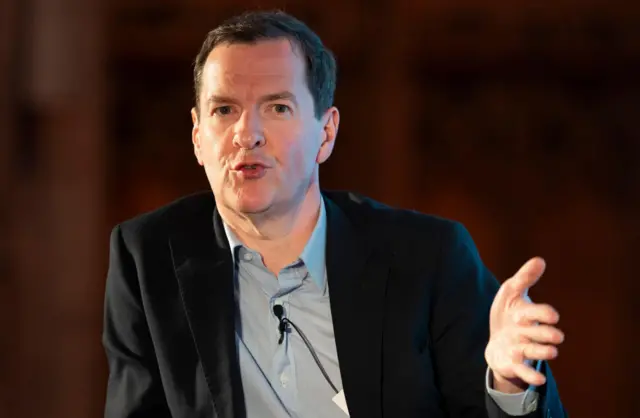
  18. George Osborne was the other 'appointable' candidate - McSweeneypublished at 11:53 BST

    George OsborneImage source, PA Media

    What happened in early December 2024, Dame Emily Thornberry asks, "for Mandelson to become the lead candidate".

    McSweeney replies the first decision the prime minister had to make was "did he want a political appointment or not?"

    Starmer would have made his decision and told his principal private secretary, so candidates could be procured.

    "He could have gone in a different direction at that point", McSweeney says.

    He continues saying he doesn’t recall having any strong disagreements with anyone in No 10.

    Two "strong candidates" were procured for the PM - former Chancellor George Osborne, and Mandelson - and he told the PM these were both "appointable" candidates.

    "I can't recall anyone saying that Mandelson was not appointable," he adds.

  19. Lots of people against the idea of appointing Mandelson, McSweeney sayspublished at 11:48 BST

    There were conversations being held in No 10 about who could be the best candidate for ambassador to Washington, McSweeney says, with several individuals making arguments for and against the names suggested.

    He goes on to say there were a lot of people against the idea of Mandelson being appointed at the time, but adds Keir Starmer is the kind of person who will listen to a lot of views when making a decision.

    He says that the prime minister likes to build a consensus within his team and that he took time the make the decision that he reached.

    McSweeney being questioned by MPsImage source, UK Parliament
  20. Mandelson 'lobbying' for ambassador role, but was looking at Oxford University rolepublished at 11:43 BST

    Thornberry now asks if McSweeney sought advice on whether Mandelson could be US ambassador on a part-time basis, as Mandelson was also seeking a role as chancellor of Oxford University.

    McSweeney replies that he doesn’t “have any recollection” of that, but Thornberry pushes for an answer.

    Mandelson was "lobbying" for the ambassador role, McSweeney says, but "hedging" by looking at other opportunities, such as Oxford.

    Mandelson holding both positions would be "incompatible", he adds.