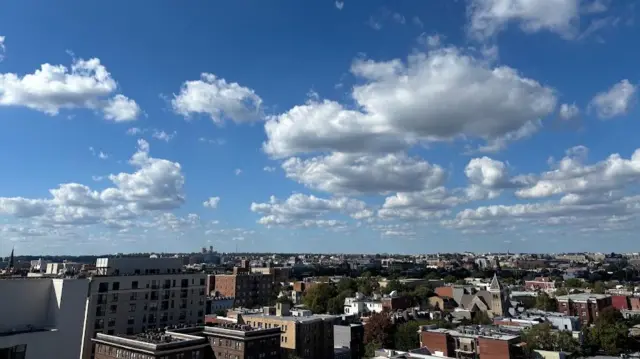
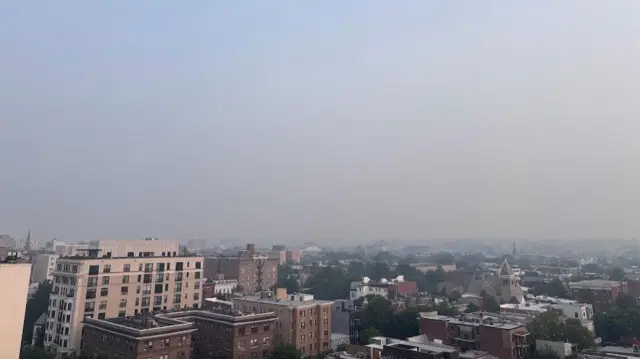
Summary

  • A blame game has emerged over the dangerous air quality, with US lawmakers saying "American lungs are paying the price for Canadian inaction" and Ontario Premier Doug Ford responding that the US should "send support, send help"

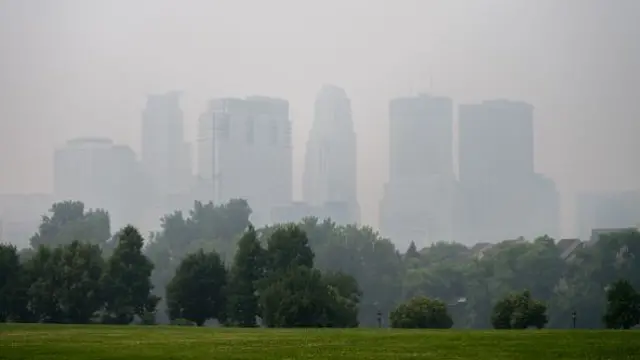
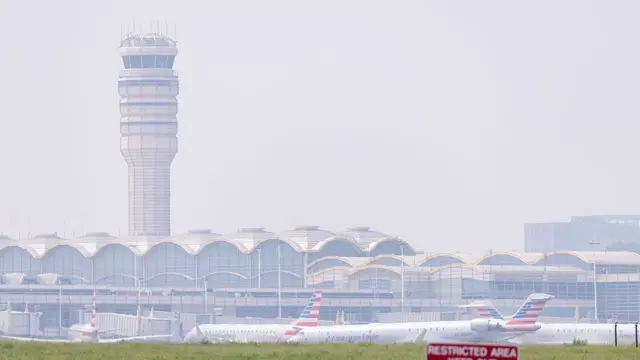
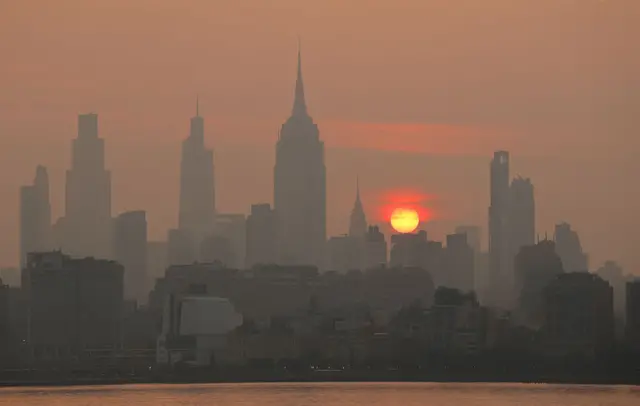
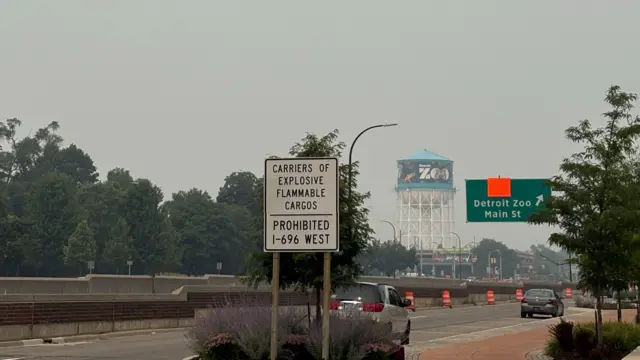
  • Detroit, Chicago, Washington DC and New York top the list for worst air quality in the world today, as nearly 900 wildfires currently burn across Canada

  • Check how they compare to more notorious cities for air pollution

  • Winds from the Great Lakes region are driving smoke and ash across the upper Midwest of the US. See how the smoke is moving and when it could improve

  • Many places are also expected to experience hot temperatures of more than 90F (32C) and high humidity

  • Air quality will likely remain a concern through the weekend when Fifa is holding its final matches in Florida and New Jersey. See a timelapse video of the World Cup final stadium nearly vanishing in the haze here

Media caption,
‘You can taste the smoke’: New Yorkers on air quality as fires burn across Canada
  1. An unpleasant day in Washingtonpublished at 18:35 BST

    Bernd Debusmann Jr
    White House reporter

    I've just come back inside after about 30 minutes filming outside - an experience I don't hope to repeat anytime soon.

    By the standards of famously hot and humid Washington, it's a relatively cool 32 Celsius. The air quality, however, is abysmal.

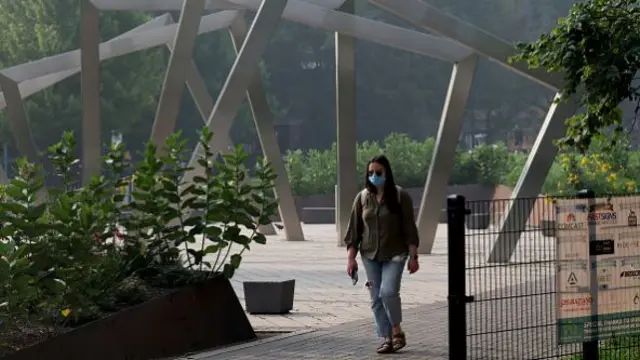
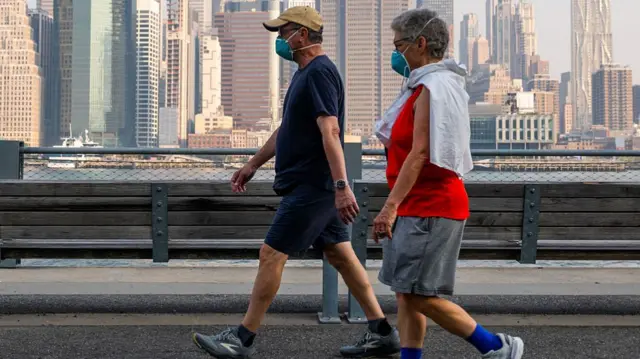
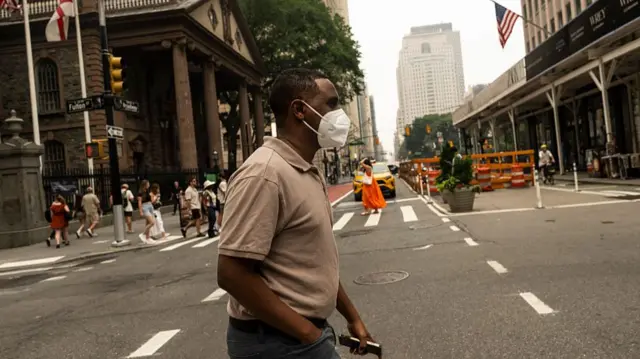
    Within seconds of stepping outside, I was assaulted by the clear scent of smoke in the air while my eyes began watering. On the street, several people were wearing masks. I saw several young women walk by smelling their hair, clearly upset at the prospect of having to carry the scent around for the rest of the day.

    Conditions are worse than expected. Earlier forecasts I saw predicted that the AQI would top out between 150 and 200 today. But my 0600 local, it already stood at 250. At the time I stepped out at around noon, it stood at 248.

    Local authorities have declared a rare "Code Purple", which means that anyone - even those without any underlying health risks - should avoid going outside.

    Some have clearly avoided these concerns. As I walked back into my office, I caught a glimpse of a young, shirtless man jogging. He did not appear to be enjoying it.

  2. Washington DC issues safety guidance as smoke hangs over city's iconic monumentspublished at 18:24 BST

    "If you must go outside, wear a mask," says Mayor of Washington DC Muriel Bowser, issuing guidance to residents grappling with the smoky conditions in the city.

    Washington DC is in Code Purple - a notice of "very unhealthy air" - Bowser says, and advises "sensitive groups to stay indoors" and everybody else "to limit both time outside and to avoid heavy exertion activities".

    She adds that all government activities in the city are cancelled, and outdoor pools and spray parks are closed.

    Smoke creates a coloured haze over the US Marine Corps War Memorial as the sun risesImage source, Getty Images
    Image caption,

    The Marine Corps War Memorial

    Army National Guard members patrol in front of the Herbert C. Hoover Federal Building shrouded in smokeImage source, Getty Images
    Image caption,

    The Herbert C. Hoover Building, which houses the US Department of Commerce

    Smoke shrouds the Lincoln Memorial, Washington Monument, and the US Capitol Building DomeImage source, Getty Images
    Image caption,

    The Lincoln Memorial

    The sun rises behind the US Capitol building as smoke hangs in the airImage source, Getty Images
    Image caption,

    The US Capitol Building

  3. 'Rather than complain, send support' says Doug Ford to US lawmakers upset about smokepublished at 18:14 BST

    Nadine Yousif
    Reporting from Toronto

    Ontario premier Doug FordImage source, Getty Images

    As the smoke from Canada wildfires drifts south, four Republican lawmakers from Michigan have publicly blamed their northern neighbour for not doing enough to put out the flames.

    Ontario Premier Doug Ford has since responded, telling reporters on Friday that Americans should support Canada instead of complain.

    He notes that Canada has helped the US battle its wildfires in California and respond to hurricanes in North Carolina in recent years.

    "Maybe what you should do rather than complain is send support, send help, because we have done the exact same thing for our American friends," Ford says.

    Defending his province's wildfire response, Ford says that Ontario has over 150 crews battling flames with the help of over 80 water bombers and helicopters.

    "We are throwing every single resource we can," he says.

    Carney has also responded, telling reporters on Thursday that combating climate change is the responsibility of both countries.

  4. US Republican lawmakers hit out at Canadian PM over wildfirespublished at 18:10 BST

    Canadian Prime Minister Mark Carney in a dark suit and tie.Image source, Getty Images

    Several Republican members of the US Congress have lashed out at Canadian Prime Minister Mark Carney, accusing his government of failing to adequately mitigate the risk of wildfires as smoke from blazes in Canada drift into northern US cities.

    John James, Jack Bergman, John Moolenaar and Lisa McClain jointly signed a letter to Carney this week, claiming "American lungs are paying the price for Canadian inaction".

    "If Canada will not manage its forests to prevent these fires, the United States will look elsewhere, and act on our own, to protect our people. That means our own agencies exploring direct involvement in cross-border fuel reduction and firefighting capacity," the 15 July letter says.

    Following US criticism, Carney reportedly said in in Ontario that fighting climate change was the responsibility of all countries, "including the United States".

  5. Wildfire trend consistent with projections from climate researcherspublished at 18:00 BST

    Stav Danaos
    BBC Weather

    A plane flies past smog-covered Toronto high-risesImage source, EPA
    Image caption,

    Planes have flown through smog to land at Toronto's Billy Bishop airport.

    Wildfires are not unusual in Canada – they are a normal part of its ecosystems – but what has become more unusual over the past couple of decades is the increasing occurrence of exceptionally large and long-lasting wildfire seasons which produce smoke that can affect millions of people across Canada and the United States.

    This trend is consistent with what climate researchers have projected as the climate continues to warm.

    Many are asking how the Canadian wildfires were started this year and the answer is a little more complex. Some Canadian wildfires were sparked by lightning while many others were caused by human activity or still remain under investigation.

  6. My asthmatic lungs have had enoughpublished at 17:35 BST

    Sakshi Venkatraman
    Reporting from New York City

    It was a bad week to catch a cold in New York City.

    Just when I thought I'd kicked the cough that had left me hacking and wheezing last week, the smoke rolled around and is trying to take my lungs out once again.

    Outside yesterday, the air was so thick and hard to breathe that I had to go to the doctor and get a new inhaler prescribed to combat my flaring asthma. I haven't had this bad of a flare since childhood.

    Safe to say I will be indoors until the smog lifts.

  7. The dangers of wildfire smokepublished at 17:25 BST

    A person crosses the street as smoke from Canadian wildfires blankets Washington DCImage source, Reuters
    Image caption,

    Smoke from Canadian wildfires seen in Washington DC

    Outdoor events including summer camps and music concerts have been cancelled in affected areas, as officials stress the health ramifications of inhaling wildfire smoke.

    Wildfire smoke is hazardous for humans as it contains a mixture of very small polluting particles like PM2.5 and nitrogen dioxide.

    "These particles when they get into our system get all the way down into our lungs, all the way down to our tiny breathing tubes and… they cause inflammation," said Jim McDonald, New York State Department of Health commissioner, in a public address video on social media.

    The smoke can exacerbate existing respiratory, heart, kidney and eye conditions, according to the World Health Organization, external.

    Emergency responders, and vulnerable groups such as those with chronic illnesses and children – who are closer to the ground where the smoke can sink – are most at risk.

  8. Heat and low pressure system bring smoke from Canada to USpublished at 17:16 BST

    Elizabeth Rizzini
    Lead weather presenter

    Wildfire smoke plumes are moving from Canada to the US as a low pressure system pushes south-eastwards across the Great Lakes region, producing south-easterly winds that are driving the smoke and ash particles across the upper Midwest of the US.

    High pressure is further west out across the Canadian Prairies and the Northern Plains, keeping the weather there dry and hot. This has allowed the wildfires to burn.

    As the low pressure system curls further northeastwards into Saturday and Sunday, the worst of the air with the greatest number of smoke particles clears from the Great Lakes area into south-eastern Canada.

    Conditions should improve across New England by the end of Saturday.

    You can see the smoke cover in this map from the Canadian government's weather service below.

    Color-coded gradients show smoke cover over North AmericaImage source, Government of Canada
  9. Ontario First Nations community 'burnt to ashes', says chiefpublished at 17:08 BST

    Nadine Yousif
    Reporting from Toronto

    Media caption,

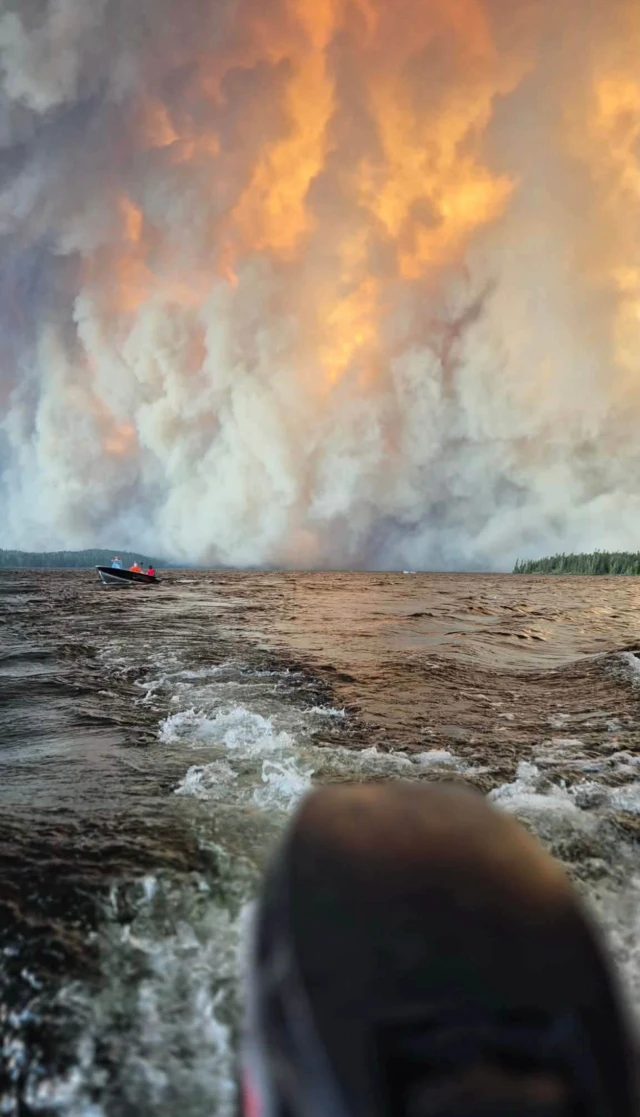
    Watch: Residents flee massive Canadian wildfire by boat

    As wildfires rage on in northern Ontario, one First Nations community is grappling with the devastation.

    Homes in Namaygoosisagagun First Nation, also known as Collins First Nation, were "burnt to ashes", said Chief Helen Paavlova in an interview with local news outlet CityNews.

    "All the homes are gone," she said on Thursday, following an aerial flyover of her community. "There's nothing left."

    Namaygoosisagagun First Nation is home to about 140 people. The fires have forced its residents, as well as those from other nearby communities, to flee. Ontario Premier Doug Ford said a total of 10 communities have been evacuated.

    Officials say that fire started very close to Collins First Nation, and firefighters did not have much time to travel there from other blazes before the flames spread. "It is a miracle that no one lost their lives", Ford said this Friday morning.

    Videos taken during the escape show residents leaving the remote community by boat across a nearby lake, with large plumes of smoke and bright orange blazes burning behind them.

  10. A hazy view of the Statue of Libertypublished at 17:00 BST

    Brandon Livesay
    Reporting from New York

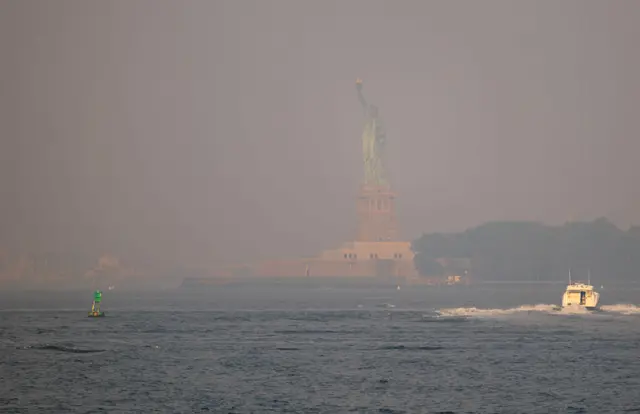
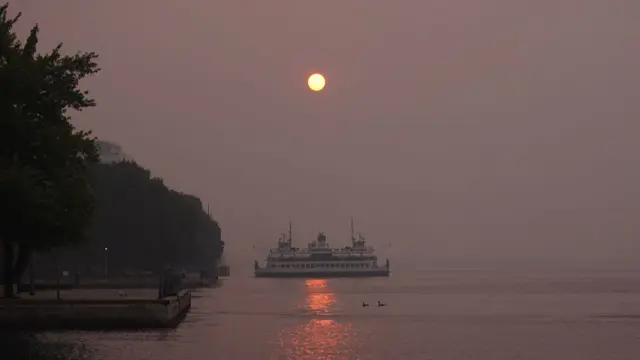
    A ship moves towards the right of frame with hazy view of the Statue of Liberty in the background.Image source, Brandon Livesay / BBC

    On my way to the office this morning in downtown Manhattan, a soldier in full camouflage fatigues handed me an N95 mask. It felt like a flashback to the pandemic.

    A lot of people were wearing masks, trying to avoid breathing in the soupy-thick air that’s been sitting on top of the city for two days.

    Conditions were really bad last night. A short walk from the subway to my apartment had me feeling like I was about to catch a cold, with a gross feeling in the throat and eyes starting to feel the burn.

  11. Where the wildfires are burning and why they startedpublished at 16:55 BST

    Map of active wildfires across Canada and the northern US. Red dots mark fires detected in the past 24 hours and pink dots show detections from the past seven days. The largest concentration is in northwestern Ontario, highlighted in an inset box, with additional clusters across western and central Canada. Toronto and New York are labelled for reference.

    There are currently more than 800 wildfires actively burning across Canada - including a large cluster in Ontario and a few in the bordering US state of Minnesota.

    Wildfires are very common in Canada, but the number of outbreaks has rapidly increased in recent weeks. Officials in both the US and Canada agree that this is likely because of sustained hot weather at the end of June across northern Ontario, coupled with a below average rainfall.

    Extreme and long-lasting heat draws moisture out of the soil and plants - and this dry vegetation is the perfect fuel for fires.

    Hot air can also churn up storms whose strong winds carry the fires and smoke to different locations. It's likely why we've seen the effects across the US.

  12. US cities have worst air quality in the world todaypublished at 16:40 BST

    Rebecka Pieder
    Reporting from Washington DC

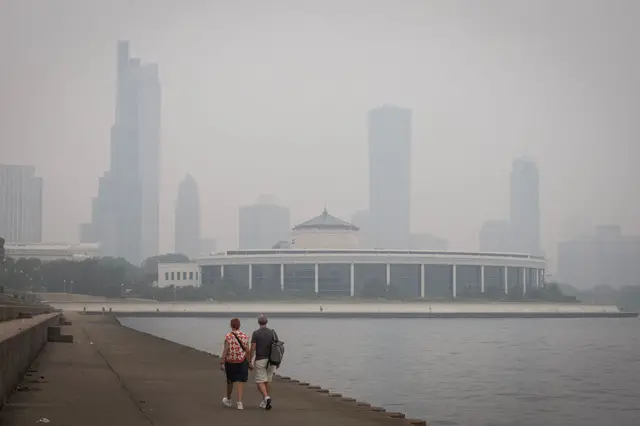
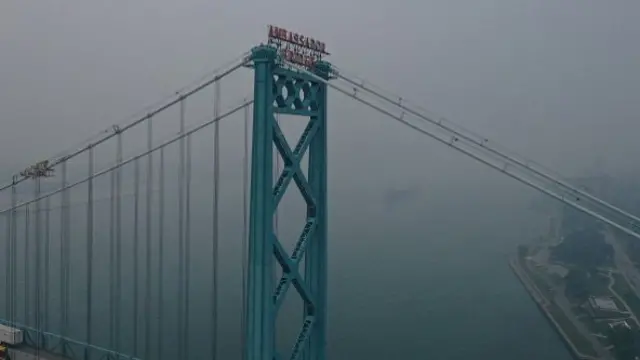
    Detroit, Chicago and Washington DC top the list for worst air quality in the world today.

    New York City sits in fourth place, according to air quality monitoring site IQ Air.

    IQ Air uses a scale called the Air Quality Index, which reflects how clean or polluted the air is throughout day. An AQI above 200 is considered “very unhealthy” and above 300 is “hazardous”.

    US cities typically don't top the list, but today they fill all of the highest slots.

    Here's where they sit as of Friday morning:

    Detroit - 435

    Chicago - 330

    Washington DC - 242

    New York - 160

    Other notoriously smoky and smoggy cities around the world have better scores today:

    Jakarta: 152

    New Delhi: 151

    Beijing: 65

    In the UK, Birmingham is the city experiencing the worst air quality today, with a rating of 82. London is at 56.

    Auckland, New Zealand is currently experiencing the best air quality in the world, with a rating of 8.

  13. Watch: Timelapse shows World Cup final stadium nearly vanish in smoky hazepublished at 16:39 BST

    Media caption,

    Timelapse shows World Cup final stadium nearly vanish in smoky haze

  14. Major US monuments shrouded in smokepublished at 16:33 BST

    Nick Johnson
    Reporting from Arlington, Virginia

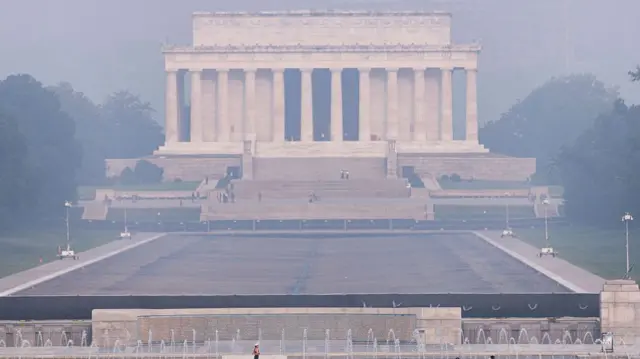
    Washington DC can be seen from across the river, hazy and covered in smokeImage source, Nick Johnson / BBC

    I’m in Arlington, Virginia, from where you’d usually get a good view of Washington DC just across the Potomac River.

    Today, the Lincoln Memorial, Washington Monument and other landmarks are shrouded in a hazy film.

    There’s also a strange smell hanging over the city - not wood smoke, more like burnt sugar - and a number of people are wearing masks.

    A “Code Purple” warning is in place to signal very unhealthy air.

    It’s been a very hot few days in the DC area and the smoky atmosphere is making the heat feel more oppressive.

  15. Wildfire smoke now the summer norm in Canadapublished at 16:18 BST

    Nadine Yousif
    Reporting from Toronto

    Smoke blankets TorontoImage source, Getty Images
    Image caption,

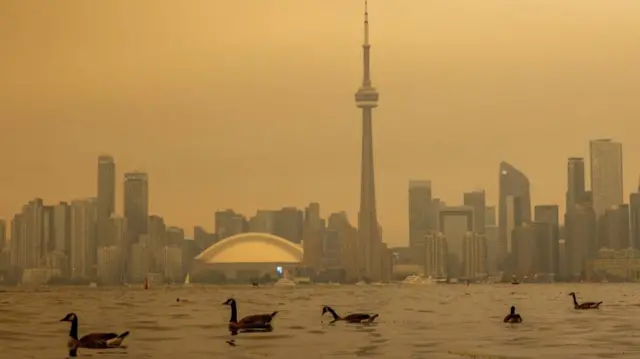
    Smoke blankets Toronto

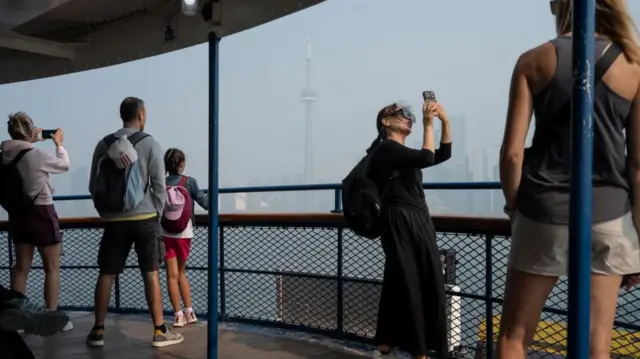
    It was hard to escape the smell of campfire yesterday, no matter where you were in Toronto.

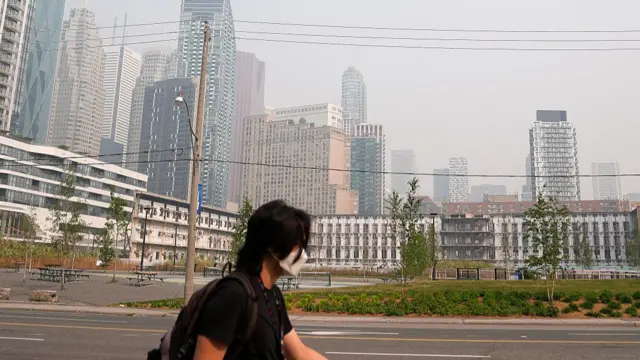
    Most of us woke up to a haze of smoke that blanketed much of the city and that made being outside for longer than necessary slightly unbearable.

    Today, the air is much better. The smell of smoke is fainter and the sky appears to be clearing up as the smoke drifts away from southern Ontario.

    A few years ago, experiencing wildfire smoke like this in Ontario was rare. It was western cities like Calgary, Edmonton and Vancouver that have often had to deal with it, as British Columbia and Alberta were the hotbed of wildfire activity.

    But in the last three years, smoke like this in Ontario has become a yearly summer occurrence.

    Experts tell me that is because wildfire patterns in Canada have changed since 2015, with blazes now happening more frequently in the east – in provinces like Ontario and Quebec – due to climate change causing drier soil that is prone to igniting quickly.

    Some residents in northern Ontario were forced to evacuate due to the ongoing fires. One First Nations chief reported her community was "burnt to ashes".

    As many of us are now beginning to learn, the impact of these blazes is also stretching way beyond the line of fire.

  16. Watch: ‘You can taste the smoke’: New Yorkers on air quality as fires burn across Canadapublished at 16:08 BST

    Media caption,

    ‘You can taste the smoke’: New Yorkers on air quality as fires burn across Canada

  17. Canadian wildfire smog blankets major US citiespublished at 16:07 BST

    Sakshi Venkatraman
    Reporting from New York City

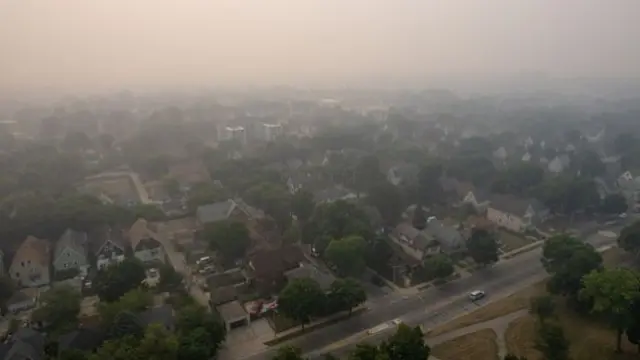
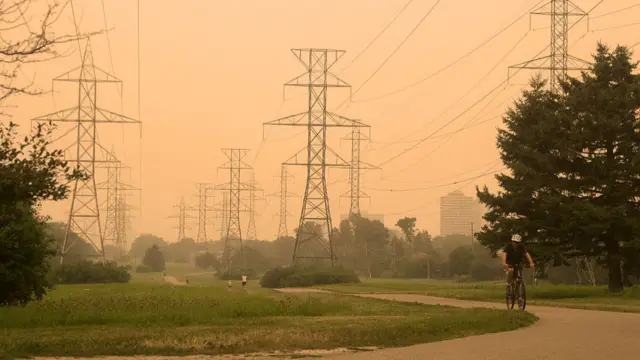
    Cities across north-eastern Canada and the US are suffering from intense smoke brought on by wildfires burning across Ontario and Minnesota.

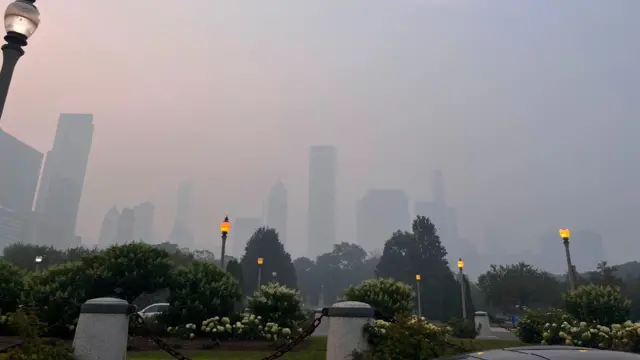
    Residents in New York, Boston, Washington DC and Chicago are stepping outside into smoggy, low-visibility conditions today. The air feels heavy, and pedestrians say the can taste the smoke hanging in the air.

    Many cities have warned people to avoid strenuous activities and stay indoors, as wildfire smoke contains particles that are hazardous for humans.

    Detroit, Toronto and Minneapolis are currently the cities with the worst air quality in the world, according to IQAir, a company which tracks global air quality.

    Our reporters across North America are out in the fray and will bring you a first-person look at how it's impacting their cities.