Summary

  1. Analysis

    The cool new designer spacesuitspublished at 18:23 BST

    Pallab Ghosh
    Science correspondent

    Space suitImage source, Getty Images

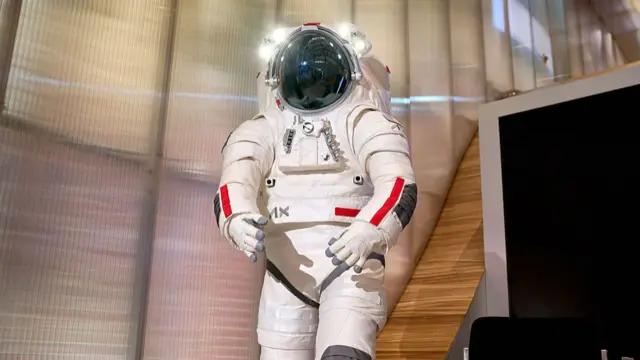
    Nasa is designing new suits — formally called the Axiom Extravehicular Mobility Unit, or AxEMU — for its astronauts. They are being built by the Houston-based company Axiom Space in partnership with the Italian fashion house Prada.

    The outer shell, unveiled in 2024, is designed to survive the temperature extremes and micrometeoroid hits of the lunar south pole. On Sunday in New York, the two companies unveiled the inner layer: a Liquid Cooling and Ventilation Garment which the astronauts will wear directly against the skin.

    The engineering is Axiom's. Chilled water is pumped through a network of fine tubes woven into the garment to draw heat away from the body, while a separate ventilation network delivers oxygen to the helmet and carries exhaled carbon dioxide to a scrubber. The novelty is a redundant cooling loop: if the primary system fails on the lunar surface, a backup keeps the astronaut alive.

    Prada's contribution is the materials and the patternmaking. What looks like a single piece of fabric is in fact several yarns woven together in a way the fashion house developed using 3D modelling, intended to distribute the cooling evenly across the body and stay comfortable through spacewalks of up to eight hours.

    It is the same expertise Prada brings to high-performance sailing kit for the America's Cup — applied here to the problem of keeping a human being cool inside a pressurised suit on the surface of the Moon.
  2. Who is Luca Parmitano?published at 18:14 BST

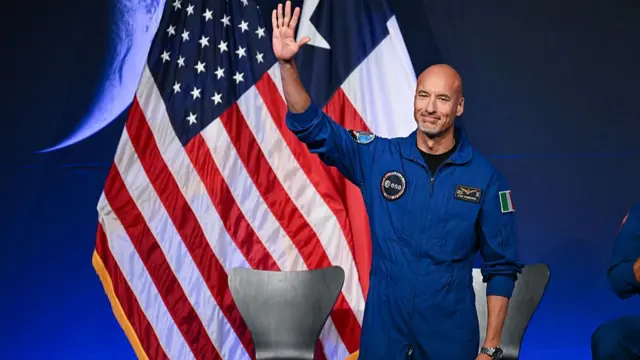
    Luca ParmintanoImage source, Getty Images

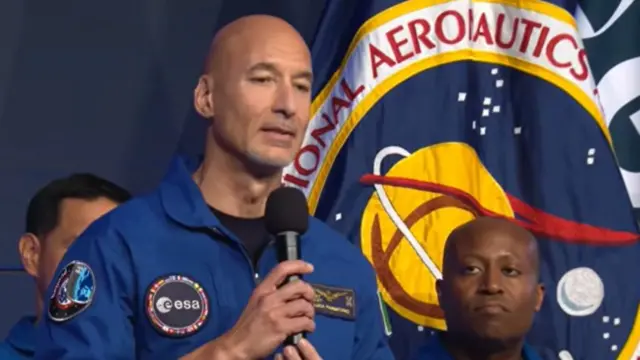
    Parmitano is the only non-American headed to space on the Artemis III mission.

    The Italian astronaut will represent the European Space Agency (ESA) after spending his career as a test pilot and colonel with the Italian Air Force.

    He has spent 366 days in space across two long-duration missions to the International Space Station, according to ESA.

    Among the things Parmitano is known for is a scary close-call he had in 2013.

    While on a spacewalk on 16 July 2013, Parmitano's helmet filled with water, nearly drowning him.

    The unexpected malfunction forced Nasa to abort the spacewalk in order to get him to safety.

    "[Parmitano's] calm demeanor in the face of his helmet filling with water possibly saved his life," members of the Mishap Investigation Board wrote in their report after the incident.

  3. Who is Artemis III crew member Andre Douglas?published at 18:08 BST

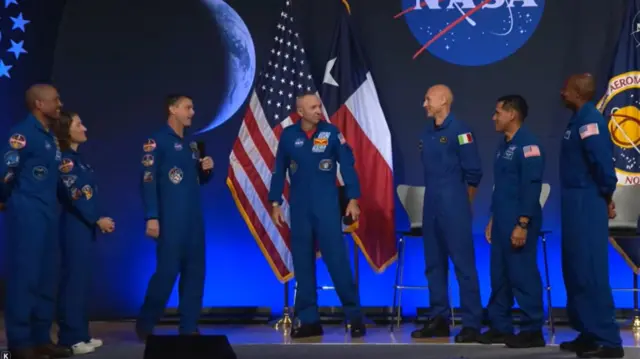
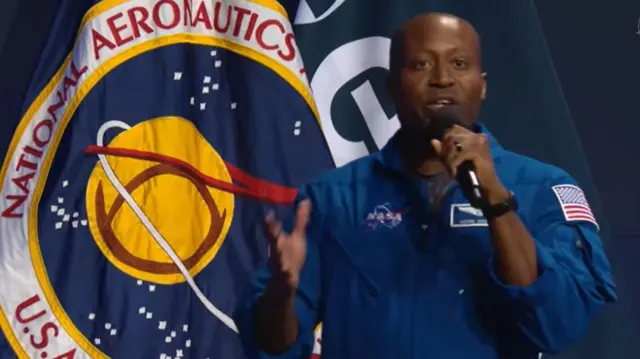
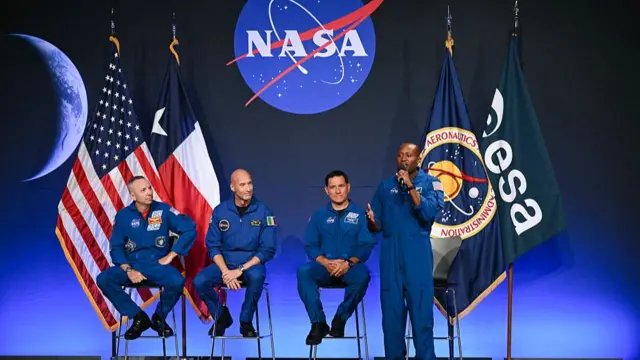
    Andre Douglas speaks on stage after being announced as the Artemis III mission specialistImage source, Getty Images
    Image caption,

    Andre Douglas pictured far right

    Andre Douglas - one of the four Artemis III crew members - will be making his first-ever space flight.

    He was given the role of mission specialist.

    Born in Florida but raised in Virginia, Douglas earned a bachelor's degree in mechanical engineering from the US Coast Guard Academy, then went on to earn three master's degrees, and a PhD in systems engineering.

    Douglas was invited by Nasa to join the 2021 Astronaut Candidate Class and reported for duty in January 2022.

    Part of his role was to identify lunar surface needs and recommend technology for development strategies.

    Douglas was among the most animated on stage on Tuesday, grabbing the baton presented by the Artemis II team - a symbolic passing of the torch - and pretending to run with it.

    He beamed with enthusiasm and gratitude.

    "My brain, it is going a mile a minute right now, but my heart, my heart, it is so warm, it is so full, and I can't thank everybody who's been along (on) my journey," he said.

    He thanked his mother, "for believing in me", his dad, "for the work ethic", and his "lovely wife" for her unwavering support.

  4. Who was the last person to set foot on the Moon?published at 18:00 BST

    Alison Francis
    Senior science journalist

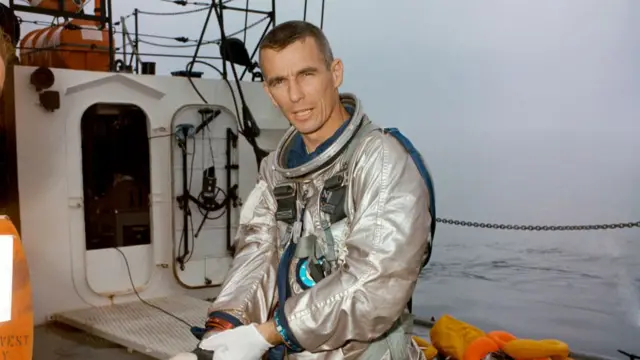
    Gene Cernan standing on deck of the NASA Motor Vessel RetrieverImage source, Getty Images
    Image caption,

    Gene Cernan

    The Artemis programme hopes to return human beings to the Moon - more than 50 years after we first set foot there.

    "As we leave the Moon… we leave as we came and, God willing, as we shall return, with peace and hope for all mankind. Godspeed the crew of Apollo 17."

    These were the words spoken in December 1972 by Commander Eugene "Gene" Cernan, the last astronaut to walk on the Moon, as he prepared to climb the ladder into the lunar module for the flight home.

    Cernan and his pilot Harrison Schmitt set several records during three days in the Taurus-Littrow valley: the longest stay on the Moon - 75 hours, the unofficial lunar rover speed record - 11.2 mph (18km/h), and the largest amount of rock-and-dust samples collected - 243.6lb (110.5kg), including some orange soil - small spheres of volcanic glass.

    Before leaving the Moon's surface, Cernan wrote his daughter Teresa Dawn Cernan's initials in the lunar dust. They're still there, undisturbed among the footprints and tyre tracks.

    Gene Cernan didn't know it would be more than 50 years before humans would make the journey back to the Moon. The next mission to land, scheduled for 2028, will be at a different location - the lunar South Pole.

  5. 'Pushing the boundaries of what's possible' - Johnson Space Center headpublished at 17:46 BST

    Vanessay WycheImage source, NASA

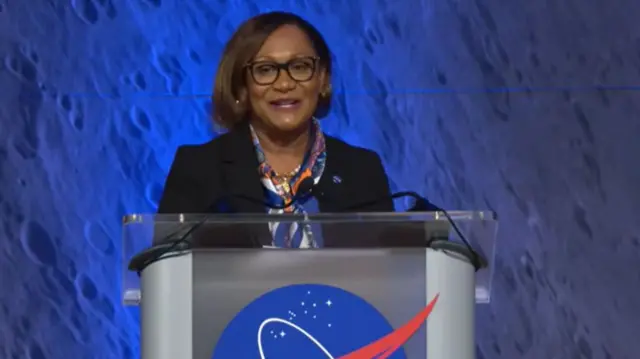
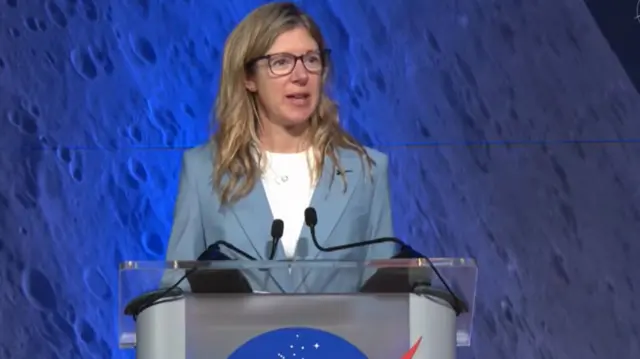
    Vanessa Wyche, director of Houston's Nasa Johnson Space Center, calls the newly announced Artemis III space crew forward to the front of the stage for a final round of applause.

    They stand cheerily, shoulder to shoulder, arms wrapped around one another, smiling upon the crowd.

    "As you prepare to embark on this next giant leap, know, we stand united, ready to support you at every turn with mission excellence, pushing the boundaries of what's possible for the benefit of all humanity," she says.

    And with that, the ceremony has concluded.

  6. US lawmakers praise Artemis missionpublished at 17:44 BST

    We are now hearing recorded messages from members of the US Congress.

    Up first is Texas Senator Ted Cruz, chairman off the Senate's Committee on Commerce, Science, and Transportation, who begins by congratulating the just named crew.

    "It is a big damn deal," he says. He says at a time of growing competition with China in space, "this mission will strengthen America's leadership, expand our economy, and help secure a lasting American lunar presence."

    "When America commits to a mission, we lead and we succeed," he adds.

    Representative Brian Babin of the US House Science, Space, and Technology Committee is up next.

    "Through your dedication, courage, and service, you will help open a new chapter in humanity's journey beyond Earth," he says. "Please know that you have the support of the American people," he says.

  7. Artemis II astronauts meet Artemis III crewpublished at 17:41 BST

    Three astronauts from the Artemis II crew, who flew around the Moon earlier this year, have now taken to the stage to express their congrats.

    Reid Wiseman, the commander of Artemis II, says the group wanted say how "fired up" they were for Artemis III and handed Bresnick, the next commander, the baton.

    "You've got the controls," he says as the crowd applauds.

    Bresnick says he is touched by the symbolism, telling the Artemis II crew that they "inspired people worldwide".

    Then there's a moment of laughter when Douglas holds up the baton.

    Bresnick says they're happy to be carrying the fire to the next mission

    Artemis II and Artemis III astronauts meetImage source, NASA
  8. ESA director general praises Italian astronaut Parmitano's role in Artemis IIIpublished at 17:35 BST

    Josef Aschbacher, director general of the European Space Agency (ESA), heaps praise on Italian crew member Luca Parmitano and the ESA's partnership with Nasa.

    "I had the privilege of witnessing the launch of Artemis II," he says. "It was an unforgettable moment. Artemis III will be a different mission, but no less remarkable."

    To the crew, he says: "You will take a system of extraordinary complexity and make it work as one. In many ways you are unlocking the lunar landing itself."

    He then lists Parmitano's achievements, including being a colonel of the Italian Air Force and the father of two daughters. He also survived a situation where his helmet filled with water, a situation which Aschbacher says will allow Parmitano to bring "a touch of Italian ease to the cockpit"

    "To Nasa, to the United States of America. Thank you for your leadership and thank you for your partnership," he says.

    "To the crew of Artemis III, you carry something important for all of us."

  9. Randy Bresnick will command Artemis IIIpublished at 17:34 BST

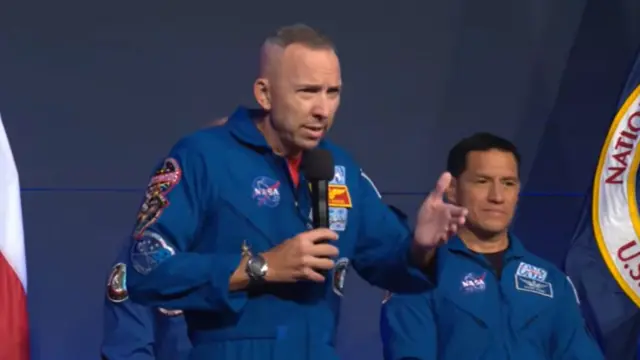
    Artemis III Commander Randy Bresnick tells the crowd that the most important Artemis mission will be the next Artemis mission.

    Bresnick, who has been with Nasa since 2004, will lead the Artemis III crew in their mission.

    Randy BresnikImage source, NASA
  10. Artemis III astronauts Rubio and Parmitano speak nextpublished at 17:29 BST

    Frank RubioImage source, NASA

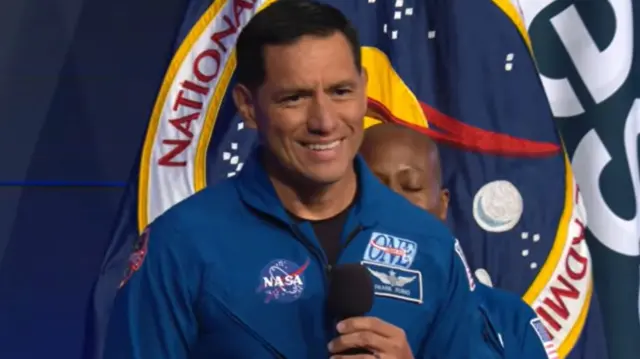
    Newly named Artemis III mission specialist Frank Rubio also thanks his wife, kids, friends, family, and the Nasa community.

    "You guys are the ones that make this happen, so thank you."

    Mission pilot Luca Parmitano, an Italian astronaut from the European Space Agency, takes the microphone next. He began by apologising in case he becomes emotional while speaking.

    "I am honoured by the role that I have been given," he says. "I am also very humbled by the task in front of us."

    He praises his Italian education and opportunities he received from the Italian air force, space agency and the European Space Agency that have helped him reach this milestone.

    Luca ParmitanoImage source, NASA
  11. Artemis III mission specialist Andre Douglas thanks familypublished at 17:21 BST

    Andre DouglasImage source, NASA

    Mission specialist Andre Douglas is the first of the astronauts up to speak.

    "My heart, it is so warm, it is so full," he says.

    He continues by thanking his parents and his wife, Rachel.

    "Mum, thank you so much for believing in me," he says before praising his father's work ethic.

    For his wife, he says: "I am so glad you are on this journey with us."

  12. Artemis III to be one of Nasa's most complex - director of flight operationspublished at 17:20 BST

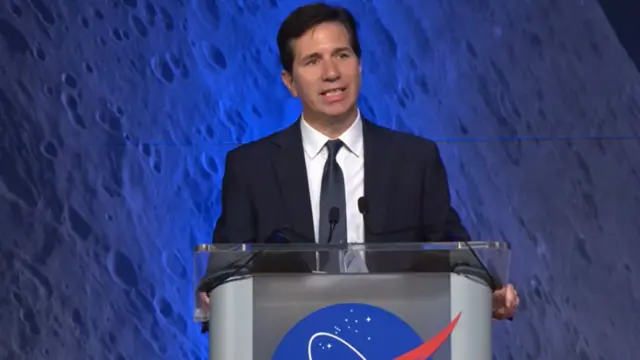
    Norman D Knight, Nasa's director of flight operations, speaks after the Artemis III crew has just been announced.

    "I am excited to welcome you as the next crew in the Artemis journey to successfully return to the Moon," he says.

    "This mission will be one of the most complex that Nasa has undertaken, and we are counting on your courage and your dedication in fulfilling this critical role.".

    Knight also thanks the crew members' families who "allow us to accomplish these ambitious goals for our country and humanity".

  13. More Artemis III crew member infopublished at 17:16 BST

    Here's some more information about the crew members:

    • Bob Heintz will serve as a backup crew member. He is a test pilot who logged 170 days in space and can step into any role needed on the mission.
    • Andre Douglas will be one of two mission specialists for the mission.
    • Frank Rubio will be the second mission specialist.
    • Luca Parmitano, of the Italian Space Agency, will be the pilot of Artemis III. He's spent more than 300 days in space.
    • Randy Bresnik, a Nasa astronaut, will serve as the mission's commander.
  14. Here is the crew for Artemis IIIpublished at 17:11 BST
    Breaking

    Artemis III astronautsImage source, NASA
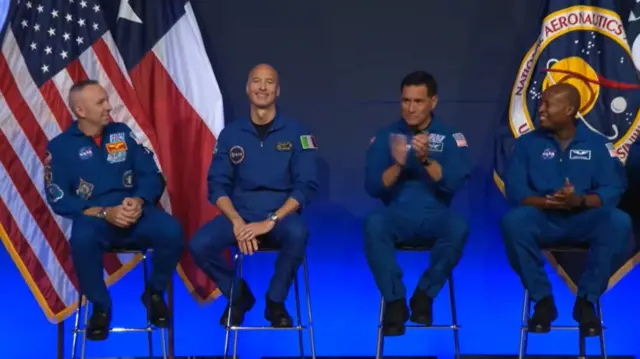
    • Andre Douglas, mission specialist
    • Frank Rubio, mission specialist
    • Luca Parmitano, pilot
    • Randy Bresnik, commander
  15. SpaceX building three new launch padspublished at 17:03 BST

    Jessica JensenImage source, NASA

    Jessica Jensen, vice president at SpaceX, outlines the company's growth plans, saying several ships and boosters are currently being built as the Artemis program works toward putting people on the Moon via partnerships between Nasa and private companies.

    "We are actively building out three more Starship launch pads in Florida and Texas," she continues.

    "We believe this... is going to lead to unprecedented launch rates and achieving aircraft-like operations, which has always been our goal."

  16. Blue Origin says it's redoubling efforts for Moon landing after explosion last monthpublished at 17:00 BST

    John CoulurisImage source, NASA

    John Couluris, a vice president at Blue Origin, tells the crowd that Artemis III is a major step toward a Moon landing.

    He says that Nasa and Blue Origin are working around the clock to be ready for launch in 2027.

    Blue Origin, Couluris says, is very motivated to make the landing work, and despite a rocket blowing up on a Blue Origin launchpad recently, they have redoubled their efforts and are moving forward.

  17. Artemis III mission will last about two weekspublished at 16:56 BST

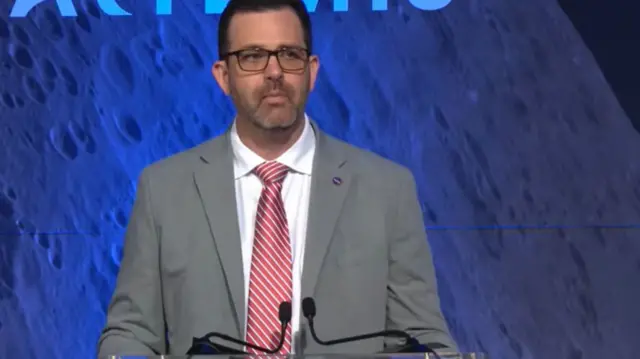
    Parsons, from Nasa's Moon to Mars Program Office, is giving an overview of the Artemis III mission.

    It will involve four crew members who will launch into low Earth orbit from the Kennedy Space Center in Florida. After their mission, they will splash down in the Pacific Ocean where they will be recovered by the a team from the US navy and Nasa.

    "In total, we expect the mission to last around two weeks," he says. "This mission is deliberately designed to take calculated risks so that future crews will be safer and ultimately successful when we put boots on the lunar surface."

  18. Artemis III to test power, navigation, communications and other systemspublished at 16:52 BST

    Parsons says this Artemis III test flight is meant to prove that Nasa can carry out "highly core" operations with its partners.

    The mission is also meant to "reduce risk for our future crewed Moon missions", he says, "to ensure we will beat China back to the Moon".

    "We will experiment with power, navigation, surface mobility, communications, and other critical systems as we learn what does and does not work in the extreme environment," he says.

  19. Nasa applauds Artemis II's accomplishmentspublished at 16:47 BST

    Issacman concludes his remarks by saying the astronauts are carrying forward the hopes and dreams of the next generation.

    "Artemis III crew, we wish you godspeed on the journey ahead," he says, "you carry the fire ...and the dreams of millions."

    Jeremy Parsons then takes the stage to applaud the accomplishments of Artemis II, noting that Nasa demonstrated it could orbit the Moon and return astronauts safely to Earth.

    He says this is why Nasa conducts test flights: to learn how to improve the Orion spacecraft.

    This test flight, Parsons says, will prove Nasa can launch in sequence with its partners.

    Jeremy ParsonsImage source, NASA
  20. Nasa can do multiple things at once, says chiefpublished at 16:45 BST

    Isaacman is still at the podium. He says Nasa will not slow down and will be embarking on several projects simultaneousnessly.

    The expectation of Nasa should be that we can do multiple things at once, he says, adding that Nasa will experiment as it learns what does and does not work for future missions.

    "We can do this all while the Artemis III crew prepare for and undertake their important mission."