Summary

  1. Artemis III mission specialist Andre Douglas thanks familypublished at 17:21 BST
    Andre DouglasImage source, NASA

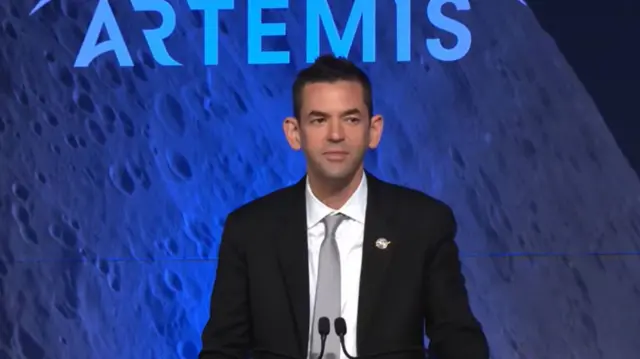
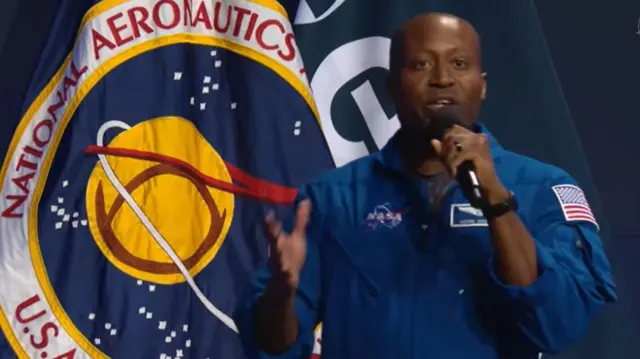
    Mission specialist Andre Douglas is the first of the astronauts up to speak.

    "My heart, it is so warm, it is so full," he says.

    He continues by thanking his parents and his wife, Rachel.

    "Mum, thank you so much for believing in me," he says before praising his father's work ethic.

    For his wife, he says: "I am so glad you are on this journey with us."
  2. Artemis III to be one of Nasa's most complex - director of flight operationspublished at 17:20 BST

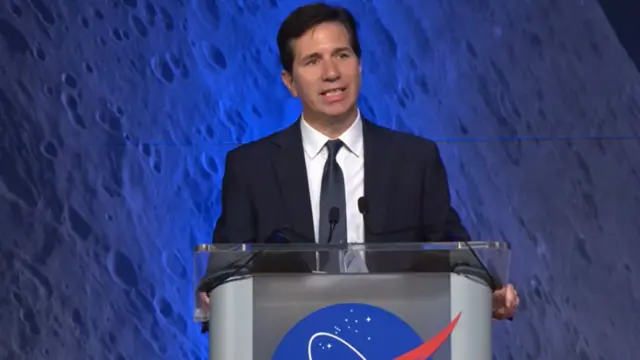
    Norman D Knight, Nasa's director of flight operations, speaks after the Artemis III crew has just been announced.

    "I am excited to welcome you as the next crew in the Artemis journey to successfully return to the Moon," he says.

    "This mission will be one of the most complex that Nasa has undertaken, and we are counting on your courage and your dedication in fulfilling this critical role.".

    Knight also thanks the crew members' families who "allow us to accomplish these ambitious goals for our country and humanity".

  3. More Artemis III crew member infopublished at 17:16 BST

    Here's some more information about the crew members:

    • Bob Heintz will serve as a backup crew member. He is a test pilot who logged 170 days in space and can step into any role needed on the mission.
    • Andre Douglas will be one of two mission specialists for the mission.
    • Frank Rubio will be the second mission specialist.
    • Luca Parmitano, of the Italian Space Agency, will be the pilot of Artemis III. He's spent more than 300 days in space.
    • Randy Bresnik, a Nasa astronaut, will serve as the mission's commander.
  4. Here is the crew for Artemis IIIpublished at 17:11 BST
    Breaking

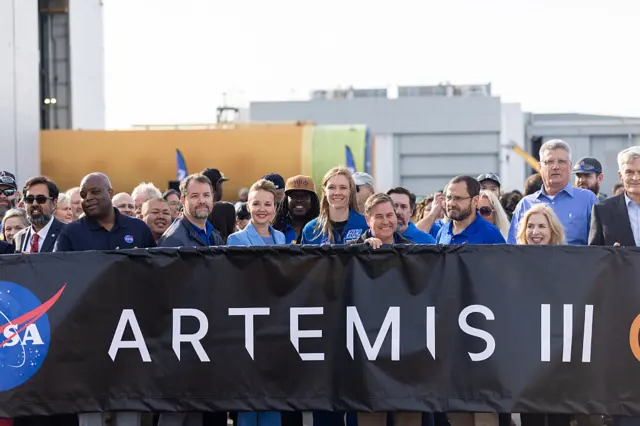
    Artemis III astronautsImage source, NASA
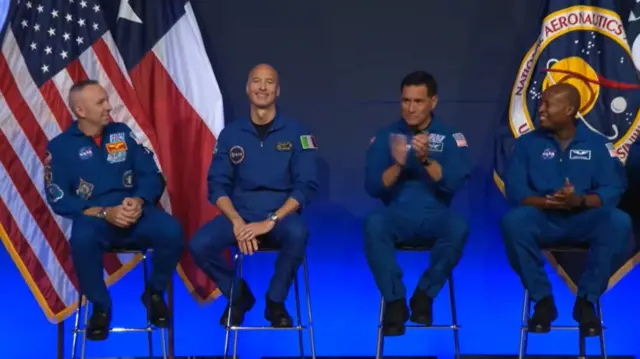
    • Andre Douglas, mission specialist
    • Frank Rubio, mission specialist
    • Luca Parmitano, pilot
    • Randy Bresnik, commander
  5. SpaceX building three new launch padspublished at 17:03 BST

    Jessica JensenImage source, NASA

    Jessica Jensen, vice president at SpaceX, outlines the company's growth plans, saying several ships and boosters are currently being built as the Artemis program works toward putting people on the Moon via partnerships between Nasa and private companies.

    "We are actively building out three more Starship launch pads in Florida and Texas," she continues.

    "We believe this, combined with fuel re-usability, is going to lead to unprecedented launch rates and achieving aircraft-like operations, which has always been our goal."

  6. Blue Origin says it's redoubling efforts for Moon landing after explosion last monthpublished at 17:00 BST

    John CoulurisImage source, NASA

    John Couluris, a vice president at Blue Origin, tells the crowd that Artemis III is a major step toward a Moon landing.

    He says that Nasa and Blue Origin are working around the clock to be ready for launch in 2027.

    Blue Origin, Couluris says, is very motivated to make the landing work, and despite a rocket blowing up on a Blue Origin launchpad recently, they have redoubled their efforts and are moving forward.

  7. Artemis III mission will last about two weekspublished at 16:56 BST

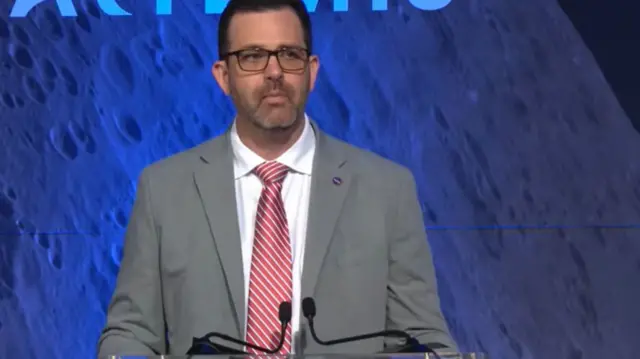
    Parsons, from Nasa's Moon to Mars Program Office, is giving an overview of the Artemis III mission.

    It will involve four crew members who will launch into low Earth orbit from the Kennedy Space Center in Florida. After their mission, they will splash down in the Pacific Ocean where they will be recovered by the a team from the US navy and Nasa.

    "In total, we expect the mission to last around two weeks," he says. "This mission is deliberately designed to take calculated risks so that future crews will be safer and ultimately successful when we put boots on the lunar surface."

  8. Artemis III to test power, navigation, communications and other systemspublished at 16:52 BST

    Parsons says this Artemis III test flight is meant to prove that Nasa can carry out "highly core" operations with its partners.

    The mission is also meant to "reduce risk for our future crewed Moon missions", he says, "to ensure we will beat China back to the Moon".

    "We will experiment with power, navigation, surface mobility, communications, and other critical systems as we learn what does and does not work in the extreme environment," he says.

  9. Nasa applauds Artemis II's accomplishmentspublished at 16:47 BST

    Issacman concludes his remarks by saying the astronauts are carrying forward the hopes and dreams of the next generation.

    "Artemis III crew, we wish you godspeed on the journey ahead," he says, "you carry the fire ...and the dreams of millions."

    Jeremy Parsons then takes the stage to applaud the accomplishments of Artemis II, noting that Nasa demonstrated it could orbit the Moon and return astronauts safely to Earth.

    He says this is why Nasa conducts test flights: to learn how to improve the Orion spacecraft.

    This test flight, Parsons says, will prove Nasa can launch in sequence with its partners.

    Jeremy ParsonsImage source, NASA
  10. Nasa can do multiple things at once, says chiefpublished at 16:45 BST

    Isaacman is still at the podium. He says Nasa will not slow down and will be embarking on several projects simultaneousnessly.

    The expectation of Nasa should be that we can do multiple things at once, he says, adding that Nasa will experiment as it learns what does and does not work for future missions.

    "We can do this all while the Artemis III crew prepare for and undertake their important mission."

  11. 'The beginning of the future' - Nasa's Isaacmanpublished at 16:40 BST

    Isaacman says the Artemis III crew will launch into lower orbit to test the Orion spacecraft.

    "They will rendezvous and dock with the Blue Origin lander, and then again with the SpaceX lander," Isaacman says.

    "This seems like the beginning of the future that we imagine as children. This seems like the very beginning of Earth's first Starfleet to me."

    The public will be able to follow along, he says, through all the "key milestones", as they test their reusable rockets, gather data, and implement improvements, "no earlier than this time next year".

  12. 'We are returning to the Moon' - Nasa administratorpublished at 16:39 BST

    Jared IsaacmanImage source, NASA

    Jared Isaacman tells the audience that Nasa will announce four astronauts who will head to space next.

    He thanks US President Donald Trump and international partners for their work on the effort to return to space.

    "We are returning to the moon," Isaacman says, to build a Moon base undertaking an "inspiring endeavor".

    Artemis II "showed us the Moon again," he says, noting that the second Artemis mission helped reinvigorate the world's interest in space exploration.

    Nasa is now passing the torch to Artemis III, Isaacman says.

  13. Nasa crew announcement to begin soonpublished at 16:32 BST

    Nasa's announcement of the Artemis III crew is about start any moment, from the Johnson Space Center in Texas.

    As a reminder, the US space agency will name four individuals who will be part of a team to explore low Earth orbit next year.

    Stay with us - we'll bring you the updates here or you can click watch live at the top of this page.

  14. How the Artemis III mission has changedpublished at 16:30 BST

    Pallab Ghosh
    Science correspondent

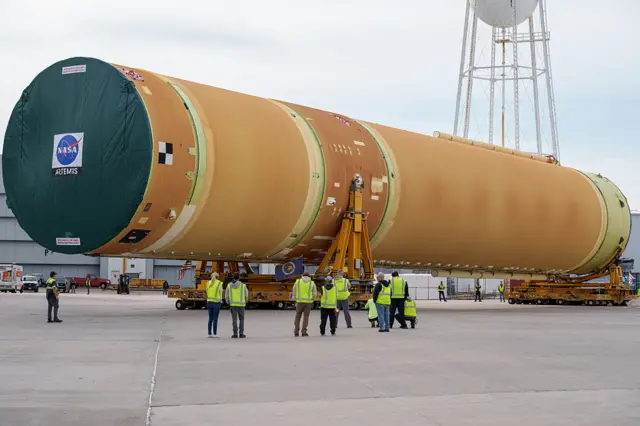
    One of the components of the Artemis III at a launch facility in New Orleans in AprilImage source, Getty Images

    When Nasa names the four astronauts for Artemis III in a few minutes, they will not be the next people to walk on the Moon.

    Artemis is the programme meant to put astronauts back on the lunar surface for the first time since Apollo 17 in 1972, and eventually to keep them there. Artemis I sent an empty Orion capsule around the Moon in 2022. Artemis II flew four astronauts on a lunar flyby in April. Artemis III was supposed to be the one to land two crew on the lunar surface, near the south pole, for about a week.

    But in February, Nasa’s boss Jared Isaacman changed the plan – it was too giant a leap for Nasa to go from looping around the Moon to landing on it. Instead, Isaacman announced an intermediate mission with crew to test docking with a lunar lander in low Earth orbit.

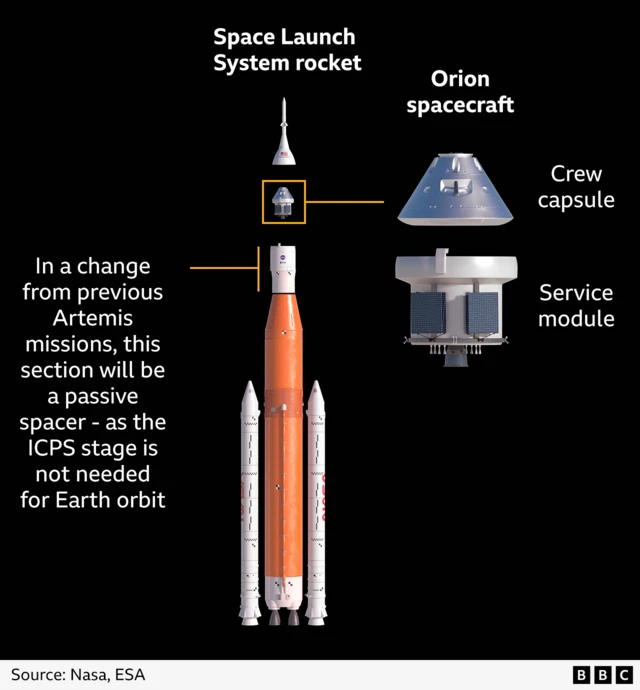
    That is due to happen about 290 miles into space, roughly the distance from Manchester to Edinburgh and barely above the International Space Station. There, astronauts in the Orion capsule will rendezvous and dock with prototype lunar landers from SpaceX and Blue Origin.

    But there are a couple of hitches: Blue Origin’s launch pad was blown up during a failed rocket test two weeks ago and SpaceX’s lander is months behind schedule. Oh, and the Artemis III mission is slated for launch around this time next year.

    A graphic explaining the various parts of the Space Rocket Launch System
  15. What other countries are planning lunar missions?published at 16:13 BST

    Kwasi Gyamfi Asiedu
    Live reporter

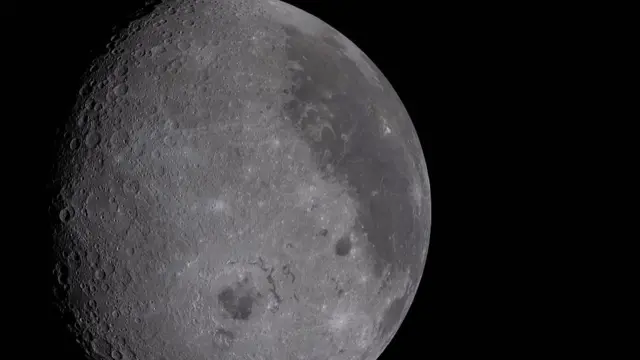
    On the first shift during the lunar flyby observation period, the Artemis II crew captured more than two-thirds of the Moon showcasing the intricate features of the nearside.Image source, NASA via Getty Images

    While the US wants to send humans to the Moon in 2028 and to build a base there, it is not the only nation with lunar ambitions.

    Nasa's Artemis missions are in fierce competition with the Chinese space agency, which also plans to send taikonauts - Chinese astronauts - to the Moon by 2030. Recent equipment and technical failures in the US could push the two timelines even closer.

    The competition is similar to the 20th Century Space Race between the US and the Soviet Union. In 1969, the US was first to land humans on the Moon, though the USSR had been first to send a human into space, in 1961.

    Although Russia's space ambitions have fallen behind, it is not out of the quest. It has signed a deal with China to create a lunar power station by 2036.

    India has already sent uncrewed missions to the Moon and plans to land humans there in 2040.

  16. Analysis

    Is the 2028 Moon landing achievable?published at 16:05 BST

    Pallab Ghosh
    Science correspondent

    The half-illuminated Moon is seen from the Artemis II mission in the foreground, with the crescent Earth visible in the backgroundImage source, NASA
    Image caption,

    The half-illuminated Moon is seen from the Artemis II mission in the foreground, with the crescent Earth visible in the background

    Yes, according to Nasa. Probably not, according to everyone else.

    The official Nasa line is that American astronauts will be back on the Moon by 2028 and that "initial base elements" will be in place by 2030. China is targeting a crewed landing of its own by 2030. The race is real, and the Americans want to win it.

    Whether they can is a different question. But there is a large gulf between Nasa's claims and the actual state of the rockets it will need. The lander that is supposed to take astronauts down to the surface – SpaceX's Starship – is too heavy to reach the Moon on a single tank. To get there, it must be refuelled in orbit by a fleet of roughly ten tanker Starships, transferring cryogenic methane and oxygen between docked spacecraft. Nobody has ever done this. The first demonstration is, optimistically, late this year. In March, Congress's own auditors said SpaceX had made only "limited progress" on the technology. Then Blue Origin's pad blew up.

    For the first crewed landing – now Artemis IV in early 2028 – every one of those things has to work, in sequence, for the first time, on a schedule with no slack.

    Most independent experts I speak to think 2028 is heroic. Dr Simeon Barber, a lunar scientist at The Open University, put it more bluntly when we talked last month. "It would not surprise me at all if China gets there first." 2028 is also President Trump's last full year in office.

  17. The explosion that might have blown up Nasa’s Moon planspublished at 15:55 BST

    Pallab Ghosh
    Science correspondent

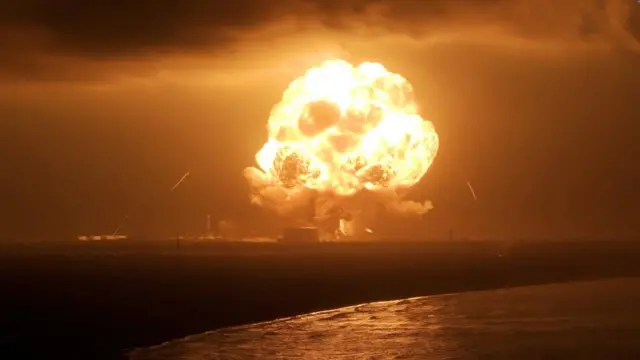
    Fire during an explosion of the uncrewed Blue Origin's New Glenn rocket during a test on a launchpad in Cape Canaveral, Florida, U.S., May 28, 2026,Image source, Reuters

    Ten days ago, on a quiet Thursday evening at Cape Canaveral, Blue Origin fired the engines of a New Glenn rocket bolted to the pad at Launch Complex 36. It was supposed to be a routine hot-fire test.

    But seconds after ignition, the rocket exploded. No one was hurt. The pad was extensively damaged.

    LC-36 is the only launch pad in the world built to handle New Glenn. Until it is rebuilt and re-certified, Blue Origin's biggest rocket cannot fly. When SpaceX lost a pad to an explosion in 2016, it took fifteen months to get back to launching – and SpaceX had other pads to fall back on. Blue Origin does not.

    And that matters for Nasa’s Moon plans. Blue Origin's uncrewed Blue Moon cargo lander, Endurance, was supposed to fly to the lunar south pole in the autumn to begin laying the groundwork for a lunar base. Its crewed lander is contracted to carry astronauts down to the surface on Artemis V in late 2028. And the prototype Blue Moon was meant to be one of the two landers Artemis III docks with next year.

    Right now, there is no obvious way to get it into orbit.

  18. What is the purpose of the Artemis programme and its third mission?published at 15:42 BST

    New Orleans Mayor Helena Moreno and NASA Astronaut Nichole Ayers pose for a group photoImage source, Getty Images

    The Artemis programme is Nasa's bold plan to return humans to the Moon.

    The mission isn't new to Nasa - the US space agency first sent humans to the lunar surface almost 57 years ago. This time around, Nasa wants crew to explore different parts of the Moon and make new discoveries. Perhaps most ambitiously, the agency wants to build a base on the Moon as a step towards its first human mission to Mars.

    Artemis III will launch four astronauts into Earth's low orbit next year, and one of its key aims is to practice docking using equipment from private partners SpaceX and Blue Origin. Using what they learn from this mission, Nasa will work towards landing humans on Moon during the Artemis IV mission in 2028.

  19. Nasa to announce Artemis III crewpublished at 15:38 BST

    Kwasi Gyamfi Asiedu
    Live reporter

    Welcome to our live coverage of Nasa's announcement of its Artemis III crew.

    The mission is set to launch in 2027 from the Kennedy Space Center in Florida. While it will not land on the Moon, it is critical to Nasa's lunar ambitions.

    The space agency wants to return humans to the Moon's surface in 2028 for about a week, and this mission will bring it one giant leap closer to that goal.

    In a short while, we will find out which astronauts Nasa chose to embark on this precursor journey. The announcement will begin at 1130 EDT (1630BST, 1530GMT).

    If Nasa officials take questions from journalists, they will undoubtedly be quizzed about the timeline for this mission, given the explosion last month of a Blue Origin rocket. Artemis III has been scheduled to include testing with spacecraft from Blue Origin as well as SpaceX.

    Stay with us as we bring you more on this announcement.