Summary

  1. 'He is not very experienced. Why not someone better placed?'published at 12:57 BST

    Screenshot of Media Q and A, full text in post below

    Let's go back now to the newly-released files.

    One of the documents is a "Media Q&A for Duke of York role announcement", seemingly written by British Trade International about Mountbatten-Windsor's appointment as trade envoy.

    The document has 24 questions and answers, preparing officials for media enquiries.

    It says no one else was approached for the trade envoy role, and there was no time limit for his appointment, as "the role is open-ended".

    Question eight is: "But he is not very experienced. Why not someone better placed?"

    The suggested answer is: "The importance of the Duke's involvement lies in the high profile and commitment he is ableto give to this work as a Member of the Royal Family.

    "It is a continuation of the Royal Family's involvement in trade and investment promotion following HRH The Duke of Kent's decision to relinquish his duties last April. The Duke will bring valuable support and visibility to British Trade International's activities at home and overseas."

    If asked whether Andrew would be paid for the role, the answer was "no".

    The BTI says it would pay for his travel and related expenses, including those of his supporting staff, but not for his personal protection officer - as they were funded by the Met Police.
  2. No evidence of formal vetting process in Andrew's appointment, minister says nowpublished at 12:32 BST

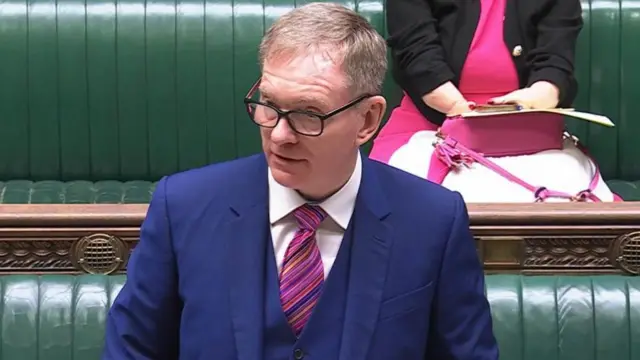
    Chris Bryant, speaking in the Commons in FebruaryImage source, UK Parliament
    Image caption,

    Chris Bryant, speaking in the Commons in February

    A written statement has been released by Trade Minister Chris Bryant to accompany the release of these documents.

    In it, the minister says: "We have found no evidence that a formal due diligence or vetting process was undertaken.

    "There is also no evidence that this was considered.

    "This is understandable since this new appointment was a continuation of the Royal Family's involvement in trade and investment promotion work following the Duke of Kent's decision to relinquish his duties as Vice-Chairman of the Overseas Trade Board."

    Bryant says the government is "co-operating fully" with Thames Valley Police's investigation into Andrew Mountbatten-Windsor.

  3. Why are the files being released now?published at 12:25 BST

    The government agreed to publish the files on Andrew Mountbatten-Windsor's appointment after the Liberal Democrats used a mechanism known as a humble address back in February, after the former prince's arrest.

    The government supported the motion, with Trade Minister Chris Bryant describing Andrew as "rude, arrogant and entitled" and saying the government would comply with the motion "as fast as we possibly can".

    Eleven documents have now been published showing "how the role was created and Andrew Mountbatten-Windsor was appointed".

    In a written statement to Parliament, Bryant says the government has found "no evidence" that a formal vetting process was carried out before Mountbatten-Windsor's appointment - more on that in our next post.

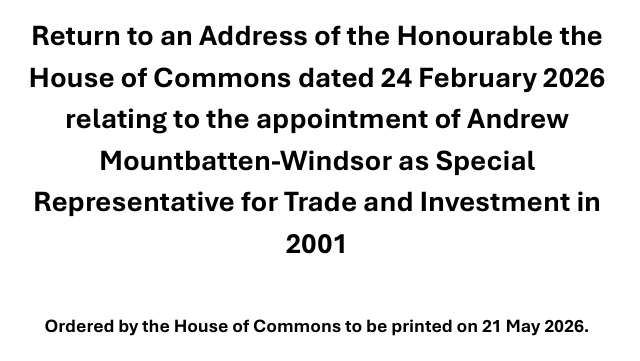
    How the files are presented on the government's website - full text to follow
    Image caption,

    How the files are presented on the government's website

  4. 'There was a mutual agreement with the Palace'published at 12:24 BST

    Earlier, we reported that Queen Elizabeth was "very keen" for Andrew to take a "prominent role in the promotion of national interests".

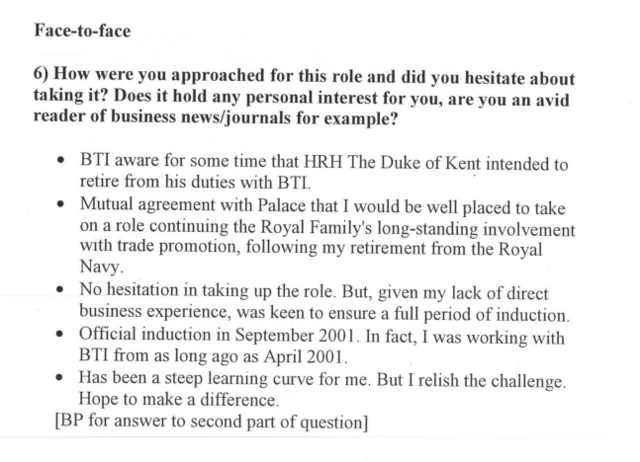
    One of the other documents in today's files is a briefing for Prince Andrew (as he was) before an interview with the Times in 2001.

    His team suggest Andrew emphasises a "mutual agreement" with "the Palace" about taking on the role.

    Mountbatten-Windsor was also told to say there was "no hesitation in taking up the role," but given his "lack of direct business experience" he was keen to "ensure a full period of induction".

    "Has been a steep learning curve for me," said a suggested answer. "But I relish the challenge. Hope to make a difference."

    File including questions from The Times and the answers Andrew Mountbatten-Windsor was instructed to giveImage source, UK Government
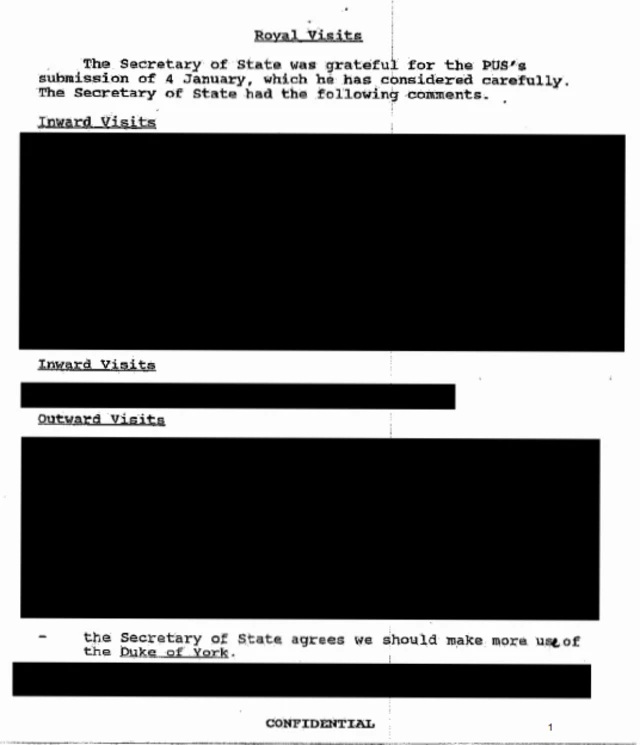
  5. Some of the files have long redactionspublished at 12:11 BST

    Some of the pages published have heavy redactions.

    Trade Minister Chris Bryant says this is to remove the "bare minimum" of personal information and information that would prejudice international relations.

    He says the police have been consulted to avoid prejudicing their investigation into Andrew Mountbatten-Windsor.

    And, he says, external, "we have also considered carefully the redaction of information relating to royal communications, mindful of the longstanding convention of confidentiality, which is codified under the Freedom of Information Act".

    "I can assure the House that we have proceeded on the basis of the maximum transparency," he adds.

    Screenshot showing an example of heavy redactions on one of the pages published in the Andrew filesImage source, Department for Business and Trade
  6. Andrew preferred to visit 'sophisticated countries', letter sayspublished at 11:51 BST
    Breaking

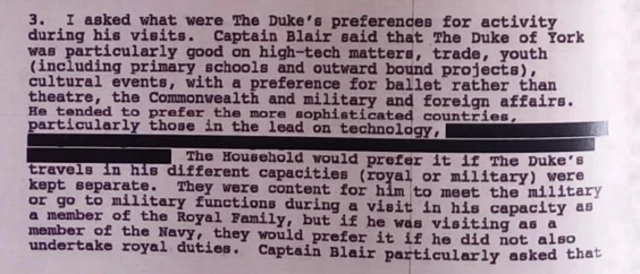
    Mountbatten-Windsor had a preference for visiting "the more sophisticated countries", and "should not be offered golfing functions abroad", according to a letter released as part of the documents.

    The letter is dated 25 January 2000 and is written by British diplomat Kathryn Colvin, though it is not clear who the letter was for.

    It includes notes from a meeting she had held with Mountbatten-Windsor's then-private secretary Captain Neil Blair.

    Colvin writes she was told that Prince Andrew was "particularly good on high-tech matters, trade, youth (including primary schools and outward bound projects), cultural events, with a preference for ballet rather than theatre, the Commonwealth and military and foreign affairs".

    Captain Blair, according to the letter, said Mountbatten-Windsor "tended to prefer the more sophisticated countries, particularly those in the lead on technology", Colvin added. A line after that is redacted in the released document.

    She continued: "Captain Blair particularly asked that The Duke of York should not be offered golfing functions abroad. This was a private activity and if he took his clubs with him he would not play in any public sense."

    • In a statement, the government says it has redacted documents "to remove the bare minimum of personal information and information whose release would prejudice international relations".
    An extract of the letter, as quoted above
    Image caption,

    An extract of the letter as it appears in the documents

  7. Wright's memo came after meeting with Queen's private secretarypublished at 11:46 BST

    The memo from David Wright, chief executive of British Trade International, was written on 25 February 2000.

    He says he wrote it after a "wide ranging conversation with The Queen's Private Secretary on Wednesday 23 February".

    "This covered a number of issues relating to the involvement of The Royal Family in trade promotion," he writes.

    After saying the Queen's "wish" was for Andrew to take the role, he says Andrew could carry out "two or three specifically targeted trade promotion visits in overseas markets each year".

    "We would want the Duke of York to be available to receive prominent trade visitors from overseas here in London and perhaps to act as host at meals or receptions as appropriate."

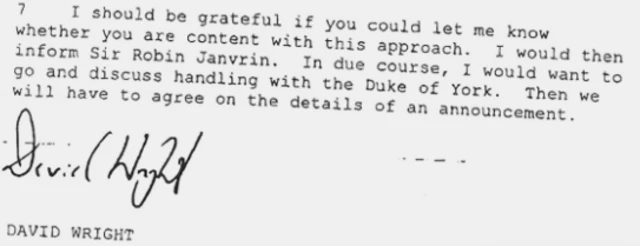
    should be grateful if you could let me know PAGE.02 But he was whether you are content with this approach. I would then inform Sir Robin Janvrin. In due course, I would want to go and discuss handling with the Duke of York. Then we will have to agree on the details of an announcement.
    Image caption,

    The memo, signed by David Wright

  8. Queen Elizabeth was 'very keen' on Andrew's appointment, memo showspublished at 11:22 BST
    Breaking

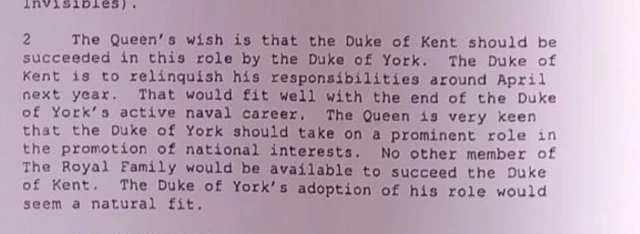
    The Queen was "very keen" for Andrew Mountbatten-Windsor to take on a "prominent role in the promotion of national interests", then-chief executive of British Trade International Sir David Wright said in a memo to then-foreign secretary Robin Cook dated February 2000.

    We'll have more on this line shortly.

    A screenshot from dopcument
    Image caption,

    A line from David Wright's memo

  9. Files related to Andrew Mountbatten-Windsor’s appointment as trade envoy in 2001 releasedpublished at 11:08 BST
    Breaking

    Andrew Mountbatten-Windsor - then Prince Andrew - became the UK’s special representative for international trade and investment in 2001 but stepped down 10 years later.

    Ministers agreed in February to publish documents related to his appointment to the post.

    We are going through the documents now, and will bring you all the key lines on this page.