Summary

  1. US says offensive stage of war is over, as questions linger over 'Operation Freedom'published at 23:23 BST 5 May

    Adam Goldsmith
    Live reporter

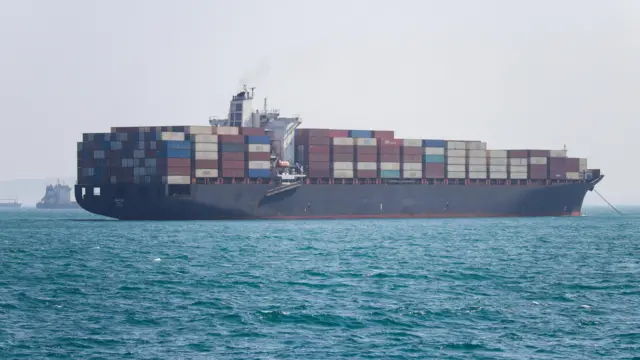
    A cargo vessel in the Strait of HormuzImage source, ISNA/Wana/Reuters

    Now into its second full day, there is little further clarity on just how effective US President Donald Trump's "Project Freedom" will be in freeing up the flow of traffic in the Strait of Hormuz.

    On a day when Trump and three officials from his US administration addressed reporters, Trump's team made clear that the new scheme is a defensive operation - and the onus is on Iran to come to the negotiating table.

    Meanwhile, Iran insists that it will take "decisive action" against ships that do not use the regime-approved route through the strait.

    And its top negotiator has accused the US of jeopardising shipping security with its own blockade of Iranian ports, saying the "continuation of the status quo is intolerable for America".

    While US Secretary of State Marco Rubio was speaking to the media, reports emerged from the UK Maritime Trade Operations (UKMTO) that a cargo vessel had been "struck by an unknown projectile".

    Away from the crucial waterway, rare missile alert warnings in the UAE are a sign of how quickly plans can change, our Dubai-based reporter writes.

    We're about to close our live page, but for more on this story you can read our international editor's piece - that says the Strait of Hormuz standoff raises the risk of sliding back into all-out war.

  2. Fuel prices keep rising, with US driving season around the cornerpublished at 23:18 BST 5 May

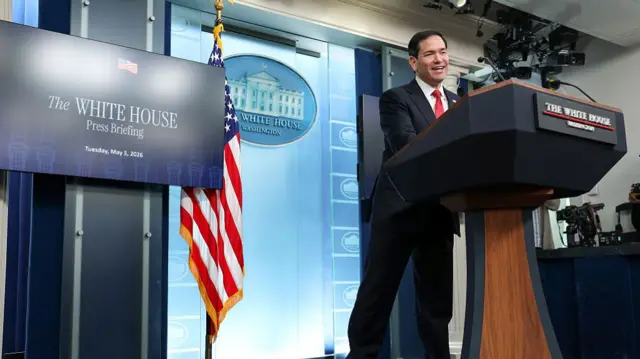
    As US Secretary of State Marco Rubio announced the offensive state of the war in Iran is over, the average price of a gallon of petrol in the US reached $4.483 (£3.31) on Tuesday, according to AAA, the industry group for auto travel.

    Prices are even higher in car-reliant western states like California ($6.131) and Washington ($5.705). States on the West Coast have major ports where goods are loaded onto trucks that drive into the heart of the country, and any added trucking costs could be passed on to shoppers..

    The lowest prices are in southern states where US oil refining is concentrated, like Texas ($3.981) and Louisiana ($3.923), and their Midwestern neighbours.

    Summer driving season is right around the corner, when many Americans take advantage of the longer days and warmer weather and embark on road trips to beaches and other attractions. Prices at the gas pump typically rise during the summer, which could add to the stress the war is already putting on drivers' wallets.

    Even though gas prices are up about 50% since the war began, they are still below AAA's highest recorded average - $5.016 a gallon in June 2022.

  3. Captain of stranded ship in Strait of Hormuz tells BBC of 'pressure'published at 22:32 BST 5 May

    Media caption,

    Watch: Captain of stranded ship in Strait of Hormuz tells BBC of 'pressure'

    The captain of a ship stranded in the Strait of Hormuz has told the BBC what it is like to be caught up in the power struggle between the US and Iran for the strategically important Strait of Hormuz.

    Captain Raman Kapoor says he and his crew contend with "mental not material pressure" as their stranded vessel is assailed by "hundreds" of missiles and the sound of explosions.

  4. Analysis

    World watching dangerous seesaw that could tip Middle East back into warpublished at 21:58 BST 5 May

    Sebastian Usher
    Middle East reporter

    The confrontation between the US and Iran continues to be a waiting game for now, although increasingly punctuated by limited military confrontations.

    Washington is hoping that its latest move to try to loosen Tehran's grip on the Strait of Hormuz pays off, with stranded merchant vessels feeling confident enough to brave the waterway once again. That hasn't happened so far.

    Iran's Gulf neighbours are nervously observing the missiles fired at the UAE again, fearful that it could build into a new and more threatening barrage.

    Top US Gen Dan Caine has said Iran's attacks don't amount to a breach of the ceasefire.

    The world's gaze remains fixed on the dangerous seesaw of events that could still tip back into all out war.

  5. Five things we heard from the US secretary of state's White House briefingpublished at 21:38 BST 5 May

    Adam Goldsmith
    Live reporter

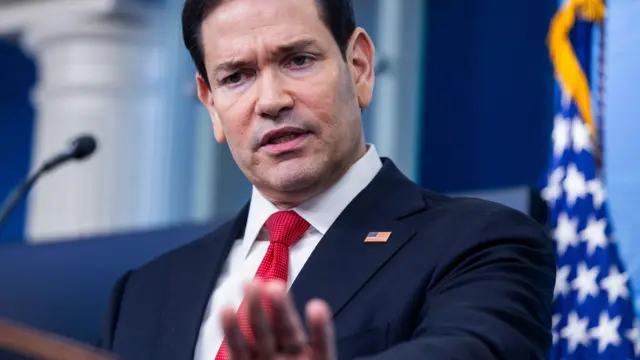
    Marco Rubio at a podiumImage source, Getty Images

    US Secretary of State Marco Rubio finished his White House briefing a short while ago. Here are some of the key things he said:

    • Stranded vessels in the Strait of Hormuz have been "left for dead" by the Iranian regime, Rubio said
    • The US secretary of state insisted that no country can be allowed to control an international waterway, which is why President Trump launched "Operation Freedom"
    • Rubio said that the US joint offensive with Israel - Operation Epic Fury - is now complete, and said Trump would prefer to meet Iran at the negotiating table
    • As a result, he stressed that "Operation Freedom" is "defensive", saying: "There's no shooting unless we're shot at first"
    • Explaining how the scheme will work, Rubio described a secure "bubble" that would allow ships to be guided out of the waterway with the support of the US military
  6. Analysis

    How important is Rubio announcing Operation Epic Fury's conclusion?published at 21:31 BST 5 May

    Bernd Debusmann Jr
    White House reporter

    Rubio made clear that Operation Epic Fury - the US bombing of targets inside Iran done in conjunction with Israel - is over.

    At least, officially, Rubio is correct. The operation as the world knew it ended when the ceasefire with Iran was announced.

    The question many around the world will be asking, however, is whether the end of Epic Fury really matters?

    When the ceasefire was announced, the conflict moved into a new phase.

    Rather than US munitions falling on Iranian targets, it is one focused on squeezing Iran economically, both through the blockade on its ports and through "Economic Fury" - the effort to cut Tehran off from global financial institutions and markets.

    As we saw yesterday, that status quo is tenuous. The vast amounts of military hardware focused on the relatively narrow Strait of Hormuz mean that shooting could erupt any day.

    Rubio, Hegseth and others have made it clear that military force is still on the table. And, as I mentioned in an earlier post, Trump said just this weekend that strikes inside Iran as a "possibility" if it "does something bad".

    But the various comments we've had from officials today make it clear that the US has little desire or appetite for a return to full-scale operations that could further disturb markets, send prices skyrocketing and be unpopular with large swathes of Americans.

  7. Offensive stage of Iran war is 'over' - Marco Rubiopublished at 21:17 BST 5 May
    Breaking

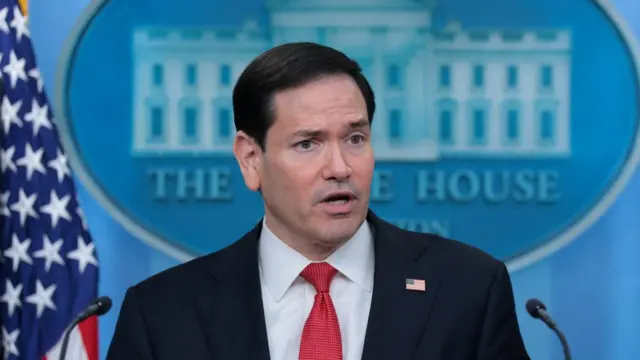
    Marco Rubio close upImage source, EPA/Shutterstock

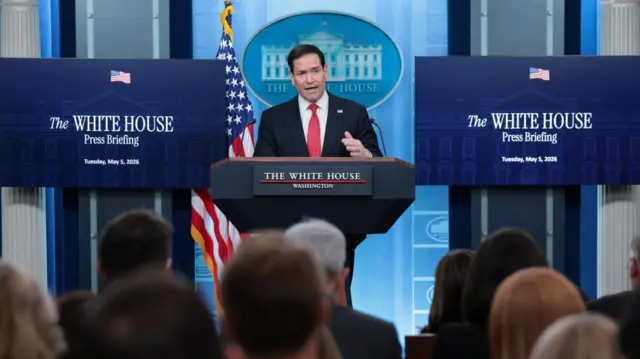
    While addressing reporters just now, Marco Rubio confirmed that "Operation Epic Fury" - the name given to the initial US-Israeli offensive against Iran - is finished.

    "Operation Epic Fury is concluded. We achieved the objectives of that operation," Rubio tells reporters and says the offensive stage of the war with Iran is "over".

    Now, Rubio says, the president would prefer to reach a deal with Iran including a memorandum of understanding on how the Strait of Hormuz can be fully reopened.

    "That's the route he prefers. That is so far not the route that Iran has chosen," Rubio adds.

    After around 50 minutes at the podium, the US secretary of state then brings his media conference to a close.

  8. US is trying to reopen the strait as a 'favour to the world', Rubio sayspublished at 21:00 BST 5 May

    More now from US Secretary of State Marco Rubio, who is continuing to speak to the media.

    The US is working to get ships through the Strait of Hormuz as a "favour to the world," Rubio has said in the news conference.

    He adds ships that are currently stranded are holding goods that are essential for the people of other countries - including fuel, fertilizer and humanitarian aid.

    "It's their ships that are stranded," he said. "Not ours."

    Americans are stepping up because "we're the only ones that can project power in that part of the world", he says.

  9. Cargo vessel struck in Strait of Hormuz, UK maritime authority sayspublished at 20:54 BST 5 May
    Breaking

    A cargo vessel has been struck "by an unknown projectile" in the Strait of Hormuz, according to the UK Maritime Trade Operations (UKMTO).

    In an update released just now, the UK maritime authority says "a verified source reported a cargo vessel has been struck by an unknown projectile. Environmental impact is unknown at time of report".

    It adds that vessels are advised to report any suspicious activity to UKMTO.

  10. US is securing 'bubble' to allow ships to pass through strait, Rubio sayspublished at 20:45 BST 5 May

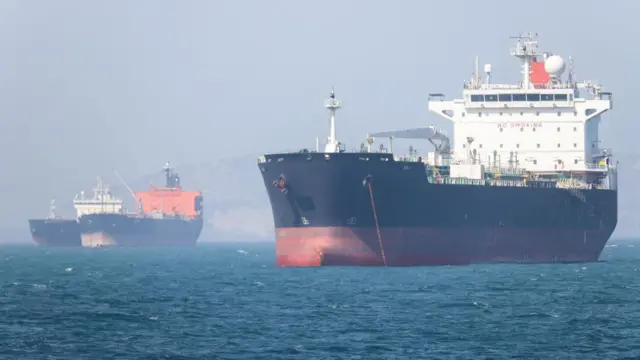
    Two large ships in the strait of hormuz.Image source, Reuters

    Rubio is asked about whether more ships will be coming through the Strait of Hormuz after the US Central Command said two US-flagged ships had been "guided" out of the waterway.

    Rubio says the US air and naval assets are establishing a secure "bubble" to allow ships to pass through.

    He says he is "not going to broadcast" details on this.

  11. Analysis

    US keen to stress 'Project Freedom' is defensivepublished at 20:35 BST 5 May

    Bernd Debusmann Jr
    White House reporter

    In the room at the White House press briefing, one thing so far stands out to me.

    Rubio is, like Defence Secretary Pete Hegseth and Joint Chiefs Chairman Dan Caine earlier, going to considerable lengths to make it clear that "Project Freedom" is defensive in nature.

    Iranian vessels, he said, will only be targeted by US forces if they attempt to engage US assets or international vessels as part of what he termed "economic arson" from the Iranians.

    This definition falls well short of a return to full-scale combat operations or a completely collapsed ceasefire.

    The US strategy, as it stands, appears to be to keep the wider war somewhat frozen while also opening the Strait of Hormuz.

    He says the US is also keeping pressure on Tehran to return to the negotiating table with a deal the US sees as workable.

    "The time has come for Iran to make a sensible choice," Rubio said.

  12. Rubio pushed on Iran nuclear programmepublished at 20:31 BST 5 May

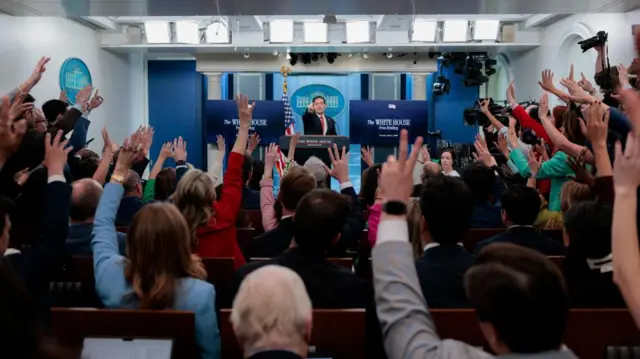
    A crowd with hands up looking at Rubio.Image source, Reuters

    The secretary of state is now fielding questions, mainly on Iran, from the media at the White House briefing.

    The room is full and members of the media are waiting for their turn to ask Rubio a question.

    He is asked about Iran’s nuclear programme, and if there are any indications that they would give it up.

    Rubio says that Iran has "always" said they don't want a nuclear weapon, but "they just don't mean it".

  13. Rubio says Iran must come to negotiating tablepublished at 20:27 BST 5 May

    Marco Rubio speaking behind podium, screens behind him say White House Press Briefing.Image source, Reuters

    Rubio says it's important for Iran to make a sensible decision and take the diplomatic path that leads to "reconstruction, to prosperity and to stability".

    "Iran must come to negotiating table and accept terms," he adds.

    "The alternative is growing isolation, economic collapse, and ultimately total defeat," he says, adding that he hopes they make the right decision.

    "They really shouldn't test the will of the United States," he says.

  14. Iran cannot be allowed to dictate control of strait, Rubio sayspublished at 20:24 BST 5 May

    On the strait, Rubio says international law is "very clear" that "no country can control" an international waterway.

    Iran "cannot be allowed to dictate who is allowed" to use the waterway, he adds, calling it a criminal act that is "completely illegitimate" and "unacceptable".

    "Something needs to be done," he says.

    Rubio explains that this is why the US military is extending this defensive operation, called "Project Freedom", to guide commercial ships through the strait.

  15. Rubio: US operations purely defensivepublished at 20:19 BST 5 May

    Media caption,

    Rubio: US operations in Strait of Hormuz are 'defensive'

    Rubio says US operations in the Strait of Hormuz are purely "defensive".

    "There's no shooting unless we're shot at first," he tells the press. "We are only responding if attacked first."

    He adds that if Iran attacks US vessels in the Strait, the US won't hesitate to respond.

    "If we're fired on, we will respond, and we will respond with lethal efficiency," he says.

  16. Ships in Strait of Hormuz at 'mercy of Iran's piracy', Rubio sayspublished at 20:18 BST 5 May

    Marco Rubio.Image source, Reuters

    US Secretary of State Marco Rubio begins the briefing by saying vessels stranded in the Strait of Hormuz have been "left for dead" by the Iranian regime.

    He warns that nations not involved in the conflict are now at risk of losing not just their cargo, but also the lives of their citizens because of Iran's blockade on the vital waterway.

    "They're at the mercy of this piracy", Rubio says as he describes fears about dwindling food and water supplies.

    "At least ten sailors have already died as a result," he says, and adds that nations have asked the US for help to guide their flagged ships to safety.

  17. US Secretary of State Marco Rubio to deliver White House briefing - watch livepublished at 20:03 BST 5 May

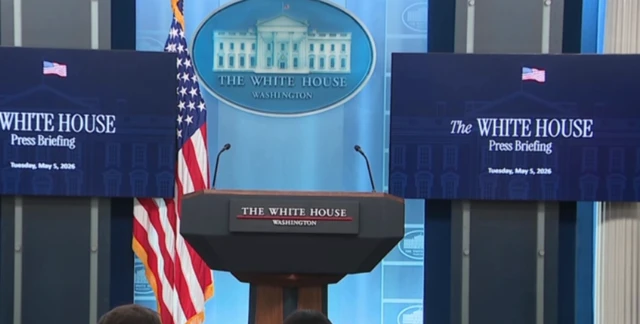
    White House briefing room.Image source, POOL

    We'll shortly be hearing US Secretary of State Marco Rubio deliver the White House briefing.

    He is filling in for White House Press Secretary Karoline Leavitt, and his update may include new comments on the Iran war and the Strait of Hormuz.

    We'll bring you any key developments and you can follow along by tapping watch live at the top of the page.

  18. Stranded captain describes sound of explosions in Hormuz straitpublished at 19:51 BST 5 May

    The captain of a ship stranded in the Strait of Hormuz has told the BBC what it is like to be caught up in the power struggle between the US and Iran in the vital waterway.

    Speaking from on board one of the vessels, Captain Raman Kapoor says he and his crew contend with "mental not material pressure" as their stranded vessel is assailed by "hundreds" of missiles and the sound of explosions.

    As we've been reporting, the US says there are 22,500 mariners on 1,550 commercial vessels trapped in the Gulf, which has been effectively blocked by Iran.

  19. Iran denies striking UAE and says retaliation will be met with 'crushing response'published at 19:28 BST 5 May
    Breaking

    The Islamic Revolutionary Guard Corps (IRGC) denies involvement in strikes reported by the UAE, according to state-run media agency IRIB.

    In a statement, the news agency quotes an IRGC spokesperson as saying: "The armed forces of the Islamic Republic of Iran have not carried out any missile or drone operations against the UAE in the past few days."

    It adds that Iran would have claimed responsibility for any of its strikes and that retaliation by the UAE would be met with a "crushing and regretful response".

    It comes after the UAE's defence ministry said on Tuesday it was working to intercept missiles and drones from Iran.

    The country also reported intercepting 15 Iranian missiles and four drones yesterday.

    BBC Verify has examined two videos showing a fire at the port of Fujairah in the UAE on Monday following an attack.

    Iran says it is not responsible for this or any other attack in recent days.

  20. Iran will take 'decisive action' against vessels not using Iran-approved Hormuz route - IRGCpublished at 19:19 BST 5 May

    The Islamic Revolutionary Guard Corps (IRGC) has vowed to take "decisive action" against vessels using routes to transit the Strait of Hormuz that have not been approved by Iran, according to news agency Fars.

    The Iranian news agency released a statement from the IRGC, originally in Persian, that warns all vessels passing through the strait to follow "the only safe route" that has been "announced by Iran" - or else, be "met with decisive action" from the navy.

    It comes as Iran's press TV reports that Iran has set up a new mechanism to manage the transit of vessels through the strait. We are yet to see confirmation of this report from the IRGC.

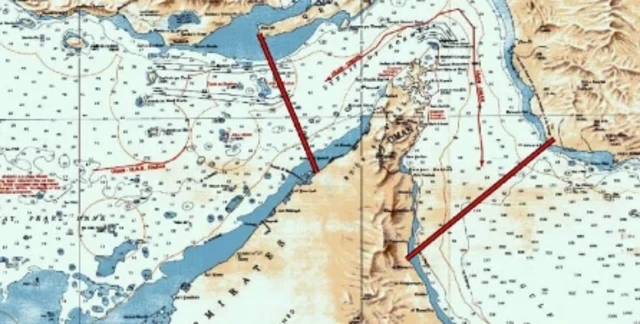
    A map showing Strait of Hormuz with two red lines indicating Iran control.Image source, FARS
    Image caption,

    On Monday, Iranian state media reported the IRGC shared this map showing Iranian control in the Strait of Hormuz