Summary

  1. Work as usual for some as UK heats uppublished at 16:15 BST

    We've been receiving lots of pictures from BBC Weather Watchers across the country. Some have been getting on with their days, while others are looking out for those taking to the water to beat the heat.
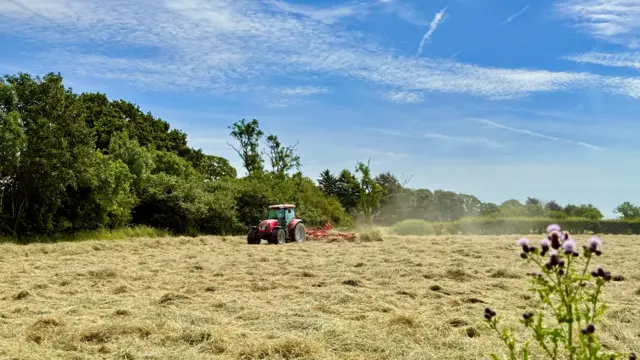
    A red tractor can be seen in the middle distance mowing a field, where yellow piles of dead grass are already covering the ground. Trees surround the filed above a blue sky with streaks of white cloudImage source, BBC Weather Watchers/Outnabout
    Image caption,

    A farmer gets on with his day despite the hot weather in Lancashire
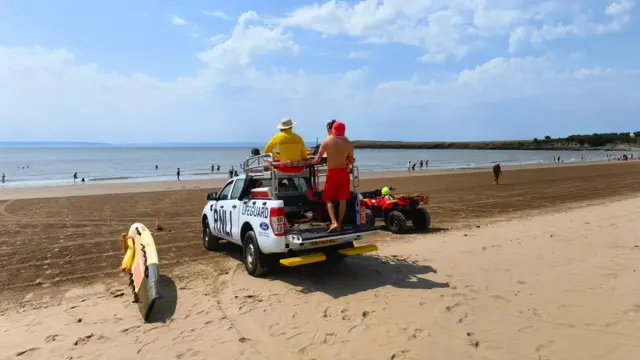
    Two lifeguards stand on the back of an RNLI pick up truck on a sandy beach overlooking the sea on Barry island. A surf broad is propped up to the left of the car and an ATV is seen to the rightImage source, BBC Weather Watchers/Nadezna
    Image caption,

    Lifeguards keep a watchful eye on Barry beach this afternoon
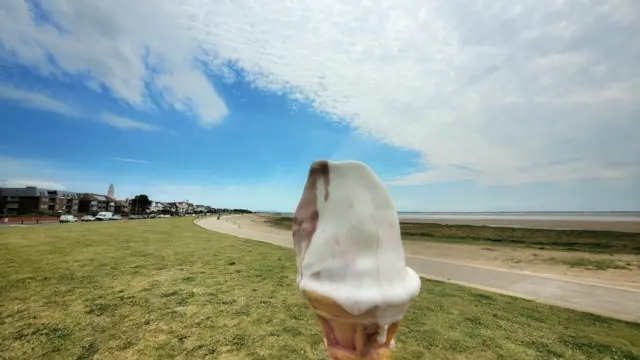
    A melted ice cream and chocolate flake on a waffle cone is being held by someone off camera in the middle of a grassy field next to the beachImage source, BBC Weather Watchers/uWhoAndyR
    Image caption,

    I'd eat that quickly if I were you
  2. South East Water asks customers to use water for 'essential purposes only'published at 16:07 BST

    South East Water is asking that people only use water for essential reasons.

    The company, which failed to supply thousands of customers in the previous heatwave, says demand is high given the temperatures.

    "Please use water for essential purposes only: hygiene, drinking and cooking," the company says.

    It adds that 644 million litres of water was treated and put into the network yesterday, 56 million litres higher than the June average.

  3. Hospital declares critical incident in hot weatherpublished at 16:05 BST
    Breaking

    A hospital in Surrey has declared a critical incident due to high levels of demand on its emergency care services, exacerbated by high temperatures.

    East Surrey Hospital is having to reschedule some non-urgent appointments to accommodate patients with the most urgent clinical need, Surrey and Sussex Healthcare NHS Trust says.

    A critical incident is declared when a service is under extreme pressure, threatening a hospital's ability to deliver safe and effective care. Patients are being urged to only attend the hospital in a life-threatening emergency.

  4. Harry Styles' Wembley show to go ahead on Tuesday - with free sun cream and half-price waterpublished at 15:59 BST

    Harry Styles wears a red bomber jacket, light blue shirt, floral tie and navy trousers while performing on stage. He can be seen holding his mouth open with a microphone in front of a crowd of people holding their phonesImage source, Getty
    Image caption,

    Harry Styles performing in Amsterdam in May

    Wembley Stadium has confirmed the Harry Styles concert will go ahead on Tuesday, despite temperatures forecast by the Met Office to reach 36C.

    Organisers told the BBC the show will proceed as planned, though it will allow guests to bring their own metal or hard plastic bottles and fill them up inside the venue.

    The prices of bottled water sold across all bars will be reduced by 50%, while free sun cream will also be available.

    Doors open at 17:00 BST, with people advised not to arrive too early and avoid waiting outside in the sun.

  5. Why cities will feel hotterpublished at 15:56 BST

    Sarah Keith-Lucas
    BBC Weather

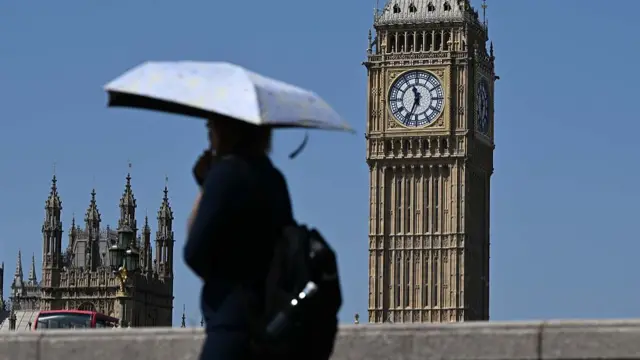
    The silhouette of a woman walking with an umbrella with Big Ben in the background.Image source, Getty Images

    Urban areas, particularly large cities like London and Birmingham will feel the heat more, and especially at night, due to the urban heat island effect.

    It's because of the materials used in cities, as well as the relative lack of green spaces and bodies of water, that heat gets trapped in urban areas - which can be up to 4C hotter than the surrounding countryside overnight.

    Coastal areas will be a few degrees cooler, especially around the south and east coasts of England, where the breeze will be coming in from the relatively cool sea.

  6. Has climate change caused this heatwave?published at 15:50 BST

    Mark Poynting
    Climate reporter

    It is always tricky to link a single weather event to climate change. But the red alert issued today is the latest in a series of increasingly intense and frequent heatwaves the UK has experienced over the last decade.

    The number of days exceeding 32C in the UK has almost quadrupled in the last ten years compared with the 1961-1990 average, the Met Office says - which all points to human-caused climate change.

    As humans burn coal, oil and gas and cut down forests, carbon dioxide and other greenhouse gases are released into the atmosphere. These gases act like a blanket, causing the planet to heat up.

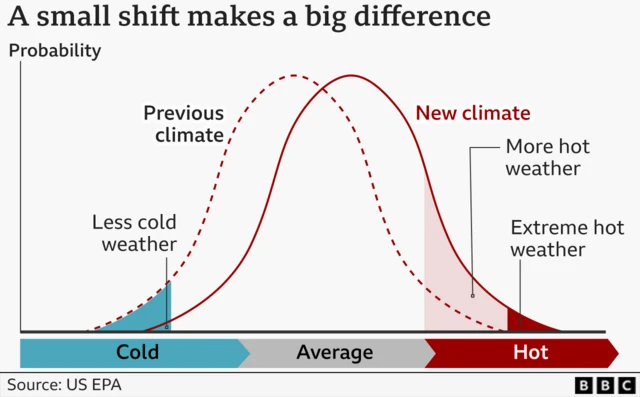
    Since the 1980s, the UK has been warming at about 0.25C per decade, according to the Met Office. That might not sound like much, but even a small increase to average temperatures makes a big difference, making hotter days more likely and more intense.

    Illustrative graph showing the difference between the previous climate and new climate, as two bell-curves. The new climate has a warmer average temperature, meaning cold weather is less frequent and less intense, while hot weather is more frequent and more intense.
  7. Met Office warns of potential heat stress impact on wider populationpublished at 15:41 BST

    The Met Office is warning of a risk to health, including heat stress, to the wider population, not just those vulnerable to extreme heat.

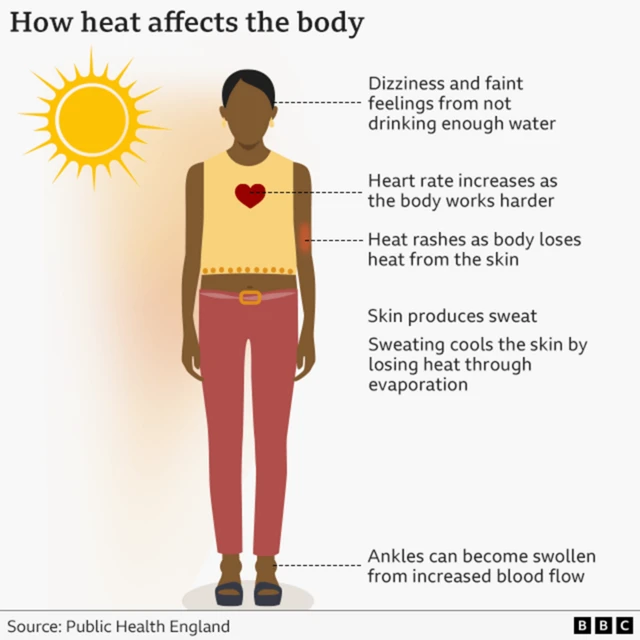
    Heat stress is when the body's way of controlling its temperature starts to fail, influenced by things like temperature, humidity and clothing. Symptoms include inability to concentrate, muscle cramps, heat rash and fainting.

    This can lead to heat exhaustion - which includes symptoms such as fatigue, dizziness, nausea and moist skin. If you see someone you think has heat exhaustion, the NHS says you should move them to a cool place, get them to lie down with their feet raised, make them drink plenty of water and cool their skin.

    Heat exhaustion is not normally serious if they can be cooled down within half an hour - but they are at risk of heatstrokeif they do not recover within 30 minutes. Symptoms include confusion, not sweating, a temperature over 40C, nausea, and vomiting. This is a medical emergency - you should call 999 immediately.

    Infographic titled “How heat affects the body.” A stylised illustration of a person stands beside a large sun icon. Dotted callouts label different parts of the body, explaining effects of heat: dizziness and faintness from dehydration; increased heart rate as the body works harder; heat rashes on the skin; sweating, which cools the body through evaporation; and swollen ankles due to increased blood flow. Source credited to Public Health England, with a BBC logo at the bottom.
  8. The hottest areas under this week's red and amber heat warningspublished at 15:31 BST

    Sarah Keith-Lucas
    BBC Weather

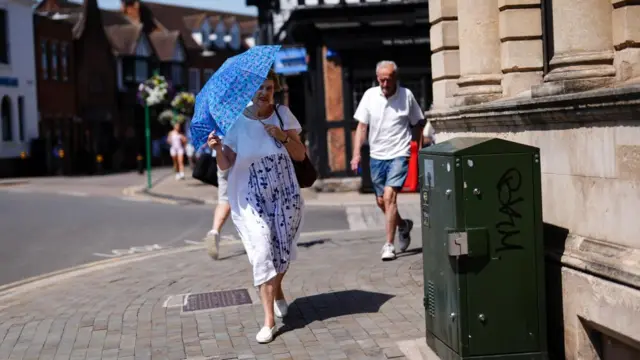
    A woman uses an umbrella to shield herself from the sun while walking along the street.Image source, PA Media

    Two levels of extreme heat warnings have been issued by the Met Office this week.

    A red warning - the highest tier - has been issued for parts of central and southern England and south-east Wales from 09:00 Wednesday until 21:00 Thursday, stretching from Kent all the way to Glamorganshire, and as far north as Birmingham.

    Within this region, temperatures are likely to exceed 37C widely. The hottest spots may see 38 to 40C. Current indications are for the very hottest places to be to the west of London, including Oxfordshire, Buckinghamshire and Berkshire.

    Amber extreme heat warnings cover a larger area of England and Wales, including large parts of central, southern and eastern England as well as east Wales until the end of Tuesday. The area then expands to cover more of south-west and northern England as well as most of Wales for Wednesday into Thursday.

    If you're within the amber warning region, then expect daytime temperatures to peak around the low to mid 30s, with 36C possible on any day between Tuesday and Thursday. And, exceptionally warm and humid conditions are expected by night too, with some places not falling below 20 to 22C.

  9. Two children found dead in vehicle in Francepublished at 15:17 BST
    Breaking

    Hugh Schofield
    Paris Correspondent

    Two children aged two and four have been found dead in their family car in the south of France, in an accident that is being linked to the heatwave.

    Emergency services were called to an address in the town of Carpentras shortly after 13:00 local time (12:00 BST).

    The two children were stuck inside the car after returning from a shopping trip with their mother. The full circumstances are not yet clear.

    The local state prosecutor said the precise cause of death had yet to be determined, but “it is probably linked to the heatwave.”

    With an exterior heat of 35C, the inside of a car with windows shut can easily reach 15 or 20 degrees above that in half an hour, experts say.

  10. First red warning for extreme heat for Walespublished at 14:59 BST

    Antonia Matthews
    BBC Wales

    Wales is often spared the worst of extreme UK heat, but this week's heatwave will see temperatures rise to 38C to 40C in some parts of the country, according to the Met Office.

    Those highs have not been seen before, and now a first red weather warning has been issued.

    The current June record in of 33.7C Wales, recorded in Machynlleth in 2000, is expected to be exceeded by several degrees.

    The all-time maximum temperature record - currently 37.1C recorded in 2022, also looks set to be overtaken.

  11. UK Health Security Agency issues red heat-health alertpublished at 14:51 BST

    The UK Health Security Agency (UKHSA) has issued a red heat-health alert for six regions in England.

    A red heat-health alert indicates that a severe heatwave could have impacts beyond health, and could potentially affect transport systems, food, water, energy supplies and businesses. It means there is a risk to life for even the healthy population.

    The West Midlands, East Midlands, South East, South West, London, and East of England will be under the alert from 01:00 BST on Wednesday until 23:00 on Thursday.

    The agency has also issued an amber alert for North West, North East, and Yorkshire and the Humber.

    This is the only the second time an alert like this has been issued.

    Dr Agostinho Sousa of the UKHSA says it is "important to look out for others, especially elderly relatives, neighbours, and those with underlying health conditions".

    This is separate to the red heat alert issued by the Met Office this morning.

  12. Not as hot as home, but fan still essential for Texan studentpublished at 14:39 BST

    Gabriela Pomeroy
    Live reporter

    TC, Hallie, Hannah and Charlotte on the steps of their college in north London
    Image caption,

    Friends TC, Hallie, Hannah and Charlotte (L to R)

    "We're having lots of cold showers," says Charlotte, 23, sitting with her friends on the steps of their performing arts college in north London.

    Hallie, 22, from Texas says it's still not as hot as her home town.

    "I'm avoiding the tube and carrying a fan everywhere. It would be lovely to run through some fountains. Honestly I prefer the rain!" she says.

  13. Whose decision is it to close schools?published at 14:21 BST

    Vanessa Clarke
    Education reporter

    It’s very unusual for schools to close due to hot weather in England - but the decision ultimately lies in the hands of the head teacher and school leaders.

    There is no legal maximum temperature for classrooms, but the World Health Organisation recommends around 24°C as a comfortable upper limit.

    School leaders will be keeping a close eye - referring to their risk assessments, checking temperatures, and watching out for pupils becoming tired more quickly, especially vulnerable pupils.

    And if a head teacher makes the decision to close the school, they will need to talk to the chair of governors and their academy trust or employer first - so it’s always a very carefully considered call.

  14. 'I cannot express how stressful this weather makes our job,' teacher tells BBCpublished at 14:16 BST

    Alex Akhurst
    BBC UGC/Eyewitness journalist

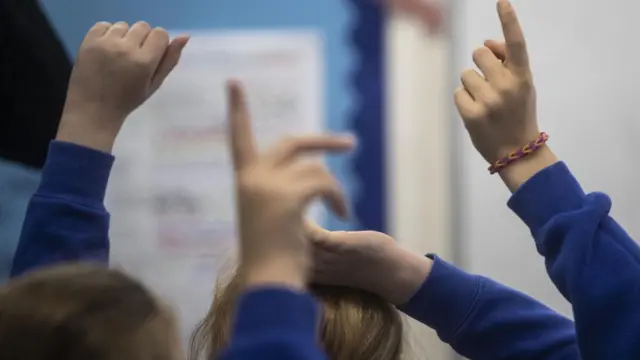
    Unidentified children in a classroom raising their hands.Image source, PA Media
    Image caption,

    Beau says the extreme heat has made work much more difficult

    Beau is a teacher at a school for special education in the south of England.

    She says that the extreme heat has made work much more difficult, with young people really struggling with their additional needs.

    "I cannot express how much more stressful this weather makes our job," she tells the BBC. "The children suffer immensely, staff are at their limit."

    She says there is no air conditioning in the building "and yet we still need to continue with our physically demanding, emotional job".

    "The poor children expected to do a full school day. They are [in] pre-verbal, autistic and ADHD classes. Awful."

    A banner which reads "Your Voice" in white font against a purple background.
  15. Gritters could be rolled out if heat makes roads 'tacky'published at 13:59 BST

    The heat means that some roadways could become softer or sticky, and heavy traffic could cause rutting in places, the AA says - meaning gritters could be out on some roads to help with areas that have become tacky with the heat.

    Speaking to the Press Association, AA President Edmund King says: "The main risk for drivers is not that the road suddenly ‘melts’ everywhere, but that patches can become tacky or uneven.

    "That can affect braking, steering and grip, especially for motorcyclists and cyclists, and can also throw up loose material."

    Drivers should slow down and avoid braking hard or steering harshly, he adds.

    "In these temperatures the advice remains never to leave passengers or animals unattended in parked cars even for short periods when the interior of the car can soon get as hot as an oven," King says.

  16. Not-so cool cats feline the heatpublished at 13:51 BST

    Rozina Sini
    BBC UGC journalist

    We've been hearing from you through the day about how you're beating the heat - and how your pets are, too.

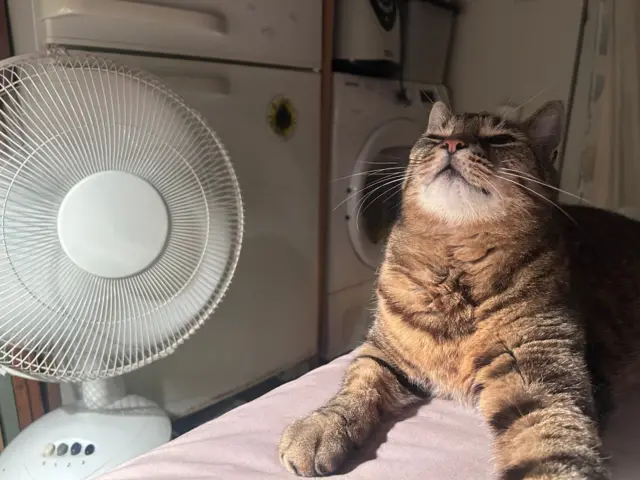
    Becki Ive's cat Inca is keeping movement to a minimum while Becki works in her cabin in Shoreham By Sea in West Sussex. They're both sheltering next to the fan, which is running at full blast.

    Becki's cat Inca lays across a wooden table top with her head resting on a metal laptop stand.Image source, Supplied/Becky Ives
    Image caption,

    Inca's got the right idea

    And Julie O'Hanlan's cat Riley has also opted for the fan method - they're both in the garden shed while they try to cool down.

    Riley, a tabby cat, lays on a pink soft surface in a garden shed, next to a fan.Image source, Supplied/Julie O'Hanlon
    Image caption,

    We believe Riley is asking: 'could you turn it a little more to the left?'

  17. Schools closed and transport disrupted as rare heat warning issued for parts of UKpublished at 13:28 BST

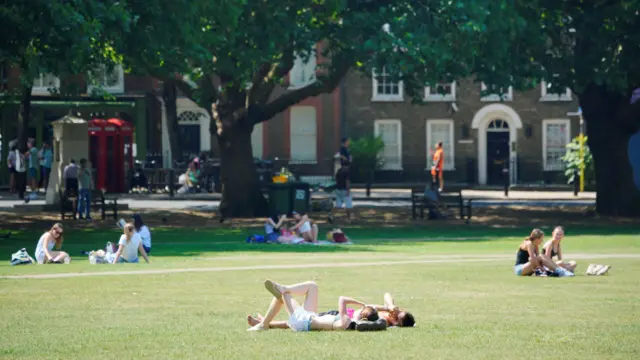
    Two women cover their eyes as they lie on the grass in Richmond Green. They are surrounded by other people sat in groups enjoying the sun, while in the distance people are sat on benches and walking along the street in the shade next to a row of treesImage source, PA Media
    Image caption,

    Sunbathers in Richmond Green, London, this morning

    It's just gone lunchtime, but it has already been a warm start to the day and temperatures are only expected to rise as the week goes on. Let's bring you up to speed:

    • Temperatures are forecast to increase significantly in the next few days, with the potential for 38 or 39C by mid week
    • The Met Office has issued arare red warning set to begin 09:00 BST on Wednesday to 21:00 Thursday for parts of England and Wales. The warning indicates a high likelihood of risk to life and people are being advised to avoid travelling where possible
    • Critical national infrastructure could also be affected, with some trains already delayed or cancelled due to the hot weather. Schools in England's west have also closed early
    • With temperatures soaring, we've put together a handy list of tips to keep yourself and your pets cool during the hot weather
    • As BBC Weather's Helen Willetts explains, the heat is building due to a combination of factors and is not just limited to the UK
    • In France, 845 schools have closed due to the warm weather, while in Spain's Basque region companies are being asked to adapt timetables for workers
  18. World cup events scrapped, trains cancelled and alcohol bans in parts of Europepublished at 13:05 BST

    Jonah Fisher
    Environment correspondent

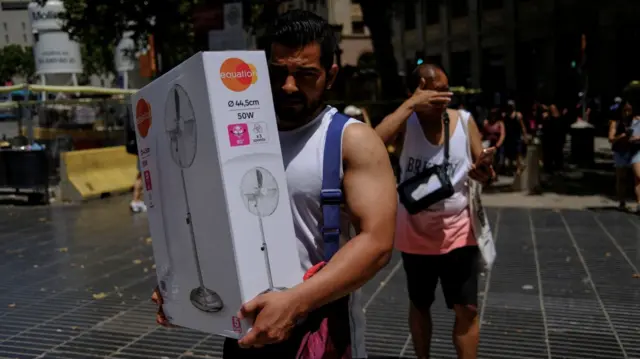
    A man carries a newly purchased fan as temperatures rise, during a heatwave affecting a large part of Spain, in Barcelona, in Spain, June 21, 2026. REUTERS/Nacho DoceImage source, Reuters
    Image caption,

    A man in Barcelona carries a newly bought fan as the country braces for a week of extreme heat

    With temperatures in parts of France tipped to reach 40C this week, and up to 44C in Spain, communities with more experience dealing with heat than the UK are still bracing for a struggle.

    On top of school closures, several towns in France have cancelled the annual music festival - Fête de la Musique - and the government has banned drinking alcohol in public places in areas that are under red alert.

    Both France and Belgium have announced cuts to their rail services to reduce the risk of breakdowns blocking the tracks.

    And in Madrid, authorities cancelled public transmission of the World Cup match against Saudi Arabia on Sunday.

  19. In Spain's Basque region, the temperature could hit 40Cpublished at 12:50 BST

    Guy Hedgecoe
    BBC News in Madrid

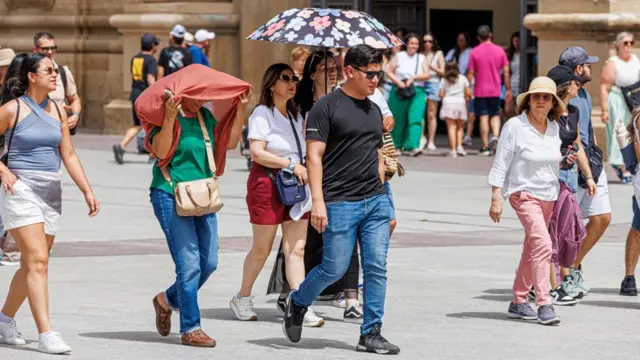
    Tourists visit Zaragoza, Aragon, Spain, 21 June 2026Image source, EPA
    Image caption,

    Tourists shielding themselves from the sun in Zaragoza on Sunday

    The temperature is expected to rise up to 40C today in parts of the Basque Country, which is unusual for the northern region - much of which is on a red weather alert.

    The Basque regional government has brought forward its plan to manage high temperatures, which includes asking companies to adapt timetables for workers, increasing their breaks and guaranteeing access to water.

    Yesterday, 25 people received medical treatment for heat-related issues in the Basque Country.

    The north-eastern region of Aragón is among several expected to see temperatures in the low 40s.

    In the region’s capital, Zaragoza, authorities have announced a discount on the price of entry to municipal swimming pools.

    The city has also made available around 60 "heat refuges", which are air-conditioned public buildings, such as libraries, churches and civic centres, where people are encouraged to spend time during the hottest part of the day.