The art deco airport terminal 'designed by accident'
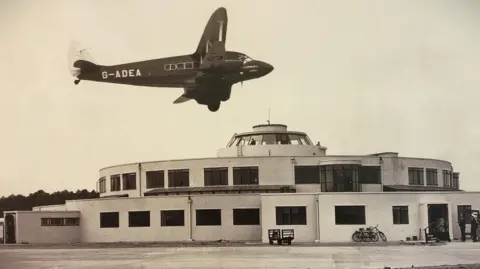 Gatwick Airport Archives
When passengers stream through the international bustle of Gatwick Airport today, few realise that just a stone's throw away lies one of Britain's most important aviation landmarks.
Sitting a short distance away from the modern airport, Gatwick's original circular art deco terminal still stands as a preserved piece of the airport's 90-year history.
Known for its distinctive shape, "The Beehive" as it is often called was in many ways ahead of its time - even though it was allegedly designed by accident.
Doug Cox, of the Horley Local History Society, told Secret Sussex: "The architect, Morris Jackaman, had been agonising over the design and was working late at night.
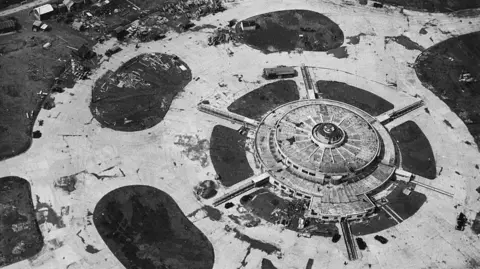 Getty
Getty"The story is that his father said to him: 'If you're not careful Maurice you'll be thinking around in circles', and that was it."
Built between 1935 and 1936, The Beehive reportedly made the airport - which sits on the border between West Sussex and Surrey - the first in the world to fully integrate trains into its design.
Now a set of offices, Simon Green, sales manager at The Beehive, said underground tunnels and pull-out canopies meant passengers could travel from their train to the plane doors without stepping out from under covers if it rained.
The first flight from the terminal, a Jersey Airways plane to Paris, took off in 1936.
As war hit in 1939, Gatwick would play its part as a base for the RAF. By the end of the fighting, commercial flights had outgrown Gatwick's terminal, and it was retired.
In 1958, the terminal was replaced with a much larger building, which now serves 43 million passengers a year.
After becoming Grade II* Listed in 1996, the terminal still sits by the airport and is now used as office space.
But, with its short but significant aviation history, the terminal remains as a key landmark in the airport's heritage.
Follow BBC Sussex on Facebook, X, and on Instagram and listen to BBC Radio Sussex on Sounds. Send your story ideas to southeasttoday@bbc.co.uk or WhatsApp us on 08081 002250.
