Sir David Attenborough reveals the animal characters inhabiting the hidden world right on our doorsteps
Secret Garden explores five very different locations across the UK
After seven decades exploring the world’s wildest places in search of exotic animals and plants, Sir David Attenborough turns his attention to Britain’s gardens. We may not realise it, but it turns out that our backyards are home to thousands of species.
Over five episodes - set in five very different gardens across the UK - Sir David reveals the lives of the often charming, occasionally daring, always secretive animal characters that inhabit the hidden world right on our doorsteps. Theirs is no cosy existence - even in these beautiful and seemingly genteel surroundings the rules of the wild still apply.
From pine martens in the Western Highlands to dormice in south Wales, swallows in the Lake District to otters in Oxfordshire and blue tits in Bristol, the series reveals not just a rich and surprising diversity of life but also how each species finds its own way to live alongside us.
And through meeting the gardeners that have created these wild oases, we discover how our nation of animal lovers and gardeners can do their bit to save struggling species. Eighty per cent of Britons have access to a garden, and together they cover an area greater than all of our national nature reserves combined - so what we do in our own backyards has an impact not only on the animals that live there, but also on whole populations.
You’ll never look at your garden in the same way again.
AJ2
Episode Synopses
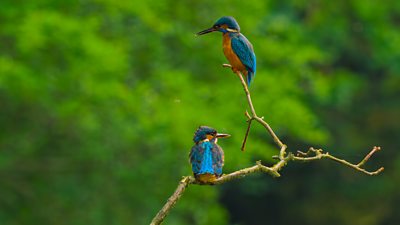
Episode One – Oxfordshire
David Attenborough reveals how animals survive in a garden on the banks of a tributary of the River Thames - a beautiful and seemingly serene location at the mercy of unpredictable floodwaters.
As winter’s high water recedes, a male kingfisher battles to survive... but his attention soon turns to attracting a mate and raising a family. A shy bank vole emerges to navigate dangers from robotic lawnmowers to predatory grass snakes. And Doris, the garden’s resident mallard, must shepherd nine ducklings safely from their treetop nest down to the river below.
As spring turns to summer, mayflies appear after years underwater - they have just one day to find a mate. Daubenton’s bats catch thousands of insects each night, and Doris continues to protect her brood despite threats from otters and red kites.
Sudden downpours test the animals’ resilience: kingfisher chicks face flooding in their nest, and the bank vole flees her woodland home. At least it’s nice weather for ducks.
Yet this fragile Eden thrives. Britain’s wildlife is remarkably resourceful, and homeowners Henry and Sara demonstrate how leaving nature to its own devices can transform a riverbank garden into a much-needed sanctuary.
Key facts:
- Otters almost disappeared from Britain between the 1950s and 70s due to persecution and pesticides. But since hunting was banned in 1978 and organochlorine chemicals were withdrawn, they have made a remarkable comeback. Since 2011 they have been present in every county in England, and in recent years they’ve been spotted increasingly frequently in cities and gardens.
- There are only 3,800-7,000 breeding pairs of kingfishers in the UK, and they have declined by 15% between 1995 and 2023. An unusual garden bird, unless you have a large pond or river running by.
- There are around 25 million bank voles in Britain, although their numbers fluctuate massively month by month. They visit gardens more frequently than their more common relatives, field voles (population ~75 million).
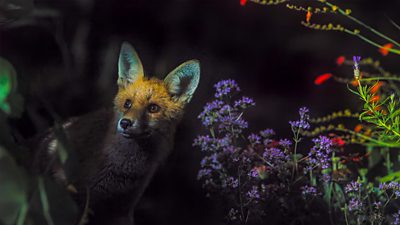
Episode Two – Bristol
In the heart of Bristol, a tiny city garden just ten metres across hosts a surprising diversity of animals. For artist Lou, it has become a refuge in the urban jungle. But for the wildlife, living alongside us is a huge challenge.
In early spring, a male fox patrols a territory spanning more than a hundred gardens. Competition is fierce - for food and mates. A hungry blue tit competes with goldfinches and pigeons for a place at Lou’s birdfeeder, whilst watching out for the neighbourhood’s apex predator, Mr Fluffy - a pet cat.
As the city warms, a hedgehog emerges from hibernation, travelling through a specially created “hedgehog highway” in search of Mr Right.
Lou’s pond becomes a vital oasis - attracting frogs and dragonflies. Fox cubs explore neighbouring gardens, froglets emerge, and insects and spiders colonise sun-warmed walls.
The blue tit family struggles to cope with city life, but much of the garden’s wildlife thrives. It is part of a green network - gardens make up a third of our city space and cover an area greater than all of Britain’s national nature reserves combined.
For the hedgehog mother, the reward is great: after weeks in hiding, four healthy hoglets emerge. And the fox father teaches one of his cubs how to make a living in the modern world.
Key facts:
- Foxes moved into our cities around a hundred years ago, just as suburban gardens (with plenty of shelter and food) were proliferating.
- Hedgehogs have declined from more than 30 million in the 1950s to fewer than 1 million today. But while the rural population continues to decline, there are signs that city populations could be increasing.
- We have seen a decline in birds – around 74 million gone in 50 years. It is estimated that around half of UK households feed their garden birds every year, providing some 50-60 thousand tonnes of bird food at a cost of £200-300 million. Yet our pet cats kill around 50 million birds (including blue tits) every year.
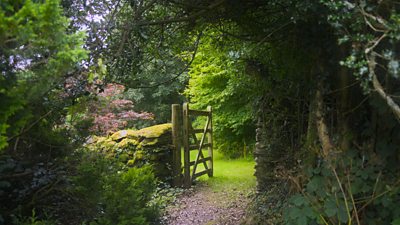
Episode Three – Lake District
David Attenborough tells the story of Chris and Liz’s idyllic English country garden in the Lake District.
Spring brings blossom and buzzing bees, but the clock is ticking for the garden’s inhabitants to find partners and raise families.
At night, a field mouse uses landmarks to avoid predators while listening out for the ultrasonic calls of a mate, inaudible to predators and humans. A barn swallow returns after a six-thousand-mile migration, nesting in the same garden where he was raised. Meanwhile, a female palmate newt selects a suitor and carefully lays her eggs.
Summer arrives and miniature dramas unfold. A zebra jumping spider hunts pests, a semaphore fly performs backflips to impress a mate, a mole searches for a partner, and butterflies flirt among the flowers.
Over the past 20 years Britain’s flying insects have declined by 60% - and during heavy rains, their numbers drop even further, leaving swallow chicks increasingly hungry. Without a steady supply of bugs, they might not survive.
Yet - through careful planning and curation - the garden’s rich habitats allow many animals to thrive. It’s a little slice of paradise for animals and people alike.
Key facts:
- Swallow numbers have fallen by 40% in the last decade, reflecting a 60% decline in their prey, flying insects.
- Britain has lost half of its rural ponds in the last 50 years, so garden ponds have never been so important for our native amphibians, which use them to breed.
- The use of portable way-markers or landmarks by field mice is the only known use of this sophisticated behaviour by any animal apart from humans.
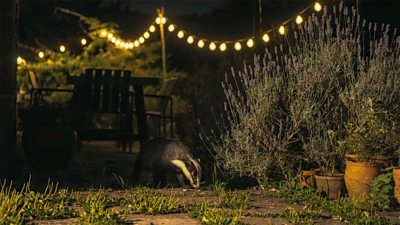
Episode Four – Wye Valley
Hidden in a steep Welsh valley, Robin, Laura, and their sons live in one of Britain’s most biodiverse woodlands. Aspect is always important to gardens, but this garden’s location means it is more affected by the seasons than most.
In winter, the sun doesn’t reach the garden for months. Dormice remain in deep hibernation while tawny owls hunt rodents and court mates.
But when sunlight returns, the woodland awakens. Wild garlic pushes through the soil, and a queen buff-tailed bumblebee emerges to establish a new colony. A badger mother brings her cubs above ground for the first time, and a wandering one-year-old is drawn towards the lawn by abundant food. In the stream that runs under the house, a dipper hunts aquatic insects to feed her hidden brood of hungry chicks. High in a nest-box, tawny owl chicks jostle for food, and in a brutal display of sibling rivalry, the smaller owlet pushes its larger brother from the nest.
Migratory flycatchers arrive from West Africa, but poor water quality in the Wye watershed leaves the dipper family facing a shortage of food. To help, Robin provides a timely supply of mealworms, ensuring the chicks survival.
Autumn means falling leaves to feed invertebrates and earthworms, enriching the soil. The bumblebee queen’s legacy passes to the next generation of queens.
As winter returns, the garden falls quiet as dormice, insects, and birds retreat. If they get their timing right, all will be back next year.
Key facts:
- Tawny owls are a woodland species but they have adapted to live in our gardens - so long as there is a large nest box at least 3m up.
- There could be 400,000 badgers in Britain, but they are so cautious that few people ever see them alive. Their diet consists mainly of earthworms and other invertebrates - so as our farmland is ploughed up and treated with pesticides, so badgers are turning to gardens in their search for food.
- Dippers are highly sensitive to poor water quality, and as a result Britain’s dipper population has declined by 39% since 1995. Supplementary feeding with mealworms could improve their chances of raising a family.
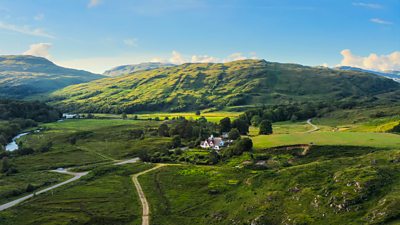
Episode Five – Western Highlands
David Attenborough tells the story of a remote garden on Scotland’s rugged west coast - a carefully managed sanctuary for barn owls, pine martens, and other rare wildlife.
Winter here is particularly harsh. A female buzzard is desperate for food, so homeowner Matt offers her a lifeline… but his extreme bird-feeding soon draws attention from rivals. A young pine marten arrives seeking territory.
Over the years, Matt’s resident barn owl has raised ten owlets in his carefully placed nest box. This spring, her mate briefly disappears but returns, and she lays four eggs. The chicks’ survival depends on both parents supplying enough prey. Slow worms, common lizards, and toads emerge as the garden becomes a breeding hotspot.
During the brief summer, crossbills feed on Scots pine seeds, house martins raise chicks under eaves and sundews trap insects near the pond. A pine marten hunts sand martins - this behaviour has never been filmed before.
As autumn gales bring redwings, wildlife seeks shelter, and Matt builds dens for pine martens. With winter returning, he continues feeding his visiting animals. Decades of care have transformed the garden into a thriving ecosystem, a magical sanctuary where nature flourishes despite tough conditions.
Key Facts
- There could be as few as 1000 pairs of barn owls in Scotland, although recent warm winters may have led to an increase in numbers. The provision of suitable nest boxes has also helped them to breed.
- By the start of the 20th century, pine martens had lost most of their forest habitat and were almost hunted to extinction due to their taste for game birds and poultry. They maintained a stronghold in the Western Highlands and in recent years have been reintroduced in various places around Britain - which means they are turning up in gardens in Monmouthshire, Cumbria, Gloucestershire, Hampshire & Devon.
- Common toads are estimated to have declined by 41% between 1985 and 2021 thanks to road traffic, the loss of ponds, increased urbanisation and a decline in their invertebrate prey. They like to breed in larger, deeper ponds than frogs - but people with bigger gardens can help.
Interview with Bill Markham
Series Producer
It’s coming up to Sir David Attenborough’s 100th birthday. What does it mean to have him narrate the series?
As Sir David Attenborough approaches his 100th birthday, having him narrate the series feels both momentous and deeply fitting. The first question anyone asks when you’re making a wildlife programme is whether he’s involved - and for good reason. Over the past seventy years, he has come to define the genre. For many of us, his films were the spark that set us on this path, so working on Secret Garden at this moment feels particularly special. His involvement has had a profound effect on the production. As a team, we’ve undoubtedly raised our standards, mindful that every frame and every line of script would be subject to his careful attention. That knowledge alone has sharpened our focus and ambition.
There’s also no denying the impact of his name. It brings a level of visibility that is invaluable - especially for a series like ours. A programme about garden wildlife might, at first glance, seem gentle or understated. But with Sir David as our guide, audiences can expect not only insight and authority, but real drama. Even within a domestic setting, the laws of the wild remain very much in force.
At a time when wildlife gardening is becoming increasingly important for supporting struggling species, his voice carries particular weight. If Secret Garden succeeds in encouraging people to rethink what their gardens can be, it will be in no small part due to his influence and enduring credibility. We are, after all, a nation that loves animals, gardens - and Sir David Attenborough. This series brings all three together. It’s a powerful combination.
Can gardens really help biodiversity and support dwindling wildlife numbers?
Yes, gardens really can play a powerful role in supporting biodiversity and helping reverse wildlife declines, especially when you consider their sheer scale across Britain.
There are an estimated 25 million gardens in the UK, together covering more land than all our National Nature Reserves combined. Rather than being isolated patches, they form a vast, interconnected network of green spaces - mini habitats and wildlife corridors that allow species to move, feed, and breed across the country. Even a typical suburban garden can be surprisingly rich: one in Leicester was found to host up to 10,000 different species, including plants, insects, amphibians, birds, and small mammals.
This matters because many traditional habitats - like wildflower meadows, wetlands, and hedgerows - have declined dramatically. As a result, British wildlife is increasingly relying on human-managed spaces. Gardens can provide food, shelter, and nesting sites. Small changes can make a big difference. Creating a pond, letting parts of the lawn grow long, planting native trees, making a compost heap, or simply avoiding pesticides all help create a more welcoming environment for wildlife. When repeated across millions of gardens, these individual efforts add up to a national-scale impact. And the need is urgent. The UK has lost around 60% of its flying insects in the past two decades and tens of millions of birds over the last half-century. By making space for nature in our own backyards, gardeners can become a crucial part of the solution - helping to restore biodiversity from the ground up.
Were there any animal behaviours which surprised you?
Two of the most exciting scenes we filmed involved predation - an otter chasing a family of ducks, and a pine marten (a stoat-like mammal) hunting nesting sand martins (swallow-like birds), a behaviour we don’t believe has ever been filmed before. I found it fascinating to see how the mother duck protected her flightless young by acting as a decoy to distract the otter. But I was particularly surprised to discover something rather more gentle. Our mother duck, “Doris”, laid her eggs over two weeks, yet somehow, they all hatched within two hours. It turns out that her unhatched ducklings were communicating with each other while still inside their eggs. It’s thought that the chirping of the older ones even hurries up the metabolism of the less developed ones, so that they grow faster, coordinate their emergence and can all leave the nest together.
What do you hope audiences take away from Secret Garden?
I hope audiences come away with a renewed sense of wonder about the natural world just beyond their back door. You don’t have to travel to remote wilderness to see remarkable species or fascinating behaviour - there’s a hidden, exciting world in even the smallest garden. More importantly, I’d love people to feel inspired to rethink what a “good” garden looks like. For too long, we’ve been conditioned to value neatness and control - trimmed lawns, tidy borders, and uniformity. But that aesthetic often leaves little room for wildlife.
The British countryside has lost half its ponds in the past 50 years, nearly all its wildflower meadows over the last century, and many of our animal populations are in freefall - so our gardens have never been more important. The scale of the climate and biodiversity crises can feel overwhelming, and it’s easy to think individual actions don’t matter. But gardens are one place where we can make a real difference. By making small, wildlife-friendly changes, we’re not only helping nature recover - we’re also inviting more beauty, life, and connection into our everyday lives.
Follow for more
Latest from the Media Centre
All newsSearch by Tag:
- Tagged with Media PackMedia Pack
- Tagged with Latest NewsLatest News
