Harry Clark opens up about his trip to Rome and an audacious quest to meet Pope Leo XIV
Harry Clark Goes to Rome blends warmth, wit and emotional honesty as Harry embarks on a personal pilgrimage
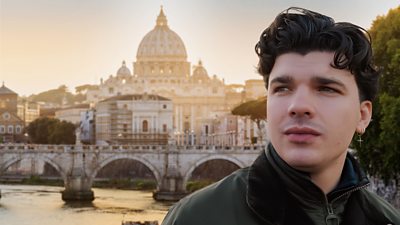
Blending warmth, wit and emotional honesty, Harry Clark Goes to Rome follows Harry Clark’s personal journey to re-connect with his Catholic faith in these modern times.
For BBC One and iPlayer, in this one-hour documentary, 25-year-old Harry Clark (of BBC Traitors and Pilgrimage: The Road to the Alps fame) embarks on a personal pilgrimage to Rome in search of answers about belief, identity, and what it means to be a “good” Catholic today. He also has an audacious quest to meet one of the most powerful figures in the world - and latest addition to his (spiritual) family; the recently appointed Pope Leo XIV.
Living with his close-knit, real family in Slough, in the house where he grew up, Harry’s faith remains central to his life. But, as the pace of modern living accelerates — pubs, clubs, media events, and relationships — his faith increasingly clashes with the traditions passed down by his mother and grandparents. Can belief survive modern life, and what does it mean to be a good Catholic in the midst of it all? For Harry, there is only one place that might offer answers — the home of the Catholic faith, Rome and the Vatican City.
As he prepares for his pilgrimage, Harry talks to those closest to him: his family and friends, his childhood priest, and the most important woman in his life — his mum, Georgia. Through these conversations, he explores what it means to be Catholic, is challenged about his lapsed habits, and learns about traditional Catholic pilgrim practices — fasting, confession, visiting the tomb of a saint, and saying a prayer for someone he loves in Rome. These lead to deeply personal insights into Harry’s life, including an emotional visit to his grandad — a former footballer who is currently battling dementia.
Running parallel to this spiritual journey is Harry’s determined — and often comic — attempt to reach the man at the very top of the Vatican hierarchy, Pope Leo XIV himself. Through letters, phone calls, social media messages – and any other way he can think of, Harry pursues a meeting with The Pope, despite the scepticism of those around him.
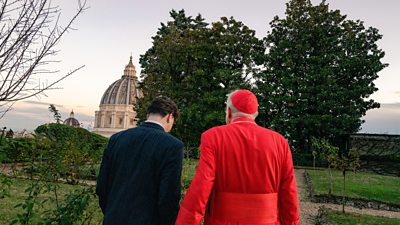
Whilst undertaking a 24 hour fast and accompanied by his mum, they arrive in the holy city of Rome, the heart of the Catholic faith. Among nodding Pope figurines, al fresco dining, and streets lined with tourists, pilgrims and religious figures, they explore important places of pilgrimage. But at the end of the first night, as Harry breaks his fast, he worries the experience isn’t bringing him any closer to God.
At the Pope’s Angelus in St Peter’s Square, Harry catches his first glimpse of Pope Leo XIV. He takes the opportunity to see if a Swiss Guard can help him get closer to a meeting with him but again, is unsuccessful. To find a deeper connection with his faith, Harry and his mum make an emotional visit to the tomb of 15-year-old millennial saint, Carlo Acutis, which raises difficult questions for them both, whilst a meeting with Sister Emanuela sees Harry nervously commit to undertaking his first private confession in nearly a decade.
As the journey reaches its climax, Harry is granted a meeting with Cardinal Roche — a member of the conclave responsible for appointing the new Pope. Here, Harry finds an opportunity to raise some of the wider questions he has about his Church.
But will this meeting within the Pope’s inner circle prove to be his chance to reach the very top of the Vatican and achieve what feels like a one-in-a-million moment? And what impact will this personal pilgrimage have on his faith and his understanding of what it means to be a modern Catholic?
GD
Interview with Harry Clark
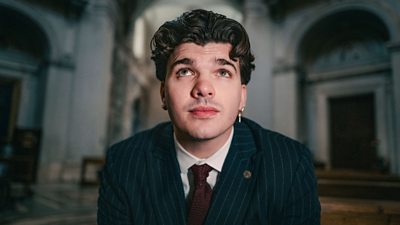
For people who may not know you well, how would you describe yourself, and where does faith fit in your life?
I wouldn't go into a conversation saying, "Hi, I'm Harry and I'm a Catholic." No one does that. Faith doesn't need to be the forefront of anything; it's something you live alongside. It's a private connection. You and God are best friends, and you just get on with it.
Having faith is like that extra armour on the side. It's like the clothes I wear or the protection I have. It's honestly why I think I am where I am now, because if I didn't pray, if I didn't have God in my life, I wouldn't be who I am today.
I mean, look at the world today, people hurting each other over what they believe in. It makes no sense. Because right here, in my own life, it shows you that we can be at peace with people who hold completely opposite beliefs. It doesn't make sense to hate one another just because you believe in something I don't. And I hope people see that in this show.
What was your motivation for making this programme?
I've always been open to speaking about my faith. It's just that no one ever asked me. No one gave me the opportunity.
When I took part in the Pilgrimage series for the BBC, that was amazing. It deepened my faith massively. And then this show came from asking – “what do I do next?” I'd got to such a good place with my faith. I honestly believe I'm only where I am now because of it. It saved me in the army. It saved me from doing a lot of stupid things.
I see myself as a modern Catholic. I believe in God, but I don't necessarily believe in every tradition the church has always dictated. And I just felt you could be as close to God through the church within yourself. So, the question became - “how do I deepen my faith further?” And I realised the answer was to go to the epicentre of Catholicism, Rome, and ask all the tough questions to the top people there.
And of course you get scared in 2026, because people can see you as a religious nutcase. But that's exactly why I'm so excited for this show. It shows firsthand that whether you believe in God or not, you can still love each other.
How formative was your religious upbringing, and who shaped your faith most?
Religion is easy when you're young, because you know nothing else. I was made to go to church every Sunday otherwise my mum would be disappointed, and she wouldn't let me out on a Sunday afternoon. It's easy as a kid. It's not until you go out into the big, bad world that your faith gets tested.
The foundations of my faith started with my mum. My granny and granddad were religious, and they passed it down to her. Then my little sister was born with a hole in her heart and had to have open heart surgery. That's when my mum went back to church, back to praying. And she got all of us properly into it.
And my granddad Dave, he was in the army. He gave me his Bible when I joined up, because he said it would protect me. In the front, his grandmother had signed it to him in 1953: "To my darling David, may this book now accompany you as your best friend throughout the rest of your days." Then he signed it to me in 2016. That Bible sits next to my bed. Funny enough, I've ended up with about eight Bibles now because people keep gifting me one. But that's still the one that matters.
Tell us about the faith journey that led you to this point and your darkest moments and how prayer pulled you through.
I struggled with mental health. I was deployed constantly. I didn't have faith in my life anymore. I was beaten up and lost my teeth and a gang tried to cut my ear off. At the same time, I had kidney stones. Then a seven-year relationship ended. It just seemed like life was getting worse and worse.
I went to my mum on the verge of saying, “I'm done now. I'm a burden on everyone.” she just looked at me and said, "What's the one thing you know how to do?" I said I didn't know where she was going. And she said: "Just pray. Just pray every day. It will get better. Trust me." That was all. Nothing more, nothing less.
So, I started praying. And it wasn't a switch. I wasn't fixed overnight. Each night I'd be fuming, effing and blinding at God like he was my mate. "Why is this happening to me?" But then I'd think to myself, has being angry for an hour got me anywhere? No. So I started giving thanks instead. Thank you for a bed. For a roof. For a fresh glass of water. For my mum, my brothers and sisters, my dad who still loves me even when I'm like this.
What I was doing subconsciously was realising how lucky I am compared to millions of people in the world. And then I started praying for strength just to see my little sister's birthday in January. I'd get there. Tick that box. And my anger started going down, and everything else started coming up. That's how my faith was deepened. That's how I believe I'm still here today.
What's your favourite Bible story, and what does it tell us about how you approach your faith?
My favourite is Adam and Eve, and it's my favourite precisely because of the argument it sparked.
I was that teenager who always had a question. At my very first confirmation lesson, the teacher barely finished explaining the story and my hand was up asking, "Doesn't that mean we're all inbred, sir?" Because if it started off as two people, surely that's incest. And they'd get annoyed and sort of dance around it.
But that's exactly why I love it. Because that question is what made me start seeing religion differently. The Bible isn't always a literal account - it's an interpretation. Adam represents the whole of mankind. Eve represents all of womankind. The snake is temptation. When you realise that faith is something you can interpret for yourself, as opposed to a rigid set of rules to follow by rote, that's when everything changes. That was my early days in church. The older people there didn't love it. But the younger ones did.
Where did the idea to go to Rome and meet the Pope actually come from?
Well firstly, I'm just a crazy guy who loves a challenge.
While I was filming Pilgrimage in Switzerland, I was chatting to the Executive Producer who asked what I wanted to do next. I had all these ideas like helping people in the army, helping people with dyslexia. He asked me, “but as a Catholic, what do you do next?" And I'd never really thought about it. And then it just came out. I said I'd try to go to Rome and ask the Pope all the tough questions. He sort of nudged me and said, “yeah, all right, mate.”
But somehow, we made the trip happen. I even called the Vatican on my phone. They thought I was absolutely mental and told me to try and get a ticket to an audience. But I tried every single path to meet him including handwritten letters, Instagram messages, every avenue. You'll see all of that on the show.
I had a gift ready for him because I'd found out through searching that even if you get to go to one of the audiences you can give the Pope a gift. I mean that sounds a bit stupid but you can give him a gift and I just thought to myself, what would be the best gift that is me all over? Something so outside the box. Everyone going to Rome is going to give the Pope a crucifix or a rosary or something to do with religion, so it was like, what's something that means a lot to me and what's something that's in my family in my blood and obviously I bleed blue so that's why it was a Chelsea top I bought. I was going to Rome with the hopes of gifting him a Chelsea top with Pope Leo 14 on the back.
I don't think anyone could top meeting a world leader, could they? I've met some amazing people, but if I was to meet the Pope, that is a world leader who runs the whole church. I don't think you could beat that. I mean, even people who aren't religious say to me, you're a bit mental trying this, aren't you?
You took your mum with you. Why was that so important?
My mum is a superwoman. She had five kids and while she was raising us, getting us to school, pressing out uniforms, and getting everyone fed, she was studying for a nursing degree. She'd go to uni, come back, pick us all up, cook food, put us all to bed, and then study. She's been a superwoman since I can remember.
We'd never been on holiday together. She's got five other kids and we're a massive family. She's never really travelled. Neither had I, despite joining the army to see the world. When you travel with the army, you go from the UK to a British base abroad, which is basically the UK in different weather. So being in Rome at all was just enough for both of us.
But more than that, when I left for the army and lost my faith, and I was going through the worst time of my life, she was the angel who said just pray. That saved me and put me on a path. So, it only made sense to take her.
Plus, I'm going for favourite child, and I think I've secured that title for at least a year.
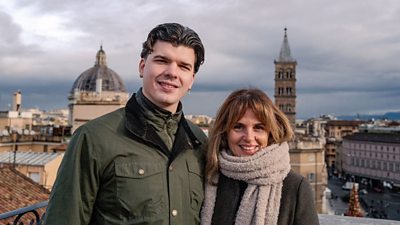
Tell us about the fast you did before setting off.
Before we go to Rome, I visit Oscott to meet my childhood priest, Father Andy. He talked me through what I needed to do to prepare for the journey and make the most out of my time in Rome. He told me that before going to Rome you can do certain things to show hardship. One of them was a fast.
So, as we were beginning the journey, I did a 24-hour fast. Water only. And it was an absolute nightmare. I broke it with fish fingers and chips. Normally I'm a chicken nuggets and chips kind of guy, but they didn't have any, so fish fingers it was.
Had either you or your mum been to Rome before? What was it like arriving?
No, neither of us had ever been. And it doesn't matter where you are in Rome, the city is beautiful. We had neck ache for the first few days from looking up, and dry mouth from how much I was dribbling. You get to see all of that in the film, us just getting dropped off in the middle of Rome, completely overwhelmed.
And that's why I love this show so much. It's not just about religion or the quest to meet the Pope. You see my life from my shoulders. You see I'm just a normal guy who lives in a council house with his mum and dad. Everyone thinks I'm some millionaire celebrity, and I've always said that is not who I am. So not only is it memorable because I got to deepen my faith, it's memorable because you see what makes Harry Clark, Harry Clark.
What did it feel like seeing St Peter's tomb?
It was just mad. Because you hear all these stories back in England, but when you actually go to Rome and see it in front of you, it makes it so much easier to believe. Just believing in something you can't see is super hard. But when it's right there in front of you, it changes everything.
In the Bible, Jesus says to Peter, "On you I will build my first church." And to think that's where Rome started, on top of St Peter, and that's St Peter's Basilica. Seeing that stuff in real life. It was crazy.
What was the most challenging moment emotionally on this whole journey?
Going to St Carlo Acutis' tomb in Assisi.
I've never been one who believes in saints. You hear about saints from 300 AD who slayed dragons, and it's a bit like, that's hard to believe. But St Carlo Acutis was canonised in 2006. He set up a whole website and internet presence so people around the world could hear the word of God. He was one of us, basically.
And when you go to his tomb, it's a shock. Because he's not covered in bronze and gold. He's just there. With his Nike trainers on. He has that same curly hair like me. I was there with my mum, and I just wasn't expecting it. I had to take a step back. That was tough.
Did you attend Mass while you were at the Vatican?
Yeah, and it was just amazing. There are four masses going on at different times, all in different languages. Same with the confession boxes, priests sitting in them all day, Italian, Spanish, English.
The nicest thing was that me and my mum got to go to a Mass that was in Latin. And we still knew where we were in the Mass because of the English echoes running through it. Even though they were speaking in Latin, we understood. If anything, it felt even more special because of that.
What were you hoping to get out of your confession?
One of the main questions I had going into all of this was: am I a good or bad Catholic? To me, I feel like a terrible one. Why should I go to heaven over some priest who's spent his whole life devoted to God? I could spend my weeks drinking, smoking, going out, and then on Sunday just go to confession and be freed? That makes no sense. What's the point if I could technically be a bad person my whole life, confess right at the end, and still get in?
When I put it to Cardinal Arthur Roche who said to me, "Yeah, but what type of person would that make you?" And that was it. That landed. If I wanted to live my life sinning every day, I could. But then I wouldn't enjoy life. I wouldn't have anyone around me who loves me.
And at the end of the day, no one knows what happens when we die. No one. Which is actually quite freeing. Because even if there isn't a heaven, I don't really care. If you told me at the end of my life that there's nothing and asked whether I regret following my faith, I'd say no. Straightaway. Because it's taught me to love my neighbour. It's taught me how to be the best possible version of myself. If we've only got one shot at this, why would I not want to take it?
Has this experience changed your idea of what it means to be a good or bad Catholic?
Yeah, massively. Everyone always talks about Catholic guilt. And it's quite annoying, because now I've been to Rome, I feel even more guilty when I sin. It's the most annoying thing — you miss church on a Sunday, and you feel like the worst person ever.
But I got to meet Cardinal Arthur Roche who told me that the first step to being a good Catholic is realising you're a sinner. Realising you think you're a bad one, that's the first step to being a good one. And that there's no such thing as a good or bad Catholic, because we're all on our own faith journey.
That was nice to hear. It made me stop feeling so bad about everything.
What did you learn about yourself and your faith from this experience?
Firstly that I was wrong, and I need to go to church more.
I was going in with all these tough questions such as, ‘how is the church going to connect with the youth?’ It's so outdated. It was modernising in ways I hadn't imagined. I just hadn't been paying attention.
And it's genuinely changed how I live. I was always a kid who said I'd never go to church, but now I want to wake up and go. It gives me a sense of calmness. I've been every Sunday since I got back from Rome. Every time, I feel like I'm back there. It's the weirdest thing to explain, but I feel like I'll always be connected to Rome and the Vatican now.
Beyond faith - how has this whole experience changed your life?
It's made me want to be a better person. I've always tried to be a nice person, that's all I've ever aimed for. But this has made me want to go further. To help people more, whether that's through religion, supporting young people who are scared to talk about faith, or just generally.
If I can talk about my religion wherever I want, other young people definitely can. And I want kids to see that. You can be cool and still believe in God. You can do both.
And I think if that's what we all try to do, just try to be better and help people, the world would be a much better place.
You've become something of a figurehead for a revival of faith among younger generations. How does that feel?
I don't really see myself that way, honestly. I'm just glad someone gave me the opportunity to talk about it.
People ask if I'm scared to speak about faith. And yeah, in the sense that it's 2026 and you can get cancelled just for mentioning religion. But I'm so bad with technology I'm hardly on my phone anyway. I post what I need to post and I'm off. I find far more interest in real life.
When my manager rang me to ask if I wanted to take part in BBC’s Pilgrimage series, he said, "Are you religious?" I said, "Yeah, I’m Catholic. I’m really religious and go to church most Sundays." And he said, "Oh, I never knew that." And it was like yeah, because you never asked.”
I'm not a serious priest telling you God is the only way. I'll always say first, before faith, before anything, that life is worth living whether you believe in God or not. You need to believe you're worth it. And then, if it helps, this is what faith has done for me. That's all I'm trying to say.
It’s great to see more young people embracing the church again. Do you think many people are looking to faith to make life feel more full?
Well, yeah, it's just a simple question, isn't it? Like, what would you rather? A life where you believe in faith, but you're wrong, or a life without faith, and you're wrong? It doesn't make sense to me as someone who would want to not believe and then be wrong, because then you're not going to have a turn of your happiness. But then, if you do believe, and you're wrong, at least you've lived your life with peace in your life. At least you've lived your life treating other human beings as human beings, with peace. With love, you know, with everything you're taught in the Catholic religion, it doesn't make sense to me as to why anyone would want to live any different.
It raises the question - could I sin my whole life, then repent right before I die and be saved? But then what would your life actually look like? If you just sinned your whole life, you'd be the most horrible person for people to be around. And is that how you want to live your life? And if that is, fair enough. But if it's not, then, well, it doesn't make sense then, does it?
If you had to pick one single most memorable moment from the whole experience, what would it be?
I mean, every single day I was like, "It can't get much better than this." So, it's almost impossible.
But I would have told you this, if you'd met five-year-old Harry Clark and told him that one day he’d go to Rome and try to meet the Pope, I wouldn’t believe you. My fans know, they just go, "Yeah, that's Harry being Harry." I was that kid who'd finish school and ask his mum why we couldn't go to Legoland on the way home.
So, to actually go there, and not just to arrive, but to have it change something in me, was beyond anything I expected. Not just one moment. The whole experience. It's something I feel like I'll always be connected to.
But meeting Cardinal Arthur Roche. That was probably the one.
What's next for you after this? Do you want to make more programmes about faith?
If I'm lucky enough to get offered amazing opportunities, I grab them with both hands. Hopefully viewers will enjoy this documentary. If they do, it naturally leads to the next question: why am I Catholic? My mum brought me up in that church. But what would it look like to live with the Shaolin monks for two weeks in Thailand? Or to spend two weeks experiencing life as a Muslim? Or a Jewish person? That stuff genuinely interests me.
Follow for more
Latest from the Media Centre
All newsSearch by Tag:
- Tagged with FactualFactual
- Tagged with Media PackMedia Pack
- Tagged with Latest NewsLatest News
