Chris Packham transports viewers back billions of years in new series Evolution
Explore the pivotal evolutionary breakthroughs that shaped every living thing
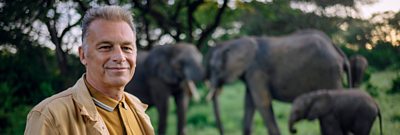
Evolution, a new five-part series tells the extraordinary story of how life on Earth has changed over more than four billion years.
Using cutting‑edge science and immersive visual effects, Chris Packham explores the pivotal evolutionary breakthroughs that shaped every living thing alive today.
Rather than telling a simple chronological history, each episode traces the deep evolutionary journey of one iconic modern animal, revealing how survival, chance, innovation and partnership have driven life’s astonishing diversity.
The scientific research underpinning Evolution involved collaborating more than 600 scientists worldwide, contributing expertise to the storytelling, scripts and visual effects, in addition to guidance from Series Academic Consultant Professor Peter Holland FRS and a long‑standing collaboration with The Open University.
At the heart of the series are the immersive VFX sequences. The production team worked with award winning VFX producer Moonraker to transport the viewer back billions of years to meet the characters that shaped the evolution of life on Earth today.
A BBC Studios Science Unit Production with NOVA and GBH for PBS and BBC, made in partnership with the Open University.
- The series includes 79 minutes of photoreal VFX
- Comprising of 242 different shots
- With over 20 different creatures brought to life
- And a total of 118,629 individual CGI frames
FS
Q&A with Chris Packham
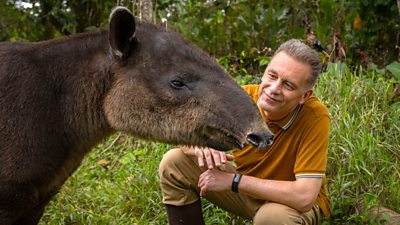
Can you tell us what the series Evolution generally is about?
Our series about evolution is an introduction to a concept which to many people is quite impenetrable, because they believe that it happens very slowly over vast periods of time, and they may even think that it's stopped. And we are the be all and end all of it.
But it isn't. Evolution is a very dynamic and interesting process. There's a pattern. There's a mechanism, but also it involves chance. And automatically through evolution we've come up with this diverse, beautiful, fascinating collection of life that we've got at the moment.
So this is entry level science full of surprising, sparkly facts about evolution, which I hope people will be immediately texting their mates to tell them about because they're going to be so excited about it. And ultimately, I hope we will end up loving life even more than we do now, because we'll realize just how fortunate we are that this mad chain of events has given rise to everything which is currently living.
Can you briefly summarise evolution?
Evolution itself is about the need for all life to try and avoid competition, to find its own way of doing things so that it can maximize its potential.
So over a period of time - and that could be five minutes, it could be a year, it could be a million years - if resources change, then life has to change to be able to take advantage of those resources. Nature has an inbuilt program which allow species to change. Some will fail, they'll become extinct. Others will then take advantage of the gap that they've left.
And it's this process which has shaped life as we know it, and it will continue to do so well into the future. I love that.
Did making the series change the way you see or think about the natural world?
I constantly change, and I constantly change the way I think about the natural world, because I care about it. And very often I'm confronted by things which make me sad.
But they never, ever rob me of hope because ultimately we have such a broad array of solutions, our disposal, opportunities to put things right. And whilst those opportunities are still viable, then I'm certainly going to be doing everything I can to try and encourage people to take advantage of those and to be actually part of the solution, rather than continuing to be part of the problem.
The only way I'm going to do that is if people care about life. And this series is about enhancing people's care for life, because you can't watch this series and not think that the horse, the elephant, the dolphin, and all of the species in between, are absolutely remarkable and invaluable. I get a real message of hope from that.
Why do you think audiences should tune in and watch Evolution?
I think that if you have an interest in natural sciences, tune in because we're going to update the ideas that you've had previously.
We've gone to the cutting edge science when it comes to evolution. We've got new stories to tell you. We've got new ideas to present to you. If you're not into natural sciences but you love life, then come to our series because we're going to surprise you. We're going to excite you, and we're going to engage you with some of the most remarkable stories that couldn't be written in, you know, in human fiction, because they've been written by nature itself over millions and billions of years, and they are just out of this world.
They really are. Here's one. Every single organism, if everything - whether it's a plant, fungi or animal - has all come from one particular cell, life's universal common ancestor. And what about that something that's in a plant, in a fungi, in a bird, in a mammal, in a squirrel is the same as you? That's just so bonkers.
Episodes
The Elephant - Episode 1
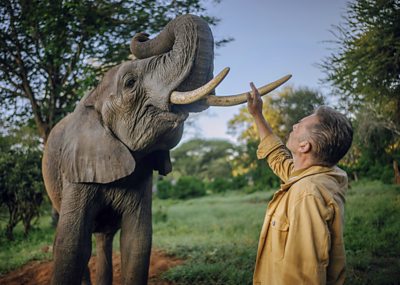
In The Elephant, Chris Packham traces the improbable origins of the largest land animal on Earth. It’s a journey that begins not with giants, but with a single microscopic cell.
Traveling back more than 4.2 billion years, the episode reveals how all life descends from LUCA - the Last Universal Common Ancestor - before following the long path from simple cells, to multicellular bodies, to animals capable of breathing oxygen, leaving the oceans, overcoming mass extinctions, and finally growing to colossal size.
Along the way, The Elephant shows that some of evolution’s most important innovations were not physical traits at all, but partnerships, especially the invisible alliances with microbes that allowed elephants and their ancestors to thrive on a plant‑based diet and reshape entire landscapes.
The Ostrich - Episode 2
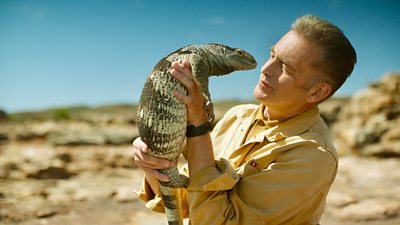
In The Ostrich, Chris Packham tells the extraordinary four‑billion‑year story behind one of nature’s greatest reproductive marvels - the largest eggs on the planet.
The episode traces the origins of sexual reproduction itself, from the first cells to exchange DNA, through the rise of eggs and sperm, to the evolutionary innovations that allowed animals to leave water and reproduce on land. It reveals how drought, chance mutations and natural selection transformed fragile jelly‑like eggs into the amniotic egg - effectively a private pond on dry land.
That breakthrough reshaped life on Earth, giving rise to reptiles, dinosaurs and birds. As some feathered dinosaurs evolved into birds, some abandoned the skies altogether, growing larger and producing ever‑bigger eggs. The story culminates with the ostrich - a living dinosaur whose immense eggs carry the legacy of reproduction’s most radical leaps.
The Bat - Episode 3
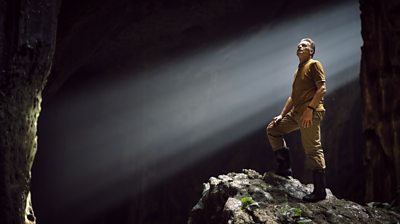
In The Bat, Chris Packham explores how one of the world’s strangest mammals evolved an insatiable appetite capable of powering flight in the dark.
The story begins over 550 million years ago, with simple animals feeding on microbial mats that carpeted the ocean floor. A tiny evolutionary innovation - the development of a through‑gut with a separate mouth and anus - triggered dramatic changes in how animals fed, reshaping ecosystems and contributing to Earth’s first mass extinction.
That same hunger‑driven arms race gave rise to jaws, teeth, and eventually mammals with complex chewing abilities, acute hearing and high metabolisms. When a small mammal combined flight with echolocation, bats unlocked an immense food source in the night sky.
Today, bats are among the most successful mammals on Earth, defined by a relentless need to feed - a legacy of evolution’s most powerful driver.
The Dolphin - Episode 4
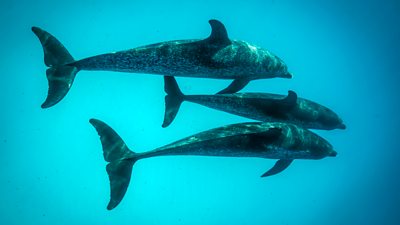
In The Dolphin, Chris Packham uncovers the extraordinary evolutionary story behind one of the most intelligent brains on the planet - a brain shaped by three billion years of sensing, survival and social living.
The episode charts intelligence from its humblest origins, beginning with single‑celled organisms that first sensed and responded to light. As primitive eyes evolved, so too did increasingly complex nervous systems and brains, driving an arms race between predators and prey that reshaped life on Earth.
A pivotal twist comes from an unlikely source - an ancient virus. By inserting its DNA into early vertebrates, it triggered the evolution of myelin, a fatty sheath that dramatically sped up nerve signals and transformed brain processing power. This hidden viral legacy still underpins fast thinking in all jawed vertebrates today.
As mammals emerged, a new brain region - the neocortex - revolutionised learning, memory and decision‑making. One group of mammals then took a bold step back into water. Over just millions of years, land‑dwelling hoofed animals transformed into sleek marine hunters, evolving echolocation, social cooperation and ever‑larger brains.
The journey culminates with dolphins - deeply social animals with complex communication, cultural learning and emotional lives - revealing how evolution built one of nature’s most remarkable minds beneath the waves.
The Horse - Episode 5
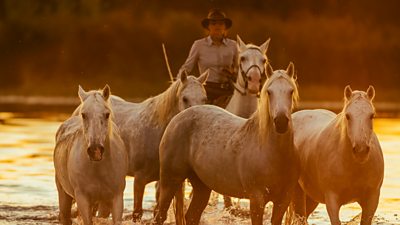
In The Horse, Chris Packham traces over half a billion years of evolutionary innovation to reveal how one animal became one of nature’s greatest athletes.
Beginning with the earliest animals incapable of moving, the episode charts the emergence of muscle, the rise of powerful hearts, the evolution of limbs from fins, and the transformation of feet into hooves, innovations that allowed animals to leave the oceans, colonise land and run at astonishing speeds.
The story culminates with the evolution of Equus - the horse, a creature shaped by movement more than almost any other animal, before exploring how humans became a powerful new evolutionary force, transforming the wild horse into one of our closest companions.
Follow for more
Latest from the Media Centre
All newsSearch by Tag:
- Tagged with Media PackMedia Pack
- Tagged with Latest NewsLatest News
- Tagged with FactualFactual
