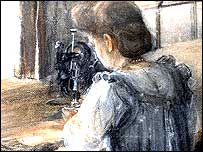
When the role of the suffragette movement, at the turn of the last century, in gaining the right for women to vote is raised, many people immediately think of the Pankhurst family. 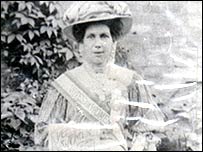 | | Alice Hawkins, The Leicetser suffragette |
Whilst this, to a large extent is rightly so, there were many women of all social backgrounds who also supported the cause. My great-grandmother, Alice Hawkins, was one such lady. Born in 1863 in Stafford of a working class background, Alice left school at 13 to spend her working life as a shoe machinist in the Leicester boot and shoe factories of the time. It begins... In February 1907 Alice attended her first meeting of the Women's Social and Political Union (WSPU) in Hyde Park, followed by a march the same day to the House of Commons to demand the vote for women in society. 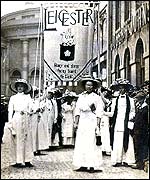 | | The Leicetser suffragettes marching |
That afternoon, mounted police charged down the women and Alice was arrested and imprisoned for the first time in her life. In the following seven years, she was to be arrested and jailed a total of five times. Leicester WSPU Alice's first term of imprisonment was to have a profound effect upon her and soon the Leicester section of the WSPU was formed. Alice and her Leicester colleagues began a tireless campaign of speaking at factory gates, market squares and village greens throughout Leicestershire and parts of Northamptonshire. | "...at night I held meetings for the local WSPU, amongst whom, only Mrs Hawkins, as yet, dared mount the platform." | | Sylvia Pankhurst |
During the summer months of 1907 Sylvia Pankhurst spent much time in Leicester working and gaining the support of the women in the shoe industry. Later in years Sylvia wrote a personal account of the struggle. "... at night I held meetings for the local WSPU, amongst whom, only Mrs Hawkins, as yet, dared mount the platform". For or against? Alice’s finest moment came when she spoke before a mass rally in Hyde Park. Known as Women’s Sunday and attended by over 250,000 supporters, Alice was reported as a keynote speaker the following day in The Times. 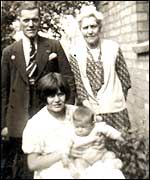 | | Alice with husband Alfred and family |
Unfortunately, not everyone was sympathetic to the militant activities of the suffragettes and speakers at public gatherings were frequently heckled and physically assaulted. One of these occasions was in Leicester market one Sunday evening when a man shouted to Alice, who was making a speech, "get back to your family". Alice replied; "but here is my family, they are here to support me". And indeed they were with her husband Alfred and their children standing by her side. Albert and Churchill 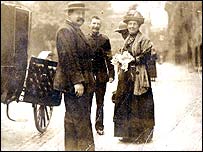 | | Alice being escorted by police |
A committed socialist, Alfred fully supported his wife in the suffragette campaign. On many occasions Alfred would gain entrance to political meetings of Cabinet ministers when women were excluded. On one such occasion Albert heckled a young Winston Churchill when he spoke at the Palace Theatre in Leicester. The suffragette activity continued up to 1914 when the Great War broke out. After the war Alice continued to support the local trade union and the labour movement up to the time of her death in 1946, at the age of 83. Looking back... 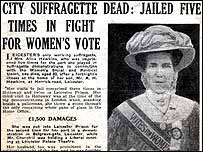 | | Article announcing Alice’s death, 12/03/1946 |
My mum is 80 now, and memories fade. But when we sit down for a cup of tea and I ask mum for her recollections of Alice, she always says - "My grandmother said to me when I was a teenager, you must use your vote, we suffered for it and I always have." Let that be a lesson to us all. |