Navratri is fantastically energetic, fun and beautifully colourful with all the traditional Indian outfits donned. With Leicester's thriving Gujarati community, the city has made its mark as the biggest host of Navratri celebrations outside India. 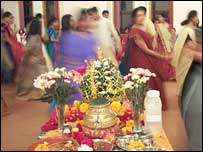 | | Dance at Shree Sanatan Mandir |
This religious Hindu festival consists of nine (nav) nights (ratri) of dancing and prayer dedicated to the Mother Goddess 'Ambica' and all Her forms. The meaning believed to be behind the festival is that thousands of years ago the Mother Goddess took on a powerful warrior-like form called Durga to slay an evil demon Mahisasur. The battle lasted for nine days and nine nights, with Mahisasur being killed on the tenth day ('Dussera). Hence, the 10-day festival attracts crowds from all ages, who all take part in the folk dances. | "In the modern context, both Navratri stories highlight the importance of unity in diversity - a potent message for current times" | |
While all of the forms of Ambica are worshipped, the three main ones are those of Parvati (Goddess of power and strength), Lakshmi (Goddess of wealth and prosperity) and Saraswati (Goddess of knowledge) - each having three nights dedicated to them. During the evening there is a prayer called an 'Aarti' or hymn singing the praises of all of Ambica's forms. It is sung twice by the congregation, many of whom honour the shrine with a lit candle or Diva. DasheraRavana was the king of Lanka (now known as Sri Lanka). He kidnapped Lord Rama's wife one day to avenge the insulting of his sister by Lord Rama. With the help of Hanuman, a monkey-like God and a huge army, Lord Rama led his troops to Lanka and fought with Ravana. 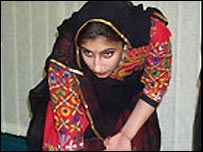 | | A Navratri dancer |
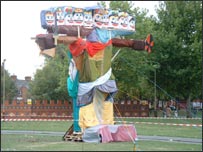
A fierce battle lasting ten days ensued, when Ravana was finally killed. So, on the day of Dashera, a giant effigy of Ravana is burnt amid great celebration. Dashera is also significant as it follows the Navratri festival. The Goddess Ambica or Durga battled with an evil demon Mahishasur for nine days and nine nights and finally killed him on the 10th day. So in both cases, it's a victory of good over evil. In the modern context, both stories highlight the importance of unity in diversity. Ambika is said to have been created by all the Gods giving up a part of their powers and weapons to create a supreme Goddess. And Rama struck a friendship with Hanuman - who's from a totally different background to His own. 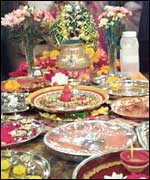 | | A Navratri Shrine |
The ritual of the Navaratra of the sowing and sprouting of corn for nine days and the climax through a variety of dances links agricultural and urban societies together. Today in the cities and towns, the dance is a social activity and entertainment practised by Hindus, rather than a religious agricultural or fertility symbol. The most two popular forms of traditional dance at Navratri include Garba and Dandia Raas. Garba is played using the clap of hands, while Dandia Raas is played using mainly wooden sticks. Feasting and fasting are also important cultural aspects of Navratri. |