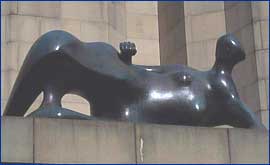
Modern sculpture also makes an important contribution to public life - it is seen as the ultimate symbol of urban regeneration.
Interest in public art is growing, so expect to see more examples springing up in the near future - including additions to the newmillennium sculpture on Eastgate roundabout. Each sculpture has its own story to tell, so take a virtual tour of some that you've probably seen before... What better place to start than with the famous figures and equestrian sculpture in Leeds City Square?
 | The Black Prince
Thomas Brook, 1903 |
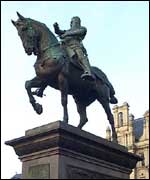
Leeds' famous Black Prince in City Square was a gift from Colonel Thomas Walter Harding, Lord Mayor of Leeds between 1898-9. Despite having no connection with Leeds, the son of King Edward III became the landmark that greets visitors arriving at the city station. The King was the personal choice of Harding, who believed he symbolised the virtues of democracy and chivalry. The Black Prince is the centrepiece of an array of statues in the square, which include Joseph Priestley, the father of modern chemistry. From here, head along Infirmary Street towards Bond Court, behind Est Est Est. 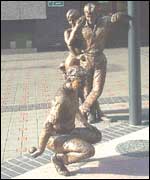 | Game of Boules
Roger Burnett, 2000 |
This bronze sculpture in Bond Court depicts a Yorkshire couple and their child watching a Frenchman playing boules.
Before the unveiling of this sculpture few people were aware that the patch of grey gravel it stands next to is actually a boules court.
Instructions and boules are available at the court, so you need never have a lazy lunch hour again. Up to the Headrow for our next sculptures... 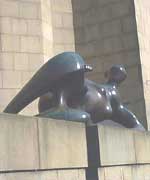 | The Reclining Woman
Henry Moore, 1929 |
This eye-catching lady has been luring people into the Leeds Art Gallery since she was given to them in 1980 by the Henry Moore Institute. During his lifetime Castleford-born Moore studied at Leed College of Art and received an Orderof Merit in 1963.
One of the most famous sculptors of the 20th century, he believed sculpture was "the art of open air." 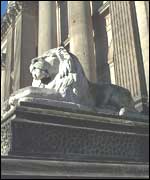 | Four Lions
William Keyworth, 1867 |
The white lions guarding the Town Hall are thought to have been inspired by the lions carved on Nelson's. The lions were added to the entrance nine years after it was officially opened by Queen Victoria.
Folklore says that the lions get up and walk around the building when they hear the clock strike twelve.
Now walk down the Headrow towards and past the Light. 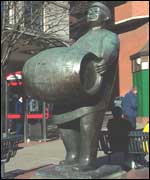 | The Dortmund Drayman
Arthur Schulze-Engels, 1980 |
Affectionately known as 'The Barrelman' this jolly figure is outside the St John's Centre.
The statue was a gift from Leeds' twin town Dortmund in 1980 and stands in the square of that name.
Now we head up past the Merrion Centre to Hyde Park for more sculptures.
|