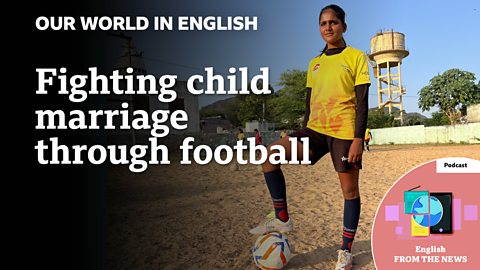
(photo credit: Divya Arya/BBC)

Introduction
Though illegal, child marriage is widely practiced in India.UNICEF’s latest estimate is that 216 million girls and women in India today have been married before they turned 18.
But some girls and young women are trying to resist the practice.
In this short documentary, we meet Munna, who found an unusual way out of becoming a child bride - through playing football.
Vocabulary from the story
illiterate
unable to read or write
marry off
arrange for someone to be married
without a care in the world
relaxed and unconcerned about things happening around you
with abandon
in an uncontrolled way
impromptu
unplanned


Transcript
Georgie
At the BBC, our colleagues investigate important stories around the world.
In this special series, Our World in English, we bring you the best documentaries from the BBC in language you can understand.
This episode is called Fighting child marriage through football.
This story hears from women in India in their first language and what they say is translated into English.
19-year-old Munna and her mother Laali are working hard. They’re pulling water up from the well by their house and washing clothes, as Munna’s father rests inside. Once Laali is done here, she will walk for a mile to work as farm labourer in a nearby field.
In this village in the Indian state of Rajasthan, a nine-hour drive from the country’s capital Delhi, women are mostly illiterate, which means they cannot read and write. And they also get married early. Laali says everything changed when she became a child bride.
Laali
It made life so difficult. Bringing up children, taking care of the husband and daily chores. And if you get a husband who is alcoholic then it’s very difficult to run the household.
Georgie
But what happened to her was going to be repeated when Laali decided to get Munna and her elder sister married early too.
Though illegal, child marriage is widely practiced in India, especially here in Rajasthan. UNICEF’s latest estimate is that 216 million girls and women in India today have been married before they turned 18.
But some girls and young women are trying to resist the practice. Today we’re going to hear the story of Munna, who found an unusual way out of becoming a child bride – through playing football.
Munna was only 14 when she was told she would be a child bride.
Munna
My sister was 16 and I was 14 years old in 2020, when she was married off. When the family came to see her, my mother also showed me to them and offered that I be married to the groom’s younger brother.
Georgie
Munna’s mother Laali was only 15 when she was married. So why did Laali arrange for her eldest daughter to be married while she was still a child, even though she knew it’s illegal?
Laali
They say that if girls step out of their homes, they will be exposed to bad influences and run away with boys. We do the marriage quietly. We don’t print a wedding invitation or put up a tent.
Georgie
Reporter Divya Arya asked Laali more.
Divya
But the difficulties you faced with early pregnancies, your eldest daughter would face them too?
Laali
No, she is marrying into a good family. The rest is up to God.
Divya
Did she ever say to you she didn’t want to be a child bride?
Laali
No, you can’t say no to parents in our society. Once we have decided their match, they cannot say no.
Georgie
Except Munna, unlike her older sister, did say no.
Munna
When they told me you will be married too. I started crying. I said I don’t want to marry right now. I am in Grade nine, I want to study.
Georgie
In Rajasthan, many families exchange their daughters to be brides as part of the custom of child marriage. And this helped Munna.
Munna
My parents wanted a bride for my brother in exchange, but that family didn’t have a girl. They pleaded that I be married to their younger son and promised they will give a bride in exchange when a girl is born in the family. But my mother refused. She said, what if you don’t have a girl then our son remains unmarried.
Georgie
Munna had a lucky escape, but she needed another way to avoid child marriage. When she began playing football, it wasn’t clear that this might be a way to find freedom.
Munna
I didn’t know anything about football. We were told it is played by using the feet. So that’s what we did. We were hitting the ball here and there, feeling scared. Then our clothes would get in the way, we couldn’t even run properly, so we would lift our clothes and try and run with the ball.
Georgie
But there were battles ahead. First Munna had to fight just to be allowed to play football, then to wear shorts on the field. And then to travel out of the village to take part in tournaments.
Munna
For the first two three days, village women would point to us and say look at those girls exposing their legs. Then we started ignoring them and decided we won’t care and continued wearing shorts.
It feels great. We had never thought that we will be able to go out to play and wear shorts. It’s been life-changing for us.
Georgie
But how could this sport stop child marriage? Or help those young girls who are already child brides?
Journalist Divya Aria is looking at pictures of young girls in wedding outfits with Padma Joshi.
Divya
It’s one thing to know of it and it’s another to see pictures of such small children
Georgie
Padma was the one to introduce football to Munna. And to 800 other girls across 13 villages in Rajasthan over the past decade. She has been leading the Football for Freedom project at MJAS, a women’s rights organisation.
Padma
When we started talking to parents, we never said that we are introducing football to stop child marriage. We said the sport will take girls forward. They will be able to get government jobs that they are allocated to sportspersons. That was our approach. But when we worked with the girls and they learnt about their rights, about the country’s constitution, the ill effects of child marriage and because girls were stepping out, they were able to raise their voices.
Georgie
Reporter Divya Arya went to see the girls play.
Divya
Munna’s village football team is clad in bright yellow jerseys, facing their neighbouring village’s football team is in bright green. Everybody is wearing black shorts, black socks, proper shoes. The picture is a stark contrast from how I saw them and their mothers in their villages. The mothers wear traditional saris, cover their heads, in fact cover their faces when in the presence of men in public. And these girls, being guided by two male coaches, are playing as if without a care in the world, with complete abandon.
Georgie
The girls play without a care in the world, that means they are relaxed and unconcerned about the opinions and societal pressures around them.
At half time, Divya wants to know how many players in the team were forced into early marriage.
Divya
This is Munna's village’s football team and I want to find out how many of the girls here were forced into early marriage and I'll ask them to step up.
That's nine out of 12. Just Munna, her sister and one other player were able to resist the pressure to marry early. So, it's incredible that all of these girls are here on the field, and have been able to fight for that right.
Georgie
Even though football hasn’t been able to prevent all these girls from marrying, it has changed things here. Even sp,e child brides being able to train in football, opening the possibility of some independence and a different life.
But even as Munna began to succeed playing football, the pressure to marry kept returning. Munna’s family received a proposal for a three-way bride exchange involving her and her niece who was just a few months old.
Munna
My elder sister has had a baby daughter and her in laws are putting pressure for my marriage again. They want to marry this baby girl into another family, get a girl from that family for my brother and marry me to their younger son to complete the exchange.
Georgie
It seems like avoiding child marriage is a constant personal fight for these girls.
Anjali Sharma is the district’s Government officer responsible for the welfare of children. She explains why people still arrange child marriages despite a law against the practice.
Anjali
The law says that every person who has helped in a marriage should be punished, even the person who prints the wedding invitations. But that doesn’t happen because no one will come forward as a witness. It becomes very difficult to get a conviction. Because we need to go and stop the marriage as soon as we know about it. But the family will then often move the marriage to a date before or after the one we are expecting.
Georgie
It’s clear then that fear of legal punishment is not working on its own.
Padma Joshi of the women’s rights organisation MJAS believes the new law needs to be accompanied by a change of attitude in local communities and more support from government institutions.
Padma
Instead of stopping one or two marriages, we believe sustained change can only come when their mindset changes and then that might stop child marriage. The other challenge for girls is they don’t have opportunities. Because it’s not like they will play in competitions and finish their education, and then somebody is waiting to give them jobs which can help them be financially independent and live a life of dignity.
Georgie
Munna is now 19, an adult. And one with dreams of a different life. Football has saved her from becoming a child bride. But if she doesn’t find a way to be financially independent, then she will be pressured to marry and her life may become much like her mother’s. A life of household chores. Cooking, washing, cleaning.
Munna has joined a group of girls from another village after they won a regional tournament – and they’re now parading their trophy. The women watching them are recording the spectacle on their smartphones, but with veils covering their faces. They are full of praise.
Woman at parade
I have never seen such a celebration in our village. They have won a trophy and now we feel we should also send our girls to play so they can make us proud. But we also hear many things happen to girls when they step out and fear for their safety.
Georgie
Munna has battled these fears herself and now wants to lead the fight for other girls. But she’s also still struggling with the pressure from her family to marry. So, Munna has trained to be a coach and plans to become a school sports teacher. It’s a path that promises financial independence and freedom to take decisions about her own life, including escaping the three-way exchange marriage the family want her to be part of.
Munna
Younger girls are able to step out because they see older ones like me out there. Their mothers ask us to take them along and drop them back home safely. For those girls who are already child brides, they face pressure to stay at home and do household chores. So I feel I have to pull these girls out and whether I am able to stop their marriage or not, help them become something in life, realise their dreams.
Georgie
The girls break into a spontaneous dance. One is even crying. Joy and relief at being able to dream, win and become champions of their own lives.
Thanks for listening to this episode of Our World in English, based on the documentary, India's sportswomen playing to be seen from Assignment on the BBC World Service. The original programme was reported by Divya Arya and produced by John Murphy. You can find more information about Assignment by following the link in the notes below this programme.
Find out more
Listen to the full programme
More from Assignment
Next
Learn more English from the news.
Discover our latest programmes.
Latest Our World in English
Fighting child marriage through football
Episode 260327 / 27 Mar 2026
In Rajasthan, India, Munna is playing football to avoid getting married young. Adapted from Assignment from the BBC World Service.

The battle for the cowboy way of life
Episode 260213 / 13 Feb 2026
People in Montana, US worry that they will lose the land the makes the place special. Adapted from Assignment from the BBC World Service.

Love in a war zone
Episode 251215 / 15 Dec 2025
Adela falls in love and moves to Kharkiv in Ukraine. Adapted from a BBC Eye documentary.