Letter from America - 80 years on
Glenda Cooper and Howard Tumber explore the BBC's longest running speech radio programme
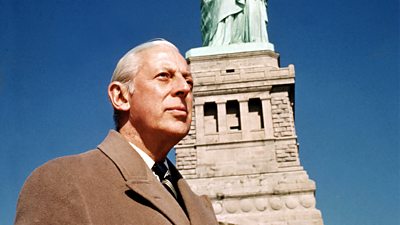


Alistair Cooke’s Letter from America ran for five decades on BBC Radio 4, its predecessor the Home Service, and the World Service. It remains the longest-running speech radio programme hosted by one individual and consists of 2,869 broadcasts made between 1946 and 2004.
Cooke said that his own career was "to try and explain this country [the US] to Britain" and that Letter from America should be equally accessible to "shrewd bishops and honest carpenters". In a memo to Lindsay Wellington, the BBC’s Controller of Programmes in 1946, he put on record his aspirations:
"a weekly personal letter to a Briton by a fireside about American life and people and places in the American news. I shall try to give him a running commentary on topical aspects of American life, some of the intimate background to Washington policy, some pictorial excursions into regions and places, some profiles of important Americans who (because they work in the shadows of the limelight or are suddenly projected into it) are unknown to him as Personalities. The stress will always tend to be on the springs of American life, rather than the bright headlines themselves."
A very particular view
Cooke’s reflection on his past experiences in the Letters and his personal approach to journalism, which at the time was a departure from the more formal language and structure of other commentators, meant that his devoted listeners in the UK were being treated to a very particular view, drawn from Cooke’s own experience, living amongst the New York elite.
Cooke’s broadcasts covered 11 presidents from Harry S Truman to George W Bush. Letter from America was broadcast through many seminal points of US history both politically and culturally: McCarthyism, the civil rights era, the Vietnam War, the two Gulf Wars, Watergate, Roe vs Wade, the ending of the Cold War as well as the changes in culture – from Elvis to the Summer of Love, from the golden age of Hollywood to the rise of CNN.
Fame
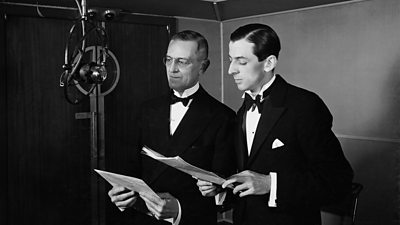
Cooke’s fame as a broadcaster was based not only on his Letter from America but also from his documentaries, in particular his series America, and his hosting of Masterpiece Theatre. But fifty years ago not everything was running smoothly between Cooke and his editors.
Long before the current era of digitisation, Cooke’s scripts and broadcast discs were sent by airmail, and communication between producers in New York and London was via letters. Looking back 70 years through these letters in the BBC Written Archives, they reveal that matters did not always go to plan. There was particular irritation about Cooke’s work habits amongst the BBC’s Talks Producers responsible for Cooke’s Letter from America.
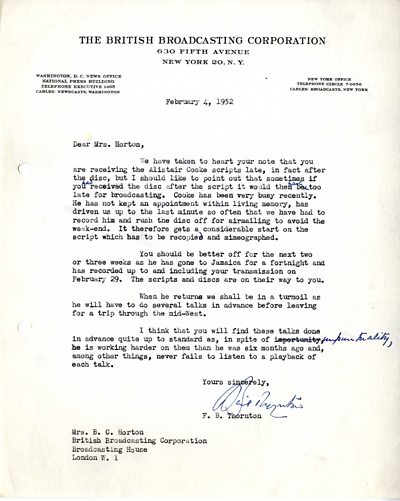
In a letter (dated 4 February 1952) from F B Thornton, producer at the BBC North American office, to B C Horton, who was a Talks Producer at the BBC London office, Thornton apologised for Cooke’s scripts arriving late after the discs were sent. Thornton pointed out though that “if you had received the disc after the script it would then have been too late for broadcasting”. Thornton then attempts to explain Cooke’s lack of diligence in this regard.
Cooke has been very busy recently. He has not kept an appointment within living memory, has driven us up to the last minute so often that we have had to record him and rush the disc off for airmailing to avoid the weekend. It therefore gets a considerable start on the script which has to be recopied and mimeographed.
Thornton then goes on to try and placate Horton regarding the future, informing her that Cooke had recorded scripts for the next two to three weeks and these were on their way to her. “I think you will find these talks done in advance quite up to standard as he is working harder on them than he was six months ago and among other things, never fails to listen to a playback of each talk.”
Delivering the scripts
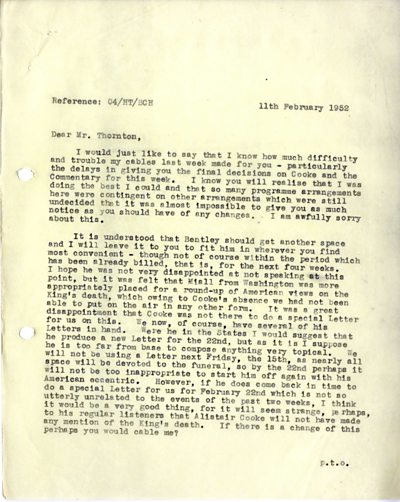
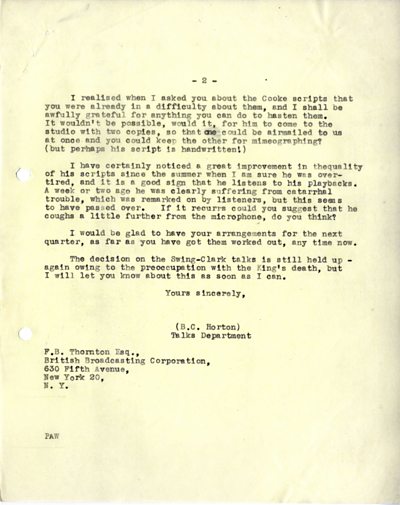
In a response to Thornton a week later (11 February 1952), Horton sympathises about the Cooke scripts and pleads for anything that could be done to hasten them to London and asks whether Cooke could be persuaded to come to the studio with two copies so that one could be airmailed immediately.
Horton then proceeds to discuss the quality of the scripts noting that there was a great improvement since the summer “when I am sure he was overtired”. Pleased to hear that Cooke listens to his playbacks, Horton then discusses Cooke’s performance, remarking that in a recent broadcast he was clearly suffering from catarrhal trouble which apparently was remarked upon by listeners.
Horton suggests to Thornton that if this problem reoccurs could he suggest to Cooke that he coughs a little further from the microphone.
Concerns
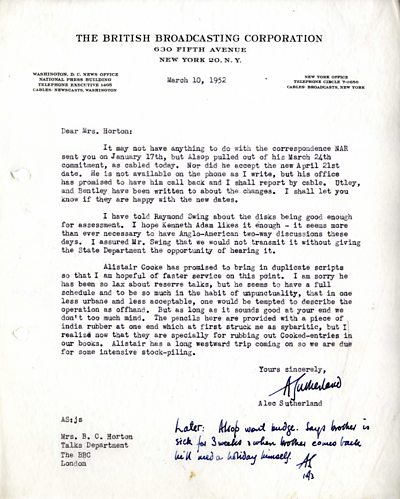
The concerns regarding Cooke’s behaviour did not end there. The following month Alex Sutherland, who was then Chief Assistant in the North American Office of the BBC, wrote to Horton (10 March 1952). Sutherland opines that he is hopeful of faster service because Cooke has promised to deliver duplicate scripts. Sutherland then apologises about Cooke’s timekeeping.
I am sorry he has been so lax about reserve talks, but he seems to have a full schedule and to be so much in the habit of unpunctuality, that in one less urbane and less acceptable, one would be tempted to describe the operation as offhand. But as long as it sounds good at your end we don’t too much mind.
And then in a rather funny barb Sutherland goes on to add
The pencils here are provided with a piece of India rubber at one end which at first struck me as sybaritic, but I realise now that they are specially for rubbing out Cooked-entries in our books. Alistair has a long westward trip coming on so we are due for some extensive stock-piling.
It is hard to imagine these kind of exchanges occurring now, whether via email or on WhatsApp. People’s language and discourse in workplaces have changed immeasurably. Thankfully, by preserving this correspondence, the BBC archives permit a glimpse into times past, and in the case of Alistair Cooke an insight into the dispensation made to his working methods by BBC producers at an early period of a career that was to prove so important in how listeners, both in the UK and beyond, understood the cultural and political life of the United States for nearly 60 years.
Links
- Letter from America1472 episodes of Alistair Cooke's Letter from America as broadcast on BBC Radio 4 from 1946-2004 can be found on BBC Sounds.
- City St.George's, Univeristy of LondonReporting America in the age of outrage.
- Further readingLetter from America 1946-2004, Penguin Modern Classics 2021. Reporting America: The Life of the Nation 1946-2004, Allen Lane 2008.
Biography
Dr Glenda Cooper is Reader/Associate Professor in Journalism Studies at City St George's, University of London. Howard Tumber is Professor Emeritus, Sociology & Journalism City St.Georges, University of London.
In 2020 Dr Glenda Cooper and Professor Howard Tumber were awarded a British Academy Small Research Grant to research the work of Alistair Cooke, having gained the first permission to access both the Cooke family archives and the BBC archives into his work.
Search by Tag:
- Tagged with BBC History ResearchBBC History Research
