Importing success
A long tradition of bringing the best international drama to British viewers began on the BBC 70 years ago. Writer and broadcaster Paul Hayes explores one of the first major drama "imports" seen on BBC Television.
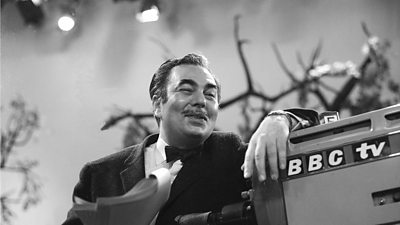
The BBC has long had close relationships with its ‘sister’ public broadcasters around the world, such as RTÉ in Ireland, SVT in Sweden, and the CBC in Canada; sharing expertise, personnel, and even programmes. 70 years ago, one import from the CBC made a particularly strong impact – the beginning of a tradition of the BBC bringing the best of international drama to British viewers…
Air journey inspiration
On 3 April 1956, CBC Television broadcast a live play which was to change the course of television history thousands of miles away. These days, Flight into Danger’s best-known legacy is its eventual 1980 remake as the comedy film Airplane!. But long before that, its effect on British television was profound.
The story is a simple one. On an airline flight across Canada, there is a choice of lamb or salmon for dinner. But the salmon is bad, and everyone who has it falls ill with life-threatening food poisoning – including both of the pilots. The only person on board with a chance of landing the plane is a former fighter pilot, who hasn’t flown for nine years and never anything this big, and who has to be talked down over the radio by a senior pilot at the airport.
The play’s author Arthur Hailey went on to be a best-selling novelist, but it was Flight into Danger which enabled him to become a professional writer. He’d come up with the story idea while on a plane journey in late 1955. Having been born and raised in Luton in the UK, Hailey had served in the RAF during World War Two, then emigrated to Canada in the late 1940s where he worked as a magazine editor and advertising man in the trucking industry.
Writing home
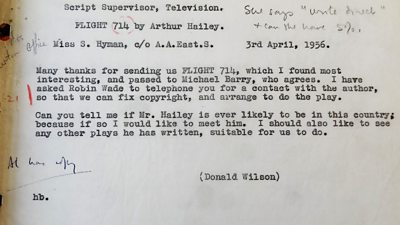
Hailey wrote Flight into Danger in nine days and sent it to the CBC, who produced it live as part of their flagship General Motors Theatre anthology series. It made a huge impact in Canada, but even before its success there Hailey had ambitions for it to be shown back home on the BBC. Prior to its CBC broadcast, he arranged for a friend who worked for the BBC to send the script, under its original title Flight 714, to the BBC Television Script Section.
Script Section boss Donald Wilson and Head of Drama Michael Barry both read and liked the play, and initially it was planned that the BBC would make their own version under Canadian director Alvin Rakoff. However, plans changed; instead, the BBC ended up showing a recording of the original Canadian version.
Michael Barry gave a special on-camera introduction to the broadcast, in which he explained that the CBC had sent the recording as a production guide. Barry told viewers that “it was so good we decided to use it and cancel our own production plan.”
An unusual import
Showing the recording of Flight into Danger was a highly unusual move. At the time, there were two main ways of making television drama. It could be entirely filmed like a movie, although to a much tighter production schedule. Or it could be produced live from a television studio.
In later decades film came to be seen as the higher-quality option with more gravitas, and television studio production the cheaper domain of soaps and sitcoms. But in the 1950s live drama was more prestigious among most in the television industry and was the dominant way of doing things in Britain.
Live dramas were seen by many writers, producers and critics as having more depth and worth as pieces of art and literature, being closer to the theatre. Film productions on television, meanwhile, were predominantly regarded as the medium of lightweight adventure series such as imported US westerns.
Although the BBC had shown such US film imports and had done live link-ups with other European broadcasters for regular programme exchanges, for them to show a recording of a live drama from another country was almost unheard of. Indeed, Flight into Danger may be the very first such example.
It’s therefore a founding part of a proud legacy of the BBC introducing British viewers to highly-regarded international dramas they might never otherwise have seen; whether that be German war series, Australian cricketing docudrama, or 21st century Scandinavian crime thrillers.
Flight into Danger also allowed the BBC to make innovations of their own. For obvious reasons they could rarely create trails for their own live plays, but Flight into Danger being a recording allowed them to experiment with the idea. This was so unusual that it even merited a mention in the Daily Telegraph. “Flight into Danger, the brilliant Canadian play, was trailed the day before it was televised and captured the fantastic audience of 9,750,000 viewers.”
Audience-winner
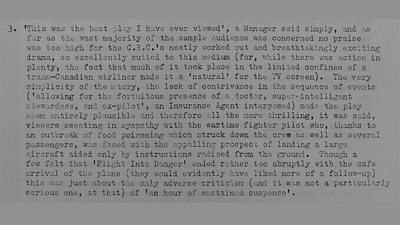
Flight’s audience on the BBC was indeed impressive. The viewing figures for that week, stored in the BBC Written Archive Centre’s files at Caversham in Berkshire, show that it was a rare hit in the ratings battle with the young and growing ITV network. It was seen by an estimated 41% of all potential viewers in homes where ITV was available – with ITV itself only managing 25% of such viewers at the same time.
A quarter of the adult population of the UK was believed to have tuned in, the most-watched show of the week, with the BBC’s audience research report showing an incredible ‘reaction index’ figure – how much those surveyed had enjoyed the programme – of 92 out of 100. This was then an all-time joint-record for a drama, and nothing else shown on the BBC that week even got into the 80s.
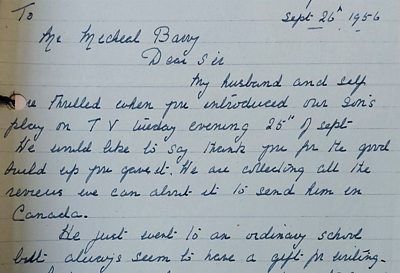
The most charming piece of feedback on the play in the BBC files at Caversham, though, is a letter to Michael Barry from Mr and Mrs GW Hailey of Albert Road in Luton – Arthur Hailey’s parents. Genuine Victorians born in the 1880s, when they were young they could surely not have imagined a world of air travel and television, and they were proud that the BBC had shown their son’s work.
“Dear Sir,” Mrs Hailey wrote, “my husband and self were thrilled when you introduced our son’s play on TV… We would like to say thank you for the good build-up you gave it. We are collecting all the reviews we can about it to send him in Canada.”
Transatlantic pride
Back in Canada, news of the reaction to Flight into Danger’s broadcast on the BBC was met with delighted surprise and no small amount of pride; a demonstration of the esteem in which the BBC was held. Even nearly half a century later, in a 2002 piece marking 50 years of Canadian television, the Ottawa Citizen newspaper marvelled how Flight into Danger had “enthralled 10 million Brits.”
“CBC Television Play Thrills UK Viewers” was the headline over a piece in the Montreal Star the day after the 1956 BBC showing. The Vancouver Sun, meanwhile, explained how Flight into Danger had “scored a smash hit on British television.” Extensively quoting the UK newspaper reviews, it also noted how “the BBC switchboard was jammed with congratulatory calls from viewers.”
Another Vancouver-based newspaper, The Province, showed how the BBC was regarded as having very high standards. The paper commented that the play had been “chosen by that hard-to-please outfit as Britain’s introduction to Canadian TV.” Similarly, the Ottawa Citizen at the time wrote that “possibly there are no more critical viewers of the CBC’s output than the BBC’s buyers.”
A new man
The success of Flight into Danger’s UK showing prompted the BBC to buy further CBC plays. These had all been overseen, like Flight into Danger, by the CBC’s Head of Drama, Sydney Newman. Over a quarter of a century later, Newman explained in a BBC Oral History interview how all of this resulted in him gaining a positive reputation in the UK.
“There was my name at the end of every one – ‘Supervising Producer, Sydney Newman’ – and so my name got known a bit here.” In his memoirs, Newman also recalls how the sale of the CBC plays to the BBC created “a ripple of excitement through the corridors of the CBC. The mother of all broadcasting organizations, the BBC, gave my drama department its stamp of approval.”
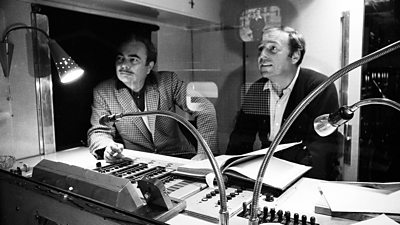
Newman was invited to England in August 1957, as a guest of Michael Barry, for the kind of cultural cross-pollination which the BBC has often been keen to encourage.
At the end of that visit Newman attended a clandestine meeting which eventually saw him recruited by ABC Weekend Television, one of the ITV companies. He moved to the UK to become their Head of Drama in 1958, but after four years could not resist the lure of the BBC – having an admiration for what he referred to in his memoirs as “the famed broadcasting organization that had inspired the creation of my own CBC.”
Newman joined the BBC as Head of Drama at the start of 1963 and spent five years there in a period of intense creativity which has come to be defined as one of the golden eras of the genre on British television. His achievements were numerous – but there is one particular programme which dominates his legacy.
For it was Sydney Newman who drove the creation of and co-devised the format for Doctor Who, one of the best-known and most popular of all BBC series. A creation which might well never have happened had the BBC not taken a chance on showing the Canadian play which would one day end up being remade as Airplane!.
Written by Paul Hayes
Links
- BBC News - Beds Bucks & HertsArthur Hailey, celebrating a Luton legacy
- BBC Oral History CollectionInterview with Sydney Newman conducted by Frank Gillard, August 1984
- BBC HistoryJamie Medhurst, Professor of Media and Communication, Aberystwyth University explores popular drama on the BBC
