| 13 November 2014 |

| |
| BBC Homepage | | |
| |||
| Contact Us | | |
HistoryYou are in: Glasgow and West Scotland > People & Places > History > The Puffers 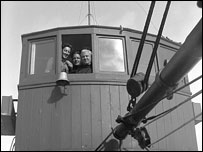 The PuffersCalum Pearson unearths rare photographs of 'the wee boats' taken by his father Stewart while working as a deckhand on the 'Celt' puffer and looks at a lost way of life in the Highlands and Islands and West Scotland. 'If you were down by the River Clyde when Glasgow’s docks were active, amongst the shipbuilding activity and cargo vessels steaming in from ports around the world you would likely have seen a much smaller, dumpy boat of simple design. With a wheel-house at the stern, above the engine room, a lum reeking black smoke obscuring the skipper’s view over the single hold, and a derrick up front in the vertical, rounded bow, this was know to many as the Clyde Puffer. Stewart Pearson spent some time as a deckhand on one of these puffers and in 1954 he took a simple box camera with him. The pictures he took lay undeveloped until he rediscovered them some 50 years later. They are a unique personal record of his time aboard the puffer 'Celt'. Puffers were essentially small steam powered cargo vessels which were a vital trade link to the west coast of Scotland for many decades. They even saw service in both World Wars, supplying the Navy’s fleet. They are fondly remembered by many and were made famous by Neil Munro’s Para Handy stories. 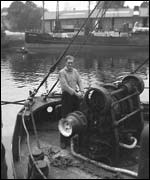 Stewart Pearson at the winch The puffers were first used to carry cargo in the Forth and Clyde Canal and they were built in the boatyards on its banks. They evolved from iron-hulled barges and a small coastal cargo sailing ship, called a gabbert. These adept new builds were fitted with a simple steam engine to compete with the railways. As the used steam went straight up the funnel with a chuffing sound, these boats worked their way along the canal under clouds of steam, and became known colloquially as the puffers. The cargo trade in the canals declined, but the need to deliver goods to the isles and inlets of West Coast of Scotland increased. Sea-going puffers were developed and were ideally suited to what was called “the west coast trade”, or just “the trade”. With a built-in crane and the ability to beach themselves if necessary, the locals could come along side and have their cargo lowered into carts or trailers. Vital cargos could be taken to places larger coasters could not access and these deliveries are fondly remembered by many highlanders and islanders. It was sometimes quite an event, with a high local attendance to either watch, or to help with the discharge. This trade link helped to preserve the hebridean way of life, delivering essential supplies. 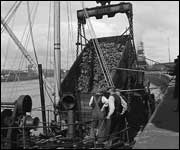 The puffer 'Celt' loading coal The steam puffers were given an extra lease of life after success tending the Navy’s fleet during World War I. The Admiralty commissioned the building of a large number of supply boats during the 1940s, based on the steam puffer design. These were given the catchy name of Victualising Inshore Craft. The puffer 'Celt' in these new-found photographs was originally one of these, and known as VIC 64 before being brought into the trade in 1953. In the years after the war it was cheaper to buy a used VIC, and some of these survive to this day. During the 1950s and 1960s efforts were made to keep the puffer trade viable with larger vessels and diesel engines becoming more common. The last steam puffer in general trade, the Invercloy was scrapped up in 1967, ending the era of steam. Larger puffer companies such as Hays, Hamiltons, and Ross and Marshall began to merge and worked under the umbrella organisation of Glenlight Shipping to improve efficiency. The puffer operators suffered a severe commercial blow with the introduction of the Western Ferries service to Islay in 1968 losing most of their trade on that profitable route. Road haulage to the islands now had a subsidised passage, the islands used less coal, several ships were lost at sea, and with a fleet needing to be modernised, the puffer trade was in a battle to survive. They did survive until 1993 when the difficult battle for grants and subsidies to compete with the ferries made the west coast trade inoperable for Glenlight Shipping. They withdrew from the business in 1994 and with that the last vestiges of puffer life disappeared only to be preserved by museums and enthusiasts.' 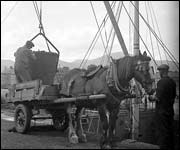 Unloading the puffer 'Celt' at Annalong Surviving puffers:1. 1902 canal puffer 'Basuto' is at the National Waterways Museum in Ellesmere Port.
The BBC is not responsible for the content of external websites last updated: 03/08/2009 at 11:57 You are in: Glasgow and West Scotland > People & Places > History > The Puffers |
| | About the BBC | Help | Terms of Use | Privacy & Cookies Policy |