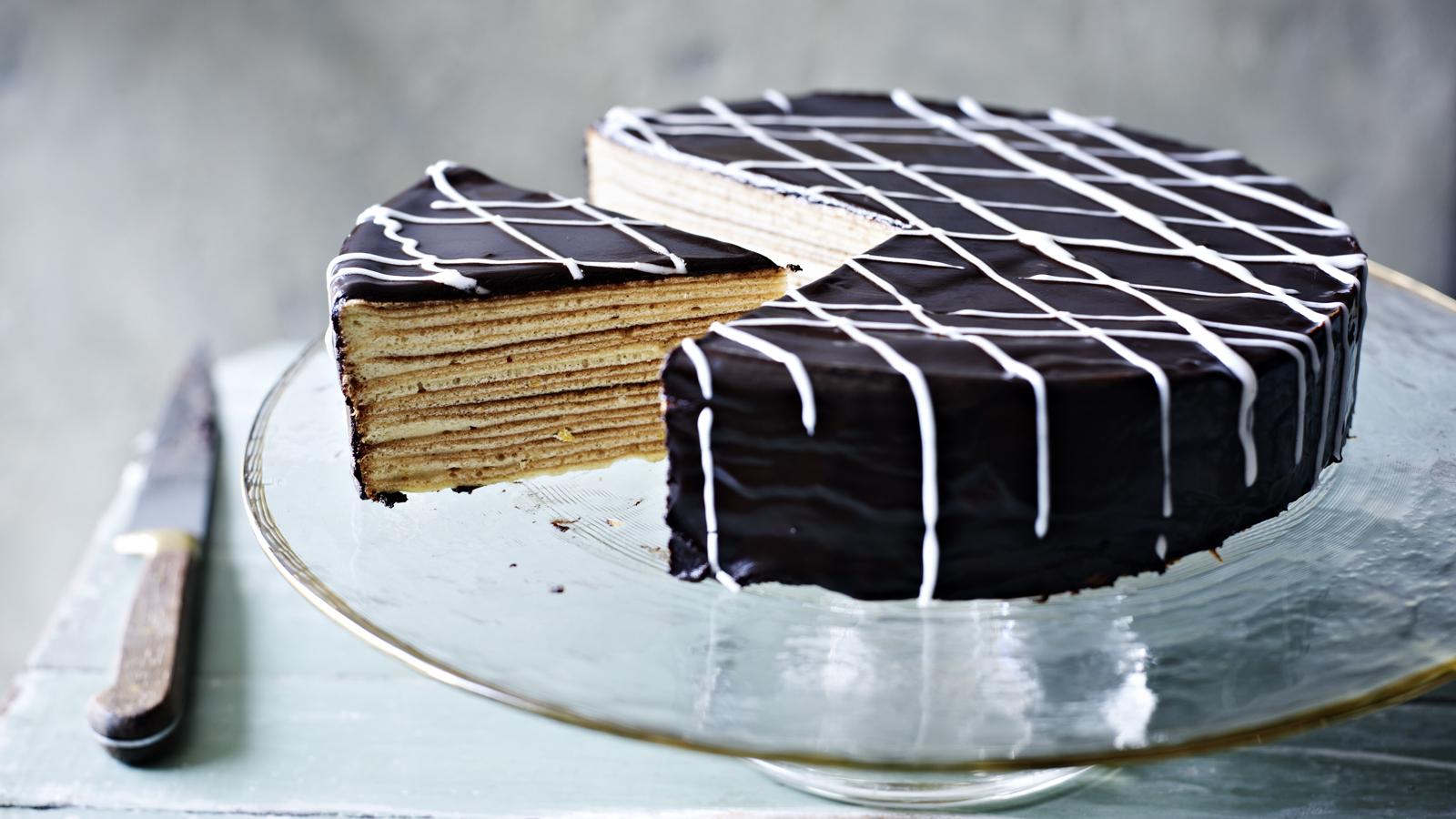
Handmade croissant dough
- Prepare
- overnight
- Cook
- 10 to 30 mins
- Serve
- Serves 6
Handmade croissant dough made by layering butter into a soft yeast dough, then folding and chilling to create light, flaky layers before baking.
Ingredients
For the croissant dough
- 55ml/2fl oz whole milk
- 10g/1/3oz fresh yeast (or ½ tsp instant yeast)
- 215g/8oz T45 or T55 croissant flour (or strong white bread flour)
- 25g/1oz caster sugar
- 15g/½oz unsalted butter, chilled
- 1 tsp salt
- 125g/4½oz unsalted French butter, for laminating
- 2 large free-range egg yolks
- 10ml/¾fl oz whole milk
Method
To make the croissant dough, combine 55ml/2fl oz water and the milk in a mixing bowl, add the yeast and dissolve with your hands.
Add the flour, sugar, 15g/½oz chilled butter and salt and knead until all the ingredients are incorporated and the dough looks shaggy.
Continue kneading with a stand mixer on medium speed for 3–4 minutes, or by hand, until smooth. It should feel strong when stretched but not quite reach a full windowpane – don't over-develop the gluten at this stage, you'll build more during lamination.
Shape the dough into a roughly 10x15cm/3½x6in rectangle, wrap tightly in cling film and leave at room temperature for 30 minutes, then refrigerate overnight.
The next day, remove the dough from the fridge and press it flat with a rolling pin to degas – it will have puffed up overnight. Place in the freezer for 15 minutes while you prepare the butter.
Place the 125g/4½oz laminating butter between two sheets of greaseproof paper and bash with a rolling pin into a block roughly 10x8cm/3½x3in, around 5–7mm/¼in thick. It should be pliable but not warm – ideally around 11-14C. If it snaps when you bend it, leave it to warm up for a few more minutes.
Place the butter block in the centre of the dough and fold both sides of the dough over it to meet in the middle, fully encasing the butter. Press the seam down firmly.
Roll the dough out confidently from the centre upwards and downwards until it's 5–7mm/¼in thick. Trim the ends. Fold the top third down and the bottom third up like a letter – this is your first fold. Wrap in cling film and refrigerate for 40 minutes.
Repeat the rolling and folding process twice more, chilling for 40 minutes between each fold. If the butter starts to soften or the dough resists, return it to the fridge. After the final fold, wrap and freeze for 2 hours, then transfer to the fridge for 2 hours before using.
Roll the laminated dough out to 24cm/9in wide and 5mm/¼in thick. Cut into triangles with an 8cm/3in base. Roll each triangle tightly from base to tip and place on a lined baking tray, tip tucked underneath.
Prove, covered, in a warm place for 2–4 hours until doubled in size, the layers are visibly separating and the croissants feel jiggly when you shake the tray. Slightly under-proved is better than over-proved.
Preheat the oven to 200C/180C Fan/Gas 6. Mix the egg yolks, milk and a pinch of salt together and brush gently over the proved croissants, taking care to avoid the cut sides.
Place in the oven and immediately reduce the temperature to 190C/170C Fan/Gas 5. Bake for 18–20 minutes until deep golden brown. Transfer to a wire rack and leave to cool completely, then leave overnight – day-old croissants work best for the filling.