Marlon Brando steals the show from Vivien Leigh in the blistering 1951 classic A Streetcar Named Desire. Tennessee Williams wrote the Pulitzer prize-winning play while the late Elia Kazan directed it on stage and screen. Brando plays the brutish Stanley Kowalski who torments his affectedly genteel sister-in-law Blanche (Leigh) when she needs a place to stay. It won four out of 12 Oscar nominations although, shockingly, both Brando and Kazan walked away empty-handed.
A Method To The Madness
"That's strictly Stanislavsky," states Kazan in archived footage that forms part of the intriguing featurette Streetcar On Broadway. He cast Brando in the Broadway production after a period of getting to know the man, his theory being that whatever life experiences an actor has been through provide his raw material at work. Brando certainly had the goods, but Kazan soon became worried that he was tipping the balance away from Jessica Tandy who originally played Blanche.
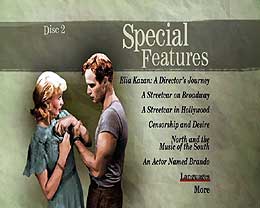
There was more bad news for Tandy when it came to making the film. The engrossing half-hour featurette Streetcar In Hollywood reveals how studio bosses ditched her in favour of a star name (Brando being an unknown at this point). "I liked Jessie a little better than I liked Vivien," admits Kazan, but of course Brando wound up being the big draw anyway. The director explains how he tried to open out the action on screen to include Blanche's back-story and perhaps redress the balance, but eventually he scrapped these scenes to preserve the claustrophobic ambience. He adds that he never used storyboards because he liked to keep things as loose as possible for the actors. Brando's co-stars Karl Malden (Mitch) and Kim Hunter (Stella) reflect on what was then a revolutionary way of working.
With its strong sexual undercurrents, the content of the film was just as radical. Desire And Censorship uncovers detailed notes handed down by the keepers of the dreaded Production Code. They pointed out that Blanche's behaviour "seems to verge on perversion" and insisted that a rape scene could only be included if it was "done tastefully..." Much of what was objectionable was only implied, but still the film was released in 1951 with some scenes omitted. The butchered scenes are contrasted here with the restored footage.
Pounding The Streets
Even the music was slammed as being "too carnal and suggestive" with its blend of classical music and smouldering jazz. There's a more detailed look at how composer Alex North worked to achieve this delicate blend in the featurette North And The South, which includes an unused musical cue. Over 15 minutes of outtakes reveal more of what didn't make the final cut, including a variation on Brando's famous call to Stella from the street. Brando's screen test is presented separately and he obviously finds some of the process amusing, smirking as the casting director asks him to "show us your profile". Naturally the great actor gets his own featurette where Kazan explains his appeal as a mix of being "simple like a child" and yet full of "passion and violence".
No doubt Kazan had an eye for talent, not only discovering Brando, but James Dean and Warren Beatty too. The feature-length documentary A Director's Journey sees the man himself recall his roots as an actor with a predilection for socially conscious drama. One of his regular players, Eli Wallach, narrates the documentary and talks about the way Kazan introduced "a level of realism new to American movies". The testimony he gave to the house Committee on Un-American Activities, naming communist sympathisers, is also referred to here although Kazan obviously plays this down.
Finally an audio commentary on disc one hears more from actor Karl Malden. His recollections are patched between detailed behind-the-scenes info from film historians Rudy Behlmer and Jeff Young. The latter was a student of Kazan who reveals some of the director's own influences and inspirations, eg, the opening scene of Blanche appearing through a cloud of steam was lifted from Tolstoy's Anna Karenina. Young fills in the gaps about the origins of the story, explaining that, "There's a great deal of Blanche in Tennessee Williams".
This two-disc Special Edition release is chockfull of fascinating insights into the production with reams of input from Kazan and Malden as well as a range of film experts. It's absolutely essential for anyone who genuinely loves cinema.
EXTRA FEATURES