| 13 November 2014 |

| |
| BBC Homepage | | |
| |||
| Contact Us | | |
Local HistoryYou are in: Essex > History > Local History > Hunt for the Beagle 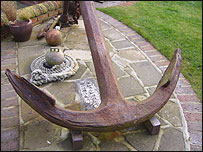 A Beagle anchor now sits in Ann's garden Hunt for the BeagleAs the world marks the 200th-birthday of Charles Darwin, we head to Paglesham to find the final resting place of his exploratory ship, HMS Beagle. This year marks the 200th anniversary of the birth of one of Britain's greatest scientists, Charles Darwin, and 150 years since the publication of his controversial work 'On The Origin of Species' thesis. Between 1831 and 1836 the young Darwin joined the crew of the HMS Beagle as a naturalist and it was on the vessel's trip around the Galapagos Islands that he developed his evolutionary ideas. 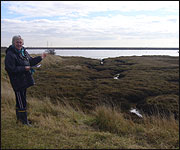 HMS Beagle is believed to be in the Paglesham mud The Beagle is thought to have ended its days off the Essex marshes and one of its anchors now rests in the back garden of local historian Ann Boulter. "When we got it out of the river, it was put in our garden," Ann explains. "We lodged it with the receiver of wrecks and after a year we were told it belonged to our group, which is the Beagle Ship Research Group. So it's all been done above board. "She's sitting in our front garden, but one day she'll have to go somewhere else. Perhaps on the sea wall, where the Beagle spent 25 years.
"It's just a pipe dream at the moment, but one has to dream and it would be a nice place for it to go." The Beagle came to be in the waters of south Essex when she was stood down by the admiralty as an exploration ship and given to the coast guard. It was originally located in the middle of the River Roach, but was soon forced into the old docks in the Paglesham mud flats. "The oystermen found she was fouling against their anchor chains and petitioned for it to be brought ashore - so she was brought here," explains Ann. HMS Beagle is believed to be in the Paglesham mud Although the group are not 100% certain the mud flats are the Beagles' final resting place, they do have a plethora of documentation and maps to validate to the claim. "We've had the geo-phys men here and on their screens we have had quite clearly the shape of the lower part of the hull," says Ann. Today, nothing is visible of the ship, which Ann estimates could be up to 21 feet under a layer of silt and mud. 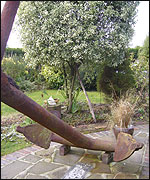 A very special garden ornament However, she hopes that in the future there could be some kind of commemoration of its existence. "It would be wonderful to excavate the dock, but it's going to be a mammoth job," she admits. "Even if we can't excavate, we would love to see something on the sea wall - either a plinth saying she was here for 25 years, or perhaps the anchor set in concrete. "But there ought to be something and ideally something nice on the sea wall." last updated: 17/02/2009 at 10:58 You are in: Essex > History > Local History > Hunt for the Beagle |
| | About the BBC | Help | Terms of Use | Privacy & Cookies Policy |