| 13 November 2014 |

| |
| BBC Homepage | | |
| |||
| Contact Us | | |
Local HistoryYou are in: Essex > History > Local History > Floats, festivities and fireworks 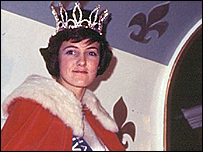 Rosemary Hawkins, 1964 Carnival Queen Floats, festivities and fireworksRay Clark As the Burnham-on-Crouch carnival celebrates its centenary, local lad and unashamed carnival fan Ray Clark looks back at the very first event, one hundred years ago. If there's one thing that Burnham-on-Crouch does well, it's the annual carnival, and this year the town is celebrating the centenary of this great event. I was born in Burnham and make no secret of my enthusiasm for the carnival. In fact I'm very much involved with the organisation of it. 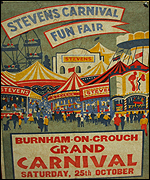 Burnham Carnival poster, circa 1960 As a child it was really the most magical day of the year, apart perhaps from Christmas Day. Every year, thousands flock to Burnham to enjoy this most unique day. There are other carnivals, but nowhere does it quite like Burnham. This year there are 'field events' held in the broad High Street, we have a stunt aircraft display, a brass band concert, huge funfair, the BBC Essex Roadshow and of course the fantastic illuminated procession winding its way around the town, leaving from the Clock Tower at 7.30pm. As part of the 100th anniversary celebrations, I've written a book about the remarkable history of Burnham Carnival, looking at its origins and troubles through the years – it really has defied the odds to become one of the most successful events of its kind in the South East. 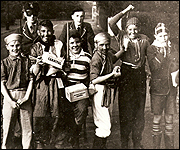 Burnham Carnival pirates in the early 1950s The early daysThe first 'official' carnival was held in the town on 5, November, 1909, but it is likely that the origins of the event go back much further. The 1605 plot to blow up Parliament is celebrated each year on November 5, but even before the escapades of Guy Fawkes and his fellow plotters, there was a belief among many that a bonfire would protect the community against evil spirits over the winter months. The rolling of blazing tar barrels was also part of this ritual in many parts of the country. In Ottery St. Mary, Devon, the practice still continues on November 5, and fires in the street are still very much part of the annual bonfire celebrations held in Lewes, Sussex. Bonfires and tar barrel rolling certainly took place in Burnham prior to 1909. 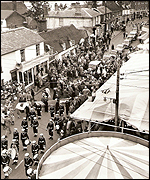 Looking down on the 1962 carnival procession The Young MarinersThe Carnival in Burnham owes its existence to a group known as 'The Young Mariners', which was formed sometime in the late 1800’s. It was made up of those men employed around the river industries of oyster dredging, boat building and yacht crewing. Many of the latter were away from the town during the summer, but returned as the winter months set in. Their efforts served two purposes; to mark the end of a summer season and to raise money for those in need. Remember, there was no social security – if you didn't, or couldn't work, then the chances were that you didn't eat. The workhouse was probably the only salvation. The first Burnham CarnivalWhat a great day November 5, 1909, must have been in Burnham. The costumes of all descriptions, crowds of people lined the route and at some corners quite a difficulty was experienced in getting through the mass of sightseers. 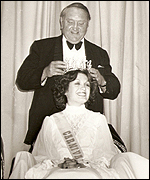 Arthur Mullard crowns Julie Frost in 1978 Much of the procession was made up of individuals walking the route. The Chief Marshall was dressed as a Field Marshall, obviously wanting everyone to see that he was in charge. He was followed by 'John Bull', 'Uncle Sam' and 'King Henry VIII'. A number of hand carts and trolleys followed, entered by local companies. One such display was by the Mildmay Ironworks, the largest employer in the town, depicting a 'North American Indian Encampment'. The Young Mariners mounted a lifeboat on a trolley and collected donations en-route and music was provided by The Temperance band and The Town band, with the 'latterly formed' Burnham Boy Scouts marching in the procession. If the procession was popular, the bonfire afterwards was certainly an event for the whole town. 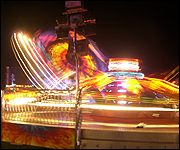 The carnival has come a long way in its 100 years A huge fire was built on the Brickwall Field, which according to The Burnham-on-Crouch & Dengie Hundred Advertiser was "consisting of twelve to fifteen wagon-loads of 'faggots' together with various boxes, paper and rubbish." It continued: "Over this was poured thirty gallons of oil, twenty gallons of tar and two gallons of petrol. Amid music from the two bands and the cheering from the large crowd, the fire was lit. "When the flames 'began to die down', rockets were sent up and a liberal display of fireworks followed." A 'roaring trade' was done in confetti and the evening closed with a 'very jolly' confetti battle "in which the younger element of the crowd was particularly prominent." To find out more about the magic of Burnham Carnival, why not visit the town on Saturday, 27, September. The book, '100 years of Burnham Carnival' tells the full history and is available throughout the town, or by calling 01621 784857.All proceeds are going towards Carnival funds – which in turn go to local charities.last updated: 23/09/2008 at 13:31 SEE ALSOYou are in: Essex > History > Local History > Floats, festivities and fireworks |
| | About the BBC | Help | Terms of Use | Privacy & Cookies Policy |