| 13 November 2014 |

| |
| BBC Homepage | | |
| |||
| Contact Us | | |
NatureYou are in: Edinburgh, Fife and East Scotland > People & Places > Nature > Springwatch holidays  Springwatch holidaysAs more of us look to spend our holidays in the UK, Springwatch presenter Martin Hughes-Games investigates ways to enjoy leisure time on the wildside, without breaking the bank. With the holiday season about to start, millions of us are thinking about spending our summer in the UK because foreign holidays are getting too expensive. But not only is the UK a fantastic place to take a break, as the BBC's Springwatch team have been discovering, it's also packed with wonderful wildlife that you can enjoy without spending a fortune. If you're planning a seaside break, heading for the hills, woodlands and rivers, or simply putting your feet up at home - it's possible to have a credit-crunching encounter with Mother Nature. Going campingCampsites are a real wildlife hotspot. There are more than 3,000 camping and caravan sites across the UK and many of them are in our most beautiful countryside. It doesn't cost the earth and it's a great adventure for the whole family.  Take a wildilfe adventure in your garden "When you go camping you're only the thickness of your tent away from the natural world," said Springwatch presenter Martin Hughes-Games. "Always make sure to take some binoculars – but you don't need to spend a fortune on a pair – and take a field guide if you're going exploring for the first time. "Make it a basic one as some of the bird guides can be too complicated. To let you into a little secret – the one I always take is Bill Oddies," he added. For information on some of the camping and caravanning locations you can enjoy in Scotland visit... The BBC is not responsible for the content of external websites Along the coastThe UK coastline stretches for thousands of miles, offering a diverse range of habitats. On a seaside break, the first instinct might be to flock to the beaches or, like moths to a flame, to the bright lights of the arcades - but by exploring a little further along the coast you can uncover a world of wildlife in the cliffs, tide pools and sea. "There are spectacular wildlife hotspots all round our coast and it's not just birds – you can see seals, dolphins, even whales if you're lucky," said Martin. Rock pools, or tide pools as they are sometimes known, are home to a wealth of sea life and provides a unique opportunity to study it at close quarters. "I hadn't been rock pooling for years and I'd completely forgotten how much there is to see. It's fabulous, it's free and it's fun for all the family," said Martin. "You'll see crabs, starfish, limpets, killer dog-whelks and if you catch a really low tide you might see British cowries or pipe fish – but don't forget to think safety first and keep an eye on the tide, it can come in far faster than you think." 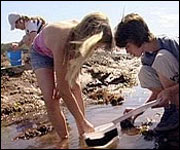 Rock pooling is fun for all the family Remember, the best sort of rock pooling means leaving no trace of your visit. Always return creatures back to the sea and leave the wonders of the rock pool for all to enjoy. Some of the best areas of the Scottish coastline to enjoy marine wildlife includes the Argyll and Clyde Islands, the Northern Isles, St Abbs and the Moray Firth. The BBC is not responsible for the content of external websites In the woodsThe woods are the UK equivalent of the rainforests, they are the most diverse habitat that we have and there's always something new going on - whatever the season. Wherever you live you're never far away from a woodland adventure. "The woods are home to some of our most spectacular wildlife and big animals like deer, wild boar, foxes and badgers," said Martin. "Surprisingly, it's often a wood that has lots of visitors that is a better place to see wildlife as they get used to people. "You should also go very early in the morning, and I mean really early - like first light, as this is when the animals are at their busiest. "Getting up that early is a real adventure and just think how delicious your breakfast will taste when you get home," he added. In Scotland, popular locations for exploring woodland habitats include Abernethy Forest, Dunnet Forest and the Forest of Ae among others. The BBC is not responsible for the content of external websites Holidaying at homeIf you're deciding to holiday at home this year, one of the most exciting wildlife habitats can be found in your own garden or from a visit to the local park. "I love spending time in my garden, but if I'm not at home there's always a green space somewhere nearby that'll act like a magnet for wildlife," said Martin. "I'm passionate about insects as they have some of the best stories. Forget looking up at the birds, look down and under things and you'll find a bizarre and fascinating world. "Again, get yourself a basic guide book and a magnifying glass. There are 20,000 different species of insect in Britain so you'll never be short of new discoveries." The Cairngorms National Park and Loch Lomond and the Trossachs National Park are open to visitors. There are other parks and gardens which you can also visit. The BBC is not responsible for the content of external websites From villages to cities, the countryside to the coast – wildlife is everywhere you look. To help you make the most of it, a number of free pocket guides are available from BBC Breathing Places. last updated: 29/05/2009 at 16:04 SEE ALSOYou are in: Edinburgh, Fife and East Scotland > People & Places > Nature > Springwatch holidays |
| | About the BBC | Help | Terms of Use | Privacy & Cookies Policy |