| 13 November 2014 |

| |
| BBC Homepage | | |
| |||
| Contact Us | | |
HistoryYou are in: Edinburgh, Fife and East Scotland > People & PLaces > History > The Miners' Strike in Scotland 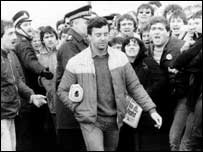 The Miners' Strike in ScotlandA quarter of a century on, we look back at the Miners' Strike in Scotland. The year-long Miners' Strike was a pivotal point in British and Scottish history. The strike began in Scotland at Polmaise Colliery in Stirlingshire after a decision in January by the National Coal Board (NCB) to close Polmaise due to geological faults in the pit and a lack of a market for Polmaise coal. 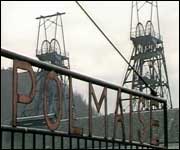 The entrance to Polmaise Colliery At this point the National Union of Mineworkers in Scotland failed to win a majority vote in support of a strike across all Scottish pits. An official strike was called at Polmaise on February 21 1984. The Polmaise miners tried to persuade others to join the strike across Scotland. The strike across the UK began on 9 March 1984 after an announcement by the NCB that they would close uneconomic pits across the UK and bring production in line with demand. The National Union of Mineworkers did not call a strike ballot for this, leading to some miners continuing to work as they declared the strike was illegal without a ballot. This led to violent clashes on the picket line as communities and trade unionists were divided. Some miners at Polkemmet, Killoch, Barony and Bilston Glen Collieries continued to report for work. Across Britain, a week into the strike, two-thirds of miners were on strike. 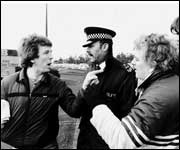 A clash on the picket line at Bilston Glen The most bitter clashes in Scotland happened at Bilston Glen Colliery outside Edinburgh with flying pickets trying to persuade those still working at Bilston Glen to take strike action. Ravenscraig too saw bitter clashes. Striking miners were determined to halt the transportation of coal to the Ravenscraig steelworks and by doing so halt steel production at the plant. They were hopeful of the steel workers joining them in the strike but the steel workers union did not call for this to happen leading to picket line violence at Ravenscraig. The strike was one of most bitter that Britain had seen. Almost a year later, on 3 March 1985, miners voted 98 to 91 to end the strike without reaching agreement with the NCB over pit closures. The strike officially ended on 5 March 1985. Today there are no working deep mines in Scotland. Pit closures1985 Bogside, Frances and Polkemmet closed. 1986 Comrie and Killoch closed. 1987 Polmaise closed. 1988 Seafield closed. 1989 Barony and Bilston Glen closed; Monktonhall mothballed. 2002 Longannet complex completely closed - Longannet comprised Bogside, Castlebridge, Castlehill, Solsgirth and Longannet mines.
More on the Miners' Strike
The BBC is not responsible for the content of external websites last updated: 13/03/2009 at 11:20 SEE ALSOYou are in: Edinburgh, Fife and East Scotland > People & PLaces > History > The Miners' Strike in Scotland |
| | About the BBC | Help | Terms of Use | Privacy & Cookies Policy |