| 13 November 2014 |

| |
| BBC Homepage | | |
| |||
| Contact Us | | |
ProfilesYou are in: Devon > People > Profiles > Sailing into Deep Water 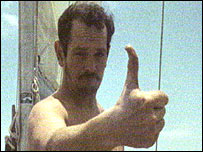 Donald Crowhurst during the race Sailing into Deep WaterBy Laura Joint Deep Water is a documentary film which tells the story of Donald Crowhurst, whose attempt to become the first man to sail solo, non-stop around the world ended in tragedy. Donald Crowhurst set sail from Teignmouth on 31 October 1968, at the start of a boy's own adventure. Crowhurst, a weekend sailor, was attempting to become the first man to sail single-handedly, non-stop, around the world in a home-made boat. He was among nine men taking part in the Sunday Times Golden Globe Race (but was the only one to head off, wearing his tie). A year earlier, Sir Francis Chichester became the first person to single-handedly circumnavigate the world. But this challenge was even tougher - there were to be no stops. The story which unfolded during the race was so incredible it could almost be fiction. Deep Water director Jerry Rothwell talks about making the documentary film: Help playing audio/video Crowhurst, 36, had problems with his boat, Teignmouth Electron, right from the start. It wasn't up to the job and there were several leaks. In his diary, Crowhurst wrote: "This bloody boat is just falling to pieces." 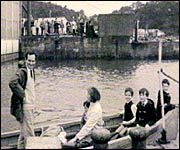 Donald Crowhurst just before setting off However, before setting off, the former army man was told by his sponsors that if he pulled out of the race, he would have to pay for the boat. If he stopped he was bankrupt, but if he continued, there was no way he could survive the Southern Ocean. He was trapped in a lose-lose situation. So he sailed around the waters of the South Atlantic, keeping two logs - a fictitious one, and one which told the truth. He cut off radio contact, as that would give away his position. His isolation was complete. He waited in the South Atlantic for the other racers to sail around Australasia and South America, at which point he would sneak in behind them and sail home quietly well behind the leaders. 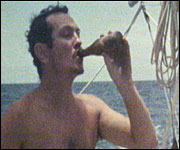 Crowhurst enjoying a drink He would save face and avoid being financially ruined. And no-one would bother to check the charts of someone who finished out of the placings. However, one by one, the other competitors fell out of the race so that amazingly, in June 1969, he was on course for winning the £5,000 for the fastest man home. Devon-based sailor Sir Robin Knox-Johnston had already made it back to England to become the first person to sail solo, non-stop around the world. But he had set off much earlier than Crowhurst and Nigel Tetley, who was just ahead of Teignmouth Electron heading up the Atlantic. Then, suddenly, Tetley's boat sank. It later emerged he had pushed the boat too hard in trying to keep ahead of Crowhurst, not knowing the truth of Crowhurst's challenge. Tetley was rescued, but a year later he committed suicide. The sinking of Tetley's boat meant Crowhurst was set to become the fastest man to sail single-handedly, non-stop, around the world. The nation prepared a hero's welcome for this underdog who had come out on top. 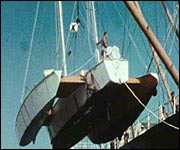 Crowhurst's boat was recovered from the Atlantic But a tormented Crowhurst knew his logs and charts would be scrutinised if he won, and that he would be found out. He tried to make radio contact with Clare, but his equipment wouldn't work - yet another bit of bad luck on an expedition dogged by ill-fortune. On 24 June, he set a course away from England and headed off to the mid-Atlantic. He said: "Suddenly you realise what's done is done and the mistakes you made, stand forever." In his diary, he wrote: "It is finished...it is finished." Teignmouth Electron was later found and recovered from the Atlantic, but there was no sign of Crowhurst. His body was never found. Knox-Johnston was the only one of the nine to complete the race. last updated: 20/04/2009 at 16:01 You are in: Devon > People > Profiles > Sailing into Deep Water |
| | About the BBC | Help | Terms of Use | Privacy & Cookies Policy |