Tuesday 5th June 2001, 1630 BST
Are we fairweather voters? | | | | With polling day almost upon us, political pundits are looking at every possible factor which could influence the outcome of the general election.
The weather is seen by some of them as a potentially major influence both on the turnout and the likely effect on each political party’s supporters.
Conventional wisdom is that bad weather results in a low turnout.
In turn, low turnouts are thought to favour Conservative voters who, perhaps, have better access to transport.
Fine weather, so the logic goes, sees Labour supporters turning out to vote in greater numbers, stopping off at the polling station on their way to, or from, work.
Liberal Democratic voters are supposedly least influenced by the weather - or perhaps there is merely less research on their voters’ intentions.
Whether these stereotypical views are valid in the political world of the 21st century is open to doubt.
Certainly a look through the weather records would suggest that any such links are tenuous at best.
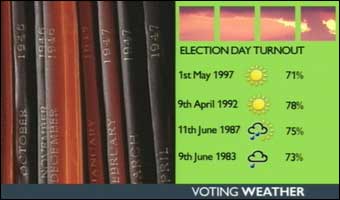
The biggest turnout for any post-war election was 83.9% in 1950. This was indeed a fine day across the country, with sunshine for much of the day.
But whilst Election Days in 1970 and in 1997 were warm and sunny across much of the United Kingdom, these were the two lowest turnouts at 72% and 71.4% respectively.
The highest electoral turnout in the past 50 years was the February election of 1974.
Rain fell in most places, with heavy rain reported over the Southwest. Yet despite the cool, wet weather there was a turnout of nearly 79%.
There is likely to be a north-south split across the country on Thursday - meteorologically not politically, that is.
Rain across southern counties of England will clear by mid-afternoon. Much of the rest of the country will be cool with a scattering of showers.
So whatever your political persuasion Thursday should be a good day for exercising your democratic right, as well as your dog. |
|