BBC TV blog - BBC TV blog

Archives for July 2010

I'm still amazed, horrified, and moved by the pitches in Dragons' Den

Blog comments are currently unavailable. Find out more.

Post categories:

Deborah MeadenDeborah Meaden|11:01 UK time, Friday, 30 July 2010

I can't believe I am in my sixth series of Dragons' Den. After many hours, days, weeks of sitting in a darkened Den and listening to countless pitches ranging from the brilliant to the frankly absurd, it still amazes me to see how relevant and refreshing the programme remains.

Fellow Dragons Peter Jones and Duncan Bannatyne have been there from the beginning. Each year all of us wonder if people will still want to watch us and each year, thanks in a very great part to the amazing, brave and innovative entrepreneurs who come and pitch to us, it seems you do.

Kirsty Henshaw from Worthenshaws in the Dragons' Den

In case you were wondering, Dragons have feelings too. We cringe, we laugh, we cry, we fail, we triumph, and emotions run the full gamut.

Watching Kirsty Henshaw, a 24-year-old single mum deliver a superb pitch for Worthenshaws "not ice-cream" - a frozen dairy-free dessert - telling us her motivation to succeed was her four-year-old son and the desire to give him a better life was a real lump in the throat moment.

On the other hand please tell me you were as horrified as I was when Derek Cozens tried to convince us that he had a safer version of the No Entry sign which, despite being told categorically by the Highways Authorities they did not like, he was going to pursue.

It's not often I beg but I could see his life, not to mention money, just being poured into a big black hole and I pleaded with him to stop. Am I right? Should he stop? I doubt he will.

The great thing about Dragons' Den is that it sparks debate. Everyone I ask has an opinion on something they saw in the Den and I bet you do too. You will also like and dislike some of the entrepreneurs and some of us Dragons and our styles of doing business and you will agree and disagree with our decisions at times.

In fairness Dragons rarely agree with other Dragons, but that is generally sorted out in the playground afterwards and doesn't last long.

So, who IS the best Dragon? We are a competitive bunch but there is a definite sense of mutual respect and a lot of humour, most of which I couldn't possibly repeat here!

We have our own busy lives but when we can we make time for dinner, although last time we did that we played spoof for the bill. It's a guessing game where one player holds a number of coins in a closed hand and everyone has to guess the value of the coins. It changes every time and bearing in mind I had never played it before - guess who ended up paying!

But when all is said and done we are in the Den for business. Serious business. I have offered around £1.3m over 21 investments in my first five series of Dragons' Den with many more to come in this series. I have some real winners, usually because the investees have lived up to their promise.

The Dragons in the Den. From left to right: James Caan, Duncan Bannatyne, Theo Paphitis, Deborah Meaden, and Peter Jones

My very first investment was from my neck of the woods, in the West Country. A young man, Ian Chamings, had written and patented an algorithm to mix dance music perfectly.

We are now the largest providers of mixed dance music to the fitness industry in the United States and FitMixPro just launched in the UK. I can't pick a favourite investment but there is always something special about your first!

The £100k I invested in MyDish, a recipe-sharing website, was definitely at the riskier side but I saw in Carol Savage someone with huge energy and real ability and it was her that won the investment. MyDish now powers the recipe websites of some of the biggest household names in media and major supermarkets.

Neil and Laura Westwood from Magic Whiteboard now have magic blackout blind and magic blackboard with more products and substantial profits in the pipeline. All have one thing in common and that is seriously good people driving a well-conceived business proposition.

This Dragons' Den series will see the highest number of investments ever made in the Den. This may seem surprising in the current economic times but I can see why. More people are thinking about doing it for themselves than ever before and they are finding it more difficult than ever to get funding.

Never has the Den been more relevant, not just for those braving it but for those wanting to gather some inside information on how investors think, what they are looking for and tips on what really works from people who have learned through experience what it takes to make a business work.

Deborah Meaden is one of the five Dragons from Dragons' Den.

Dragons' Den is currently on BBC Two on Mondays at 9pm. To find out when the next episode is on please visit the upcoming episodes page.
The Great Outdoors: Can rambling ever be cool?

Blog comments are currently unavailable. Find out more.

Post categories:

Kevin CecilKevin Cecil|12:34 UK time, Wednesday, 28 July 2010

Being a comedy writer is quite a sedentary job, and the advent of email made it worse as we don't even get to nip to the Post Office to send off scripts any more. Eventually they will find a way to make coffee via USB and then we will never leave our chairs again.

But you have to be active - everyone says so - and so, in between working on shows like Black Books, Hyperdrive or Armstrong and Miller, I've always tried to exercise. I do a bit of running, a bit less swimming, but most of all I like to walk.

In order to see this content you need to have both Javascript enabled and Flash installed. Visit BBC Webwise for full instructions

My writing partner, Andy Riley, now he does proper hiking and likes nothing more than to go wild camping taking just a pack of sausages and a loo roll. I do the junior version, but between us we've walked the Peak District, Yorkshire, the west of Ireland and, time and time again, the Chilterns.

We'd come back from these trips, swapping horror stories while trying to come up with new ideas for TV shows. After a mere 15 years or so it occurred to us to write a show about all this rambling.

Andy had a book of walks which spent its introduction railing against unnecessary fancy equipment and more or less said that you don't need to buy a coat when bin bags can do the job just as well. That attitude was the basis of the character of Bob played by Mark Heap.

Ruth Jones' character Christine, who insists on buying any new piece of technology whether or not it's any use and packs enough equipment to survive a nuclear winter for a 10 mile hike, well I've no idea where that came from (writer shuffles in his seat and looks awkward).

In order to see this content you need to have both Javascript enabled and Flash installed. Visit BBC Webwise for full instructions

We wanted it to feel as real as possible so we interviewed anyone we could find in a pair of stout boots. One incident that happened in real life and made the jump into the series takes place in episode three when our group are told in a pub garden that they can only eat food purchased on the premises. Fine they say and sell each other their sandwiches. This, we were assured proudly, is an old rambling trick.

We got an enthusiastic producer in Alex Walsh-Taylor and a clever and weatherproof director in Catherine Morshead. They assembled a cast which I can't quite believe we managed to get even now after we've finished filming.

As well as Mark and Ruth we secured Katherine Parkinson (The IT Crowd), Steve Edge (Phoenix Nights), Steve Wight, Joe Tracini and Gwyneth Keyworth. They all play walkers with different attitudes to the hobby and I have to say I think they do it amazingly.

The cast of The Great Outdoors in a field, decked in rambling clothes

There is one characteristic that all walkers share. One pleasant-seeming bystander I got talking to during filming asked me whether we were on the side of the ramblers or not. Well, we made jokes at their expense, I explained, but we were definitely on their team.

"I think they should be shot," he replied cheerfully, "coming through our village. Like rats in anoraks."

Rambling will never be cool. The people who take it seriously will always be outsiders and that's probably one of the reasons why I identify with them.

But when you are standing on top of Dorset's Golden Cap at 8am and you can see so far it feels as if you should be able to see all the other edges of Britain, well, you couldn't give a protein ball about whether you're fashionable then.

After three weeks, Ruth Jones, who had declared herself hobbyless, admitted she had 'got the bug' and would be a regular walker from now on. Well that's one more of us. I wonder if we can persuade you to join in.

Kevin Cecil is the co-writer of The Great Outdoors. Kevin has also written about his experiences on pitching and making the programme on the BBC Comedy blog.

The Great Outdoors starts at 9pm on Wednesday, 28 July on BBC Four and BBC HD, and is part of The Call Of The Wild, a season of shows.

To find out all future transmission times for this programme, please visit the upcoming episodes page.

Your preview of BBC Three's new season

Blog comments are currently unavailable. Find out more.

Post categories:

Danny CohenDanny Cohen|13:40 UK time, Tuesday, 27 July 2010

Can I introduce BBC Three's new autumn showreel to you?

This season we are excited to bring young audiences a unique range of thought-provoking factual programmes, innovative British drama, and unique comedy and entertainment.

In order to see this content you need to have both Javascript enabled and Flash installed. Visit BBC Webwise for full instructions

2010 has been a very successful year so far. Young audiences are up a further 14%, with the channel reaching over five million 16 to 34s each week. In our broadcast hours, BBC Three is now reaching more young people than E4 and ITV2.

More importantly, viewers are recognising the unique quality and range of the channel's output. In March, our award-winning documentary on the lives of women in post-Taliban Afghanistan - Women, Weddings, War and Me - got the highest audience appreciation score of any factual programme on any channel ever reported. The audience appreciation score is calculated through the TV Pulse survey, which measures our audiences' enjoyment of TV programmes.

Alongside it, series like Blood, Sweat and Luxuries, Being Human, Mongrels, and Russell Howard's Good News, are winning BBC Three great loyalty and affection with young British viewers.

In the coming months, we hope to build on this success with more new programmes, and a rich range to the schedule that young viewers will not find elsewhere on British television.

In current affairs, BBC Three will explore a range of complex subjects that have a particular relevance to young viewers including child soldiers, forced marriages, bullying, and sex trafficking.

Thought-provoking documentary has also become a hallmark of the channel now, and the Adult season this year will provide a context for us to explore themes including caring for a parent with mental health problems, living with blindness, and education.

We are also using the BBC Three blog to hear your stories about growing up and coming of age. If you'd like, you can share your stories and thoughts on the subject, so please join the conversation.

And of course comedy remains central to the channel's remit and reputation. The wonderful talents of Simon Brodkin in break-out hit Lee Nelson's Well Good Show, and the acclaimed adult puppet show Mongrels (see the creator's post on this blog) will be followed this autumn by the return of Johnny Vegas in Ideal and Dan Clark in How Not To Live Your Life.

Alongside these much-loved shows, comes new comedy in the shape of Him And Her. It's a beautifully written piece by Stefan Golaszweski, and stars Russell Tovey and Sarah Solemani.

In order to see this content you need to have both Javascript enabled and Flash installed. Visit BBC Webwise for full instructions

In drama, we move from the supernatural to the streets of Glasgow for a new lesbian relationship drama, Lip Service. Written by Harriet Braun, it's a seductive and addictive series, and a strong piece of authored work.

And finally in entertainment, Russell Howard returns with more of his Good News, and we're delighted to welcome Simon Bird to BBC Three as the star of a new studio entertainment show, The King Is Dead. It is part panel show, part celebrity interview, and part scripted comedy. It is unique and surprising, with lots of young British talent at its heart.

I hope this gives you a good sense of the creative range of programmes on BBC Three in the coming months. We are now established as a firm favourite with young audiences but we plan to keep working hard to discover exciting new talent, and deliver bold and thought-provoking ideas to young viewers.

Danny Cohen is controller of BBC Three.

Sherlock: For Holmes and Watson, the game is afoot

Blog comments are currently unavailable. Find out more.

Post categories:

Mark GatissMark Gatiss|10:50 UK time, Friday, 23 July 2010

I still have the first Sherlock Holmes book I ever owned. It had a purple spine (the purple of one of Holmes' dressing gown, I liked to imagine), a Sidney Paget illustration on the front and a wonderful introduction which ended with the magical words, "I wish I were reading these stories for the first time."

I can remember the frisson I felt then. I was reading them for the first time!

In order to see this content you need to have both Javascript enabled and Flash installed. Visit BBC Webwise for full instructions

Now, more than 30 years later it's sheer delight to bring a modern-day Sherlock to BBC One. It came about as a result of very pleasant chats with Steven Moffat as both of us travelled to and from Cardiff for various Doctor Who duties.

It seems nicely fitting that it all started on a train. We're both huge fans of the original stories and the absolute copper-bottomed genius of Arthur Conan Doyle's writing.

It didn't take long, though, for us both to shyly admit that our favourite versions of the oft-told tales were the Basil Rathbone/Nigel Bruce films of the 1930s and 1940s. Particularly the ones where they brought them up to date.

This may sound like heresy but really it isn't. Although Steven and I are second to none in loving the flaring gas-lit atmosphere of a lovely old London, it felt as though Sherlock Holmes had become all about the trappings and not the characters.

Also, the original stories are models of their kind. Incredibly modern, dialogue-driven, fast paced and short! What better way to get back to the roots of these fantastic creations than to make Holmes and Watson living, breathing, modern men just as they had been originally?

Happily for us, the BBC were immediately excited at the idea of modern Sherlock Holmes.

Sherlock Holmes, played by Benedict Cumberbatch, peers through a window

Some might think that's a depressing indicator of our major broadcaster falling back on the most familiar of fictional archetypes, but it isn't. Sherlock Holmes may be the most filmed character in all fiction but to reinvent him for a new audience - as well as fans - is not just thrilling and exciting, it's an honour.

From the very outset, what excited us was the very rare chance to go right back to the beginning. To get to the heart of the characters.

In the very first story, A Study in Scarlet, Dr John Watson, an army surgeon, is invalided home from war in Afghanistan. Well, sad but true, we're pretty much in the same war now.

A chance meeting with an old friend leads to him sharing rooms with a mysterious man called Sherlock Holmes. For 'sharing rooms', read 'flat-share'! Again, you don't have to strain for the modern parallels. If anything, the idea of two bachelors living together is more common now than in the 19th Century.

And then there's the immortal first meeting between the two men destined to become the best, but least likely of friends. It's still in Bart's Hospital, we still have young Stamford. What's thrilling, though, is that this legendary moment has hardly ever been dramatised.

And so a new audience gets to meet Sherlock Holmes through John Watson's eyes and ask the question: who are you?

After that, it was all fun with perplexing decisions! What are the immutable aspects of the characters and the stories? They'd call themselves Sherlock and John now, of course. Who calls their best friend by their surname?

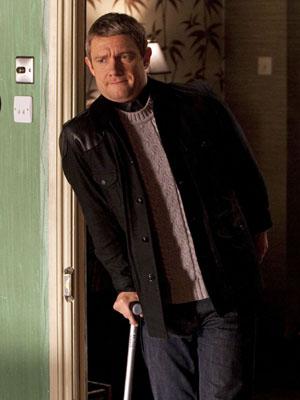
Dr John Watson, played by Martin Freeman, leans on his walking stick

They still live in Baker Street, but next door to a sandwich shop, and they get a good deal on the rent because Sherlock did Mrs Hudson a favour. And the lady herself! Landlady not housekeeper.

Doyle wrote of Holmes having a "certain quiet primness of dress" so we've made Sherlock a neat, almost conservative dresser. Yet he needs to feel different. Special. So the ByronicBenedict in his big winter coat can't possibly wear a paper forensic suit or it's all too CSI.

And what about that? Doyle virtually invented forensic detection. How can Sherlock exist in a world where the police do all the finger-printing, criminal profiling and analysis that were once his unique attribute?

The answer, in our version anyway, is that Sherlock Holmes is still, and always, the best and wisest man there is. The police may be able to put clues together, but only Sherlock has the vast brain power and imagination that can make the huge leaps of deduction.

As for Watson's stories for The Strand magazine, he now writes up their adventures in a blog. It is online for all to see, including references to the cases we'll never know about!

Addressing the heresy once more, I can only say again that Sherlock Holmes and Dr Watson are immortal. It's been a privilege and a thrill to put our new version of Doyle's blessed and wonderful creations onto the screen. We hope you enjoy. The game is on!

Mark Gatiss is the co-creator of Sherlock and writer of episode three.

Sherlock starts on Sunday, 25 July at 9pm on BBC One and BBC HD. To find out times of all future episodes, please visit the upcoming episodes page.
Danielle Lineker on My New Stepfamily

Blog comments are currently unavailable. Find out more.

Post categories:

Fiona WickhamFiona Wickham|11:18 UK time, Tuesday, 20 July 2010

Lingerie model Danielle Lineker (neé Bux) was a single mother to one small daughter until she marriedGary in 2009, and became a stepmother to his four teenage sons - the eldest being only 12 years younger than her.

Danielle talked to me about making the BBC Three documentary, My New Stepfamily, from her car as she picked up her stepsons.

In order to see this content you need to have both Javascript enabled and Flash installed. Visit BBC Webwise for full instructions

What did you find most rewarding about doing the programme?

I think what majorly came out of it for me was that everybody has the same worries, once they find themselves in a stepfamily. Everyone has the same thoughts and feelings and goes through the same process it so I wasn't on my own. And it was quite nice to know that.

It takes time for a family to adjust, that was the main thing I learnt. It takes time for everyone to establish their roles within a family.

How long do you think it's taken you in your new family to adjust?

We still are now. Everybody gets on, everything works really well but you know, relationships are still being built and bonds are still being made. We're three years down the line but I'm still learning a lot and getting to know the boys as well.

You came from a stepfamily too didn't you?

I lived with my mum and my stepfather and my two half sisters and one half brother, growing up. I spent a lot of time with my father's mother so I saw my dad and his side of the family a lot, usually at weekends and school holidays. I was quite split really.


You said in the programme that you'd forgotten a lot of what that felt like.

Yes, I left home at 17 and I'm 31 now, so quite a long time ago. You do forget these things - things like packing a bag to go off to my grandmother's for the weekend and then packing another bag to go home and not wanting to go home because I went home to all the things like school and all the rest of it.

Those sort of things I spoke to Lauren about, the 12-year-old girl I spoke to in the film. She had the same anxieties of going from one house to the other and they're the kind of things you forget really. It was fine but there was that upheaval of moving house at the weekends and that's what it felt like sometimes - that I was moving from house to house.

And it was just the upheaval, it wasn't that you were unhappy in either home?

No, it was just packing the bag and sleeping in different beds. I have to say now in my later life, it hasn't done me any harm. I'm quite robust in that I could pack up and move somewhere and really not care as long as I've got Gary and Ella and the kids, I'll happily move anywhere. I think that comes from being a bit of a gypsy as a kid.

I liked the scene where you admitted to your best friend that you picked on your own daughter more than your stepsons, when they were equally at fault.

And my friend agreed! You do single out your own because it's just so easy to go for your own child, it's the easy option really. And that's the reason - I just don't feel it's my place to be telling off someone else's kids. But there's ways of doing it which is something I've learned. I did This Morning today with Denise [Robertson] and she hit the nail on the head. You say it half serious, half joking.

The boys have just got in the car now so they're going to be picking up on all these tips I'm giving you! (laughing) They'll be like, agh, she's only joking, she's not really telling us off!

Like I say in the film, it's like being a big sister really rather than a parental figure. Because they've got that, they don't need somebody else.

Danielle Lineker holds paper cut outs of children

Did your daughter ever say to you, you're not being fair because you're telling me off and not the boys?

Yes, on occasion. But I think she's quite sensitive to the fact that she's mine and I can tell her off whereas you know, with the boys, I don't feel I can sometimes. I think she kind of knows, she picks up on that.

Do you think it took longer to feel comfortable with your stepsons because they are four teenage boys and you were working as a lingerie model?

I've got three teenage brothers so I kind of know what teenage boys are like. And at the end of the day I honestly don't think they really see me as a model. I think they just see me as their stepmum, the person who does their dinner and picks up their dirty socks. Like they don't see their dad as a TV presenter. You just don't do you, look at your dad that way?

And you never think of yourself in that light either so it's not something I ever thought about. They just take me on face value really. From the outside, yes, to the rest of the world it can look like that but when you're in your own situation, it's just not.

Do you feel the programme helped you mature into the role of a stepmum, with a bit more confidence?

Yes, I think what helped me was meeting other kids, and them being brutally honest with me on the way I should handle it. What was most useful to me was meeting the three Fox boys, because they're all teenage boys and they gave it to me straight whereas I couldn't speak to my own stepkids like that because they don't want to upset me or hurt my feelings particularly.

So speaking to them was like getting the word on the street really (laughing) and realising that maybe I am a bit out of touch with what's going on. I think I'm young because I'm 31 but God! Especially on the programme when I met Lisa from the magazine, that made me feel really old! She was using words I'd never heard of. So it was good to keep in tune with what's going on.

I felt this subject isn't talked about very much and when it is, it's in quite a negative light. We always hear stories about when it hasn't worked out. And like I've said, the Royal Family are a stepfamily now so we need to be talking about it.

Fiona Wickham is the editor of the BBC TV blog.

Danielle Lineker: My New Stepfamily is on at 9pm on Tuesday, 20 June on BBC Three. The programme is part of BBC Three's Adult Season and is available on iPlayer until Tuesday, 27 July.

As part of Adult Season, BBC Three is asking you to share your stories on what it means to be an adult on the BBC Three blog. Reggie Yates, Kirsten O'Brien, and Stacey Dooley have contributed videos with their thoughts on adulthood.

On Hannibal's Trail: Cycling from Spain to Italy via the Alps

Blog comments are currently unavailable. Find out more.

Post categories:

Ben WoodBen Wood|12:05 UK time, Monday, 19 July 2010

My brother Sam is the brains, or lack thereof, behind BBC Four'sOn Hannibal's Trail. After a cycling holiday in the Pyrenees his suggestion for our next trip was following the 2,500 mile route Hannibal took when he invaded Italy.

Sam is an archaeologist and one his heroes is Hannibal - the Carthaginian general who brought Rome to the brink of destruction when he marched an enormous army and herd of elephants from southern Spain, over the Alps and into Italy.

In order to see this content you need to have both Javascript enabled and Flash installed. Visit BBC Webwise for full instructions

Hannibal's Carthage was fighting Rome for the domination of the Mediterranean. They had lost the first great war to the Romans and Hannibal planned to restore Carthaginian pride and prestige with this audacious march.

Sam's plan wasn't so audacious but it was slightly ambitious. He suggested we film it and we hadn't made a "film" together since I was 12 and Sam starred as Chuck Norris (it's very embarrassing - you can watch it on YouTube).

Luckily our other brother, Danny, came to the rescue. He was working as a journalist in Madrid and his contacts at the BBC loved Sam's idea.

So, after an involved commissioning process and an exhausting yet exhilarating two and a half month film shoot/cycle ride, we are now on the brink of transmission and thrilled that the plan came together. Thanks mostly to the fantastic crew we worked with.

Before we left to start our epic cycle though, I was a little worried about what I had gotten myself into. The cycling wasn't so much of a concern - I had done similar trips to this before - but the TV presenting was an unknown quantity.

I've worked as a software developer most of my life so I'm more comfortable joking with computer nerds about how to set the laser printer to stun than talking to a camera about an ancient Carthaginian general.

I love riding and I love cycle touring - I can't get enough of the freedom and the satisfaction you get at the end of a hard day of riding - but I was very nervous about talking to the camera. At the same time I was very curious about how you go about making a documentary.

Brothers Danny, Sam and Ben Wood on their bikes.

I tried as best I could to prepare myself mentally and physically for the journey. My brothers and I were living in different parts of the world at this time so we spent endless hours on Skype discussing everything from which pass Hannibal may have used to cross the Alps to what sort of brakes we should have on our bikes.

I was in Sydney, in our native Australia, and in between work and reading everything I could about Hannibal, I followed a strengthening programme in the hope it would stave off injury during filming. I also cycled absolutely everywhere and went for long training rides a few times a week.

Before I knew it we were arriving in Murcia airport where we were met by our location manager Jason. He had illegally, but conveniently, parked our support vehicle which doubled as the crew's living quarters right outside the front door of the airport.

I initially thought this is what happens when you are on a film shoot - you do whatever you like - ignore all the rules for the sake of art. I started to get a little carried away, thinking innocent bystanders and local laws had to bend to accommodate artists and the cultural vanguard we represented.

But just as I was about to demand a nearby civilian carry my bike box for me (and get me a mineral water) I noticed Jason was busy fending off a few different sorts of Spanish parking police. It turned out the camper van was just too big to get into the car park. So we packed it up as quickly as we could and headed off to Cartagena without a parking ticket.

This was one of the most enjoyable parts of the trip. Everything was new. I was excited about starting the journey.

The local Spanish were so welcoming and friendly. We hung out with the crew who were all so engaging and entertaining - they would all make way better TV presenters, I thought.

Ben, Sam, and Danny pose in front of The Alps

We quickly came to appreciate the effort it takes to put together a TV documentary. Filming requires patience, imagination and expertise - qualities the crew had in abundance. And what I had imagined was going to be a physically strenuous but mentally soothing touring bike holiday quickly became an intense film shoot plus demanding cycle ride.

We had 10 weeks to cover 2,500 miles and film three hours of documentary. So a full day of filming followed by 60 miles on a fully laden touring bike meant we would arrive at our campsite completely and utterly exhausted.

One of the lowest points on the trip was after just such a day. We pitched our tents in a hungry and frazzled silence and realised all too late we had chosen the local dog poo park for a campsite!

There were so many more high moments on the trip than lows though and hopefully that will be obvious in the programme. I hope you enjoy it. All comments are very welcome!

Ben Wood is the co-presenter of On Hannibal's Trail.

On Hannibal's Trail starts at 8.30pm on Monday, 19 June on BBC Four. To find out tranmission times for all episodes, please visit the upcoming episodes page.

On Hannibal's Trail is part of The Call Of The Wild, a season of programmes on BBC Four.

BBC Two: Your sneak preview of new programmes

Blog comments are currently unavailable. Find out more.

Post categories:

Janice HadlowJanice Hadlow|12:55 UK time, Wednesday, 14 July 2010

If you're interested in a sneak preview of what will be hitting your screens on BBC Two later this year and in early 2011, here's a quick peek at some of our highlights.

In order to see this content you need to have both Javascript enabled and Flash installed. Visit BBC Webwise for full instructions

Watching it now, I don't think there's any other channel that would offer such a diverse picture of what intelligent TV looks like, or attempt to provide such a steady and consistent supply of the unexpected, the thoughtful and the entertaining.

There's a bit of everything in there - from Matt 'The Doctor' Smith in a very different role as Christopher Isherwood in 1930s Berlin for Christopher And His Kind, to Sue Perkins causing mischief with an well-aimed udder in Giles And Sue Live The Good Life.

There are moments that made my eyes fill with tears of laughter, like Rob Brydon and Steve Coogan arguing over who does the best Michael Caine impression in The Trip, and moments that made them fill with tears of sadness, like witnessing the raw emotion of Neil Morrissey - Care Home Kid.

After the success of the recent year of science, I'm really looking forward to a focus on history, which is something of a passion for me.

We have a host of new programmes and some very exciting presenters including Behind Closed Doors with Amanda Vickery and Pompeii with Mary Beard (more on those with this blog post), plus the return of Brian Cox - the man who made the solar system sexy - with a new series called Wonders Of The Universe.

I really hope you enjoy it.

Janice Hadlow is controller of BBC Two.

For a full list of programmes on BBC Two in autumn 2010 and winter 2011 please visit the BBC Press Office.

The One Show and The Open go into High Definition

Blog comments are currently unavailable. Find out more.

Post categories:

Danielle NaglerDanielle Nagler|14:45 UK time, Tuesday, 13 July 2010

For those who missed it, last night saw the debut of The One Show in High Definition (HD).

It has been a challenging process of migration. As loyal viewers will know, it is a busy show with lots of different types of subjects covered, and many different production teams compiling the reports that you see.


The sofa needed an upgrade too, although we didn't quite anticipate when we started on discussions that by the time we completed the move its usual occupants would look so radically different.

Matt Baker and Louise Minchin with Monty Python star Eric Idle on Monday, 12 July's episode of The One Show. This was the first episode of The One Show to be broadcast in High Definition

Yesterday's programme was a great debut for a fast-moving show. The studio looked bright and clean, and I really appreciated some of the extra detail on the films, in particular the items on high school proms and wrestling.

The archive shots from Live Aid made me realise how far what we can do in television has come - and I hope that seeing your favourite early evening magazine programme routinely in HD will add to the enjoyment.

Later this week there's another first - The Open golf in HD. We've broadcast the US Masters for a couple of years now, and those who enjoy the sport have been able to see the detail of one of the world's most lovely championship golf courses.

The Open is of course a different beast - always more rugged and windswept as befits a links course - but I hope that in some ways the benefits that HD can bring will be even more pronounced: Being able to see the ball as it flies above the fairway through the grey skies for example.

So from one point of view, blue skies could be a bit of a disappointment, though I'm sure whatever the weather does between Thursday and Sunday, the sight of the best golfers in the world battling it out together will be enhanced by HD.

Finally, you'll notice some changes in our regular schedule over the coming weeks. We're working to bring you even more HD content, and also to find ways to offer children's programming more effectively.

We'll be on air for longer at the weekends - when we know many of you spend most time with your HD TV - and we'd really welcome your views on how the changes in schedule work for you.

Danielle Nagler is controller of BBC HD.

The One Show continues on BBC One and BBC HD at 7pm each weeknight, and if you want to see last night's episode you can catch it on iPlayer in Standard Definition or High Definition for the next six days.

The Silence: From classroom to film set

Blog comments are currently unavailable. Find out more.

Post categories:

Genevieve BarrGenevieve Barr|11:10 UK time, Monday, 12 July 2010

"Miss, where does beef come from?" one pupil asked me.

"Cows," I replied, grateful that I knew the answer and that I wasn't being tested of my knowledge of the latest single by Alicia Keys.

Ten minutes later, when we've settled into the year eight novel, Montmorency, another question pops up.

"Miss, what does 'lascivious' mean?"

Help.

A minute later, I was testing out my acting skills by trying to demonstrate lascivious to a bunch of 14-year-olds, with my elbow propped on the filing cabinet and curling a lock of hair around my finger.

"Does it mean flirting, Miss?"

Whoops and calls from the pupils echoed around the classroom.

Genevieve Barr as Amelia in The Silence

As far as my acting skills go, it's reducing the more sophisticated words in the English language to the behaviour rituals of Bermondsey kids.

How I miss my year eights.

Just 15 days after that particularly lively lesson, I walked on to the set of The Silence. It was an epic experience. But I was always conscious of the huge standard expected of me; to step up from being a nobody in the acting industry to playing the lead role.

I was surrounded by not only actors who had been hugely successful in their craft, deservedly so, but younger actors who had been through drama school and been coveting these kind of roles for years. I didn't want to take anything for granted.

It was tough, really tough.

I spent every night wracked with nerves for the next day - going over my lines, thinking about their meaning, learning sign language from the videos the interpreter had made for me.

I couldn't wear my hearing aids on set, and these were 13 hour days. There was no time to slow things down on my behalf. The emotional depth required of me in every scene - witnessing a murder, learning to hear for the first time, being alienated from my family, meant that I had to step up to a very high mark, and deep low (!) every time.

Paul Begley, played by Conor Mullen, interviews Amelia, played by Genevieve Barr

Not only did I have to reach into the darkest parts of myself to convey the depth of emotion required, but I had to fantasise about how I would feel if I witnessed a murder. Tinkerbell would never have got me to think happy thoughts!

I was constantly tempted to pull mock looks of terror and relieve the mood by being comical. But I couldn't. It was intense, gritty reality.

Filming wasn't chronological either. That meant that by the end of every day, I had pretty much circumnavigated through every single emotion in the book. What a rollercoaster. If that isn't good training for an actress, then what is?

But I loved it.

I often get asked about the impact my deafness had on the filming process, as do the other actors who starred in The Silence with me. It's the first question on people's lips!

It's been interesting reading about what their reactions were. They were pretty similar - she wasn't a deaf actress, she was an actress. I am grateful.

Amelia, played by Genevieve Barr, stands by Jim, played by Douglas Henshall

For me that reinforced the fact that they saw me for who I was and my disability didn't act as a veil - narrowing their vision of who I am and what I have to offer.

I hope that people will see the uniqueness of Amelia, my character, and that while she struggles to adapt to a hearing world, her personality is in no way subdued.

If anything, her disability enhances her charisma and makes her stand out even more as a pretty forthcoming and stubborn individual! Amelia Edwards - she's definitely not just a 'deaf girl'.

Many times in my teenage years I exercised the verb 'flirt' quite transparently. That's normal, I think.

When I was 16, the boy I was going out with at the time said to me "stop staring at boys' lips all the time when you go out, it makes you look like you want to kiss them". In other words, he was feeling threatened.

After that, for a few weeks anyway, I tried to look away every other second but not only did I look like I was attempting some very strange dance moves, but I looked distracted, disinterested and missed half of what they were saying. I ended up feeling pretty foolish. Deaf people need to read lips. I'll never apologise for that!

So how did I find the flirting scenes in The Silence? No one's asked me that yet.

Pretty easy.

Thank you, 8J, for teaching me the true definition of 'lascivious'.

Genevieve Barr stars as Amelia Edwards in The Silence.

The Silence starts on Monday, 12 July at 9pm on BBC One and BBC HD. For more information about future episodes, please visit the upcoming episodes page.
Between Life And Death: Why medicine is art as much as science

Blog comments are currently unavailable. Find out more.

Post categories:

David MenonDavid Menon|08:53 UK time, Monday, 12 July 2010

About 18 months ago, I was approached by the BBC asking whether we would be interested in making a programme about critical illness, death, and dying.

I work as a consultant in the Neurosciences Critical Care Unit (NCCU) at Addenbrooke's Hospital in Cambridge. Our unit is one of the largest in Europe, and takes care of patients with severe head injury, brain bleeds and stroke.

We were interested, but also a bit wary.

In order to see this content you need to have both Javascript enabled and Flash installed. Visit BBC Webwise for full instructions

The successes of modern medicine are often rightly publicised, but we rarely discuss what happens when medicine fails.

For example, death is commonly viewed as an event which involves cessation of the heartbeat. In actual fact, it is irreversible damage to the brain that decides whether a person survives or not, and the heart needs to have stopped for several minutes before such damage results.

Indeed, it is common, as with head injury, for the brain to be irreversibly damaged, while the function of the heart and lungs is maintained by intensive care.

People have little concept of the varying degree of brain injury that result in brain death, coma, a vegetative state, or severe disability.

A discussion of such difficult topics is important in a civilised society, and helpful to families of patients. I felt that the knowledge from a well-made programme could inform such a discussion.

However, there were also significant pitfalls in making such a programme. There were difficult issues about filming unconscious patients who could not provide consent, and we were concerned that a poorly made programme would display patients as exhibits.

Also, as you might imagine, there were sensitivities about being recognised as an expert on dying! It was clear that there was an opportunity to make a very good programme, but also the danger of making a very bad one.

We thought long and hard about the issue of consent, and finally took the same approach as we would for research in this setting.

We felt that if there was a wider good, the patient was not put at risk, and this was likely to have been what they would have wished, it was appropriate to include them in the programme.

In order to understand whether or not patients would have wished to be part of the programme, we sought advice from those that knew them best - their close families.

We also agreed that patients and their families would have the right to withdraw consent to participate in the program up to the point of transmission.

Nick Holt (director of the film), and Marina Parker (producer) spent several months in the NCCU and Emergency Department (ED) at Addenbrooke's even before they even started to film.

In the succeeding months they essentially became part of the NCCU team, and shot nearly 90 hours of film! Their interviews took them right across the spectrum of clinical activity in the NHS, including the ED, intensive care units and operating theatres; the wards and rehabilitation centres; and even the mortuary and anatomy dissection rooms!

In the event, the programme's editors chose to focus on three patients who had been through the NCCU. Their stories make unconventional television viewing.

Richard was one of those people. He was admitted with an isolated spinal injury, but then fell into a coma, from which he showed no signs of emerging.

The consequence was that we had a man in his forties who was unable to respond to us and who, his family informed us, had previously expressed the conviction that he would not want to survive in that state.

Richard Rudd (left) and his father, also Richard

Given that this was the best information we had of his wishes, we were willing to be guided by this, but decided to wait a bit longer to clarify the situation.

When, after a period of waiting, he showed voluntary movement of his eyes, everything changed. We could use these eye movements to document "yes" or "no" responses, and through such communication, allow Richard to have a say in his own care.

This was crucial, because we know that there may sometimes be differences between what a patient declares when he is fit and healthy, and what he feels when he is the one in the hospital bed.

As time passed, we were confident that Richard had enough comprehension and memory to make these interactions meaningful. We were then able to establish, on three successive occasions, that he understood what had happened to him, and that he was happy for us to carry on with his treatment.

The presence of such communication also enabled both the ICU staff and Nick to directly ask Richard whether he was happy to continue to participate in the making of the programme, and we be certain of the fact that he was in agreement with this.

Since completion of the programme, Richard has continued to improve very slowly.

However, we need to ensure, through continuing communication, that he remains happy with treatment. Given the length of any potential recovery process, it is also essential that we maximise his enjoyment of life, particularly in terms of interactions with his family and friends.

Arguably, none of the three cases that are featured might be considered a success.

However, I hope that viewers will take away a sense of the uncertainties that medical teams sometimes face, and why good clinical care remains just as important in these difficult settings.

I also hope that the programme shows why medicine remains as much an art as a science, why good clinical care requires wisdom as well as knowledge, and that common humanity does not need to be a casualty of "high tech" intensive care.

Many of the staff on the unit were initially wary about the filming because of the fears expressed earlier in this discussion. Despite these fears, we chose to go ahead, because a well made programme could illuminate a very difficult topic, and inform the public about this grey area between life and death.

In the event, any fears were completely unjustified. Nick and Marina were absolutely fantastic, and have become good friends not just to us, but also to the patients' families.

Their feedback has been uniformly positive. Indeed, after they viewed the programme, the feeling that came across was that it gave them a voice that they would otherwise not have.

My only regret is that, because of the need to keep the program to a manageable length, we could not tell all of the stories that we recorded.

Still, there is always a next time...

Professor David Menon is a consultant at Addenbrooke's Hospital, Cambridge.

Between Life And Death is on BBC One at 10.35pm on Tuesday, 13 July and on BBC HD at 00.00 on Wednesday, 14 July.

Aisling Loftus: Playing the lead role in Dive

Blog comments are currently unavailable. Find out more.

Post categories:

Aisling LoftusAisling Loftus|10:03 UK time, Thursday, 8 July 2010

At 15, Lindsey is hugely driven, self-contained, astute and ambitious. In Dive, she is hoping to make it to the Olympics in 2012, representing Great Britain as a diver, and is not the sort of person you expect to be depicted falling pregnant.

When Lindsey meets Robert she's at a point when everything has been turned on its head at home. He's like the antidote to all the structure and discipline that had conditioned her life so far.


In order to see this content you need to have both Javascript enabled and Flash installed. Visit BBC Webwise for full instructions

Robert and Lindsey confess their love for each other

It took a while to get my head around that about Lindsey and the daily routine of a diver, what it asks of a person. Hour upon hour of practice, no lie-ins. I don't think I could put my body through that. It definitely says a lot about a person to have that kind of foresight.


All the dives you see in the drama were actually completed by Jenny Cowen, who is training for the 2012 Olympics. All I had to do was go through the motions before the dive.

Chris Snode (an Olympic diver from the 1970s and 1980s) taught me what to do and then I'd swim underneath Jenny. Sometimes she would do some amazing complex dive and the shot would be manipulated so I rose up from under the water and claimed it as my own.


Someone asked me, did I talk to other teenage mums to prepare for playing Lindsey? I didn't, maybe I should have. But I didn't feel like I was representing a demographic in how I portrayed Lindsey.

I felt an affinity with her and approached all the things that happened as unequipped as she was. Dominic Savage (the co-writer and director) kept things very organic like that, letting us just 'be' the characters and helping us to find the truth in them in the most natural way.

Aisling Loftus as Lindsey stands by a swimming pool


I didn't realise how good Dom was until we'd finished - at the time it just felt right. He would make sure Jack O'Connell and I were on the same page and then let the scenes sit with us. He wasn't precious about his script.

We were though- it's so truthful and such personal storytelling, Dom and Simon Stephens, the co-writer, are wicked.


I got cast after a few auditions - my final one was with Jack, who plays Robert. I think that was the point that they chose to have Robert and Lindsey from our native East Midlands, which meant we shot outside stuff in Skegness, which was great!

The rest of it was shot in Eastbourne and Watford. I think it was about getting that small-town feel and I got Lindsey's need for broader horizons keenly.

I loved working with Jack. He's got a real dignity as well as being a proper laugh. We both cut our teeth at the Junior Television Workshop together in Nottingham (along with four others in the cast) and so we had the same kind of attitude.

Ian Smith - Workshop's leader, a mentor, a paternal figure - encouraged us to take risks and only be inhibited by being emotionally truthful. No melodramatics, just get Robert and Lindsey real and honest.


My favorite scene is when Robert and Lindsey are sat at the table in their little flat, which all of a sudden seems too big and overwhelming. And I loved when I was filming with Ewen Bremner, I really value that time.

Lindsey, played by Aisling Loftus, lies on the grass with boyfriend Robert, played by Jack O'Connell

We did a particularly emotional scene together and I was feeling the emotion of it but it wasn't registering on my face, Ewen gave me great advice about adjusting my emotion so that it comes out more obviously. I've kept that with me and use it in auditions.


I don't think Dive has an agenda or casts judgment. It doesn't sensationalise teenagers or plonk an issue in the middle of the drama and have the characters illustrate it. Maybe some people will be less quick to make assumptions about the people behind a set of circumstances.

It's too easy to dismiss it all as naivety. I think it's braver to take that plunge into the unknown, even if it isn't wiser. But wisdom comes with age, I heard.

Aisling Loftus plays Lindsey in Dive.

Dive starts at 9pm on Thursday, 8 July on BBC Two and BBC HD. Please visit Dive's upcoming episodes page to find out dates and times of all episodes.

BBC Switch have been asking their readers to have their say on the storyline in Dive. You can read their responses on the Slink, the area of Switch for teenage girls.

Roger Mosey, the BBC's director of London 2012 has also written about Dive on his BBC Sport blog.

The changing face of BBC Daytime: Moving On, The Indian Doctor, Land Girls and more

Blog comments are currently unavailable. Find out more.

Post categories:

Liam KeelanLiam Keelan|15:07 UK time, Tuesday, 6 July 2010

BBC Daytime has gone through a pretty significant shift in terms of our programmes over the last couple years, so it was interesting to read the BBC Trust's thoughts on Daytime in their Strategy Review and particularly where they think there's room for improvement.

While some headlines are bound to focus on the criticism, it's worth having a look at how far BBC Daytime has changed in recent times, where this overlaps with the Trust's argument for greater distinctiveness and how this all compares to our commercial competitors.

Land Girls, one of BBC Daytime's successes

Going back to February 2008, BBC Daytime no longer continued to broadcast the Australian soap Neighbours. At the time this felt like a major loss to the schedule -after all it was the highest rating show in Daytime and had been part of the schedule for more than 20 years!

Although it didn't feel like it at the time, it was probably the best thing that could have happened to BBC Daytime as it freed up schedule space and, more importantly, money to invest in making daytime feel much more distinctive than our rivals.

So what's been done in the intervening period and what more is being done to address the Trust's particular emphasis on thinking there are too many property and collectibles programmes.

It's fair to say the three genres we've focused upon more than any other since 2008 are current/social affairs, consumer and UK-originated drama. In fact, we have increased consumer, social and current affairs programmes in Daytime by 140% - a rise from around 80 hours to almost 200 planned for 2010.

Among the many examples we're rightly proud of are Rip-Off Britain, a consumer series fronted seasoned journalists Angela Rippon, Gloria Hunniford and Jennie Bond, Missing Live, a campaigning series to reunite missing people with their families and which was commended in the House of Commons, and the award-winning The Estate We're In, which is on air at 09.15 at the time of writing, and which Philip Johnston in yesterday's Daily Telegraph called "a programme for our time... it touches on Broken Britain and the Big Society".

Another big push has come in the area of UK-originated drama. For some years we've been the only broadcaster to produce drama in Daytime and Doctors has a long history of covering a broad range of social issues, winning several awards along the way. Have a read of Diane Keen's post on this blog about the show's 10th anniversary on this blog.

Over the last year this has been joined by event drama which I really believe has changed perceptions of what we do in Daytime.

A scene from BBC Daytime's Doctors, where Jimmy, played by Adrian Lewis Morgan, has his blood taken by Karen, played by Jan Pearson

Missing, starring Pauline Quirke, undoubtedly raised the issue of missing people to a wider audience and drew greater attention to the campaign overall. Jimmy McGovern's single plays Moving On touched on many issues our audience really care about and is back this autumn with double the number of episodes.

Finally, Land Girls was a first for BBC Daytime in that we'd never before produced a period drama in that part of the schedule - this too was paired with a factual series (The Week We Went to War) and was recognised with a Broadcast award earlier this year.

Several of the programmes I've mentioned, including Land Girls and Moving On, have received such acclaim that they've been repeated in peak-time. Factual programmes such as Fake Britain, Real Rescues and Dom's on the Case: NHS have also been promoted to peak time and have performed very well for the channel.

The Trust rightly gives us credit for the range of programmes in Daytime: we launched more than 50 different shows last year compared with fewer than 10 on each of our commercial rivals.

A large influx of new programmes, such as those mentioned above, does of course mean we have to lose others from the schedule to make space. Most recently Car Booty has been decommissioned alongside property series such as The Unsellables.

The Trust has also acknowledged that Daytime has already started the process of changing its mix of programmes - the challenge remains to continue to provide the broadest range of programming of any broadcaster.

Despite challenging budgets (a daytime series budget is roughly a quarter of a peak time series) the aim in daytime will always be to produce the highest quality programming other broadcasters wouldn't go near.

Sanjeev Bhaskar's new drama The Indian Doctor, set in Wales in 1963 and part of a wider season of programming on 60s, is one example in the autumn.

A scene from the last series of Moving On. The episode The Rain Has Stopped features Sheila Hancock as Liz, Emma Lowndes as Alice, and Dominic Senior as Joe

The next series of Moving On kicks off with John Fay's Sauce For The Goose, a powerful study of senile dementia with a stunning performance from Anna Massey.

It's followed by Shaun Duggan's Losing My Religion, a riveting film about Catholic hypocrisy and it concludes with Esther Wilson'sI Am Darleen Fyles, the two stars of which are actors with serious learning difficulties.

And, as Jimmy McGovern said, "This series just wouldn't have been possible without BBC Daytime's commitment to commissioning drama that takes risks. Drama with something to say. Drama that is inexpensive. Drama that is excellent value for money."

Expect many more to follow.

Liam Keelan is the controller of BBC Daytime.

How healthy are BBC One, Two and Four?

Blog comments are currently unavailable. Find out more.

Post categories:

Jana BennettJana Bennett|14:00 UK time, Monday, 5 July 2010

Today the BBC's governing body the BBC Trust has published its report on three of the BBC's television channels, BBC One, BBC Two and BBC Four.

These reports are essentially health checks done every five years to ensure that the channels are delivering the kind of programmes that audiences expect of them.

The way it works is quite simple.

We submit a report on each channel to the Trust, analysing its performance, the range of programming provided and an outline of its achievements and strategy for the future.

The Trust examines these reports, canvasses the views of licence fee payers and then publishes its findings. You can read the reports we submitted for each channel - part one is here: (BBC Trust Review Exec Submission 1 [pdf]) and part two is here: (BBC Trust Review Exec Submission 2 [pdf]). There's a summary of the report at the beginning of each one.

Also you can read the Trust's conclusions on their website.

In order to see this content you need to have both Javascript enabled and Flash installed. Visit BBC Webwise for full instructions

I've had a chance to read these reports in full and I'm pleased to see that the Trust has recognised all the good work that the channels have been doing to deliver great programmes to you on all channels. On BBC One, dramas like Five Daughters and Luther have been truly distinctive offerings this year.

Both have had a passionate reaction from the audience as seen on the posts on this blog by Five Daughters executive producer, Susan Hogg and Luther scriptwriter, Neil Cross.

Elsewhere on the channel we've had programmes like The Day The Immigrants Left, Bang Goes The Theory and Modern Masters that are offering viewers the kind of unique peak viewing that you just wouldn't see anywhere else.

This is what the Trust want to see even more of but I'm pleased they can see how much we are already doing here.

On BBC Two and BBC Four the Opera season, Gareth Malone Goes To Glyndebourne and Wonders of The Solar System have proved to be hits with audiences and critics alike.


In order to see this content you need to have both Javascript enabled and Flash installed. Visit BBC Webwise for full instructions

More recently I've been watching the Fatherhood season on BBC Four which is the kind of distinctive programming that only BBC Four would offer and that the Trust is challenging us to provide more of in order to increase the 'reputational dividend' for the BBC still further.

Richard Klein, controller of BBC Four, has written on this blog about the Fatherhood season, as has Andrew Martin, presenter of Disappearing Dad.

Another area where the Trust has asked some searching questions is our daytime output.

We've made great headway in introducing more current and consumer affairs into the daytime schedules with programmes such as Rip Off Britain, Crimewatch Roadshow and The Estate We're In (which won a Royal Television Society award and the second series of which is airing today) alongside new dramas Land Girls and Missing.

Silla Carron stands outside the block of flats in The Estate We're In

There is even more that we plan to do here; new Missing Live, a week of programmes around Remembrance Sunday, a new series of Jimmy McGovern's Moving On and a 1960s season of programmes including drama The Indian Doctor with Sanjeev Bhaskar - just the sort of quality programmes that sets us apart from all other channels in daytime.

So overall I am pleased to see that the Trust has endorsed our determination to bring audiences programmes that surprise and delight in a truly distinctive way.

There is plenty more to do and you will see this coming over the next year or so with new dramas such as Outcasts and Sherlock and factual programmes such as Frozen Planet, the Battle of Britain season and a major new literature series, Faulks On Fiction.

But in the meantime I encourage you to have a read of both reports and let us know what you think.

Jana Bennett is the director of BBC Vision

My nerve-wracking night on The Culture Show's Samuel Johnson Prize special

Blog comments are currently unavailable. Find out more.

Post categories:

Pauline Law|14:21 UK time, Thursday, 1 July 2010

If you're growing weary of the World Cup and tiring of tennis, then you could try the Culture Show Special on the BBC Samuel Johnson Prize (SJP) as an antidote to this summer of sport.

As far as I know there's no wall chart available detailing the group stages of the SJP so the programme, presented by Andrew Graham-Dixon, offers a comprehensive guide to the six shortlisted books battling for glory, as well as featuring the nail-biting final.

In order to see this content you need to have both Javascript enabled and Flash installed. Visit BBC Webwise for full instructions. If you're reading via RSS, you'll need to visit the blog to access this content.

The Samuel Johnson Prize, now in its 12th year, is the equivalent of The Booker Prize for non-fiction books.

Recent recipients have included Kate Summerscale with The Suspicions of Mr Whicher and Philip Hoare's Leviathan - both of which were catapulted into the best seller charts.

Winning the prize not only makes you famous but £20,000 richer so there's all to play for at the award ceremony in the Royal Institute for British Architecture where the judges, chaired by economist Evan Davis, will announce this year's winner.

As a topical arts magazine programme we often film close to transmission but this week we really are cutting it fine as the ceremony doesn't even start till 7pm tonight.

We'll be filming live at the event then I'll be making a mad dash across London to edit the results into the programme for its 11.20pm slot on BBC Two.

Making The Culture Show is a real team effort but as series producer it's my job to bring the different elements of the programme together in the edit suite and work with our presenter Andrew on the script that links it all up seamlessly - well that's the aim.

I really like the excitement of a fast turnaround magazine show but tonight could be slightly nerve wracking. Basically if Newsnight seems to be running a little long you'll know I'm still frantically putting the finishing touches to the show.

In order to see this content you need to have both Javascript enabled and Flash installed. Visit BBC Webwise for full instructions. If you're reading via RSS, you'll need to visit the blog to access this content.

Fortunately we've already filmed with the shortlisted authors and the team have worked furiously to find just the right people to interview them.

As the writers are, rather inconveniently, spread across the globe we've had to set up filming in locations from Boston to Beijing, where the BBC's China correspondent Damian Grammaticas spoke to author Barbara Demick about her moving book on the lives of North Korean citizens, Nothing to Envy.

We tried to find people who have a real relationship to a book's subject or form. So, for example, writer and journalist Lynn Barber, who's achieved great success with her memoir An Education speaks to Luke Jennings about committing his personal memories to the page in Blood Knots.

She says of writing her own, "I thought it would be a doddle...but when I got down to it, it was really difficult and I don't think I particularly pulled it off. That's why I'm so envious of what Luke Jennings has achieved."

We also knew Peter Snow was a British history enthusiast so we invited him to talk to Jenny Uglow about her riveting take on the Restoration and Charles II - A Gambling Man.

Previous Samuel Johnson Prize winner Philip Hoare stands in front of a whale mural, on the BBC Arena show about his novel, Leviathan.

We were delighted that he was our first interviewer to confirm when he called to say, "Hello, I'm Peter Snow and I believe I'm one of your chaps".

There's always a worry you won't get people to agree to take part in your programme in time but once we had his name on the board others followed in quick succession so many thanks Mr Snow.

Hopefully The Culture Show might encourage you to check out one or two of this year's shortlisted books - I can guarantee more enthralling passages between the pages than we've seen on the South African pitches and there's no doubting these finalists passion and enthusiasm for their subject.

Meanwhile, we've just got time to catch our breath before we pack our bags for Edinburgh to cover this year's Festival.

I think that's what I love most about working on The Culture Show - every programme is a new adventure, we get to meet lots of fascinating people and to work on a vast range of subjects from comedy to contemporary art and books to ballet. I still haven't met David Bowie though, so I guess a girl can't have everything.

Pauline Law is series producer for The Culture Show.

The BBC Samuel Johnson Prize For Non-Fiction first airs at 11.20pm on Thursday, 1 July on BBC Two and BBC HD.

To find out times of all future episodes of The Culture Show please visit the programme's upcoming episodes page.

More from this blog...