<?xml version="1.0" encoding="utf-8"?>
<feed xmlns="http://www.w3.org/2005/Atom">
    <title>BBC - Today: Tom Feilden</title>
    <link rel="alternate" type="text/html" href="https://nontonwae.pages.dev/blogs/today/tomfeilden/" />
    <link rel="self" type="application/atom+xml" href="https://nontonwae.pages.dev/blogs/today/tomfeilden/atom.xml" />
    <id>tag:www.bbc.co.uk,2009-02-13:/blogs/today/tomfeilden//173</id>
    <updated>2011-05-23T11:28:31Z</updated>
    <subtitle>I&apos;m Tom Feilden and I&apos;m the science correspondent on the Today programme. This is where we can talk about the scientific issues we&apos;re covering on the programme.</subtitle>
    <generator uri="http://www.sixapart.com/movabletype/">Movable Type Pro 4.33-en</generator>

<entry>
    <title>A new home</title>
    <link rel="alternate" type="text/html" href="https://nontonwae.pages.dev/blogs/today/tomfeilden/2011/05/a_new_home.html" />
    <id>tag:www.bbc.co.uk,2011:/blogs/today/tomfeilden//173.291060</id>


    <published>2011-05-23T11:06:21Z</published>
    <updated>2011-05-23T11:28:31Z</updated>


    <summary type="html">Thanks for reading my blog. From today, it&apos;s moving to a new home. As well as being able to read my comments on science and the environment, you&apos;ll now be able to view my other contributions, including picture galleries and...</summary>
    <author>
        <name>Tom Feilden</name>
        
    </author>
    
    
    <content type="html" xml:lang="en" xml:base="https://nontonwae.pages.dev/blogs/today/tomfeilden/">
        <![CDATA[<p>Thanks for reading my blog. From today, it's moving to <a href="https://nontonwae.pages.dev/news/correspondents/tomfeilden/">a new home</a>. </p>

<p>As well as being able to read my comments on science and the environment, you'll now be able to view my other contributions, including picture galleries and audio slide shows, pick up tweets, and listen to my reports for the Today programme.</p>

<p>You can find it <a href="https://nontonwae.pages.dev/news/correspondents/tomfeilden/">here</a>. </p>]]>
        
    </content>
</entry>

<entry>
    <title>Saturn loses its cool</title>
    <link rel="alternate" type="text/html" href="https://nontonwae.pages.dev/blogs/today/tomfeilden/2011/05/saturn.html" />
    <id>tag:www.bbc.co.uk,2011:/blogs/today/tomfeilden//173.290958</id>


    <published>2011-05-20T10:50:56Z</published>
    <updated>2011-05-20T11:39:44Z</updated>


    <summary type="html"> In Roman mythology Saturn is the God of the harvest who presides over a golden age of abundance and peace. Well, not any more. Beneath the planet&apos;s normally serene façade a massive, angry storm is broiling: A storm so...</summary>
    <author>
        <name>Tom Feilden</name>
        
    </author>
    
    
    <content type="html" xml:lang="en" xml:base="https://nontonwae.pages.dev/blogs/today/tomfeilden/">
        <![CDATA[<div class="imgCaptionCenter" style="text-align: center; display: block; ">
<img alt="Saturn northern storm in infrared and visible light" src="https://nontonwae.pages.dev/blogs/today/tomfeilden/saturn.jpg" width="580" height="300" class="mt-image-center" style="margin: 0 auto 5px;" /><p style="width:580px;font-size: 11px; color: rgb(102, 102, 102);margin: 0 auto 20px;"> </p></div>

<p>In Roman mythology Saturn is the God of the harvest who presides over a golden age of abundance and peace.  </p>

<p>Well, not any more.  Beneath the planet's normally serene façade a massive, angry storm is broiling: A storm so powerful it stretches around the entire northern hemisphere and has produced a 3,000 mile-wide dark vortex similar to Jupiter's Great Red Spot.</p>

<p>Caught on film by infrared cameras on the <a href="http://www.eso.org/public/news/eso1116/">ESO's Very Large Telescope</a> and <a href="http://www.nasa.gov/mission_pages/cassini/whycassini/cassini20110519.html">NASA's Cassini spacecraft,</a> these fantastic images, published in the journal Science, show a phenomenon recorded only six times since 1876 in unprecedented detail.</p>

<p>As spring comes to Saturn's northern hemisphere - an event that occurs only once every 30 earth years - variations in temperature drive giant convection currents through the planet's normally stable upper atmosphere.</p>

<p>"This disturbance creates a gigantic, violent and complex eruption of bright cloud material" according to the lead author of the study, Oxford University's Dr Leigh Fletcher.  "By observing it in infrared for the first time we can reveal hidden regions of the atmosphere and measure the really substantial chasnges in temperatures and winds".</p>

<p>It's the first major storm on Saturn observed by an orbiting spacecraft. Cassini's CIRS infrared spectrometer initially detected the disturbance as it emerged in December 2010, but researchers have been surprised by its strength.  </p>

<p>"Our new observations show the storm has had a major effect on the atmosphere" says Brigette Hesman, a scientist working on the CIRS team at NASA's Goddard Space Centre. "If you were flying in an airplane on Saturn the storm would reach so high it would probably be impossible to avoid it."<br />
</p>]]>
        
    </content>
</entry>

<entry>
    <title>A new and sharper view on the cosmos</title>
    <link rel="alternate" type="text/html" href="https://nontonwae.pages.dev/blogs/today/tomfeilden/2011/03/a_new_and_sharper_view_on_the.html" />
    <id>tag:www.bbc.co.uk,2011:/blogs/today/tomfeilden//173.287705</id>


    <published>2011-03-31T09:34:49Z</published>
    <updated>2011-03-31T10:19:27Z</updated>


    <summary type="html"> Scientists and engineers from more than 20 countries meet in Rome today to decide whether the UK (or Germany or the Netherlands), should host the project office for the biggest radio telescope the world has ever seen. The Square...</summary>
    <author>
        <name>Tom Feilden</name>
        
    </author>
    
    
    <content type="html" xml:lang="en" xml:base="https://nontonwae.pages.dev/blogs/today/tomfeilden/">
        <![CDATA[<div class="imgCaptionCenter" style="text-align: center; display: block; ">
<img alt="An artist's impression of telescope dishes at the heart of the network" src="https://nontonwae.pages.dev/blogs/today/tomfeilden/_51921073_dishes_overview_464.jpg" width="464" height="261" class="mt-image-center" style="margin: 0 auto 5px;" /><p style="width:464px;font-size: 11px; color: rgb(102, 102, 102);margin: 0 auto 20px;"> </p></div>

<p>Scientists and engineers from more than 20 countries meet in Rome today to decide whether the UK (or Germany or the Netherlands), should host the project office for the biggest radio telescope the world has ever seen.</p>

<p>The <a href="http://www.skatelescope.org/pages/page_genpub.htm">Square Kilometre Array</a> (SKA) has been dubbed astronomy's answer to the <a href="http://public.web.cern.ch/public/en/lhc/lhc-en.html">Large Hadron Collider </a>- a multi billion Euro project that will dramatically improve our understanding of the universe and take us beyond Einsteinian physics. </p>

<p>The telescope is actually not one, but some 3,000 individual dishes all connected together in a series of spiralling arms (it looks a bit like a spiral galaxy), and giving an overall collecting area of a square kilometre - hence the name.  </p>

<div id="tomf20110331" class="player" style="margin-left:40px"><p>In order to see this content you need to have both <a href="https://nontonwae.pages.dev/webwise/askbruce/articles/browse/java_1.shtml" title="BBC Webwise article about enabling javascript">Javascript</a> enabled and <a href="https://nontonwae.pages.dev/webwise/askbruce/articles/download/howdoidownloadflashplayer_1.shtml" title="BBC Webwise article about downloading">Flash</a> installed. Visit <a href="https://nontonwae.pages.dev/webwise/">BBC&nbsp;Webwise</a> for full instructions. If you're reading via RSS, you'll need to visit the blog to access this content. </p> </div> <script type="text/javascript"> var emp = new bbc.Emp(); emp.setWidth("400"); emp.setHeight("106"); emp.setDomId("tomf20110331"); emp.setPlaylist("http://news.bbc.co.uk/media/emp/9440000/9441700/9441735.xml"); emp.write(); </script> 

<p>Because of the vast area of land required, and the need to keep interference from mobile phones, electrical appliances, even people, to a minimum just two front runners have emerged to host the array: A Southern African bid based in the Karoo desert in the northern Cape; and an Australia-New Zealand consortium centred on Murchison in the Western Territory.</p>

<p>But in a sense it doesn't really matter where the dishes are located.  What matters, according to the professor of Astrophysics at Oxford University Steve Rawlings, is the resolution they give on the cosmos.  </p>

<p>"Even phase one of the Square Kilometre Array is getting on for being a hundred times more sensitive than instruments we have at the moment.  That's a massive improvement in capability".</p>

<p>That first phase of the project will allow astronomers to study the so called "dark ages" of the universe, the period before the first stars began to shine, in unprecedented detail. It should confirm the existence of gravitational waves, the ripples in space-time predicted in Einstein's theory of general relativity.  </p>

<p>But the real power of the SKA may be to take us beyond Einsteinian physics to explore the structure of dark matter and dark energy.</p>

<p>Before all that can happen, scientists, engineers and government officials meeting in Rome have a series of more mundane decisions to make on funding, the administrative structure of the project, and where all this astronomical data comes back down to earth.  </p>

<p>An announcement on the UK bid to host the SKA project office at the Jodrell Bank Centre for Astrophysics is expected on Saturday.<br />
</p>]]>
        
    </content>
</entry>

<entry>
    <title>Messenger reaches its destination</title>
    <link rel="alternate" type="text/html" href="https://nontonwae.pages.dev/blogs/today/tomfeilden/2011/03/messenger_reaches_its_destinat.html" />
    <id>tag:www.bbc.co.uk,2011:/blogs/today/tomfeilden//173.286633</id>


    <published>2011-03-17T10:33:04Z</published>
    <updated>2011-03-17T10:55:55Z</updated>


    <summary type="html"> It&apos;s taken the best part of 7 years - including a dozen laps of the inner solar system and six planetary flybys - but at a little after midnight tonight NASA&apos;s Messenger spacecraft will fire its main thrusters and...</summary>
    <author>
        <name>Tom Feilden</name>
        
    </author>
    
    
    <content type="html" xml:lang="en" xml:base="https://nontonwae.pages.dev/blogs/today/tomfeilden/">
        <![CDATA[<div class="imgCaptionRight" style="float: right; ">
<img alt="An enhanced photo image of Mercury from its Messenger probe's 2008 flyby of the planet" src="https://nontonwae.pages.dev/blogs/today/tomfeilden/planet.jpg" width="210" height="440" class="mt-image-right" style="margin: 10px 0 5px 20px;" /><p style="width:210px;font-size: 11px; color: rgb(102, 102, 102);margin-left:20px;"> </p></div>It's taken the best part of 7 years - including a dozen laps of the inner solar system and six planetary flybys - but at a little after midnight tonight <a href="http://www.nasa.gov/mission_pages/messenger/main/index.html">NASA's Messenger spacecraft </a>will fire its main thrusters and manoeuvre into orbit around the planet Mercury.

<p><br />
The "burn" should last about 15 minutes, slowing the spacecraft enough for it to be captured by Mercury's relatively weak gravitational field, and allowing the seven scientific instruments on board to begin Messenger's year long primary mission: to map and study the surface of the smallest and closest planet to the sun.</p>

<p>"What's wonderful about the orbital mission," according to principal investigator Dr Sean Solomon from the Carnegie Institution in Washington, "is that we will be at Mercury continuously.  We will be making continuous measurements not only of the surface but of the whole environment of Mercury and how it changes in response to solar activity".</p>

<p>Mercury is a world of violent extremes. While daytime temperatures can reach 427degrees celsius, at night that plummets to -184 degrees.  And despite the planet's proximity to the sun - a mere 36 million miles - Messenger could well discover ice at its poles.</p>

<p>The fleet-footed messenger of the gods in Roman mythology, Mercury was one of five planets known to ancient astronomers.  A fitting description for the fastest planet in the solar system, which completes a single orbit of the sun once in every 88 earth-days.  Oddly, the planet also rotates very slowly so that a single blast-furnace day on Mercury lasts for nearly two of its years.  </p>

<p>Partly because of this brutal physical environment, Mercury has often been dismissed as little more than a barren, scorched rock.  </p>

<p>Messenger could be about to change all that.  Unlike any of the other inner solar system planets Mercury has a huge metal core.  Understanding how the planet was created could provide fresh insights into the processes of planetary formation. </p>

<p>The suite of instruments on board will photograph and map the surface of the planet, study its atmosphere and its geological structure and history.  </p>

<p>The sun-scorched messenger of the Gods could yet deliver a more profound understanding of our own solar system, and the planetary systems orbiting distant stars.<br />
</p>]]>
        
    </content>
</entry>

<entry>
    <title>Three into one fertility treatment</title>
    <link rel="alternate" type="text/html" href="https://nontonwae.pages.dev/blogs/today/tomfeilden/2011/03/three_into_one_fertility_treat.html" />
    <id>tag:www.bbc.co.uk,2011:/blogs/today/tomfeilden//173.286249</id>


    <published>2011-03-11T11:54:31Z</published>
    <updated>2011-03-11T12:08:40Z</updated>


    <summary type="html"> Health Secretary Andrew Lansley has asked the Human Fertilisation and Embryology Authority to assess a controversial new fertility treatment which could help couples at risk of passing on serious inherited disorders to have a healthy child. The technique, known...</summary>
    <author>
        <name>Tom Feilden</name>
        
    </author>
    
    
    <content type="html" xml:lang="en" xml:base="https://nontonwae.pages.dev/blogs/today/tomfeilden/">
        <![CDATA[<div class="imgCaptionRight" style="float: right; ">
<img alt="A step in the process of in vitro fertilisation" src="https://nontonwae.pages.dev/blogs/today/tomfeilden/ivf.jpg" width="300" height="226" class="mt-image-right" style="margin: 10px 0 5px 20px;" /><p style="width:300px;font-size: 11px; color: rgb(102, 102, 102);margin-left:20px;"> </p></div>Health Secretary Andrew Lansley has asked the Human Fertilisation and Embryology Authority to assess a controversial new fertility treatment which could help couples at risk of passing on serious inherited disorders to have a healthy child.

<p><br />
The technique, known as three-parent IVF, has been developed by researchers at Newcastle University and targets mitochondrial diseases - a devastating group of potentially fatal conditions including muscular dystrophy, heart disease and diabetes.</p>

<p>Mitochondria are found in every cell in the human body and provide the energy cells need to function.  But because mitochondrial DNA is only passed down the female line, and is not present in the nucleus of a fertilised human egg, it's possible to extract that genetic material - the nucleus - and transplant it into a second, donor egg.  </p>

<p>The resulting embryo has nuclear DNA from the mother and father, but mitochondrial DNA from the donor. </p>

<p>"The technique completely prevents the transmission of mitochondrial disease from mother to child," according to Professor Doug Turnbull who lead the research. "Genetic information from the mother and father is transferred from one egg to another, leaving the defective mitochondrial DNA behind."</p>

<p>The amount of genetic material contained in mitochondrial DNA is very small - just 13 protein producing genes compared to the 23,000 genes we inherit from our parents - but even this limited genetic relationship to a third parent has raised ethical questions.  </p>

<p>Speaking on the programme this morning, Dr David King from the pressure group Human Genetics Alert claimed that manipulating embryos in this way risked long term genetic damage to the child.  </p>

<p>"I hate to be the one to pour cold water on people's hopes, but we already know that there are significant risks to the child from manipulating embryos in this way. There is a perfectly viable and safe alternative which is to use donated eggs."</p>

<div id="tomf20110309" class="player" style="margin-left:40px"><p>In order to see this content you need to have both <a href="https://nontonwae.pages.dev/webwise/askbruce/articles/browse/java_1.shtml" title="BBC Webwise article about enabling javascript">Javascript</a> enabled and <a href="https://nontonwae.pages.dev/webwise/askbruce/articles/download/howdoidownloadflashplayer_1.shtml" title="BBC Webwise article about downloading">Flash</a> installed. Visit <a href="https://nontonwae.pages.dev/webwise/">BBC&nbsp;Webwise</a> for full instructions. If you're reading via RSS, you'll need to visit the blog to access this content. </p> </div> <script type="text/javascript"> var emp = new bbc.Emp(); emp.setWidth("400"); emp.setHeight("106"); emp.setDomId("tomf20110309"); emp.setPlaylist("http://news.bbc.co.uk/media/emp/9420000/9421800/9421873.xml"); emp.write(); </script> 

<p>That might not be enough to satisfy Beth Wilkes, whose son Caspar died from the mitochondrial disorder Leigh's disease in July last year aged just 3 months.  In a moving testimony on the programme this morning Mrs Wilkes talked about the devastating impact of the disease as it progressed.  </p>

<p>"It was six weeks before we realised there was something wrong.  He was floppy and he wasn't as responsive as he had been.  He stopped crying.  He just wasn't the baby we brought home from the hospital."</p>

<p>Mrs Wilkes is trying for another child, but wants to be sure the baby is free from mitochondrial disease.  The three-parent IVF technique developed at Newcastle might ensure that, but it's not yet available as a fertility treatment.  "We've not only lost our child, we've lost our future" she says.</p>

<p>The researchers concede the technique is not yet ready to be rolled out as an IVF treatment, but the science is progressing very fast.  They want the review process, which will inform a wider political debate, to start now.</p>

<p>And it seems that the Health Secretary Andrew Lansley agrees.  He's instructed the HFEA to set up an expert panel to assess the effectiveness and safety of the new technique.  </p>

<p>In a statement issued this morning a DoH official stressed the technique was not allowed under current legislation.  "When the expert group reports back, and based on the evidence available, we can decide whether it is the right time to consider making these regulations".</p>

<p>That would involve votes in both Houses of Parliament.<br />
</p>]]>
        
    </content>
</entry>

<entry>
    <title>A roadmap for wildlife</title>
    <link rel="alternate" type="text/html" href="https://nontonwae.pages.dev/blogs/today/tomfeilden/2011/03/a_roadmap_for_wildlife.html" />
    <id>tag:www.bbc.co.uk,2011:/blogs/today/tomfeilden//173.286070</id>


    <published>2011-03-09T10:36:44Z</published>
    <updated>2011-03-09T11:06:38Z</updated>


    <summary type="html"> Standing beside the Holme Fen post on the edge of what was once the largest lowland lake in England, Whittlesey Mere just south of Peterborough, you get some idea of the formidable task at hand. The post, originally a...</summary>
    <author>
        <name>Tom Feilden</name>
        
    </author>
    
    
    <content type="html" xml:lang="en" xml:base="https://nontonwae.pages.dev/blogs/today/tomfeilden/">
        <![CDATA[<div class="imgCaptionRight" style="float: right; ">
<img alt="The RSPB's Andre Farrah standing beside the Holme Fen post at Holme Fen National Nature Reserve" src="https://nontonwae.pages.dev/blogs/today/tomfeilden/pole.jpg" width="226" height="400" class="mt-image-right" style="margin: 10px 0 5px 20px;" /><p style="width:226px;font-size: 11px; color: rgb(102, 102, 102);margin-left:20px;"> </p></div>Standing beside the Holme Fen post on the edge of what was once the largest lowland lake in England, Whittlesey Mere just south of Peterborough, you get some idea of the formidable task at hand.

<p><br />
The post, originally a cast iron strut from the Crystal Palace at the Great Exhibition, was driven into the peat flush with the ground in 1852.  But as the fenland habitat has been drained to make way for intensive agriculture the peat has shrunk, exposing more and more of the post which now towers overhead.</p>

<p>It's a tangible reminder, according to the RSPB's Andre Farrar, of the staggering power of the incremental changes man has wrought on natural habitats and the ecosystems they sustain.  </p>

<p>"It illustrates just how much we've lost over the last 150 years. As the peat dries out it oxidises and erodes. It simply blows away. And while this little patch is still a great haven for wildlife, it's nothing compared to the 1000 square miles of wetland habitat that used to be the fens".</p>

<p>A further demonstration of that power came last year (the International Year of Biodiversity), when the UN secretary general Ban Ki-Moon was forced to admit that efforts to halt the remorseless decline of plant and animal species worldwide had failed.  </p>

<p>The 2010 deadline was originally set - amid much fanfare and back slapping - at the Rio Earth Summit in 1992, and world leaders met in Nagoya, Japan last November to pick over the ashes of that failure and to agree a new deal. That they did, promising to halt the loss of global biodiversity by 2020.  </p>

<p>Both the EU and the British Government have signed up to the new target, but what are the chances that this time it will be met?  </p>

<p>The RSPB isn't waiting to find out. The charity is launching what it claims is the most ambitious campaign of its 122 year history.  <a href="http://www.rspb.org.uk/news/273583-rspb-launches-ambitious-campaign-for-global-wildlife">Stepping Up for Nature </a>sets out a roadmap to reach the 2020 target, incorporating a series of interim targets and objectives to keep the government on track.  </p>

<p>Phase one of the plan focuses on reforming European farming policy, the creation of marine protected areas, halting the loss of tropical rainforests, and amending planning legislation in the UK to take more account of the environmental impact of development.</p>

<p>"When we missed the 2010 biodiversity target we failed nature," says the RSPB's chief executive Mike Clarke. "We can't let that happen again. We have a choice here, and if we make the right choice we can create a space for nature, ensure vital habitats are not lost, and bring back those species on the brink."</p>

<div id="tomf20110308" class="player" style="margin-left:40px"><p>In order to see this content you need to have both <a href="https://nontonwae.pages.dev/webwise/askbruce/articles/browse/java_1.shtml" title="BBC Webwise article about enabling javascript">Javascript</a> enabled and <a href="https://nontonwae.pages.dev/webwise/askbruce/articles/download/howdoidownloadflashplayer_1.shtml" title="BBC Webwise article about downloading">Flash</a> installed. Visit <a href="https://nontonwae.pages.dev/webwise/">BBC&nbsp;Webwise</a> for full instructions. If you're reading via RSS, you'll need to visit the blog to access this content. </p> </div> <script type="text/javascript"> var emp = new bbc.Emp(); emp.setWidth("400"); emp.setHeight("106"); emp.setDomId("tomf20110308"); emp.setPlaylist("http://news.bbc.co.uk/media/emp/9410000/9419400/9419482.xml"); emp.write(); </script> 

<p><br />
One of the key speakers at the launch will be Environment secretary Caroline Spelman.  Commenting on the programme this morning she stressed the Government's commitment to the environment and to establishing a green infrastructure, joining up the network of wildlife sites across the country.</p>

<p>Interestingly the Government seems to have identified conservation as an area where the Big Society is already flourishing. Caroline Spelman wants to tap into the expertise - and the vast army of potential volunteers the RSPB's million members represent - to monitor the impact of environmental stewardship schemes.</p>

<p>"We give money to farmers to attract birds to come and nest, but who checks the outcome?  Did the skylarks come, did they successfully nest? That's where these partnerships with the RSPB and with farmers come in.  Is the money we're devoting to these schemes really producing the outcomes we want to achieve?"</p>

<p>Whether the RSPB, or its members, will be as keen to take on the role of environmental policeman remains to be seen.<br />
</p>]]>
        
    </content>
</entry>

<entry>
    <title>Mending a broken heart</title>
    <link rel="alternate" type="text/html" href="https://nontonwae.pages.dev/blogs/today/tomfeilden/2011/02/mending_a_broken_heart.html" />
    <id>tag:www.bbc.co.uk,2011:/blogs/today/tomfeilden//173.282704</id>


    <published>2011-02-01T08:57:13Z</published>
    <updated>2011-02-02T11:50:02Z</updated>


    <summary type="html"><![CDATA[In order to see this content you need to have both Javascript enabled and Flash installed. Visit BBC&nbsp;Webwise for full instructions. If you're reading via RSS, you'll need to visit the blog to access this content. var emp = new...]]></summary>
    <author>
        <name>Tom Feilden</name>
        
    </author>
    
    
    <content type="html" xml:lang="en" xml:base="https://nontonwae.pages.dev/blogs/today/tomfeilden/">
        <![CDATA[<div id="tomf_01022011" class="player" style="margin-left:40px"><p>In order to see this content you need to have both <a href="https://nontonwae.pages.dev/webwise/askbruce/articles/browse/java_1.shtml" title="BBC Webwise article about enabling javascript">Javascript</a> enabled and <a href="https://nontonwae.pages.dev/webwise/askbruce/articles/download/howdoidownloadflashplayer_1.shtml" title="BBC Webwise article about downloading">Flash</a> installed. Visit <a href="https://nontonwae.pages.dev/webwise/">BBC&nbsp;Webwise</a> for full instructions. If you're reading via RSS, you'll need to visit the blog to access this content. </p> </div> <script type="text/javascript"> var emp = new bbc.Emp(); emp.setWidth("400"); emp.setHeight("260"); emp.setDomId("tomf_01022011"); emp.setPlaylist("http://news.bbc.co.uk/media/emp/9380000/9383200/9383216.xml"); emp.write(); </script>

<p>Take a look at this short film made by Dr Nadire Ali at Imperial College London.  It shows a cluster of beating heart cells made form embryonic stem cells.</p>

<p>It's a remarkable scientific achievement, and one that has helped convince the <a href="http://www.bhf.org.uk/default.aspx?page=12798?sc_id=FP-00298&utm_source=MN-MBH&utm_medium=MN-MBH&utm_campaign=MN-MBH-MainStatic%20280111">British Heart Foundation</a> that regenerative medicine - stem cell technology - could hold the key to mending broken hearts.</p>

<p>The charity, which is already the biggest contributor to medical research into heart disease in the UK, is launching an appeal to raise an extra £50m for stem cell research over the next five years.  Money the BHF says could make recovering from a heart attack as simple as repairing a broken bone.</p>

<p>While conventional medical treatments have improved dramatically in recent years, with over 750,000 people now living with heart failure, they're essentially palliative - allowing patients to live with the damage caused by heart disease.  Stem cell therapies offer the prospect of repairing that damage, returning the patient to full health.  </p>

<p>"We've made great strides in medical research to diagnose and treat people with all kinds of heart problems," says Professor Peter Weissberg, the medical director at the BHF.</p>

<div class="imgCaptionRight" style="float: right; ">
<img alt="" src="https://nontonwae.pages.dev/blogs/today/tomfeilden/zebrafishcut.jpg" width="200" height="300" class="mt-image-right" style="margin: 10px 0 5px 20px;" /><p style="width:200px;font-size: 11px; color: rgb(102, 102, 102);margin-left:20px;"> </p></div>"But the biggest single issue that still eludes us is how to help patients once their heart has been damaged.  Mending human hearts is an achievable goal". 

<p>Somewhat surprisingly the TV ad promoting the "Mending Broken Hearts" campaign features a talking fish.  But this is not just any fish.  Along with amphibians the Zebrafish has retained the ability to regenerate damaged heart tissue in adult life.</p>

<p>It's a technique professor Paul Riley at University College London is keen to understand, and exploit.  "The whole point of studying the Zebrafish is to understand how it does this, both at a cellular and a molecular level, and to translate that to humans.  We want to understand what we need to do try and make a human heart more like a fish heart".</p>

<p>By understanding how the Zebrafish regenerates heart tissue we could learn how to re-awaken the same developmental processes in humans, stimulating the body to heal itself.  Then we really would be able to mend a broken heart.</p>]]>
        
    </content>
</entry>

<entry>
    <title>Are political beliefs hard-wired?</title>
    <link rel="alternate" type="text/html" href="https://nontonwae.pages.dev/blogs/today/tomfeilden/2010/12/are_political_beliefs_hard_wir.html" />
    <id>tag:www.bbc.co.uk,2010:/blogs/today/tomfeilden//173.280449</id>


    <published>2010-12-28T08:10:13Z</published>
    <updated>2010-12-29T11:23:57Z</updated>


    <summary type="html"> Alan Duncan&apos;s brain scan &quot;Give me the child until he&apos;s seven and I&apos;ll give you the man.&quot; It&apos;s clear from their motto that the Jesuits are firmly in the acquired camp when it comes to whether our political beliefs...</summary>
    <author>
        <name>Tom Feilden</name>
        
    </author>
    
    
    <content type="html" xml:lang="en" xml:base="https://nontonwae.pages.dev/blogs/today/tomfeilden/">
        <![CDATA[<div class="imgCaptionCenter" style="text-align: center; display: block; ">
<img alt="Alan Duncan's brain scan" src="https://nontonwae.pages.dev/blogs/today/tomfeilden/alan_duncan.jpg" width="580" height="450" class="mt-image-center" style="margin: 0 auto 5px;" /><p style="width:580px;font-size: 11px; color: rgb(102, 102, 102);margin: 0 auto 20px;">Alan Duncan's brain scan </p></div<div style="text-align: left;"></div></p>"Give me the child until he's seven and I'll give you the man."

<div style="text-align: left;">It's clear from their motto that the Jesuits are firmly in the acquired camp when it comes to whether our political beliefs and values are learned or hard wired from birth: the product of experience rather than genetics.  

<p>But is that true?  </p>

<p>It's a question the Today programme's guest editor, the actor Colin Firth, was keen to explore.  He wanted to know if it was possible to "see" political belief in the structure of the brain, and if science could predict whether a person was left or right wing.</p>

<div class="imgCaptionCenter" style="text-align: center; display: block; "><a href="https://nontonwae.pages.dev/blogs/today/tomfeilden/brain3.JPG"><img alt="MPs Stephen Pound and Alan Duncan" src="https://nontonwae.pages.dev/blogs/today/tomfeilden/assets_c/2010/12/brain3-thumb-4000x3000-64599.jpg" width="460" height="345" class="mt-image-center" style="margin: 0 auto 5px;" /></a><p style="max-width:460px;font-size: 11px; color: rgb(102, 102, 102);margin: 0 auto 20px;">MPs Stephen Pound and Alan Duncan </p></div>

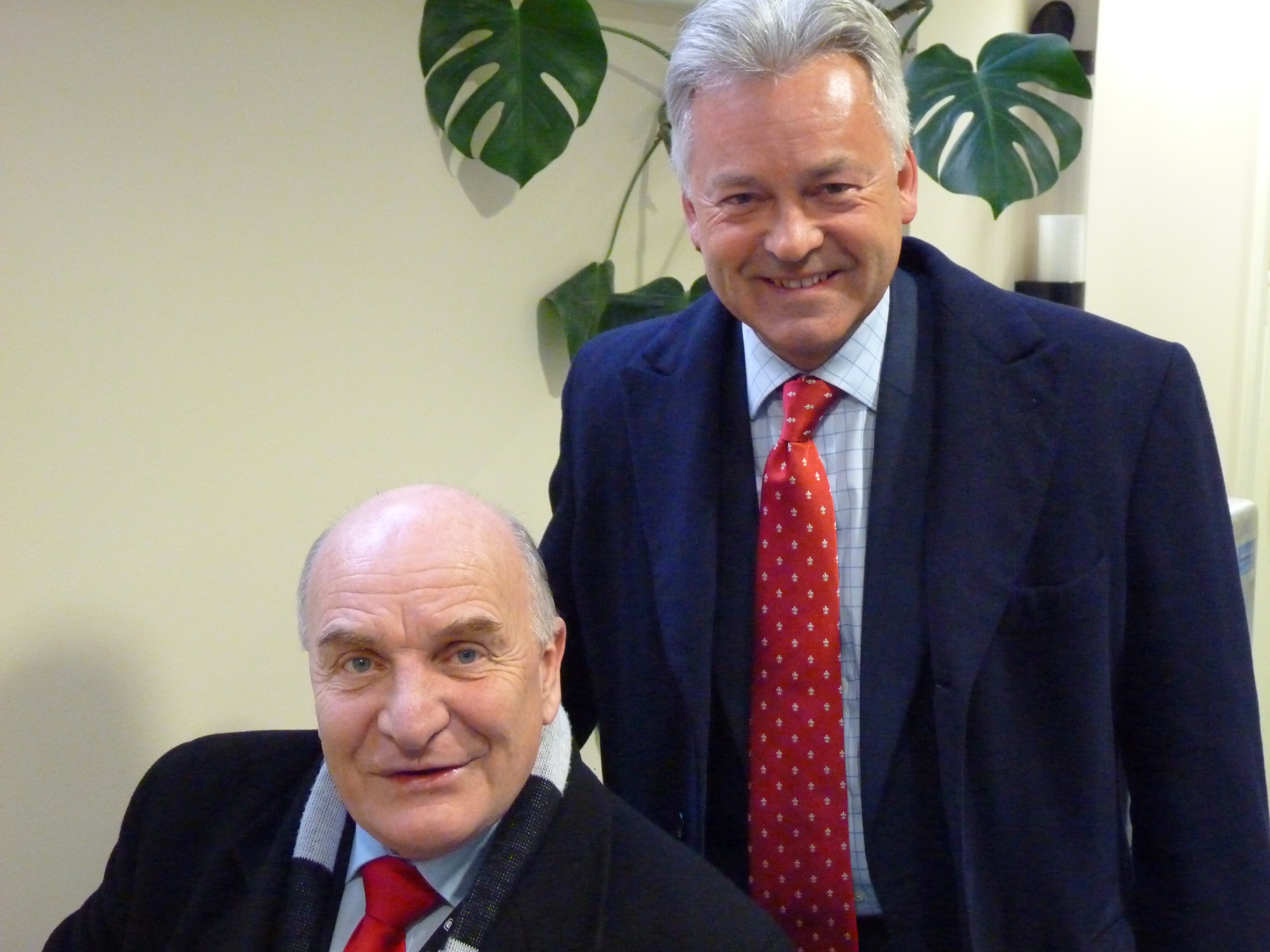
<p>The obvious answer was to take a look at the brains of two MP's with diametrically opposing views - step forward Thatcherite Conservative Alan Duncan, and Labour stalwart Stephen Pound, who agreed to undergo a structural brain scan using Magnetic Resonance Imaging, or MRI.</p>

<p>The MP's were put through their paces by professor Geraint Rees at UCL's Institute of Cognitive Neuroscience earlier this month.  </p>

<p>Obviously a study with just two subjects - however different their perspectives might be - was not a big enough sample to produce a statistically significant conclusion, so professor Rees expanded the study to include a pool of students and post-docs previously scanned at the Institute in other, unrelated, experiments.</p>

<p>This larger cohort was asked to fill in a questionaire assessing their political values, and their answers (along with those from Alan Duncan and Stephen Pound) were compared with earlier structural brain scans.</p>

<p>The results showed a strong correlation between between political belief and two specific regions of the brain. The grey matter of the anterior cingulate was significantly thicker amongst those who described themselves as liberal, or left wing, while the amygdala - an area associated with emotional processing - was larger in those who regarded themselves as conservative or right wing. </p>

<p>"It's a remarkable finding" says professor Rees. "We were very surprised to find two areas of the brain from which we could predict political attitudes."</p>

<p>Interestingly the results from Alan Duncan and Stephen Pound were consistent with the overall findings.  Stephen Pound's scan revealed a thicker anterior cingulate - consistent with those students who described themselves as left-wing - while Alan Duncan's was thinner.  Both MP's recorded similar densities for the amygdala.</p>

<p>Although the results do show that political belief is reflected in the physical structure of the brain it's not clear which comes first.  Whether the structure of the brain shapes political belief or political belief leads to the differential development of brain structure.</p>

<p>In that sense we haven't answered Colin Firth's original question, but what started out as a bit of fun has turned into a significant piece of scientific research.  </p>

<p>Professor Rees has written up the results of the experiment and submitted them to a scientific journal.  That paper is currently undergoing peer review and should be published in the New Year.</div></p>]]>
        
    </content>
</entry>

<entry>
    <title>Your chance to spot an alien world</title>
    <link rel="alternate" type="text/html" href="https://nontonwae.pages.dev/blogs/today/tomfeilden/2010/12/your_chance_to_spot_an_alien_w.html" />
    <id>tag:www.bbc.co.uk,2010:/blogs/today/tomfeilden//173.279947</id>


    <published>2010-12-17T10:03:48Z</published>
    <updated>2010-12-17T10:21:40Z</updated>


    <summary type="html"> Fancy yourself as a planet hunter? Who knows, you could be the first to spot the telltale signature of an earth-like world orbiting a distant star. That&apos;s the tantalising prospect scientists at NASA and Oxford University are offering to...</summary>
    <author>
        <name>Tom Feilden</name>
        
    </author>
    
    
    <content type="html" xml:lang="en" xml:base="https://nontonwae.pages.dev/blogs/today/tomfeilden/">
        <![CDATA[<p> <div class="imgCaptionCenter" style="text-align: center; display: block; "><br />
<img alt="" src="https://nontonwae.pages.dev/blogs/today/tomfeilden/planetscreenshotjpg.jpg" width="580" height="300" class="mt-image-center" style="margin: 0 auto 5px;" /><p style="width:580px;font-size: 11px; color: rgb(102, 102, 102);margin: 0 auto 20px;"> </p></div></p>

<p>Fancy yourself as a planet hunter?  Who knows, you could be the first to spot the telltale signature of an earth-like world orbiting a distant star.</p>

<p>That's the tantalising prospect scientists at NASA and Oxford University are offering to those willing to wade through the mountain of data being generated by the Kepler Space Observatory.</p>

<p>Kepler has been sitting out there in deep space quietly photographing a patch of sky between Cygnus and Lyra every 30 seconds or so for 18 months.  That's generated a colossal amount of data - and while the computer algorithms researchers are using to process the images are good at spotting huge Jupiter-like gas giants, they're less reliable when it comes to teasing out the signal of smaller planets 'lost' in the background noise.</p>

<p>For that you need the subtle pattern processing powers of a much more sophisticated computer - the human brain.  And that's where you come in.</p>

<p>"There's a good chance that some of these alien worlds are being lost in the noisy background data from Kepler" says physicist Dr Chris Linott from Oxford University's Department of Physics.  "What we're hoping is that the human eye might be able to spot these lost worlds, rescuing planets that automatic techniques have missed".</p>

<p>The team has built a website, <a href="http://www.planethunters.org/">Planethunters.org</a>, that allows anyone to sift through the Kepler data on individual stars one by one, and to submit likely candidates for hidden planets. </p>

<p>When a planet orbiting a distant star passes in front of it - a transit - the light from that star dims briefly before picking up again.  It's this telltale dip in luminosity researchers want people to highlight in the data.  Then they can go back and confirm the discovery. </p>

<p>"We've found from previous projects that people, armchair astronomers, are very good at sifting this sort of data," says Arfon Smith who helped design the website, "but one of our users spotting an earthlike planet in another star system would be a fantastic achievement."</p>

<p>It's an exciting idea, and who knows, perhaps a Today programme listener will be the first to spot a planet orbiting a distant star.<br />
</p>]]>
        
    </content>
</entry>

<entry>
    <title>Scientists have sense of humour, shock</title>
    <link rel="alternate" type="text/html" href="https://nontonwae.pages.dev/blogs/today/tomfeilden/2010/12/scientists_have_sense_of_humou.html" />
    <id>tag:www.bbc.co.uk,2010:/blogs/today/tomfeilden//173.279834</id>


    <published>2010-12-16T09:52:22Z</published>
    <updated>2010-12-16T11:25:26Z</updated>


    <summary type="html">&quot;This paper is desperate. Please reject it completely and then block the author&apos;s email&quot;. Hardly the sort of dry, dispassionate, technical assessment you expect from one researcher about another&apos;s work, but it seems that scientists are human after all. That&apos;s...</summary>
    <author>
        <name>Tom Feilden</name>
        
    </author>
    
    <category term="peerreview" label="peer review" scheme="http://www.sixapart.com/ns/types#tag" />
    <category term="science" label="science" scheme="http://www.sixapart.com/ns/types#tag" />
    <category term="scientificmethod" label="scientific method" scheme="http://www.sixapart.com/ns/types#tag" />
    
    <content type="html" xml:lang="en" xml:base="https://nontonwae.pages.dev/blogs/today/tomfeilden/">
        <![CDATA[<p>"This paper is desperate.  Please reject it completely and then block the author's email".  </p>

<p>Hardly the sort of dry, dispassionate, technical assessment you expect from one researcher about another's work, but it seems that scientists are human after all.  </p>

<p>That's the verdict after the <a href="http://onlinelibrary.wiley.com/doi/10.1111/j.1462-2920.2010.02394.x/pdf">Journal of Environmental Microbiology</a> chose to publish some of the wittier one-liners from referees involved in the peer review process.  </p>

<p>The results veer from the downright rude - "The biggest problem with this manuscript, which has nearly sucked the will to live out of me, is the terrible writing style" - via the enigmatic - "Preliminary and intriguing results...that should be published elsewhere" - to the artlessly charming - "Very much enjoyed reading this one and do not have any significant comments.  Wish I had thought of it."</p>

<p>Much of the vitriol can be put down to the pressures of competition. Inevitably, referees are picked from a pool that includes an author's closest rivals.  Other comments seem deliberately designed to try the patience of the journal's editors.</p>

<p>"I agreed to review this in the golden glow of a balmy evening on Lake Como. Back in the harsh light of reality in Belfast I realise that it would probably have been better not to have volunteered".</p>

<p>On the whole though it's the acerbic viciousness that catches the eye.  "The writing and data presentation are so bad that I had to leave work and go home and then spend time to wonder what life is about," writes one reviewer.</p>

<p>Speaking on the programme this morning the neurologist professor Colin Blakemore acknowledged there was a long and celebrated history to the caustic review. </p>

<div id="tomf20101216" class="player" style="margin-left:40px"><p>In order to see this content you need to have both <a href="https://nontonwae.pages.dev/webwise/askbruce/articles/browse/java_1.shtml" title="BBC Webwise article about enabling javascript">Javascript</a> enabled and <a href="https://nontonwae.pages.dev/webwise/askbruce/articles/download/howdoidownloadflashplayer_1.shtml" title="BBC Webwise article about downloading">Flash</a> installed. Visit <a href="https://nontonwae.pages.dev/webwise/">BBC&nbsp;Webwise</a> for full instructions. If you're reading via RSS, you'll need to visit the blog to access this content. </p> </div> <script type="text/javascript"> var emp = new bbc.Emp(); emp.setWidth("400"); emp.setHeight("106"); emp.setDomId("tomf20101216"); emp.setPlaylist("http://news.bbc.co.uk/media/emp/9290000/9292800/9292853.xml"); emp.write(); </script> 

<p>"Hans Krebs' classic paper on the Krebs cycle, perhaps the most important development in cell biology in the 20th century, was rejected by Nature.  They said it was of insufficient general interest.  He went on to win the Nobel prize for that".</p>

<p>With apologies to William Congreve, it seems Hell hath no fury like a scientist scorned.<br />
</p>]]>
        
    </content>
</entry>

<entry>
    <title>A near miss for the North Sea oil industry</title>
    <link rel="alternate" type="text/html" href="https://nontonwae.pages.dev/blogs/today/tomfeilden/2010/12/a_near_miss_for_the_north_sea.html" />
    <id>tag:www.bbc.co.uk,2010:/blogs/today/tomfeilden//173.279079</id>


    <published>2010-12-07T09:21:52Z</published>
    <updated>2010-12-07T11:25:01Z</updated>


    <summary type="html"> Deepwater Horizon An internal safety review passed to the Today programme shows that Transocean - the company operating BP&apos;s Deepwater Horizon oil rig in the Gulf of Mexico - narrowly avoided a similar accident in the North Sea, four...</summary>
    <author>
        <name>Tom Feilden</name>
        
    </author>
    
    
    <content type="html" xml:lang="en" xml:base="https://nontonwae.pages.dev/blogs/today/tomfeilden/">
        <![CDATA[<div class="imgCaptionCenter" style="text-align: center; display: block; ">
<img alt="Deepwater Horizon" src="https://nontonwae.pages.dev/blogs/today/tomfeilden/dh.jpg" width="580" height="450" class="mt-image-center" style="margin: 0 auto 5px;" /><p style="width:580px;font-size: 11px; color: rgb(102, 102, 102);margin: 0 auto 20px;">Deepwater Horizon </p></div>An internal safety review passed to the Today programme shows that Transocean - the company operating BP's Deepwater Horizon oil rig in the Gulf of Mexico - narrowly avoided a similar accident in the North Sea, four months earlier.

<p>The blowout happened on Shell's Sedco 711 platform on 23 December last year as the Transocean crew was preparing to switch from a drilling operation to production, bringing the reservoir in stream.</p>

<p>The report, a nine-page safety review of the incident, details a series of errors and misjudgements that led to the blowout.  </p>

<p>In a marked parallel with the Deepwater Horizon disaster, key indicators that something was going badly wrong were either misinterpreted or discounted - in this case in favour of a positive pressure test from a valve at the base of the well.  </p>

<p>That valve had been dislodged, or damaged, in earlier operations and the report concludes: "The risk perception of barrier failure was blinkered by the positive inflow test."</p>

<p>By the time the crew realised there was a problem oil and gas from the reservoir was forcing its way up the drill shaft and out onto the rig.  </p>

<p>Crucially there was not enough heavy mud available to pump back down into the well, counteracting the kick, or surge of gas and oil.  A major spill was averted only when the BOP, or blowout preventer, was activated capping-off the well on the sea floor.</p>

<p>The Commons Energy and Climate Change Committee is currently holding an inquiry into the safety implications of the Deepwater Horizon disaster for the UK off-shore oil industry.  </p>

<p>MP's heard from Paul King, the managing director of Transocean's North Sea Division, back in September but were unaware of the incident on the Sedco 711 platform at the time.</p>

<p>The committee's chairman, Tim Yeo, confirmed the report would now feature in their inquiry, and said it was important to understand how frequently this kind of thing was happening off-shore, and whether there was a risk of a more serious accident.</p>

<p>"It's not clear that this is something that had been properly prepared for, and it may well have been more luck than judgement that got it under control.  We don't want to see people working without the necessary kit, without proper training or procedures, and the result of that being a major spill."</p>

<p>We asked Transocean for an interview.  Sadly no one was available to comment, but in a statement the company stressed the importance of safety and well control on all its installations.</p>

<p>"Any related events that occur on a rig anywhere in the world, including the one in December of 2009, are immediately reported to management, fully investigated, and the valuable information gleaned from that investigation is used to improve existing safety systems across the fleet."</p>

<p>Thankfully for all those on the Sedco 711 rig - and for the wider environment of the North Sea - a major accident and spill was averted.  </p>

<p>But the parallels between this and the Deepwater Horizon disaster in the Gulf of Mexico raise serious questions about the operating procedures and safety margins employed on rigs across the off-shore oil industry.</p>

<p>According to the Health and Safety Executive there were 85 major or significant unplanned hydrocarbon releases across the sector in the North Sea last year - up 20 percent on 2008/9.</p>]]>
        
    </content>
</entry>

<entry>
    <title>Scientists capture antimatter</title>
    <link rel="alternate" type="text/html" href="https://nontonwae.pages.dev/blogs/today/tomfeilden/2010/11/scientists_capture_antimatter.html" />
    <id>tag:www.bbc.co.uk,2010:/blogs/today/tomfeilden//173.277570</id>


    <published>2010-11-18T09:44:03Z</published>
    <updated>2010-11-18T09:57:34Z</updated>


    <summary type="html"> It&apos;s a staple of science fiction: the energy source that powers the Starship Enterprise, and the explosive charge fuelling a dastardly plot to blow up the vatican in Dan Brown&apos;s Angels and Demons. But now antimatter has moved from...</summary>
    <author>
        <name>Tom Feilden</name>
        
    </author>
    
    
    <content type="html" xml:lang="en" xml:base="https://nontonwae.pages.dev/blogs/today/tomfeilden/">
        <![CDATA[<div class="imgCaptionCenter" style="text-align: center; display: block; ">
<img alt="Antimatter trap at Cern" src="https://nontonwae.pages.dev/blogs/today/tomfeilden/antimattertrap.jpg" width="580" height="400" class="mt-image-center" style="margin: 0 auto 5px;" /><p style="width:580px;font-size: 11px; color: rgb(102, 102, 102);margin: 0 auto 20px;"> </p></div>It's a staple of science fiction: the energy source that powers the Starship Enterprise, and the explosive charge fuelling a dastardly plot to blow up the vatican in Dan Brown's Angels and Demons.  

<p>But now antimatter has moved from the realm of science fiction - or more accurately science theory - to science fact.  Researchers working on the Alpha experiment at Cern have succeeded in trapping 38 atoms of anti-hydrogen for one sixth of a second.</p>

<p>That may not sound like much of an achievement, but the problem with antimatter is that as soon as it comes into contact with ordinary matter they annihilate each other instantly.  Studying such an elusive substance in a laboratory where everything is inevitably made of matter presents a unique challenge.</p>

<div id="tomf2010118" class="player" style="margin-left:40px"><p>In order to see this content you need to have both <a href="https://nontonwae.pages.dev/webwise/askbruce/articles/browse/java_1.shtml" title="BBC Webwise article about enabling javascript">Javascript</a> enabled and <a href="https://nontonwae.pages.dev/webwise/askbruce/articles/download/howdoidownloadflashplayer_1.shtml" title="BBC Webwise article about downloading">Flash</a> installed. Visit <a href="https://nontonwae.pages.dev/webwise/">BBC&nbsp;Webwise</a> for full instructions. If you're reading via RSS, you'll need to visit the blog to access this content. </p> </div> <script type="text/javascript"> var emp = new bbc.Emp(); emp.setWidth("400"); emp.setHeight("106"); emp.setDomId("tomf2010118"); emp.setPlaylist("http://news.bbc.co.uk/media/emp/9200000/9202200/9202277.xml"); emp.write(); </script> 

<p><br />
The researchers at the Alpha experiment have got round this problem by trapping antimatter particles in a series of overlapping magnetic fields.  For a brief moment the particles are held in suspended animation.  </p>

<p>"Capturing anti-hydrogen is a major breakthrough in antimatter physics" claims Swansea University's Dr Niels Madsen, a co-author on the research paper published in the journal Nature.  "Having the anti-atoms trapped will allow for comparisons of matter and antimatter to a level that, until now, would have been considered wishful thinking".</p>

<p><br />
<div class="imgCaptionRight" style="float: right; "><br />
<img alt="The equipment for the Cern antimatter experiment" src="https://nontonwae.pages.dev/blogs/today/tomfeilden/antimatterexperiment.jpg" width="350" height="280" class="mt-image-right" style="margin: 10px 0 5px 20px;" /><p style="width:350px;font-size: 11px; color: rgb(102, 102, 102);margin-left:20px;"> </p></div><br />
The existence of antimatter was first suggested by the theoretical physicist Paul Dirac in the 1930's.  </p>

<p>Working on a theory to combine quantum mechanics with Einstein's special relativity he realised his equations predicted a corresponding antiparticle for every particle in existence - identical in every respect, but with an opposite electrical charge.  </p>

<p>It's important because scientists studying the origins of the universe believe that almost equal amounts of matter and antimatter were created in the big bang.  The vast majority of these particles were instantly annihilated as matter and antimatter came into contact.  The slight discrepancy in favour of matter accounts for all the stuff we see today - every atom in every star, galaxy, planet or cup of coffee in existence.  </p>

<p>The problem is that scientists can't explain this discrepancy - exactly why there is any stuff at all left over to make up the universe.  </p>

<p>Studying antimatter in the laboratory could shed new light on the problem, and help to explain the fundamental laws of physics.  Warp speed ahead.<br />
</p>]]>
        
    </content>
</entry>

<entry>
    <title>Black holes, carnivorous plants, smoking and... frogs</title>
    <link rel="alternate" type="text/html" href="https://nontonwae.pages.dev/blogs/today/tomfeilden/2010/11/black_holes_carnivorous_plants.html" />
    <id>tag:www.bbc.co.uk,2010:/blogs/today/tomfeilden//173.277309</id>


    <published>2010-11-16T10:16:47Z</published>
    <updated>2010-11-16T10:53:28Z</updated>


    <summary type="html">It&apos;s one of those days. A lot seems to be going on and there&apos;s not enough space to fit it all on the programme. So for those of you interested in black holes, smoking, the discovery of new species and...</summary>
    <author>
        <name>Tom Feilden</name>
        
    </author>
    
    
    <content type="html" xml:lang="en" xml:base="https://nontonwae.pages.dev/blogs/today/tomfeilden/">
        <![CDATA[<p>It's one of those days.  A lot seems to be going on and there's not enough space to fit it all on the programme. So for those of you interested in black holes, smoking, the discovery of new species and the latest developments in stem cell research....read on.</p>

<div class="imgCaptionRight" style="float: right; ">
<img alt="Smoking" src="https://nontonwae.pages.dev/blogs/today/tomfeilden/smoker.jpg" width="250" height="300" class="mt-image-right" style="margin: 10px 0 5px 20px;" /><p style="width:250px;font-size: 11px; color: rgb(102, 102, 102);margin-left:20px;"> </p></div>One thing that did make it is a study of women who smoked heavily during pregnancy in the 1960's.  It shows that their children were more likely to have become repeat criminal offenders as adults.

<p>The findings, published in the <a href="http://jech.bmj.com/content/early/2010/10/18/jech.2009.095802.abstract?sid=54323d33-ab75-4770-90bd-bc69989833e3">Journal of Epidemiology and Community Health</a>, held true even after a comprehensive range of social factors, like mental ill-health and deprivation, were taken into account.</p>

<p>The study drew on data supplied by mothers who had taken part in one of the biggest and longest running surveys designed to track the ongoing impact of a wide range of behaviours during pregnancy - the Collaborative Perinatal Project.</p>

<p>The team, lead by Dr Angela Paradis at the Harvard School of Public Health, ran criminal records checks on nearly 4000 individuals whose mothers had been enrolled in the project between 1959 and 1966 and who smoked more than 20 cigarettes a day during pregnancy.  </p>

<p>"While not definitive", Dr Paradis concludes "the findings do support a modest causal relationship between smoking during pregnancy and adult criminal offending".</p>

<p>While all that was going on in Massachusetts, doctors in Glasgow have broken new ground by <a href="https://nontonwae.pages.dev/news/health-11763681">injecting stem cells into the brain of a stroke patient.</a>  The PISCES study - Pilot Investigation of Stem Cells in Stroke - is the world's first fully regulated clinical trial of a neural stem cell therapy.  </p>

<p>According to professor Keith Muir, principle Investigator for the study, the patient underwent a successful surgical procedure at Glasgow's Southern General Hospital and has now been discharged.  </p>

<p>"We hope that, in future, it will lead on to larger studies to determine the effects of stem cells on the disabilities that result from stroke".</p>

<p>The patient will be monitored closely for the next two years as part of a phase 1 clinical trial to assess the safety of the procedure.</p>

<div class="imgCaptionCenter" style="text-align: center; display: block; ">
<img alt="Nasa picture of newly discovered black hole" src="https://nontonwae.pages.dev/blogs/today/tomfeilden/black-hole.jpg" width="580" height="300" class="mt-image-center" style="margin: 0 auto 5px;" /><p style="width:580px;font-size: 11px; color: rgb(102, 102, 102);margin: 0 auto 20px;"> </p></div>

<p>Meanwhile astronomers monitoring the constellation Virgo say they've witnessed the <a href="http://www.nasa.gov/mission_pages/chandra/news/H-10-299.html">birth of a black hole </a>for the first time.</p>

<p>Originally spotted by an amateur astronomer in 1979, researchers have used NASA's Chandra X-Ray Observatory to study the object - believed to be the remnant of a supernova in the galaxy M100 some 50 million light years from earth.</p>

<p>NASA astrophysicist Kimberly Weaver says the black hole formed when a star 20 times more massive than the sun collapsed at the end of its life.</p>

<p>"What's really exciting about it is that we know the exact birth date of this black hole.  Now we want to watch how this system evolves and changes because that's how we will understand the physics of black hole systems".</p>

<p>Back on terra firma researchers at <a href="http://www.conservation.org/Pages/default.aspx">Conservation International</a> have identified three new species of frog in western Colombia.<br />
<div class="imgCaptionCenter" style="text-align: center; display: block; "><br />
<img alt="Newly discovered species of frog" src="https://nontonwae.pages.dev/blogs/today/tomfeilden/frog.jpg" width="580" height="300" class="mt-image-center" style="margin: 0 auto 5px;" /><p style="width:580px;font-size: 11px; color: rgb(102, 102, 102);margin: 0 auto 20px;"> </p></div></p>

<p>The expedition, lead by CI's amphibian specialist Dr Robin Moore, was actually on a quest to rediscover the Mesopotamia beaked toad, which hasn't been seen since the outbreak of the first world war and is listed as Critically Endangered on the IUCN Red List of Threatened Species.</p>

<p>Despite an intensive search extending from the cold, high cloud-forests to the tropical lowland rainforests of Colombia's Chocó and Antioquia departments, no trace of the elusive toad could be found.  </p>

<p>Instead researchers returned having documented the discovery of three species new to science. </p>

<p>"After spending several days searching for the Mesopotamia beaked toad with no success, the team's spirits were pretty low" says Moore.  "But finding these new species, including a new beaked toad, was like a shot of adrenaline. We definitely left on a high." </p>

<div class="imgCaptionRight" style="float: right; ">
<img alt="Newly discovered pitcher plant Nepenthesholdenii Cardamom" src="https://nontonwae.pages.dev/blogs/today/tomfeilden/NepenthesholdeniiCardamom.jpg" width="250" height="400" class="mt-image-right" style="margin: 10px 0 5px 20px;" /><p style="width:250px;font-size: 11px; color: rgb(102, 102, 102);margin-left:20px;"> </p></div>

<p>The penchant for describing new species isn't limited to South America.  Scientists at <a href="http://www.fauna-flora.org/">Flora and Fauna International </a>have announced the discovery of a new species of carnivorous pitcher plant, Nepenthes Holdenii, in Cambodia's remote Cardamom Mountains.</p>

<p>The large red and green pitchers are actually modified leaves designed to capture and digest insects.  Photographer Jeremy Holden, who first found the plant and after whom it is named, says "The Cardamom mountains are a treasure chest of new species, but it was a surprise to find something as exciting and charismatic as an unknown pitcher plant".</p>

<p>But it isn't all good news for scientists set on discovering new species in obscure, unsurveyed regions of the planet.  The Natural History Museum has suspended a planned expedition to Paraguay after protests that it might disturb one of the world's last uncontacted tribes. </p>

<p>As we featured on the programme last week anthropologists have warned that the expedition, to the remote Chaco region, was likely to make accidental contact with the Ayoreo people, putting them at risk of infectious diseases. <br />
</p>]]>
        
    </content>
</entry>

<entry>
    <title>The &apos;golden age&apos; of Arabic science</title>
    <link rel="alternate" type="text/html" href="https://nontonwae.pages.dev/blogs/today/tomfeilden/2010/11/the_golden_age_of_arabic_scien.html" />
    <id>tag:www.bbc.co.uk,2010:/blogs/today/tomfeilden//173.276263</id>


    <published>2010-11-13T08:22:53Z</published>
    <updated>2010-11-13T08:46:26Z</updated>


    <summary type="html"> A brief thumb-nail sketch of the history of science typically begins in antiquity - with the likes of Pythagoras, Euclid and Plato - before leaping the best part of a thousand years to Kepler, Galileo and the European Renaissance...</summary>
    <author>
        <name>Tom Feilden</name>
        
    </author>
    
    
    <content type="html" xml:lang="en" xml:base="https://nontonwae.pages.dev/blogs/today/tomfeilden/">
        <![CDATA[<div class="imgCaptionCenter" style="text-align: center; display: block; ">
<img alt="Arabic astrolabe" src="https://nontonwae.pages.dev/blogs/today/tomfeilden/astrolabe.jpg" width="300" height="400" class="mt-image-center" style="margin: 0 auto 5px;" /><p style="width:300px;font-size: 11px; color: rgb(102, 102, 102);margin: 0 auto 20px;"> </p></div>
A brief thumb-nail sketch of the history of science typically begins in antiquity - with the likes of Pythagoras, Euclid and Plato - before leaping the best part of a thousand years to Kepler, Galileo and the European Renaissance of the 16th century.  

<p>What went in between is often dismissed as the Dark Ages - a period in which Europe, and scientific progress, slumbered.</p>

<p>But this, admittedly western, model overlooks the importance of a huge blossoming of science and scholarship in the Islamic world of the middle ages.  A period in which the Ummayyad and Abbasid Caliphs created one of the greatest centres of learning the world had ever known - the Bayt al-Hikma, or House of Wisdom.</p>

<p>"Just because Europe was stuck in the Dark Ages," argues Jim Al-Khalili the professor of physics at the University of Surrey and author of Pathfinders: The Golden Age of Arabic Science, "we shouldn't assume that the rest of the world had stagnated.  There was this great flourishing of scholarship and discovery in the Islamic world of the middle ages".</p>

<p>Great advances were made across a range of fields between the 9th and 13th centuries, from mathematics and astronomy to medicine and chemistry.  The proof lies in the words we still use today: words like algebra, alchemy and alkaline; and in the names of stars like Dubhe, Megrez, Alioth, Mizar and Alkaid - five of the seven stars that make up one of the most familiar constellations in the night sky, the plough, or Ursa Major.</p>

<p>Among the many great thinkers of the period al-Hassan Ibn al-Haytham stands out as the father of the modern scientific method.  Long before Francis Bacon and Rene Descartes al-Haytham was scrupulously gathering data and testing his ideas through meticulous observation and experiment.  </p>

<p>According to Jim Al-Khalili, al-Haytham's work on the defraction of light puts him on a par with Galileo and Newton.   </p>

<p>"We learn at school that Isaac Newton was the father of optics, using prisms to split light into its constituent colours.  But al-Haytham also wrote extensively on light and optics and the Latin translations of his work were hugely influential in the European Renaissance."</p>

<p>Not all Al'Khalili's heroes were Arabs: Persians, Christians and Jews all played their part in this golden age.<div class="imgCaptionCenter" style="text-align: center; display: block; "><br />
<img alt="al-Khwarizmi" src="https://nontonwae.pages.dev/blogs/today/tomfeilden/al-Khwarizmi-engraved.gif" width="344" height="475" class="mt-image-center" style="margin: 0 auto 5px;" /><p style="width:344px;font-size: 11px; color: rgb(102, 102, 102);margin: 0 auto 20px;"> </p></div>One of the greatest mathematicians of the medieval world was al-Khwarizmi, a Persian credited with inventing algebra.  Even the word "algebra" comes from the title of his great work, Kitab al-jebr, and the Latin translation of his name, Algorithmus, gives us algorithm.</p>

<p>Ultimately civilisations ebb and flow and the 'baton of enlightenment', as Al-Khalili describes it, ultimately passed to Europe.  So much so that today, he says, science is widely regarded with suspicion in the Islamic world: a western, secular, even atheist construct.</p>

<p>But all that may be about to change: In Saudi Arabia a £20 billion pound endowment aims to turn the King Abdullah University of Science and Technology into a powerhouse to rival anything the West has to offer.  Qatar is committed to invest 2.8 percent of its GDP on research, and Abu Dhabi is planning to raise the world's first fully sustainable city and innovation hub from the desert sands.</p>

<p>It's a modern, Arabic renaissance, that Jim Al-Khalili hopes will benefit us all.</p>

<p>"Look where the Muslim world was a thousand years ago.  It was the centre of the civilised world.  There's a long way to go, but the signs are that things are moving impressively rapidly in the right direction".</p>]]>
        
    </content>
</entry>

<entry>
    <title>TWO GALAXIES FOR THE PRICE OF ONE </title>
    <link rel="alternate" type="text/html" href="https://nontonwae.pages.dev/blogs/today/tomfeilden/2010/11/two_galaxies_for_the_price_of.html" />
    <id>tag:www.bbc.co.uk,2010:/blogs/today/tomfeilden//173.273110</id>


    <published>2010-11-04T18:00:00Z</published>
    <updated>2010-11-04T18:02:16Z</updated>


    <summary type="html"> Any child can tell you that light travels in straight lines, but it takes a genius like Albert Einstein to appreciate that (with apologies to George and Ira Gershwin) it ain&apos;t necessarily so. Einstein&apos;s theory of General Relativity showed...</summary>
    <author>
        <name>Tom Feilden</name>
        
    </author>
    
    
    <content type="html" xml:lang="en" xml:base="https://nontonwae.pages.dev/blogs/today/tomfeilden/">
        <![CDATA[<div class="imgCaptionCenter" style="text-align: center; display: block; "><a href="https://nontonwae.pages.dev/blogs/today/tomfeilden/C_ImageSDP81-sm.jpg"><img alt="Two galaxies show the effect of gravitational lensing" src="https://nontonwae.pages.dev/blogs/today/tomfeilden/assets_c/2010/11/C_ImageSDP81-sm-thumb-825x450-60134.jpg" width="580" height="250" class="mt-image-center" style="margin: 0 auto 5px;" /></a><p style="max-width:260px;font-size: 11px; color: rgb(102, 102, 102);margin: 0 auto 20px;"> </p></div>Any child can tell you that light travels in straight lines, but it takes a genius like Albert Einstein to appreciate that (with apologies to George and Ira Gershwin) it ain't necessarily so. 

<p>Einstein's theory of General Relativity showed that gravity can bend light - a phenomenon known as gravitational lensing, and one which was spectacularly confirmed by a team lead by Sir Arthur Eddington in 1919.  </p>

<p>The effect is normally extremely small, and it is only when light passes close to a very massive object, such as a galaxy containing hundreds of billions of stars, that it can be spotted.</p>

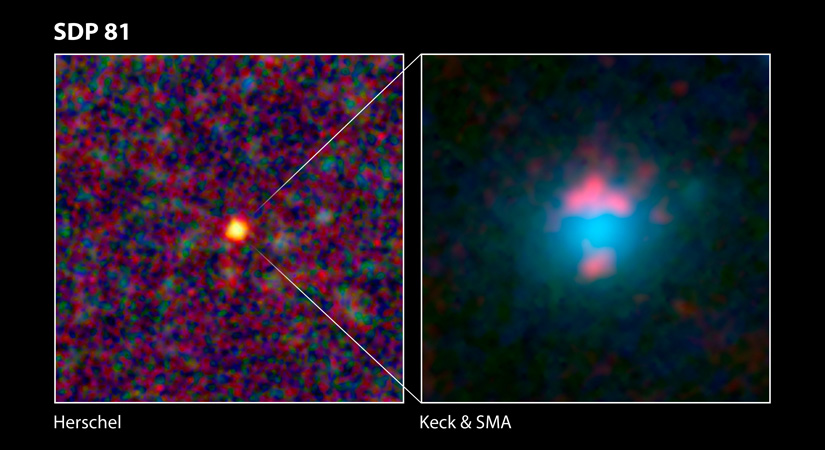
<p>Take a close look at the two images above. The first, taken by ESA's Herschel Space Observatory, shows an unusually bright orange blob located in the constellation Hydra.  </p>

<p>The second, taken at higher resolution from the ground-based Keck Telescope and the Smithsonian Astrophysical Observatory's Submilimetre Array in Hawaii, shows that Herschel has found a gravitational lens.  </p>

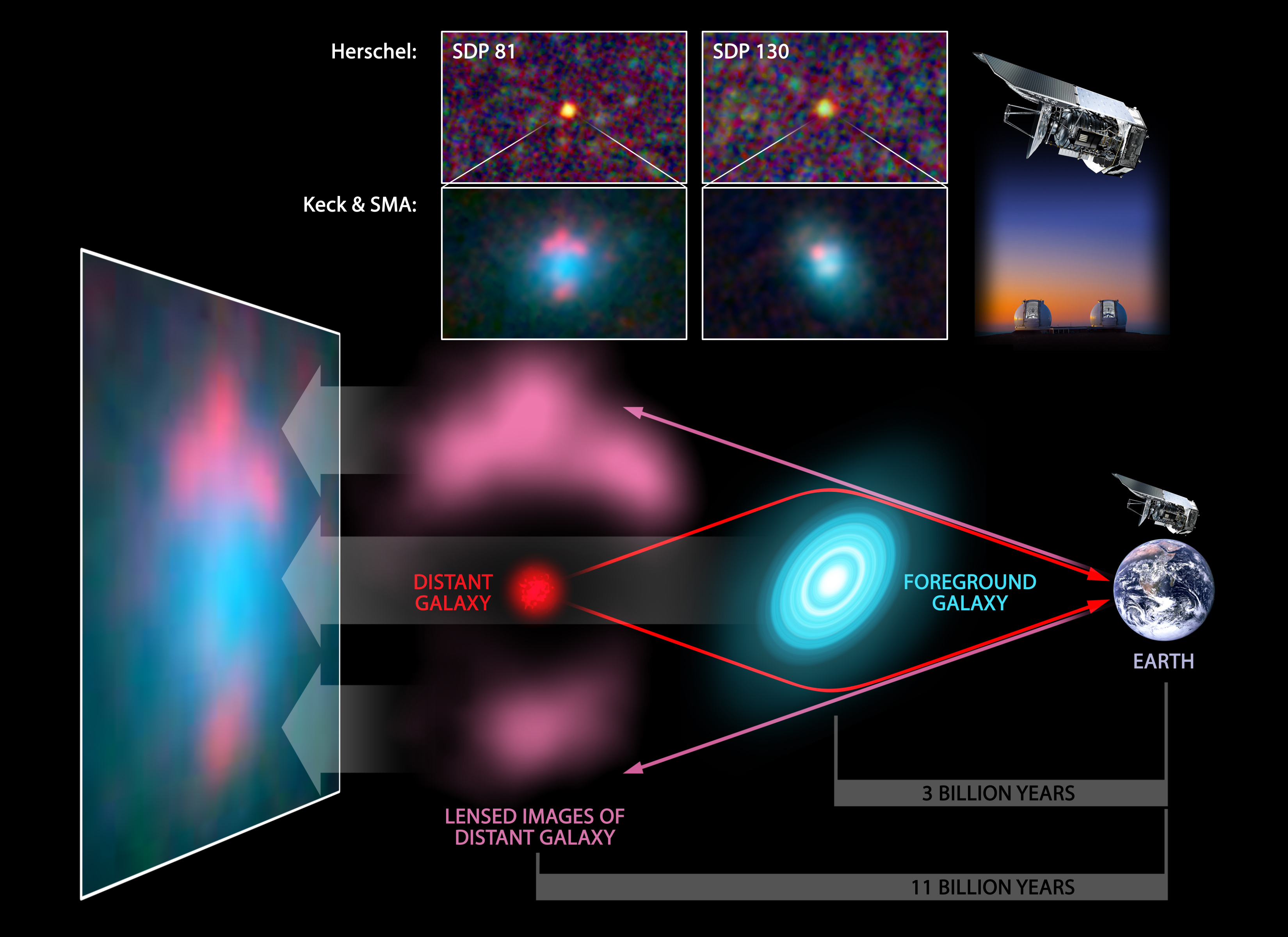
<p>The reason why this blob is so bright is that we are actually seeing two galaxies, with the red light from the more distant one bent around and superimposed over the light emanating from the nearer, blue, galaxy.</p>

<p>If light really did travel in straight lines we might expect the much longer wavelength light from the background galaxy to be "blotted out" by the stronger signal from the closer one.  Instead this longer wavelength light has been magnified and distorted by gravitational lensing.  </p>

<p>The overall effect is to increase the brightness, making the orange blob appear considerably closer to earth than it really is.</p>

<p>The images, published in the journal Science, are the first to come from the Herschel-ATLAS project - the largest imaging survey at sub-milimetre wavelengths conducted so far with ESA's Herschel Observatory.  </p>

<p>The lead author, Dr Mattia Negrello from the Open University, says the findings will help to pinpoint many more examples of this rare phenomena.  </p>

<p>"The big breakthrough is that we have discovered many of the brightest sources are being magnified by lenses," he explains.</p>

<p>"Which means we no longer have to rely on the rather inefficient methods at visible and radio wavelengths to find them."</p>

<div class="imgCaptionCenter" style="text-align: center; display: block; "><a href="https://nontonwae.pages.dev/blogs/today/tomfeilden/A_LensingDiagram.jpg"><img alt="How gravitational lensing works" src="https://nontonwae.pages.dev/blogs/today/tomfeilden/assets_c/2010/11/A_LensingDiagram-thumb-3300x2400-60140.jpg" width="580" height="250" class="mt-image-center" style="margin: 0 auto 5px;" /></a><p style="max-width:260px;font-size: 11px; color: rgb(102, 102, 102);margin: 0 auto 20px;">How gravitational lensing works </p></div>
The magnification created by the effect of gravitational lensing allows astronomers to see galaxies that would otherwise be hidden, providing key insights into the history of the cosmos and bringing us a step closer to understanding the complex birth of stars and galaxies. 

<p>According to Professor Rob Ivison from the Royal Observatory, Edinburgh, the technique promises to unlock the secrets of how galaxies form and evolve.</p>

<p>"Not only does the lensing allow us to find them very efficiently, but it helps us to peer within them to figure out how the individual pieces of the jigsaw came together back in the mists of time." <br />
</p>]]>
        
    </content>
</entry>

</feed>