<?xml version="1.0" encoding="utf-8"?>
<feed xmlns="http://www.w3.org/2005/Atom">
    <title>BBC - Richard Black&apos;s Earth Watch</title>
    <link rel="alternate" type="text/html" href="https://nontonwae.pages.dev/blogs/thereporters/richardblack/" />
    <link rel="self" type="application/atom+xml" href="https://nontonwae.pages.dev/blogs/thereporters/richardblack/atom.xml" />
    <id>tag:www.bbc.co.uk,2009-02-13:/blogs/thereporters/richardblack//198</id>
    <updated>2011-05-12T11:51:25Z</updated>
    <subtitle>I&apos;m Richard Black, environment correspondent for the BBC News website. This is my take on what&apos;s happening to our shared environment as the human population grows and our use of nature&apos;s resources increases.</subtitle>
    <generator uri="http://www.sixapart.com/movabletype/">Movable Type Pro 4.33-en</generator>

<entry>
    <title>New beginnings</title>
    <link rel="alternate" type="text/html" href="https://nontonwae.pages.dev/blogs/thereporters/richardblack/2011/05/new_beginnings.html" />
    <id>tag:www.bbc.co.uk,2011:/blogs/thereporters/richardblack//198.290333</id>


    <published>2011-05-12T11:50:09Z</published>
    <updated>2011-05-12T11:51:25Z</updated>


    <summary type="html">Thanks for having read my blog over the last few years. As of today, it is moving to a new home with a new look - as are the BBC&apos;s other blogs. The new page will carry all my posts,...</summary>
    <author>
        <name>Richard Black</name>
        
    </author>
    
    
    <content type="html" xml:lang="en" xml:base="https://nontonwae.pages.dev/blogs/thereporters/richardblack/">
        <![CDATA[<p>Thanks for having read my blog over the last few years. As of today, it is moving to a new home with a new look - as are the BBC's other blogs. The <a href="https://nontonwae.pages.dev/news/correspondents/richardblack/">new page will carry all my posts</a>, as well as other bits of analysis from around the site. It'll carry tweets as soon as I'm up and running on that platform, and will also carry my news stories when BBC technology allows.<br />
</p>]]>
        
    </content>
</entry>

<entry>
    <title>Megafires - a vicious climate circle?</title>
    <link rel="alternate" type="text/html" href="https://nontonwae.pages.dev/blogs/thereporters/richardblack/2011/05/the_term_megafire_sounds_a.html" />
    <id>tag:www.bbc.co.uk,2011:/blogs/thereporters/richardblack//198.290248</id>


    <published>2011-05-10T15:50:46Z</published>
    <updated>2011-05-10T15:53:09Z</updated>


    <summary type="html">The term &quot;megafire&quot; sounds a bit serious... and so it is. Even more serious is the idea - raised in a report compiled for a UN meeting this week - that megafires are becoming more frequent. Still more alarming is...</summary>
    <author>
        <name>Richard Black</name>
        
    </author>
    
    
    <content type="html" xml:lang="en" xml:base="https://nontonwae.pages.dev/blogs/thereporters/richardblack/">
        <![CDATA[<p>The term "megafire" sounds a bit serious... and so it is.</p>
<p>Even more serious is the idea - <a href="http://www.fao.org/news/story/en/item/74214/icode/">raised in a report</a> compiled for a UN meeting this week - that megafires are becoming more frequent.</p>
<p>Still more alarming is the notion that these magafires are somehow quantitatively different from their smaller and more common cousins:</p>
<blockquote>
<p>"Megafires exceed all efforts at control until firefighters get a favourable change in weather or a break in fuels.</p>
<p>"Even in countries with modern tools and techniques to combat severe wildfires, firefighters are generally forced onto the defensive; taking action where they can on the fire's terms."</p>
</blockquote>
<p>The grand-daddy of the fires we're talking about here is the sequence <a href="http://news.bbc.co.uk/1/hi/special_report/1998/04/98/haze_98/75171.stm">in Kalimantan on Borneo in 1997/8</a>, where forests smouldered for many months, sparked by extremely dry <a href="http://en.wikipedia.org/wiki/El_Ni%C3%B1o-Southern_Oscillation">El Nino</a> conditions.</p>
<div class="imgCaptionRight" style="float: right; "><img class="mt-image-right" style="margin: 10px 0 5px 20px;" src="https://nontonwae.pages.dev/blogs/thereporters/richardblack/fireklap304.jpg" alt="Haze in Malaysia" width="304" height="464" />
<p style="width: 304px; font-size: 11px; color: #666666; margin-left: 20px;">Haze from the 1997/8 Kalimantan fires caused chaos in the Malaysian capital Kuala Lumpur</p>
</div>
<p>The episode smoked out much of East Asia, with people in countries such as Malaysia, Thailand and The Philippines suffering respiratory diseases, and economic damage put in the billions of dollars.</p>
<p>Since then, Brazil in 1998, the US in 2003, Greece in 2007, Botswana in 2008, Australia in 2009, and both Israel and Russia in 2010 have all seen conflagrations that the report's authors believe merit the description "megafire".</p>
<p>The paper's been written by a team of 10 experts from across the world, at the behest of the <a href="http://www.fao.org/">UN Food and Agriculture Organization (FAO)</a>, and has been released at the <a href="http://www.wildfire2011.org/index.php">Wildfire 2011 conference</a> in South Africa.</p>
<p>The list of eight fires listed above isn't exhaustive, and Kalimantan wasn't the first megafire.</p>
<p>But being the most recent, this group have been better studied than most, especially given the modern availability of satellite monitoring; so it with this group that the FAO panel concerns itself.</p>
<p>Is there a pattern across these fires? And if so, what factors, environmental and other, does it relate to?</p>
<p>The answer to the first question appears to be a cautious "yes - probably".</p>
<p>Virtually all had a human cause - mostly intentional - ranging from lighting camp fires in Europe to clearing forests for farmland in Indonesia.</p>
<p>Extreme weather, especially drought, was another common factor. And in virtually all, the forest had been "altered" as a result of intensive logging, land clearance, and development for human settlement.</p>
<p>And what of the climate?</p>
<p>The El Nino conditions of 1997/8 were extraordinary for the modern era. But given that climate models predict declining rainfall in some areas that are already rather dry (parts of Australia perhaps being the exemplar here), what does that imply for the future?</p>
<p>Here, the FAO does not draw firm conclusions - and given the uncertainties in climate modelling and the fact that there is a limited dataset of past fires on which to draw, their caution is easily understood.</p>
<p>Nevertheless, a cautionary note is raised:</p>
<blockquote>
<p>"With the onset of more pervasive, world-wide drought, there is no longer the assurance that some places, only because they have not had severe wildfires in the past, will be safe from conflagrations in the future."</p>
</blockquote>
<p>But there is also a fillip:</p>
<blockquote>
<p>"Mega-fires are not occurring where land management practices are consistent with the fire ecologies and disturbance dynamics that define the ecosystem.</p>
<p>"Mega-fire risk is likewise much reduced in those areas where wildfire protection programs are more balanced between prevention, mitigation, and suppression elements."</p>
</blockquote>
<div class="imgCaptionRight" style="float: right; "><img class="mt-image-right" style="margin: 10px 0 5px 20px;" src="https://nontonwae.pages.dev/blogs/thereporters/richardblack/firegreeceap304.jpg" alt="Firefighting in Greece" width="304" height="434" /></div>
<p>The one thing governments and their people must not do, the report  cautions, is to treat megafires as something that can be combated with  greater numbers of firefighters or more sophisticated means of aerial  assault.</p>
<p>Instead, they need to be understood as a natural phenomenon, but as living entities, subject to the whims of weather, and capable of being coaxed into relative quiescence.</p>
<p>And addressing them is best done with forest management - although the report notes that here there is a question of skills declining around the world.</p>
<p>In terms of what climate change means here, you can draw something of a parallel with coral reefs.</p>
<p>A healthy reef may be able to bat away the impact of exploitative fishing or excessive pollution from land.</p>
<p>But coral impacted by rising temperatures and progressively less alkaline oceans may not be able to.</p>
<p>So too, the FAO suggest, with fire.</p>
<p>Controls that worked in a cooler, wetter environment may not work at all as the world warms - the addition of climate change to other factors driving fires may be what's already causing the rise in incidence that the report suggests.</p>
<p>A final note on the climate front. The 1997 Kalimantan fires released  about as much carbon dioxide as Europe's industry - plus the fact that  those trees were not there any more to absorb CO2.</p>
<p>So in principle, megafires could be another positive feedback loop for CO2-driven warming, especially if they are increasing as the FAO suggests:</p>
<blockquote>
<p>"Because CO2 emissions contribute to global warming and mega-fires are the result of drought, mega-fires (and carbon releases) may represent a dangerous feed-back loop that becomes self-perpetuating in the absence of stronger wildfire emissions monitoring and control.</p>
<p>Little is known of this possible iterative relationship and its long-term ramifications."</p>
</blockquote>]]>
        
    </content>
</entry>

<entry>
    <title>Generation game warms legal climate</title>
    <link rel="alternate" type="text/html" href="https://nontonwae.pages.dev/blogs/thereporters/richardblack/2011/05/generation_climate_game.html" />
    <id>tag:www.bbc.co.uk,2011:/blogs/thereporters/richardblack//198.290052</id>


    <published>2011-05-06T15:56:58Z</published>
    <updated>2011-05-06T15:58:25Z</updated>


    <summary type="html">There are times when writing articles about climate change brings a distinct feeling of deja vu. There was a time five or six years ago when litigation over climate impacts featured regularly on this website.Scientists were working up methods of...</summary>
    <author>
        <name>Richard Black</name>
        
    </author>
    
    
    <content type="html" xml:lang="en" xml:base="https://nontonwae.pages.dev/blogs/thereporters/richardblack/">
        <![CDATA[<p>There are times when writing articles about climate change brings a distinct feeling of deja vu.</p>
<p>There was a time five or six years ago when litigation over climate impacts featured regularly on this website.<br /><br />Scientists  were working up methods of attribution - methods that would allow you  to say, for example, "60% of the risk of that particular impact  happening was due to climate change" - and allow plaintiffs to sue on  that basis.</p>
<div class="imgCaptionRight" style="float: right; "><img class="mt-image-right" style="margin: 10px 0 5px 20px;" src="https://nontonwae.pages.dev/blogs/thereporters/richardblack/alecinuit304.jpg" alt="Inuit on the ice" width="304" height="171" />
<p style="width: 304px; font-size: 11px; color: #666666; margin-left: 20px;">&nbsp;</p>
</div>
<p>So we saw <a href="http://news.bbc.co.uk/1/hi/sci/tech/6408441.stm">an Inuit group filing a legal petition</a> to the Inter-American Commission on Human Rights, on the basis that US emissions were melting away their way of life.<br /><br />We saw <a href="http://news.bbc.co.uk/1/hi/sci/tech/4556662.stm">legal cases brought against Shell</a> over gas-flaring in Nigeria - thought to be Africa's biggest point source of greenhouse gases, and a waste of valuable fuel that could be used to improve lives locally.<br /><br />We saw <a href="http://news.bbc.co.uk/1/hi/world/south_asia/4668627.stm">legal petitions go into the World Heritage Committee</a> on the basis that climate change was melting Himalayan glaciers, putting lives at risk through increasing the chances of glacial lake outburst floods - and curbing emissions was the only way to protect these sites, as government are legally obliged to do.<br /><br /><a href="http://www.biologicaldiversity.org/news/press_releases/2010/corals-02-09-2010.html">US organisations argued</a> that protecting some endangered species, such as corals, must mean curbing climate change, and lodged actions accordingly under the Endangered Species Act.<br /><br />More directly, actions were brought against power companies and the state authorities that license them, notably in the US and Australia. <br /><br />There was even talk of nation suing nation, with The Maldives at one point leading the charge of small island developing states to wring compensation from the high-emitting West.<br /><br />In Europe, there was talk in legal circles about a suit based on additional deaths caused by the heatwave of 2003, although nothing came to court.<br /><br />And so it's been intriguing this week to see the idea raising its head in a somewhat novel way, with a group of young people lodging a number of legal cases across the US, possibly amounting eventually to one in every state.<br /><br />Among the leading lights is Alec Loorz, the 16-year-old founder of <a href="http://kids-vs-global-warming.com/Home.html">Kids vs Global Warming</a>, who <a href="http://www.guardian.co.uk/environment/2011/may/05/sueing-us-government-climate">says he is suing the US</a>...</p>
<blockquote>
<p>"...for handing over our future to unjust fossil fuel industries, and ignoring the right of our children to inherit the planet that has sustained all of civilization.<br /><br />"Even though scientists overwhelmingly agree that CO2 emissions are totally messing up the balance of our atmosphere, our leaders continue to turn their backs on this crisis.<br /><br />"The time has come for the youngest generation to hold our leaders accountable for their actions."</p>
</blockquote>
<p>The concept of "inter-generational equity" is something that campaigners have urged for some years without necessarily managing to turn into a major support winner.</p>
<div class="imgCaptionRight" style="float: right; "><img class="mt-image-right" style="margin: 10px 0 5px 20px;" src="https://nontonwae.pages.dev/blogs/thereporters/richardblack/alec304.jpg" alt="Alec Loorz" width="304" height="304" />
<p style="width: 304px; font-size: 11px; color: #666666; margin-left: 20px;">&nbsp;</p>
</div>
<p>It's not just a climate issue, they say.</p>
<p>Every barrel of oil used unnecessarily now is one barrel fewer remaining for the next generation.<br /><br />As far as I'm aware, <a href="http://www.eenews.net/assets/2011/05/05/document_gw_03.pdf">the Kids vs Global Warming lawsuit</a> <span style="font-size: x-small;">[pdf link]</span> is the first to stem from the idea.<br /><br />So how will they get on?<br /><br />In a strictly legal sense, the portents are not good.<br /><br />The majority of the cases mentioned above (and there are others) <a href="http://news.bbc.co.uk/1/hi/sci/tech/5164476.stm">did not result in sanctions</a> that materially altered emissions, or that paid compensation.<br /><br />Peter Roderick, a London-based adviser to the Climate Justice Programme who was involved in several of these cases, said:</p>
<blockquote>
<p>"I think if as a lawyer people came to you saying 'I've suffered this loss, can we sue?', most lawyers would be very reluctant to take that on because no court has ruled on whether compensation can be given, and it would probably take years. <br /><br />"But I can see how it could be done.<br /><br />"So most of the actions so far aren't arguing for that, for compensation - they're trying to get curbs on emissions, and to get public bodies to act."</p>
</blockquote>
<p>Even that, though, has proven hard.</p>
<div class="imgCaptionRight" style="float: right; "><img class="mt-image-right" style="margin: 10px 0 5px 20px;" src="https://nontonwae.pages.dev/blogs/thereporters/richardblack/alechims304.jpg" alt="Building water channels in the Himalayas" width="304" height="404" />
<p style="width: 304px; font-size: 11px; color: #666666; margin-left: 20px;">&nbsp;</p>
</div>
<p>Is the science of attribution up to it? <br /><br />Even if it is, how do you assign degrees of responsibility to different countries, especially bearing in mind the international acceptance that developing countries have a right to increase emissions in order to promote development?<br /><br />And how do you put a monetary value on a melting glacier?<br /><br />On the other hand, some of the actions have been brought against states for apparently ignoring, in this special case of climate change, pledges they have made.<br /><br />One that hasn't yet been tested, as far as I'm aware, is the EU commitment to the precautionary principle in environmental matters.<br /><br />If there's a reasonable chance that rising temperatures will impact biodiversity or fish stocks, for example, doesn't that suggest the EU is obliged to take every action it can to reduce emissions?<br /><br />Some clarity may emerge next month, when the US Supreme Court is due to rule on a set of cases known as <a href="http://www.pawalaw.com/cases/aep.php">the AEP cases</a> that's been rumbling on since 2004.<br /><br />A group of US states is asking power companies that they describe as "the five largest emitters of greenhouse gases in the United States" to cut back on those emissions.<br /><br />It's said to be an important case in the sense of setting a legal precedent for others - at least, in the US.<br /><br />Meanwhile, Mr Loorz and his group will presumably press on with their actions.<br /><br />Whether they succeed or not in a legal sense, they have found a way of getting the issue of inter-generational equity on the news agenda.<br /><br />In his words:</p>
<blockquote>
<p>"If we continue to hide in denial and avoid taking action, my generation will be forced to grow up in a world where hurricanes as big as Katrina are normal, people die every year because of heat waves, droughts, and floods, and entire species of animals we've come to know disappear right before our eyes.<br /><br />"This is not the future I want."</p>
</blockquote>]]>
        
    </content>
</entry>

<entry>
    <title>Money in trees: The poor end of forest protection</title>
    <link rel="alternate" type="text/html" href="https://nontonwae.pages.dev/blogs/thereporters/richardblack/2011/05/money_in_trees.html" />
    <id>tag:www.bbc.co.uk,2011:/blogs/thereporters/richardblack//198.289905</id>


    <published>2011-05-04T16:07:24Z</published>
    <updated>2011-05-04T16:28:49Z</updated>


    <summary type="html"><![CDATA[Some of the world's most important forests may emerge from this week in a more secure state than they were before. &nbsp; Others may end it worse off. The latest stage in the European Union's plans to help developing countries...]]></summary>
    <author>
        <name>Richard Black</name>
        
    </author>
    
    
    <content type="html" xml:lang="en" xml:base="https://nontonwae.pages.dev/blogs/thereporters/richardblack/">
        <![CDATA[<p>Some of the world's most important forests may emerge from this week in a more secure state than they were before.</p>
<div class="imgCaptionRight" style="float: right; "><img class="mt-image-right" style="margin: 10px 0 5px 20px;" src="https://nontonwae.pages.dev/blogs/thereporters/richardblack/brazkids400.jpg" alt="Children by Brazilian river" width="400" height="300" />
<p style="width: 400px; font-size: 11px; color: #666666; margin-left: 20px;">&nbsp;</p>
</div>
<p>Others may end it worse off.</p>
<p>The latest stage in the <a href="http://www.euflegt.efi.int/portal/">European Union's plans</a> to help developing countries clean up illegal logging is <a href="https://nontonwae.pages.dev/news/science-environment-13272393">the signing of a potentially important agreement with Indonesia</a>.</p>
<p>Essentially, from early 2013, wood and products made from it can only be imported into the EU if they've been produced in accordance with Indonesian environmental laws.</p>
<p>There are questions, for sure, over how it'll be implemented, with the spectre of corruption not fully banished, especially in a country where distant provinces carry a fair amount of independence from Jakarta.</p>
<p>Another big question is whether current environmental laws guarantee sustainable logging - because "legal" doesn't automatically equal "environmentally sound".</p>
<p>But this is an area where steps forward are incremental, so these are caveats campaigners are prepared to live with for the moment.</p>
<p>However, on the other side of the tropics, in Brazil, a different forestry issue has raised its head.</p>
<p>Brazil is a timber producer; but <a href="http://www.mongabay.com/brazil.html">the destruction of its forests has largely been driven by other concerns</a>.</p>
<p>Trees have been felled to produce farmland for growing soya beans, and for raising cattle.</p>
<p>The drivers have partly been economic, although historically there has also been a desire to settle people into remote regions as a guard on sovereignty.</p>
<p>As in Indonesia, state governors have a lot of power.</p>
<p>But in this area, they're supposed to work under the national framework of <a href="http://en.wikipedia.org/wiki/Brazilian_Forest_Code">the Forest Code</a>, a set of principles aimed initially at issues such as soil and water conservation, and later at sustainable exploitation, that date back to 1965.</p>
<p>The code contains some pretty powerful measures. Notably, private landowners must conserve a certain proportion of forest on their property - 80% in the ecologically sensitive Amazon - and in principle, they can be forced to replant if they don't comply.</p>
<p>Before the National Congress this week is a proposal to reform the code so as to water down some of its protective clauses.</p>
<p>The proposal comes not from big landowners or beef barons, but from the Communist Party of Brazil (PCDoB), and in particular its charismatic leader <a href="http://www.aldorebelo.com.br/?pagina=noticias&amp;cod=1220">Aldo Rebelo</a> - and it's not the first time that <a href="http://blogs.nature.com/news/thegreatbeyond/2010/07/proposal_to_scale_back_brazili.html">he, or like-minded politicians, has entered this arena</a>.</p>
<p>He argues that some of the current regulations are simply unfair, preventing owners of small tracts of land from developing agriculture far enough to drag them out of poverty.</p>
<div class="imgCaptionRight" style="float: right; "><img class="mt-image-right" style="margin: 10px 0 5px 20px;" src="https://nontonwae.pages.dev/blogs/thereporters/richardblack/chicomendes304.jpg" alt="Chico Mendes' house" width="304" height="404" />
<p style="width: 304px; font-size: 11px; color: #666666; margin-left: 20px;">&nbsp;</p>
</div>
<p>He also says that with the Brazilian population expanding, the  country needs to produce more and more food - and expanding land use is  the obvious thing to do.</p>
<p>Among the revisions he's proposing are reducing the amount of forest  that must be left intact along the banks of rivers and streams, and  giving an amnesty to landowners below a certain scale who cleared  forests before 2009.</p>
<p>The details are currently the subject of intense horse-trading between managers of the <a href="http://en.wikipedia.org/wiki/National_Congress_of_Brazil">myriad political parties</a> that make up the Congress.</p>
<p>What may emerge, and whether the proposal will go to a vote, are as yet unclear.</p>
<p>In a way, the issue illustrates the familiar dichotomy of whether it's better to use natural resources fast and stash the proceeds, or to use them sustainably and continue to draw on "nature's bank", as you might call it, for a much longer time.</p>
<p>But what's intriguing is that this time, the division is not primarily concerned with rich and powerful industries - although they are supporting the changes that would suit them best.</p>
<p>Instead, it divides two sets of politicians who both speak - or claim to speak - for the poor.</p>
<p>In one corner sit the philosophical descendents of rubber-tapper <a href="http://news.bbc.co.uk/1/hi/7795194.stm">Chico Mendes, murdered just over 20 years ago</a> by ranchers because of his belief that maintaining nature was the best way to ensure a long-term income for the rural poor.</p>
<p>Mr Rebelo and his followers, by contrast, see loosening the ties on exploitation as the socially just thing to do.</p>
<p>More and more organisations in areas as diverse as forestry and fisheries are talking about chain of supply certification as the route to sustainability; and as the signing of the EU-Indonesia agreement shows, it can work.</p>
<p>But as the Brazilian debate makes equally clear, it can't guarantee environmental protection when livelihoods are at stake.</p>]]>
        
    </content>
</entry>

<entry>
    <title>Personal tales: a climate-changer?</title>
    <link rel="alternate" type="text/html" href="https://nontonwae.pages.dev/blogs/thereporters/richardblack/2011/05/personal_tales_a_climate-cha.html" />
    <id>tag:www.bbc.co.uk,2011:/blogs/thereporters/richardblack//198.289565</id>


    <published>2011-04-30T23:01:00Z</published>
    <updated>2011-04-28T15:19:41Z</updated>


    <summary type="html"><![CDATA[Even before the Intergovernmental Panel on Climate Change (IPCC) made its much-discussed error in glacier melting dates, the question of how climate change impacts were being felt across the Himalayas was something of a hot topic. &nbsp; One of the...]]></summary>
    <author>
        <name>Richard Black</name>
        
    </author>
    
    
    <content type="html" xml:lang="en" xml:base="https://nontonwae.pages.dev/blogs/thereporters/richardblack/">
        <![CDATA[<p>Even before the <a href="http://www.ipcc.ch/">Intergovernmental Panel on Climate Change (IPCC)</a> made its much-discussed <a href="http://news.bbc.co.uk/1/hi/sci/tech/8468358.stm">error in glacier melting dates</a>, the question of how climate change impacts were being felt across the Himalayas was something of a hot topic.</p>
<div class="imgCaptionRight" style="float: right; "><img class="mt-image-right" style="margin: 10px 0 5px 20px;" src="https://nontonwae.pages.dev/blogs/thereporters/richardblack/himaadibbc304.jpg" alt="Adi tribesman in the Himalayas" width="304" height="450" />
<p style="width: 304px; font-size: 11px; color: #666666; margin-left: 20px;">&nbsp;</p>
</div>
<p>One of the problems back then, which remains a problem now, is simply lack of data.</p>
<p>Getting into some of the regions is time-consuming and arduous. Satellites give an incomplete picture - and only since the early 1980s, at that.</p>
<p>Nevertheless, it's a hugely important issue given the vast number of people who depend on Himalayan glaciers to store their drinking water and release it in a steady, controlled fashion during the year.</p>
<p><a href="http://rsbl.royalsocietypublishing.org/content/early/2011/04/16/rsbl.2011.0269.short?rss=1">The journal Biology Letters this week reports</a> a novel yet kind of obvious way to tackle the data dearth; simply asking Himalayan villagers about their experiences.</p>
<p>To be fair, the phrase "simply asking" does the researchers a  disservice, because what they emphasise throughout their paper is the  need to gather local knowledge "rapidly and efficiently... using  systematic tools".</p>
<p>It has to be structured, internally consistent and rigorous; that's the message.</p>
<p>This particular project involved villages in the Darjeeling Hills in  the north-east of India and in Ilam District just across the border in  Nepal.</p>
<p>Researchers went to 28 villages in total, and did 250 face-to-face interviews as well as a number of focus group exercises.</p>
<p>Their top line conclusions are that villagers are noticing signals suggestive of climate change.</p>
<p>Warmer weather, drying water sources, the advance of summer and the  monsoon, new insect pests, earlier flowering of plants... all consistent  with the basic idea of a warming world.</p>
<p>The sample size was big enough that researchers - Pashupati Chaudhary and Kamal Bawa from the <a href="http://www.umb.edu/">University of Massachusetts</a> in Boston, US - could note different perceptions at different altitudes.</p>
<p>Dr Bawa is also president of the <a href="http://www.atree.org/">Ashoka Trust for Research in Ecology and the Environment</a>, based in Bangalore, India - and the trust is keen to see more of this type of research.</p>
<div class="imgCaptionCenter" style="text-align: center; display: block; "><img class="mt-image-center" style="margin: 0 auto 5px;" src="https://nontonwae.pages.dev/blogs/thereporters/richardblack/himabhutannasa595.jpg" alt="Satellite image of the Himalayas" width="595" height="300" />
<p style="width: 595px; font-size: 11px; color: #666666; margin: 0pt auto 20px;">Glaciers play a key role in regulating water supply in the Himalayas and for people outside the immediate region</p>
</div>
<p>The conclusions themselves are less intriguing, I think, than the idea that this kind of research could play a much larger role than it has done up to now in building a picture of how climate is changing - and not just in the Himalayas.</p>
<p>Report after report bemoans the lack of instrumental data across Africa - but more than any other continent, African lives are lived close to the land, which is exactly the situation in which you'd expect people to build up the most detailed and accurate internal pictures.</p>
<p>I had a quick chat with Martin Parry, who co-chaired <a href="http://www.ipcc.ch/publications_and_data/ar4/wg2/en/contents.html">the working group on climate impacts, adaptation and vulnerability for the 2007 IPCC assessment</a>.</p>
<p>Now a visiting professor at the <a href="http://www3.imperial.ac.uk/climatechange">Grantham Institute for Climate Change Research</a> in London, he told me there definitely is a role for evidence gathered through word-of-mouth.</p>
<blockquote>
<p>"We need to expand the information we can collect on the evidence of climate change occurring now, which the last IPCC report kicked off and the next one is no doubt going to grow greatly - because it's ground-truthing, it's not model-based future stuff.</p>
<p>"But also the gaps in the knowledge are so big, and filling them in by going out and asking people is going to be increasingly the way to go.</p>
<p>"It's about less formal ways of collecting data. It takes time to set up monitoring stations and get 10 years of data, but if we can get into peoples' memories... I guess the one concern is the drift that occurs in peoples' memories, and how do you account for that?"</p>
</blockquote>
<p>This is indeed going to be an issue - you can almost hear the objection forming in the minds of researchers around the world who are more used to dealing with the hard numbers churned out by thermometers, mass spectrometers and satellite-based radar.</p>
<p>How can you trust people's recollections?</p>
<p>And even if it gives  you some qualitative indication of how things are changing, can this  kind of research ever be quantitative, as instruments are?</p>
<div class="imgCaptionRight" style="float: right; "><img class="mt-image-right" style="margin: 10px 0 5px 20px;" src="https://nontonwae.pages.dev/blogs/thereporters/richardblack/himadjennebbc304.jpg" alt="Woman with cow outside Djenne mosque, Mali" width="304" height="171" />
<p style="width: 304px; font-size: 11px; color: #666666; margin-left: 20px;">This could be a good way of gathering data in Africa too</p>
</div>
<p>The Himalayan work threw up questions as  well as answers.</p>
<p>For example, in some villages about half of the people questioned  reported that summer was now starting earlier than 10 years ago; which  raises the question of why the other half did not.</p>
<p>In villages where life is based almost totally on farming, you might expect a more consistent view.</p>
<p>In one sense, that is like putting two thermometers in the same place  and finding that one registered a temperature rise while the other did  not.</p>
<p>If that happened in practice, you would need to have experts in  thermometers on hand to interpret the divergent readings - and perhaps  there's a parallel need for expertise in interpreting the apparently  conflicting recollections of different villagers.</p>
<p>As Professor Parry pointed out, help may come from other disciplines. Social anthropologists (and indeed other social scientists) depend on people data for much of their work, and may already have protocols that can be adapted for climate-based questionnaires.</p>
<p>Medicine, too, has its share of structured questionnaires. For example, <a href="http://www.license.umn.edu/Products/Minnesota-Living-With-Heart-Failure-Questionnaire__Z94019.aspx">heart failure can be assessed through people's evaluation of their own symptoms</a> - to what degree are they out of breath when climbing stairs, for example - and there are myriad indices for pain and quality of life.</p>
<p>One of the recommendations coming out of recent inquiries into climate science (as pertaining to the IPCC and the <a href="http://www.uea.ac.uk/">University of East Anglia</a>) is that researchers could and should make more use of specialist statisticians.</p>
<p>And perhaps the increasing use of orally-gathered evidence will require the systematic and rigorous involvement of social scientists in order to ensure best practice is followed.</p>
<p>But there surely is going to be more data of this kind used in climate circles in future.</p>
<p>It's cheap, is available in many regions with poor instrumental coverage, it can span large timeframes, and data can be gathered simultaneously on what communities are experiencing and how they're coping.</p>
<p>What's not to like, provided the cautions are heeded?</p>]]>
        
    </content>
</entry>

<entry>
    <title>Climate laws don&apos;t wait for UN</title>
    <link rel="alternate" type="text/html" href="https://nontonwae.pages.dev/blogs/thereporters/richardblack/2011/04/with_un_climate_negotiations_i.html" />
    <id>tag:www.bbc.co.uk,2011:/blogs/thereporters/richardblack//198.289499</id>


    <published>2011-04-26T21:47:24Z</published>
    <updated>2011-04-26T21:43:58Z</updated>


    <summary type="html">With UN climate negotiations in something of a quagmire, you might assume that fewer and fewer governments were passing national legislation on the issue. According to a report just out from Globe International, the parliamentarians&apos; alliance, you&apos;d be mistaken. US...</summary>
    <author>
        <name>Richard Black</name>
        
    </author>
    
    
    <content type="html" xml:lang="en" xml:base="https://nontonwae.pages.dev/blogs/thereporters/richardblack/">
        <![CDATA[<p>With UN climate negotiations in something of a quagmire, you might assume that fewer and fewer governments were passing national legislation on the issue.</p>
<p>According to <a href="http://www.globeinternational.info/2011/results-of-1st-globe-climate-legislation-study-launched/">a report just out from Globe International</a>, the parliamentarians' alliance, you'd be mistaken.</p>
<div class="imgCaptionRight" style="float: right; "><img class="mt-image-right" style="margin: 10px 0 5px 20px;" src="https://nontonwae.pages.dev/blogs/thereporters/richardblack/arnieafp304.jpg" alt="Arnold Schwarzenegger winning climate activism award" width="304" height="404" />
<p style="width: 304px; font-size: 11px; color: #666666; margin-left: 20px;">US states such as California are moving ahead with legislation, the report notes</p>
</div>
<p>Compiled in association with the Grantham Institute, the London-based climate think-tank, the report doesn't simply list climate laws.</p>
<p>Instead it analyses legislation in 16 of the world's major economies (15 countries plus the EU), including established powers such as the UK and Russia and emerging players such as Mexico, South Africa and Brazil.</p>
<p>One of their top-line conclusions is that most of the laws have been passed within the last 18 months - giving the lie to any notion that glacial progress on a new international agreement has caused governments to think again.</p>
<p>You might ask "so how do you define a law as climate legislation?" given that emissions can in principle be altered by a huge number of things - building schools closer to where pupils live, taxes on meat, encouraging flexible working... just about anything, in fact, could have an impact.</p>
<p>So selection criteria could be an issue; nevertheless, reading the entries for different countries does give a strong sense of what's happening, and of the legislative processes in the various capitals.</p>
<p>And there are some interesting comparisons.</p>
<p>The analysts divide climate legislation into seven main areas: carbon pricing, energy efficiency, renewables, forestry, other land use issues, transport, and adaptation to climate impacts.</p>
<p>Perhaps reflecting concern over the security of future energy supplies, the only category in which all 16 economies have all established policies is efficiency.</p>
<p>The only three countries to score a tick in all seven categories are Asian - Indonesia, Japan and South Korea.</p>
<p>The UK has the highest number of laws, with 22. But as the report's authors note:</p>
<blockquote>
<p>"...the number of laws relating to climate change is not a reliable indicator of the comprehensive nature of a given country&rsquo;s legislative response. Some laws are integrative whilst others are very narrow in scope."</p>
</blockquote>
<p>By comparison, a relatively recent entrant - South Korea - has fairly comprensive legislation stemming largely from its espousal of "green growth".</p>
<p>The US, as you'll know if you follow this stuff even in a cursory way, <a href="https://nontonwae.pages.dev/news/science-environment-10739800">is a long way away</a> from enacting comprehensive climate legislation, and apparently getting further away every month.</p>
<p>But the authors have some interesting observations:</p>
<blockquote>
<p>"Although the passing of energy and climate change bills through Congress amount to a time‐consuming and complex process, US legislation on the issue tends to be rather comprehensive, precise, and with clear financial commitments and monitoring mechanisms.</p>
<p>"Additionally... the Senate Committee on Energy and Natural Resources saw over 30 bill proposals relevant to tackling climate change introduced for its consideration in 2009‐2010.</p>
<p>"Finally, it is useful to note that although this project covers federal legislation only, there is a myriad of policies and legislation on climate change at the state level."</p>
</blockquote>
<p>As to why Globe has released the report, its president <a href="http://en.wikipedia.org/wiki/Lord_Deben">Lord Deben</a> (former UK Environment Secretary John Gummer) writes:</p>
<blockquote>
<p>"It is my view that an effective post‐2012 climate change agreement will only be possible when countries are already taking the necessary domestic action, firmly rooted in their own national interest.</p>
<p>"In other words, an international agreement will only reflect the political realities in the major economies, not define them."</p>
</blockquote>
<p>You might find an implicit criticism therein of the UN climate process, which is posited on the idea of a negotiated agreement in which countries first agree the scale of the problem and then assign themselves fair, equitable shares of pain incurred in its solution.</p>
<div class="imgCaptionRight" style="float: right; "><img class="mt-image-right" style="margin: 10px 0 5px 20px;" src="https://nontonwae.pages.dev/blogs/thereporters/richardblack/towerafp304.jpg" alt="Solar tower" width="304" height="304" />
<p style="width: 304px; font-size: 11px; color: #666666; margin-left: 20px;">&nbsp;</p>
</div>
<p>Lord Deben's analysis might not find favour with countries most vulnerable to climate impacts, nor with some activists.</p>
<p>But given the nature of <a href="http://news.bbc.co.uk/1/hi/sci/tech/8424522.stm">the outcome from 2009's Copenhagen summit</a>, it's hard to argue with his analysis of the political reality.</p>
<p>Still, in this picture, governments have to feel there's reason enough to enact this kind of legislation; what might persuade them?</p>
<p>Well, some types of legislation clearly come with side benefits - energy efficiency being the most obvious example, with forestry not far behind.</p>
<p>But cross-referencing the Globe study with the recent <a href="http://www.pewenvironment.org/news-room/reports/whos-winning-the-clean-energy-race-2010-edition-329291">Pew Environment Group analysis</a> of investment in renewables, it appears that there's something of a correlation between countries with active climate legislation and those that are attracting the cash for wind, solar and so on.</p>
<p>Perhaps that's not a surprise; but it is an economic reality.</p>
<p>One other aim of the Globe report is simply to help governments compare their relative situations and learn from each others' approaches.</p>
<p>Will it have any impact? We will only know by following the volume and the nature of climate legislation passed over the next few years.</p>
<p>&nbsp;</p>]]>
        
    </content>
</entry>

<entry>
    <title>Giant tortoise brings slow salvation</title>
    <link rel="alternate" type="text/html" href="https://nontonwae.pages.dev/blogs/thereporters/richardblack/2011/04/giant_tortoise_salvation.html" />
    <id>tag:www.bbc.co.uk,2011:/blogs/thereporters/richardblack//198.289242</id>


    <published>2011-04-21T16:00:00Z</published>
    <updated>2011-04-21T16:17:39Z</updated>


    <summary type="html">In a week when the introduction of species to islands has been under discussion for other reasons, news comes from Mauritius of a new inhabitant that is restoring a vital piece of long-extinct ecology. And it centres on a tortoise....</summary>
    <author>
        <name>Richard Black</name>
        
    </author>
    
    
    <content type="html" xml:lang="en" xml:base="https://nontonwae.pages.dev/blogs/thereporters/richardblack/">
        <![CDATA[<p>In a week when <a href="https://nontonwae.pages.dev/news/science-environment-13095307">the introduction of species to islands has been under discussion</a> for other reasons, news comes from Mauritius of a new inhabitant that is restoring a vital piece of long-extinct ecology.</p>
<p>And it centres on a tortoise.</p>
<div class="imgCaptionRight" style="float: right; "><a href="https://nontonwae.pages.dev/blogs/thereporters/richardblack/talltortoise304.jpg"><img class="mt-image-right" style="margin: 10px 0 5px 20px;" src="https://nontonwae.pages.dev/blogs/thereporters/richardblack/assets_c/2011/04/talltortoise304-thumb-304x454-72522.jpg" alt="Aldabara giant tortoise" width="304" height="454" /></a>
<p style="max-width:304px;font-size: 11px; color: #666666;margin-left:20px;">&nbsp;</p>
</div>
<p>Several hundred years ago, settlers wiped out the big wildlife from the <a href="http://www.ile-aux-aigrettes.com/">Ile aux Aigrettes</a>, a small island off the Mauritian coast that's now a nature reserve.</p>
<p>Vanished creatures include a giant tortoise of the <a href="http://en.wikipedia.org/wiki/Cylindraspis"><em>Cylindraspis</em></a> genus and <a href="http://www.iucnredlist.org/apps/redlist/details/11410/0"><em>Leiolopisma mauritiana</em></a>, the largest skink in the world while it still existed.</p>
<p>So far, so bad - but so familiar.</p>
<p>What might not been have anticipated was the impact on one of the island's most important trees, <a href="http://www.iucnredlist.org/apps/redlist/details/30539/0">a species of ebony (<em>Diospyros egrettarum)</em></a>.</p>
<p>The giant tortoises, and maybe the skinks too, would eat fruit from the ebony trees as it lay on the ground.</p>
<p>The animals would then waddle away; so when the fruit emerged some days later at their nether end, it was now some distance away from its parent tree.</p>
<p>So just as the forest was essential for the tortoise's survival, the reverse is also true.</p>
<p>And without the giant seed-dispersers, <em>egrettarum</em>'s capacity to spread itself around Ile aux Aigrettes has become so compromised that the species is <a href="http://www.iucnredlist.org/apps/redlist/details/30539/0" target="_self">now listed as Critically Endangered</a>.</p>
<p>It's not the only issue threatening them - chopping valuable ebony trees down hasn't helped, and neither has the introduction of plants from outside the island - but without their carapaced companions, the ebony fruit and the seeds they contain can only fall under existing trees, with no chance of spreading further afield.</p>
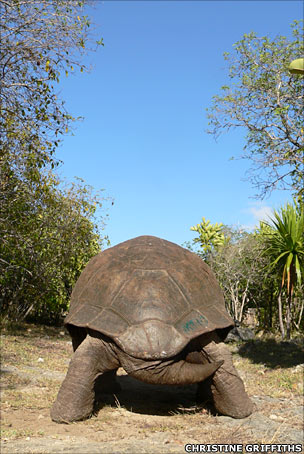
<p>A group of scientists headed by <a href="http://www.bristol.ac.uk/biology/?mailid=480">Christine Griffiths from the UK's University of Bristol</a> decided to attempt something a bit radical; stocking the island with another giant tortoise.</p>
<p>And in the journal <a href="http://www.cell.com/current-biology/">Current Biology</a> this week, they relate what happened.</p>
<p>Essentially, it's a good news story. The tortoises - <a href="http://en.wikipedia.org/wiki/Aldabra_giant_tortoise"><em>Aldabrachelys gigantea</em></a>, one of the largest species in the world - were imported from fairly close by, the Aldabra atoll in the Seychelles, and appear to live happily in their new home.</p>
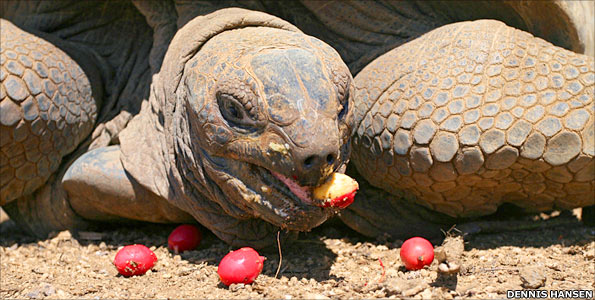
<p>They have been eating the ebony fruits and dispersing them over large distances, which should help the trees' recover something of their former range.</p>
<p>And the researchers discovered another important role that the tortoises play. Passage through their digestive system strips some of the fruit away, meaning that the seeds within it germinate much faster after they hit the ground - perhaps meaning that more seeds germinate in total.</p>
<p>Tortoises are to the ebony trees <a href="http://en.wikipedia.org/wiki/Civet_coffee">what civets are to coffee-lovers</a> - at least in parts of Southeast Asia...</p>
<div class="imgCaptionCenter" style="text-align: center; display: block; "><a href="https://nontonwae.pages.dev/blogs/thereporters/richardblack/chomping595.jpg"><img class="mt-image-center" style="margin: 0 auto 5px;" src="https://nontonwae.pages.dev/blogs/thereporters/richardblack/assets_c/2011/04/chomping595-thumb-595x300-72524.jpg" alt="Tortoise with ebony fruits" width="595" height="300" /></a>
<p style="max-width:595px;font-size: 11px; color: #666666;margin: 0 auto 20px;">The tortoises have developed a taste for the ebony fruit</p>
</div>
<p>As <a href="https://nontonwae.pages.dev/blogs/thereporters/richardblack/2011/04/sir_richard_bransons_plan_to.html">we've discussed here</a> (and thanks for all your incisive comments on that thread), introducing new species to islands isn't something to be done lightly.</p>
<p>But as the researchers point out, here they were using a species very similar to the one that disappeared; plus the tortoises are so big and so slow-moving that if anything does seem to be going wrong, they can be plucked out of the ecosystem again.</p>
<p>The team also cautions that longer-term observation is needed because there are also introduced plants on Ile aux Aigrettes; and what impacts the tortoises may have on them is an unknown, as presumably the twain will not previously have met.</p>
<p>At some point down the road, I guess, an ethical decision will have to be made.</p>
<p>Do the tortoises stay, or go? Deciding the former implies a judgement that overall, the ecological health of the island is better with a large, lumbering, introduced new inhabitant than without.</p>
<p>In the Seychelles, the quarter-tonne beasts have quite an impact.</p>
<p>They make burrows; and some of the land is now covered in what's termed "tortoise turf", where more than 20 species of grasses and other plants grow together - some having evolved to produce seed low down their stems, better placed to avoid the animals' chomping jaws.</p>
<p>And - an important issue for an island introduction - they can swim.</p>
<p>But take them away, and perhaps the ebony's fate will be sealed.</p>
<p>So do they stay or do they go?</p>
<p>Hope you enjoy chewing this one over!</p>]]>
        
    </content>
</entry>

<entry>
    <title>Re-homing nature: A step too far?</title>
    <link rel="alternate" type="text/html" href="https://nontonwae.pages.dev/blogs/thereporters/richardblack/2011/04/sir_richard_bransons_plan_to.html" />
    <id>tag:www.bbc.co.uk,2011:/blogs/thereporters/richardblack//198.288987</id>


    <published>2011-04-18T13:27:18Z</published>
    <updated>2011-04-20T12:52:03Z</updated>


    <summary type="html">Sir Richard Branson&apos;s plan to introduce lemurs to islands he owns in the Caribbean, which I reported on Saturday, has thrown into new light a real dilemma facing conservation scientists as they struggle to contain and reverse the loss of...</summary>
    <author>
        <name>Richard Black</name>
        
    </author>
    
    
    <content type="html" xml:lang="en" xml:base="https://nontonwae.pages.dev/blogs/thereporters/richardblack/">
        <![CDATA[<p><a href="http://en.wikipedia.org/wiki/Richard_branson">Sir Richard Branson</a>'s plan <a href="https://nontonwae.pages.dev/news/science-environment-13095307">to introduce lemurs to islands he owns in the Caribbean, which I reported on Saturday</a>, has thrown into new light a real dilemma facing conservation scientists as they struggle to contain and reverse the loss of species and ecosystems across the world.</p>
<div class="imgCaptionRight" style="float: right; "><a href="https://nontonwae.pages.dev/blogs/thereporters/richardblack/redruffedspl304.jpg"><img class="mt-image-right" style="margin: 10px 0 5px 20px;" src="https://nontonwae.pages.dev/blogs/thereporters/richardblack/assets_c/2011/04/redruffedspl304-thumb-304x304-72244.jpg" alt="Red-ruffed lemur" width="304" height="304" /></a>
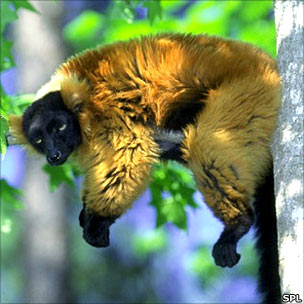
<p style="max-width:304px;font-size: 11px; color: #666666;margin-left:20px;">The red-ruffed lemur is among the most threatened</p>
</div>
<p><a href="http://en.wikipedia.org/wiki/Lemurs">Lemurs</a> are Madagascar's most iconic animals, very old in evolutionary terms and seriously enchanting to the human eye.</p>
<p>And they're seriously threatened - some species more than others - principally by deforestation.</p>
<p>As always, the first requirement for effective conservation is the effective rule of law.</p>
<p>And many reports indicate that <a href="https://nontonwae.pages.dev/blogs/thereporters/richardblack/2009/03/for_those_of_us_closer.html">since the overthrow of President Marc Ravalomanana two years ago</a>, the country's civil turmoil has resurrected the climate of opportunistic environmental plundering that the deposed leader had done much to curb.</p>
<p>With some lemurs now facing extinction in the wild, what would be more natural than to think of taking some of them somewhere else - in Sir Richard's words, "giving them a new island" - where they can live in peace and tranquility?</p>
<p>At first sight, it's a solution that could be implented on a wide scale. Indonesia alone has about 7,000 uninhabited islands - why not set up a scheme that distributes imperilled plants and animals from southeast Asia between them, for example?</p>
<p>If something seems simple and straightforward, there's usually a reason why it isn't being done already.</p>
<p>And in this case, there are several.</p>
<p>There's a saying "marry in haste, repent at leisure"... and it appears to be especially true when the marriage is a forced one between components of different ecosystems.</p>
<p>Well-known examples would include the introduction of the rabbit and the cane toad in Australia. But we can add <a href="http://www.invasivespeciesinfo.gov/unitedstates/hi.shtml">birds and plants to Hawaii</a>, <a href="http://en.wikipedia.org/wiki/Common_Brushtail_Possum_in_New_Zealand">possums to New Zealand</a>, <a href="http://www.glfc.org/sealamp/">lampreys to the Great Lakes of North America</a>, and rats on countless islands.</p>
<p>So when conservation scientists sat down a couple of decades ago to write <a href="http://intranet.iucn.org/webfiles/doc/SSC/SSCwebsite/Policy_statements/IUCN_Position_Statement_on_Translocation_of_Living_Organisms.pdf">a set of guidelines</a> on how and when introductions should be used as a tool for conserving species, they were naturally cautious:</p>
<blockquote>
<p>"The damage done by harmful introductions to natural systems far outweighs the benefit derived from them.</p>
<p>"The introduction and establishment of alien species in areas where they did not formerly occur, as an accidental or intended result of human activities, has often been directly harmful to the native plants and animals of many parts of the world and to the welfare of mankind."</p>
</blockquote>
<p>Introductions, it continues, have resulted in a few species coming to dominate a large number of ecosystems as they either eat, infect or out-compete the traditional inhabitants.</p>
<p>Even worse:</p>
<blockquote>
<p>"Islands, in the broad sense, including isolated biological systems such as lakes or isolated mountains, are especially vulnerable to introductions because their often simple ecosystems offer refuge for species that are not aggressive competitors."</p>
</blockquote>
<p>The guidelines - developed by the <a href="http://www.iucn.org/">International Union for the Conservation of Nature (IUCN)</a> - don't say "never do it". But they do say "tread carefully" - because obviously it would be hugely ironic if introductions with a conservation motive ended up doing damage.</p>
<div class="imgCaptionRight" style="float: right; "><a href="https://nontonwae.pages.dev/blogs/thereporters/richardblack/kakapophotolibrarycom304.jpg"><img class="mt-image-right" style="margin: 10px 0 5px 20px;" src="https://nontonwae.pages.dev/blogs/thereporters/richardblack/assets_c/2011/04/kakapophotolibrarycom304-thumb-304x304-72246.jpg" alt="Kakapo" width="304" height="304" /></a>
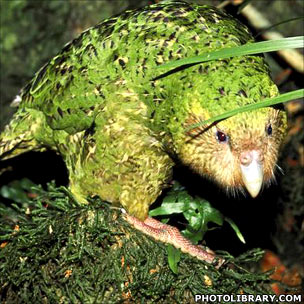
<p style="max-width:304px;font-size: 11px; color: #666666;margin-left:20px;">Kakapos have been given to new homes - but not far away</p>
</div>
<p>So far, species introductions have mostly been used over small distances, in situations where the original habitat has become impossible.</p>
<p>Several New Zealand birds, for example, <a href="http://www.iucnredlist.org/apps/redlist/details/142526/0">such as the flightless kakapo</a>, have been successfully introduced to islands off the coast after human expansion and newly-introduced pests meant they simply could not survive in their native lands.</p>
<p>A particularly intriguing situation concerns the <a href="http://en.wikipedia.org/wiki/Kihansi_Spray_Toad">Kihansi spray toad</a>, one of the world's smallest amphibians.</p>
<p>It lived in a single waterfall. Now that habitat has gone - construction of a hydro-electric dam first dried up and then polluted the water supply, and introduced the lethal disease <a href="http://en.wikipedia.org/wiki/Chytridiomycosis">chytridiomycosis</a>.</p>
<p>Discussions are ongoing as to whether captive populations should be introduced to a similar waterfall, and if so, where; but certainly its native home is not an option, and perhaps never will be.</p>
<p>But taking a species from one continent and "giving it another island" on the other side of the world as a place where it can live more or less in perpetuity - that is, as far as I can ascertain, unprecedented.</p>
<p>The islands are Moskito (also written Mosquito) and Necker, in the British Virgin Islands (BVI), which Sir Richard owns.</p>
<p>Clive Petrovic, a BVI ecologist whose CV includes contributing to global assessment of coral reefs and cataloguing local butterflies, led the Environmental Impact Assessment in 2007 for&nbsp; Moskito Island.</p>
<p>He tells me that although they did not specifically evaluate the potential impact of lemurs...</p>
<blockquote>
<p>"...in several places in the assessment we cautioned against non-native  introductions."</p>
</blockquote>
<p>He elaborated:</p>
<blockquote>
<p>"You should realise that there are no lemur-sized mammals native to Moskito or  Necker because the islands cannot support such large animals. Therefore, it is  almost certain that lemurs would not survive long on the island without  significant care and feeding.</p>
<p>"Further, there are toxic plants native to the  islands that could possibly harm lemurs, and at least two native raptors are  large enough to prey on young lemurs. Also, the lemurs may negatively impact  native birds or some of the rare reptiles and that could become a problem."</p>
</blockquote>
<p>At least a dozen species of bird nest on the island, he said; and some lemur species are partial to eggs.</p>
<p>Dr Petrovic was at pains to point out that Sir Richard has been ecologically an excellent custodian of his islands, and has gone to great lengths (and expense) to conserve and improve the environment.</p>
<p>Sir Richard also told me that if problems were to arise - if lemurs started eating the dwarf gecko, for example - he would take measures to deal with that.</p>
<p>However, even if these local impacts can be dealt with, then if Clive Petrovic is right and the island can't support lemurs without constant human intervention, one has to ask whether this project really meets the criterion of giving the animals another island.</p>
<p>It would, however, meet another aim of Sir Richard's - to give captive lemurs a  better home than the ones they currently have in cages in zoos.</p>
<p>We're not talking about all zoos here; but some he's targeting do appear to be keeping animals in less than optimum conditions.</p>
<p>But that's an animal welfare issue, not a conservation issue.</p>
<div class="imgCaptionRight" style="float: right; "><img class="mt-image-right" style="margin: 10px 0 5px 20px;" src="https://nontonwae.pages.dev/blogs/thereporters/richardblack/bransonreuters304.jpg" alt="Sir Richard Branson" width="304" height="405" />
<p style="width: 304px; font-size: 11px; color: #666666; margin-left: 20px;">&nbsp;</p>
</div>
<p>The potential biological impact is only one reason why conservation scientists tend to regard species introductions as a last-ditch measure.</p>
<p>Iconic animals such as lemurs are seen as ways of leveraging money and political pressure that can be used to conserve the whole native ecosystem.</p>
<p>Some of the activists who began campaigning to "Save the Whale" all those years ago were actually interested in the entirety of ocean life, but used whales as a flag around which governments and ordinary folk could rally.</p>
<p>So it is with lemurs. Use their iconic value to save the Madagascan forests, and you also preserve the entire ecosystem, not just its cuddliest component; that's the argument.</p>
<p>So there is concern about the potential impact of sending a message - however unwittingly - that could be taken as meaning "the animals are OK because now they have a second home".</p>
<p>Some also find it a difficult ethical issue.</p>
<p>Who are we, they argue, to distribute species around the planet according to a set of criteria that we develop ourselves and which may well contain a deal of anthropocentric reasoning?</p>
<p>The counter-argument is that we've been redistributing species as long as we've been travellers, and have wrought more profoundly damaging change - usually by accident - than anything we're likely to do through the unintended impact of conservation programmes.</p>
<p>Yet more opposition comes from the idea that there's obviously a limit to what species introductions can achieve.</p>
<p>Could we, for example, take the endangered <a href="http://www.iucnredlist.org/apps/redlist/details/22732/0">snow leopard</a> and find it a couple of uninhabited islands, perhaps in the Canadian Arctic? To where should the <a href="http://www.iucnredlist.org/apps/redlist/details/6557/0">northern black rhino</a> be transplanted?</p>
<p>As summer sea ice in the Arctic becomes a scarce commodity, are there any uninhabited islands around the Antarctic that could take on some <a href="http://www.iucnredlist.org/apps/redlist/details/22823/0">polar bears</a>?</p>
<p>And what about the oceans - how does the notion of second homes work there?</p>
<p>So - the argument goes - let's just set this limited and problematic idea to one side and concentrate on the fundamental aim of conserving places where the animals actually live now, and to which they're optimally adapted through millennia of evolution.</p>
<p>There will doubtless be readers who take the view: "yes but we've still got to do something", and would applaud Sir Richard unreservedly for offering sanctuary to some of these undeniably charming and fascinating creatures - and perhaps wish that other people would similarly get off their richly-caveated backsides and actually do something.</p>
<p>And I'm sure everyone concerned about nature would wish him well with the venture.</p>
<p>However, there are concerns out there. An e-mail I received from another ecologist who has worked with lemurs asked simply:</p>
<blockquote>
<p>"Haven't these guys seen Jurassic Park?"</p>
</blockquote>
<p>And while that over-dramatises the situation, the wider issues demonstrate that saving nature is about far more than giving it a new home.</p>]]>
        
    </content>
</entry>

<entry>
    <title>Exploring the &apos;oceans crisis&apos;</title>
    <link rel="alternate" type="text/html" href="https://nontonwae.pages.dev/blogs/thereporters/richardblack/2011/04/exploring_ocean_crisis.html" />
    <id>tag:www.bbc.co.uk,2011:/blogs/thereporters/richardblack//198.288718</id>


    <published>2011-04-14T13:50:22Z</published>
    <updated>2011-04-14T14:16:32Z</updated>


    <summary type="html"> Just how .......d are the world&apos;s oceans? I&apos;ve put the dots in that sentence so you can insert the word of your choice. According to a high-level seminar of experts in Oxford earlier this week, there&apos;s one word starting...</summary>
    <author>
        <name>Richard Black</name>
        
    </author>
    
    
    <content type="html" xml:lang="en" xml:base="https://nontonwae.pages.dev/blogs/thereporters/richardblack/">
        <![CDATA[<div class="imgCaptionCenter" style="text-align: center; display: block; "><a href="https://nontonwae.pages.dev/blogs/thereporters/richardblack/oceansblogwhale.jpg"><img class="mt-image-center" style="margin: 0 auto 5px;" src="https://nontonwae.pages.dev/blogs/thereporters/richardblack/assets_c/2011/04/oceansblogwhale-thumb-595x300-71974.jpg" alt="Humbpack whale" width="595" height="300" /></a></div>
<p>Just how .......d are the world's oceans?</p>
<p>I've put the dots in that sentence so you can insert the word of your choice.</p>
<p>According to a high-level seminar of experts in Oxford earlier this week, there's one word starting with the letter S that would fit quite well, a longer option beginning Kn - and a few more that are even stronger in meaning.</p>
<p>The S option, by the way, is not "secured".</p>
<p>Scientists are famous for staying in silos and never peering over the edge at what's going on in the world around them.</p>
<p>What marked this week's event - convened by the <a href="http://www.stateoftheocean.org/">International Programme on the State of the Ocean</a> -  as something a bit different was the melange of expertise in the same room.</p>
<p>Fisheries experts traded studies with people studying ocean  acidification; climate modellers swapped data with ecologists; legal  wonks formulated phrases alongside toxicologists.</p>
<p>They debated, discussed, queried, swapped questions and answers.  Pretty much everyone said they'd learned something new - and something a  bit scary.</p>
<p>Warnings on the impacts of issues such as overfishing, pollution and  habitat loss aren't new. With some of them, scientific findings have translated  into a pressure for change, and indeed to actual change - as seen this  week, for example, with the <a href="../../news/world-europe-13054597">European Union's adoption of new rules</a> on illegal fishing.</p>
<div class="imgCaptionRight" style="float: right; "><a href="https://nontonwae.pages.dev/blogs/thereporters/richardblack/oceanblogsharks.jpg"><img class="mt-image-right" style="margin: 10px 0 5px 20px;" src="https://nontonwae.pages.dev/blogs/thereporters/richardblack/assets_c/2011/04/oceanblogsharks-thumb-304x304-71978.jpg" alt="Decapitated sharks" width="304" height="304" /></a></div>
<p>But the various threats tend to be considered in isolation.</p>
<p>By  contrast, the idea behind this project is to look at what happens under a  combination of threats, and ask what this more comprehensive picture  demands in the way of policy changes.</p>
<p>It's fairly well-known now, for example, that <a href="http://news.bbc.co.uk/1/hi/sci/tech/7306693.stm">the impacts of climate change on coral reefs can be delayed by keeping the reef healthy</a> - by preventing local pollution, keeping fish stocks high and blocking invasive species.</p>
<p>So a policy to reduce climate impacts can mean curbing fishing or  pollution, which might in turn mean changing farming practices to  prevent fertiliser run-off.</p>
<p>In places, filter-feeding fish are apparently living in sediments  containing so many particles of plastic that it makes up half of each  mouthful. Other pollutants such as endocrine-disrupting  ("gender-bending") chemicals gather on the plastic surfaces - which  obviously can be harmful to the fish.</p>
<p>So a "healthy fisheries" policy might again involve regulating pollutants.</p>
<p>If the ways in which these various threats combine was a central  theme of the seminar, another was the way in which trends appear to be  speeding up.</p>
<p>Many researchers noted that in their field of study, the pace of  decline and degradation exceeded even the worst projections made just a  few decades ago.</p>
<p>The conclusions of the seminar will be released later this year. One of the aims is to get some serious commitments on ocean issues at <a href="http://www.earthsummit2012.org/">the Rio+20 summit</a> next year.</p>
<p>And here lies the biggest challenge for this project - especially in a  world where the number of "other Cassandras", to use a phrase from the <a href="http://www.jmkfund.org/history.html">JM Kaplan Fund</a>'s Conn Nugent, appears to have grown way beyond the public's appetite for messages of doom.</p>
<div class="imgCaptionRight" style="float: right; "><img class="mt-image-right" style="margin: 10px 0 5px 20px;" src="https://nontonwae.pages.dev/blogs/thereporters/richardblack/oceandblogturtle.jpg" alt="Turtle swimming" width="304" height="170" />
<p style="width: 304px; font-size: 11px; color: #666666; margin-left: 20px;">Turtles are among the animals facing multiple threats - fishing nets, habitat loss, pollution...</p>
</div>
<p>For scientists, the route from research findings to policy change can appear simple.</p>
<p>They tell politicians and the general public how it is, the public  gets concerned, and politicians then reform the system so as to halt the  destruction - partly because it's the right thing to do, partly because  the public is telling them to.</p>
<p><a href="http://www.barrygardiner.com/">Barry Gardiner MP</a>, a leading light in the <a href="http://www.globeinternational.info/">Globe International</a> organisation of environmentally concerned parliamentarians and recently appointed as Labour leader Ed Miliband's special envoy on climate change, gave the scientists a condensed and forceful lesson in political realities.</p>
<p>Of 650-odd MPs in the UK Parliament, he said, there are perhaps 50 who would have any reason to pay attention to global tales of ocean decline; and only perhaps 10 who would find a political motive for taking up such an issue in the House.</p>
<blockquote>
<p>"There has to be a level of political engagement, and that engagement has to be not by scientists coming with the best analysis there is and wagging your fingers and saying 'now go and get this sorted out', because no politician listens to this," he said.</p>
<p>"You've got to listen to the politician and what his problems are, and them come with solutions."</p>
</blockquote>
<p>This full-frontal assault on assumptions provoked some shocked scientific faces around the table; and Jelle Bijma, a biogeochemist from the <a href="http://www.awi.de/en/home/">Alfred Wegener Institute</a> in Bremerhaven, Germany, said it...</p>
<blockquote>
<p>"...makes you feel like a moron... what keeps politicians from operating with proper minds?"</p>
</blockquote>
<p>But to people used to the cut and thrust of lobbying, some who have spent 40 years working for environmental progress, it wasn't such a surprise - <a href="http://www.pewtrusts.org/experts_profile.aspx?id=56644">Josh Reichert, head of the Pew Environment Group</a>, likening the current situation to...</p>
<blockquote>
<p>"...driving towards the edge of a cliff while taking copious notes along the way.</p>
<p>"For years the science has gotten better, and the problem has become worse. Better science will enhance our understanding of the dilemma we face but will not resolve it - we depend on government to do that, and the challenge we face is getting government to act."</p>
</blockquote>
<p>When the final report is written, its conclusions are likely to include (however worded) a warning that the oceans are in deep trouble, that decline is speeding up, and that impacts of this are already being felt.</p>
<p>It will probably outline many dimensions of the issue, and make a comprehensive set of recommendations for politicians - and perhaps, for the public and the corporate sector.</p>
<p>The major challenge, as always, will be getting the message heard and acted upon.</p>
<p>For all the understanding of links between various threats out there in the oceans, the most important link is still between scientific findings and political action - and it's the one where progress remains most conspicuously lacking.</p>]]>
        
    </content>
</entry>

<entry>
    <title>Science and politics - a tale of two meetings</title>
    <link rel="alternate" type="text/html" href="https://nontonwae.pages.dev/blogs/thereporters/richardblack/2011/04/science_and_politics_-_a_tale.html" />
    <id>tag:www.bbc.co.uk,2011:/blogs/thereporters/richardblack//198.288451</id>


    <published>2011-04-12T06:55:00Z</published>
    <updated>2011-04-12T06:55:43Z</updated>


    <summary type="html">More than 8,000km separate Vienna and Bangkok. That&apos;s roughly the distance that appeared to be separating the minds of people attending very different meetings that took place in the two capitals last week. In between bites of Sachertorte, scientists unveiled...</summary>
    <author>
        <name>Richard Black</name>
        
    </author>
    
    
    <content type="html" xml:lang="en" xml:base="https://nontonwae.pages.dev/blogs/thereporters/richardblack/">
        <![CDATA[<p>More than 8,000km separate Vienna and Bangkok.</p>
<p>That's roughly the distance that appeared to be separating the minds of people attending very different meetings that took place in the two capitals last week.</p>
<p>In between bites of Sachertorte, scientists unveiled their latest research in many disciplines relating to the Earth - including climate change - at the <a href="http://meetings.copernicus.org/egu2011/">European Geosciences Union (EGU) annual meeting</a>.</p>
<p>Betwixt pad thai and green curry, at this year's first session of preparatory talks within the <a href="http://unfccc.int/2860.php">UN climate convention (UNFCCC)</a>, delegates from the vast majority of the world's governments attempted to find a political route simultaneously acceptable to their masters and appropriate to the level of scientific concern.</p>
<div class="imgCaptionRight" style="float: right; "><img class="mt-image-right" style="margin: 10px 0 5px 20px;" src="https://nontonwae.pages.dev/blogs/thereporters/richardblack/bkkmonksafp300.jpg" alt="Protesting monks in Bangkok" width="300" height="170" />
<p style="width: 300px; font-size: 11px; color: #666666; margin-left: 20px;">&nbsp;</p>
</div>
<p>Reporting both accurately is a tough task, for different reasons.</p>
<p>The EGU, which I attended, is formed of multiple parallel sessions at which new research is presented - there are so many that keeping track of everything is an impossible task.</p>
<p>The UNFCCC, on the other hand, is a tangled political web that's pretty opaque even if you are present - which clearly, on this occasion, I wasn't.</p>
<p>Those caveats given, here's my brief summary of the two meetings as they relate to climate change.</p>
<p>Vienna saw lots of talk about ice, particularly the Arctic kind... and not much of it was optimistic.</p>
<p>We saw new models of how quickly Arctic sea ice will melt, and new attempts to understand key mechanisms affecting the <a href="http://en.wikipedia.org/wiki/Greenland_ice_sheet">Greenland ice sheet</a>.</p>
<p>You may have read about <a href="https://nontonwae.pages.dev/news/science-environment-13002706">Wieslaw Maslowski's renewed projections</a> that summers will be free of sea ice within this decade.</p>
<p>Not all modellers agree with that timescale... even so, the fact that it's on the agenda indicates the speed of changes in this most totemic of regions.</p>
<p>I didn't have time to report on the Greenland modelling, but one of the packed presentations I attended saw a study indicating that the ice sheet could well reach a tipping point of melting at a global average temperature rise of only 1.5C (2.7F) from pre-industrial times.</p>
<p>We are about halfway there already.</p>
<p>I also dipped into sessions on methane releases from around the Arctic.</p>
<p>This is a really tough issue to research, because historical records aren't good.</p>
<p>So <a href="http://news.bbc.co.uk/1/hi/sci/tech/8437703.stm">when ships monitor methane bubbling up</a> from around Svalbard, for example, and wonder how important it is, there's no database that you can open to compare present day releases against those from half a century ago.</p>
<p>Nevertheless, we heard that the water in some of these locations has warmed by one or two Celsius in the last few decades, and scientists presented simulations indicating how that may be affecting methane emissions.</p>
<p>Hard data appeared in short supply - for the reasons I've given, plus the fact that this sort of research is hard and expensive.</p>
<div class="imgCaptionRight" style="float: right; "><img class="mt-image-right" style="margin: 10px 0 5px 20px;" src="https://nontonwae.pages.dev/blogs/thereporters/richardblack/bkkpolarspl300.jpg" alt="Polar bear" width="300" height="300" />
<p style="width: 300px; font-size: 11px; color: #666666; margin-left: 20px;">&nbsp;</p>
</div>
<p>But I was accosted by one scientist who said his initial calculations indicate methane release could be serious enough to amplify human-induced warming 40-fold.</p>
<p>OK... we're talking here about non-peer-reviewed science, for the most part - the rituals and rhythms of science mean conference presentations are habitually of non-published material.</p>
<p>Even so, I trust this little tour d'horizon has given you a flavour of discussions and debates at what is a purely scientific gathering, with no politics and very small amounts of hype.</p>
<p>Take a trans-continental jet over to Bangkok, meanwhile, and we see politics and science trading places.</p>
<p>Those of you familiar with the UN process will know that for the last few years the official negotiations have been run along two parallel tracks - <a href="http://unfccc.int/kyoto_protocol/items/4577.php">one dealing with the Kyoto Protocol</a>, the other (named <a href="http://unfccc.int/meetings/ad_hoc_working_groups/lca/items/4381.php">Long-term Co-operative Action, or LCA</a>) with everything else.</p>
<p>This was a week-long meeting, and the LCA group did not agree its agenda until the Thursday evening.</p>
<p>From that, you might judge that not much was accomplished; and from what I've been hearing, you'd be absolutely right.</p>
<p>There are now less than two years until the Kyoto Protocol's <a href="http://en.wikipedia.org/wiki/First_commitment_period_%282008%E2%80%932012%29">first commitment period</a> - in other words, its first set of targets for reducing emissions - comes to an end.</p>
<p>This is why developing countries are vehement in their assertion that their richer cousins need to get on with agreeing a new set of targets very soon.</p>
<p>Business groups at the Bangkok meeting said the same thing. After all, if you were making investment decisions that might be financially affected by carbon targets, you'd want to know as far as possible in advance what those targets are going to be.</p>
<p><a href="http://thestar.com.my/news/story.asp?file=/2011/4/11/focus/8456013&amp;sec=focus">Tuvalu and others demanded</a> that rich countries should either say right now that they are going to agree further emission cuts under the Kyoto Protocol, or leave the room.</p>
<p>This was aimed partially at <a href="https://nontonwae.pages.dev/news/science-environment-11966710">Japan, Russia and Canada, which have said</a> they won't entertain the prospect. But it was also presumably intended to draw out the final positions of those that have said they might, such as the EU, Australia and New Zealand.</p>
<p>The EU then countered that they couldn't say yes or no until technical details of what a second commitment period might look like had been nailed down.</p>
<p>And so the loop played round.</p>
<p>The US, meanwhile, stuck to two positions that have become very familiar over the last year:</p>
<ul>
<li>that it is pledging to cut emissions by as much as other developed nations, but only if you count from a baseline of 2005 rather than 1990 which just about everyone else uses</li>
<li>that it will not do more without "symmetry"- i.e. unless China pledges pretty much the same thing.</li>
</ul>
<p>At this point in the cycle of talks, looking back to the last big summit (Cancun, in this case) and forward to the next one (Durban), there's often a deal of friction.</p>
<p>Later on in the year, countries that want major progress on fundamental issues are often more or less forced to accept their demands won't be met, and in the ensuing "something or nothing" situation, to work alongside those whom at root they consider recalcitrant.</p>
<p>So the political path may yet smooth out as the year progresses.</p>
<p>But if the scientific picture is getting worse, as soundings at the EGU would indicate... what then?</p>
<p>Do the politics reflect the new urgency that science appears to be generating?</p>
<p>And if not, can they be reformed so they do - especially given the huge obstacles that materialise now, when attempting to agree measures that are acknowledged as inadequate by just about every party in the climate convention?</p>
<p>&nbsp;</p>]]>
        
    </content>
</entry>

<entry>
    <title>Reflections on a fortnight in Fukushima</title>
    <link rel="alternate" type="text/html" href="https://nontonwae.pages.dev/blogs/thereporters/richardblack/2011/03/reflections_on_a_fukushima_for.html" />
    <id>tag:www.bbc.co.uk,2011:/blogs/thereporters/richardblack//198.287243</id>


    <published>2011-03-24T16:15:14Z</published>
    <updated>2011-03-24T16:16:07Z</updated>


    <summary type="html">Earth Watch posts have been in smaller supply than usual in recent days. For a week, your humble correspondent was virtually living inside the Fukushima nuclear power station, attempting to make sense of what we knew and what we didn&apos;t...</summary>
    <author>
        <name>Richard Black</name>
        
    </author>
    
    
    <content type="html" xml:lang="en" xml:base="https://nontonwae.pages.dev/blogs/thereporters/richardblack/">
        <![CDATA[<p>Earth Watch posts have been in smaller supply than usual in recent days.</p>
<p>For a week, your humble correspondent was virtually living inside <a href="https://nontonwae.pages.dev/news/world-asia-pacific-12711226">the Fukushima nuclear power station</a>, attempting to make sense of what we knew and what we didn't know as the situation unfolded.</p>
<p>Now - almost two weeks after <a href="https://nontonwae.pages.dev/news/science-environment-12792943">the devastating Magnitude 9.0 Tohoku earthquake and tsunami</a>, and a few hours before heading on leave for a little while - it seems like an apt time to take stock.</p>
<div class="imgCaptionCenter" style="text-align: center; display: block; "><img class="mt-image-center" style="margin: 0 auto 5px;" src="https://nontonwae.pages.dev/blogs/thereporters/richardblack/nukeprotestreuters595.jpg" alt="Anti-nuclear protest" width="595" height="250" />
<p style="width: 595px; font-size: 11px; color: #666666; margin: 0pt auto 20px;">Fukushima has raised protests elsewhere in the world - how serious is another matter</p>
</div>
<p>In the broadest of senses, the situation at the power station itself appears slowly to be coming under control. Electrical power is progressively being restored across the site - no small task - and as time goes by, the rate of radioactive decay and therefore the heat output in the cores will naturally get lower.</p>
<p>Temperatures and pressures within some of the reactor containment vessels are well above the intended operating levels. A bulletin from the <a href="http://www.tepco.co.jp/en/index-e.html">Tokyo Electric Power Company (Tepco)</a> on Thursday put the vessel temperature in number 1 reactor building at 390-400C (734F), against an operating value of 138C (280F).</p>
<p>So the reactors themselves are not completely in the clear.</p>
<p>Nevertheless, the longer time goes by without any significant new development, the smaller the chances of something serious occurring.</p>
<p>It's important to point out a couple of things here.</p>
<p>Firstly, nothing definitive can yet be said about the sequence of events at the plant, nor about the response of Tepco employees in the critical early hours.</p>
<p>And it is certainly too early to make a comprehensive assessment of the health impacts. With <a href="http://en.wikipedia.org/wiki/Windscale_fire">the Windscale reactor fire of 1957</a> - like Fukushima, rated Level Five on <a href="http://www-ns.iaea.org/tech-areas/emergency/ines.asp">the International Nuclear and Radiological Event Scale (INES)</a> - the health consequences <a href="http://news.bbc.co.uk/1/hi/sci/tech/7030536.stm">were still being assessed four years ago</a>, on its 50th anniversary.</p>
<p>Fukushima will not take half a century to analyse because the facility has a civilian rather than a military purpose, because monitoring and knowledge of nuclear processes are far higher now than in 1957, and because the Japanese population is not likely to stand for it.</p>
<div class="imgCaptionRight" style="float: right; "><img class="mt-image-right" style="margin: 10px 0 5px 20px;" src="https://nontonwae.pages.dev/blogs/thereporters/richardblack/nukegetty400.jpg" alt="Destroyed petrol station" width="400" height="250" />
<p style="width: 400px; font-size: 11px; color: #666666; margin-left: 20px;">Operators have had to struggle with devastation from the earthquake and tsunami across the region</p>
</div>
<p>But at the moment, information is being disinterred bit by bit - and a truly comprehensive picture will in all probability have to wait on the first official inquiry.</p>
<p>The second point is that despite the allegations of secrecy and poor flow of information levelled against Tepco in the early days of the crisis, those allegations do not currently stand up to scrutiny.</p>
<p>The company is now publishing bulletins several times a day, sending them to reporters, responding to questions promptly and seriously, and posting mounds of data such as radiation levels on its website.</p>
<p>Whether the company is taking this stance entirely voluntarily or whether it has been dragged kicking and screaming by the government - whose leader, <a href="http://en.wikipedia.org/wiki/Naoto_Kan">Prime Minister Naoto Kan</a>, was possibly our best source of information early on - is not entirely clear.</p>
<p>And it cannot be proven that all the data we receive is entirely accurate. Nevertheless, this has to go down as a huge change from the situation seen at every other serious nuclear accident (by which I mean INES Level Five and above) in history.</p>
<p>At the time of writing, there are some intriguing tidbits.</p>
<p>Perhaps the most tantalising is a report by Kyodo News, Japan's principal news agency, to the effect that <a href="http://english.kyodonews.jp/news/2011/03/80539.html">neutron radiation was observed</a> more than a kilometre from reactor buildings 1 and 2.</p>
<p>Neutrons are emitted during a <a href="http://en.wikipedia.org/wiki/Nuclear_chain_reaction">nuclear chain reaction</a>; so given the context, is Kyodo's report to be taken as indicating that a chain reaction took place after the reactors shut down?</p>
<p>If it is, does that relate to <a href="https://nontonwae.pages.dev/news/science-environment-12773350">the company's warning last week</a> that there was a possibility of "re-criticality" in a pool storing fuel rods?</p>
<p>The neutron flux outlined by Kyodo - 0.02 microsieverts per hour - is within levels that are observed naturally in some locations - which raises the question of why it became an issue in conversations between reporters and Tepco representatives in Tokyo.</p>
<p>As I said, a tantalising tidbit; and a demonstration that in this story, every piece of information comes swimming in a sea of questions.</p>
<p>Meanwhile, what we are seeing away from the Fukushima site, in terms of restrictions on drinking milk and water and eating vegetables, recalls measures in place after Windscale and <a href="http://en.wikipedia.org/wiki/Chernobyl_disaster">Chernobyl</a>.</p>
<p>The big difference is that monitoring by Japanese agencies appears to have been prompt, informed and proactive, with results quickly disseminated to the public.</p>
<div class="imgCaptionCenter" style="text-align: center; display: block; "><img class="mt-image-center" style="margin: 0 auto 5px;" src="https://nontonwae.pages.dev/blogs/thereporters/richardblack/nukemilkreuters595.jpg" alt="Milk being drained into field" width="595" height="304" />
<p style="width: 595px; font-size: 11px; color: #666666; margin: 0pt auto 20px;">Milk has had to be thrown away near the plant</p>
</div>
<p>Outside Japan, the big issue is what Fukushima means for nuclear power - and by implication, for plans to switch away from fossil fuels to restrain carbon emissions.</p>
<p>There are plenty of analyses around suggesting climate targets can be met through efficiency and renewables alone - <a href="http://www.greenpeace.org/international/en/publications/reports/Energy-Revolution-A-Sustainable-World-Energy-Outlook/">Greenpeace's is one of them</a> - but the political equation is more complex.</p>
<p>Imagine, for example, a decision at European level not to build any new nuclear power stations.</p>
<p>Nuclear is the basis of low-carbon electricity in France. Finland and the UK are among other countries committed to a partially nuclear future.</p>
<p>The question is not whether it is technically feasible to scrap those plans and replace the shortfall with wind turbines, solar panels and storage capacity - clearly, it could be done.</p>
<p>But would it be politically feasible? Given that we are past the era of state direction, <a href="http://www.businessweek.com/news/2011-03-23/merkel-review-shows-fukushima-put-eu-energy-targets-at-risk.html">will the private sector deliver on this scale?</a></p>
<p>On the other hand, utilities that are currently sounding pretty bullish about continuing with new nuclear build may look at things rather differently if public discontent manifests itself at building sites where new plants are scheduled.</p>
<p>On yet another hand, will Fukushima actually lead to serious public opposition? In Germany, <a href="http://www.guardian.co.uk/environment/2011/mar/12/nuclear-safety-worries-spread-europe">it produced marches</a>; but the UK public does <a href="https://nontonwae.pages.dev/news/science-environment-12810867">not appear to have taken against the technology</a> completely because of an accident on the other side of the world.</p>
<p>Perhaps a bigger practical issue than new build is how ancient plants should be regulated - what should be insisted on in terms of upgrading, given that safety practices have changed hugely in the 40-odd years since the Fukushima generation of commercial reactors came online.</p>
<p>How all this plays out cannot, I think, be predicted; and events will be fascinating to follow.</p>
<p>But at the present time, Fukushima can be used to bolster the arguments of either anti-nuclear or pro-nuclear factions.</p>
<p>One can - and is - saying, essentially, "you see - nuclear will never be safe - here's proof".</p>
<p>The counter is that if you exclude events in closed societies and those that took place in the 1950s, there have only been two nuclear accidents big enough to rate a Level Five or above - <a href="http://en.wikipedia.org/wiki/Three_Mile_Island_accident">Three Mile Island</a> and Fukushima.</p>
<p>No-one appears to have died in the first; and it is possible that the second will end with a similar statistic, given that workers unaccounted for at the plant may have come to grief in the tsunami rather than any nuclear cause.</p>
<p>Fukushima Daiichi was designed to withstand seismic ground movements of the scale that materialised during the Tohoku quake.</p>
<p>But it was not designed to withstand a 14m (46ft) tsunami - the latest estimate of the wave height that engulfed the plant two weeks ago.</p>
<p>So whatever governments and societies decide on the nuclear question, however they prioritise questions of energy security and climate change, it will have to be on the basis of relative risks; because nothing in this arena comes with certainties attached.</p>]]>
        
    </content>
</entry>

<entry>
    <title>Bees: a sting in the tale</title>
    <link rel="alternate" type="text/html" href="https://nontonwae.pages.dev/blogs/thereporters/richardblack/2011/03/the_united_nations_environment.html" />
    <id>tag:www.bbc.co.uk,2011:/blogs/thereporters/richardblack//198.286165</id>


    <published>2011-03-10T14:13:17Z</published>
    <updated>2011-03-10T14:26:46Z</updated>


    <summary type="html"><![CDATA[ &nbsp; The United Nations Environment Programme (Unep) buzzes into the ongoing discussion of bee decline this week, with a report examining the global nature of the issue and some of the reasons behind it. Their top-line conclusions are that...]]></summary>
    <author>
        <name>Richard Black</name>
        
    </author>
    
    
    <content type="html" xml:lang="en" xml:base="https://nontonwae.pages.dev/blogs/thereporters/richardblack/">
        <![CDATA[<div class="imgCaptionRight" style="float: right; "><img class="mt-image-right" style="margin: 10px 0 5px 20px;" src="https://nontonwae.pages.dev/blogs/thereporters/richardblack/beebbc304.jpg" alt="Bee on flower" width="304" height="304" />
<p style="width: 304px; font-size: 11px; color: #666666; margin-left: 20px;">&nbsp;</p>
</div>
<p>The <a href="http://www.unep.org/">United Nations Environment Programme (Unep)</a> buzzes into the ongoing discussion of bee decline this week, <a href="http://www.unep.org/Documents.Multilingual/Default.asp?DocumentID=664&amp;ArticleID=6923&amp;l=en&amp;t=long">with a report examining the global nature of the issue</a> and some of the reasons behind it.</p>
<p>Their top-line conclusions are that it's becoming a widespread, if not quite global, phenomenon, and that there's a multiplicity of causes.</p>
<ol> </ol>
<p class="ArticleText">Declines - and in some cases, sudden collapses - of colonies in <a href="http://news.bbc.co.uk/1/hi/world/europe/7739798.stm">Western Europe</a>, <a href="http://news.bbc.co.uk/1/hi/sci/tech/6400179.stm">North America</a> and Japan have been widely reported.</p>
<p class="ArticleText">But it's perhaps not quite so commonly known that Chinese beekeepers "faced several inexplicable  and complex symptoms of colony losses", as Unep puts it, or that collapses have also been seen in beehives along the banks of the Nile.</p>
<p class="ArticleText">As to the causes, the report highlights more than a dozen factors that could be responsible, in varying proportions, in different parts of the world, including:</p>
<ul>
<li>diseases exacerbated by increased global movement of bees and of other things that may carry pathogens</li>
<li>agricultural chemicals</li>
<li>climatic factors</li>
<li>atmospheric pollution, which reduces insects' capacity to detect smells of, for example, important plants</li>
<li>loss of plant biodiversity, reducing the variety of bees' diet</li>
</ul>
<p class="ArticleText">A while back, <a href="https://nontonwae.pages.dev/blogs/thereporters/richardblack/2010/01/the_attack_of_the_killer_every.html">writing about the stark and global crisis facing amphibians, I suggested</a> that the only factor to hold responsible was "everything" - and that the same might be true for bees.</p>
<p class="ArticleText">And this is basically the thesis that Unep is spelling out, through the scientific assessments of the Swiss, French and US experts enlisted to write its report.</p>
<p class="ArticleText">A recurring theme in Unep's work at the moment is the importance of <a href="http://en.wikipedia.org/wiki/Natural_capital">"natural capital"</a> - the goods and services that nature provides and that humanity makes use of - and Unep chief Achim Steiner was keen to outline how bees fit into this vision when he launched the bee report in Geneva on Thursday:</p>
<blockquote>
<p class="ArticleText">"Human beings have fabricated the illusion that in the 21st Century they  have the technological prowess to be independent of nature.</p>
<p class="ArticleText">"Bees  underline the reality that we are more, not less dependent on nature's  services in a world of close to seven billion people."</p>
</blockquote>
<p>And as concern slowly rises about the availability of food in the future, the UN report also floats the statistic that...</p>
<blockquote>
<p>"...of some 100 crop species which provide 90% of food worldwide, 71 of these are bee-pollinated."</p>
</blockquote>
<p>What to do about the problem is another matter.</p>
<p>Given the mixed nature of the threat - a largely unquantified mixture - it's even debatable whether there is a single solution, given that simply returning the world to an era before agricultural chemicals, atmospheric pollutants and international trade is hardly feasible.</p>
<p>Several governments have committed funds to research the problem; and when you consider that pollination is said to contribute $14bn (&pound;8.7bn) to the US economy alone, you can see why the US government is one of the leaders here.</p>
<div class="imgCaptionCenter" style="text-align: center; display: block; "><img class="mt-image-center" style="margin: 0 auto 5px;" src="https://nontonwae.pages.dev/blogs/thereporters/richardblack/bees595.jpg" alt="Graph" width="595" height="350" />
<p style="width: 595px; font-size: 11px; color: #666666; margin: 0pt auto 20px;">The number of healthy hives has fallen markedly in the US</p>
</div>
<p>One of the questions to ask is why declines have been documented in the areas noted above, while in others - South America, Australia, most of Asia and Africa - there's no visible sign.</p>
<p>From a practical standpoint, if you're faced with a complex problem that you don't completely understand but where there are some threats that are eminently addressable, then clearly it makes sense to deal with them while you wait for the scientific conclusions to come through.</p>
<p>So in a number of countries, there are now projects - supported by  industry or government agri-environment schemes or both - aimed at  giving bees practical support.</p>
<p>In the UK, <a href="http://www.operationpollinator.com/">farmers are encouraged</a> to plant clover mixes and other bee-friendly plants around the edges of their fields.</p>
<p>The <a href="http://www.j-sainsbury.co.uk/index.asp?PageID=424&amp;NewsID=1306">Sainsbury's supermarket chain</a> and even the <a href="http://www.london-se1.co.uk/news/view/5018">Tate Modern art gallery</a> in the heart of London sport roof-level hives and "bee hotels".</p>
<div class="imgCaptionRight" style="float: right; "><img class="mt-image-right" style="margin: 10px 0 5px 20px;" src="https://nontonwae.pages.dev/blogs/thereporters/richardblack/beediseasedspl304.jpg" alt="Bee with varroatosis" width="304" height="450" />
<p style="width: 304px; font-size: 11px; color: #666666; margin-left: 20px;">Diseases such as varroatosis are a major threat</p>
</div>
<p><a href="http://www.indymedia.org.uk/en/2010/11/467782.html">A number of European countries have banned neonicotinoid pesticides</a> that they believe are implicated in bee decline.</p>
<p>And bee-keepers internationally are bombarded with information about the need to keep their hives clean against <a href="http://en.wikipedia.org/wiki/Varroa">varroa mites</a> and other pests.</p>
<p>None of these is likely to be a complete defence, but each is likely to give the insects something of a lift.</p>
<p>There's a parallel here with coral reefs, which are likewise afflicted by a complex set of threats.</p>
<p>So the question for authorities is what can be tackled, and what can't.</p>
<p>The <a href="http://www.gbrmpa.gov.au/">Great Barrier Reef Marine Park Authority</a> might not have the power to stop global warming and ocean acidification.</p>
<p>But it can restrict shipping and tourism, limit pollution from agricultural land, attack the voracious <a href="http://en.wikipedia.org/wiki/Crown-of-thorns_starfish">crown of thorns starfish</a> and encourage fish that nibble on unwanted algae.</p>
<p>Each of these will keep coral healthier and better able to withstand the threats that can't as yet be controlled.</p>
<p>As Loretta Burke of the <a href="http://www.wri.org/">World Resources Institute</a> said <a href="https://nontonwae.pages.dev/news/science-environment-12530439">on the publication of a major global reef assessment</a> last month:</p>
<blockquote>
<p>"There are reasons for hope. Reefs are resilient; and by reducing the local pressures, we  can help buy time to find solutions to global threats that can preserve  reefs for future generations."</p>
</blockquote>
<p>Unep's bee prescription is along the same lines, recommending the restoration of good habitat, low-input agricultural methods, and the provision of a diverse population of pollinators.</p>
<p>Will it be enough? Or are we flying, slowly and inexorably, towards a world without bees?</p>
<p class="ArticleText">And if we are, what will that mean for the meals on our plates?</p>]]>
        
    </content>
</entry>

<entry>
    <title>Green tuna goes FAD-free</title>
    <link rel="alternate" type="text/html" href="https://nontonwae.pages.dev/blogs/thereporters/richardblack/2011/03/tuna_moving_to_end_of_the_pole.html" />
    <id>tag:www.bbc.co.uk,2011:/blogs/thereporters/richardblack//198.286113</id>


    <published>2011-03-09T19:52:48Z</published>
    <updated>2011-03-09T20:49:21Z</updated>


    <summary type="html">Environmental group Greenpeace is claiming something of a victory with the news that the UK&apos;s biggest supplier of canned tuna, Princes, is going to source its fish from more sustainable supplies than previously. Greenpeace has been spearheading a campaign to...</summary>
    <author>
        <name>Richard Black</name>
        
    </author>
    
    
    <content type="html" xml:lang="en" xml:base="https://nontonwae.pages.dev/blogs/thereporters/richardblack/">
        <![CDATA[<p>Environmental group Greenpeace is claiming something of a victory with <a href="http://www.greenpeace.org.uk/blog/oceans/you-did-it-princes-will-indeed-change-their-tuna-and-so-will-asda-20110309">the news</a> that the UK's biggest supplier of canned tuna, <a href="http://www.princesgroup.com/">Princes</a>, is going to source its fish from more sustainable supplies than previously.</p>
<div class="imgCaptionRight" style="float: right; "><img class="mt-image-right" style="margin: 10px 0 5px 20px;" src="https://nontonwae.pages.dev/blogs/thereporters/richardblack/TUNAPROTESTGREENPEACE.jpg" alt="Greenpeace tuna protest" width="304" height="304" />
<p style="width: 304px; font-size: 11px; color: #666666; margin-left: 20px;">Greenpeace has been spearheading a campaign to get companies to adopt sustainable tuna policies</p>
</div>
<p>A certain proportion of its tuna will come from pole-and-line fishing, while the remainder, from 2014, will come from fleets that pledge not to use <a href="http://en.wikipedia.org/wiki/Fish_aggregating_device">fish aggregating devices (FADs)</a>.</p>
<p>It's reportedly been joined by <a href="http://www.asda.com/">Asda</a>, one of the country's principal supermarket chains, although at the time of writing the company hasn't got back to me to confirm.</p>
<p><a href="http://www.greenpeace.org.uk/tunaleaguetable">Greenpeace has been leading a campaign aiming to "name and shame" suppliers</a> who don't put particularly sustainable standards on their tuna, and to stimulate consumer pressure to demand that shops up their game on the issue.</p>
<p>Part of the camapign has been a "league table" of retailers - and at the most recent iteration, Princes came in eighth and last place, condemned for a number of apparent failings, including:</p>
<ul>
<li>sourcing most of its fish from FAD-deploying fleets</li>
<li>not telling customers what species of tuna are in its cans or where they were caught</li>
<li>not giving public support to the notion of marine reserves in tuna-fishing areas.</li>
</ul>
<p>So the new announcement clearly marks a change. A company spokesman described it to me as "the next phase in Princes' tuna sustainability plan" - although to the environmental group's eye, it's a sharper change of direction than that.</p>
<p>The announcement means that from now on, more than half of the canned tuna bought in the UK (which is the world's second-biggest market) will be supplied by companies signed up to a sustainable sourcing policy.</p>
<p>Given the huge amount of publicity given to <a href="https://nontonwae.pages.dev/blogs/thereporters/richardblack/2010/11/paris_and_brussels_are_present.html">bluefin tuna</a> over the last few years, it's important to point out that what we're talking about here isn't bluefin, whose delicate flesh is far too valuable to be imprisoned in tins.</p>
<p>And indeed, the primary ecological reasons for concern are rather different.</p>
<p>The biggest issue with the bluefin is simply that the species have been fished to the point of exaustion.</p>
<div class="imgCaptionRight" style="float: right; "><img class="mt-image-right" style="margin: 10px 0 5px 20px;" src="https://nontonwae.pages.dev/blogs/thereporters/richardblack/tunaskipjack304.jpg" alt="Skipjack tuna" width="304" height="171" />
<p style="width: 304px; font-size: 11px; color: #666666; margin-left: 20px;">The skipjack is one of the smallest tuna species fished commercially</p>
</div>
<p>The main ingredient of canned tuna is the <a href="http://en.wikipedia.org/wiki/Skipjack_tuna">skipjack</a> <em>(Katsuwonus pelamis)</em>, a small, fast-swimming, fecund, gregarious species that is generally thought not to be significantly depleted, despite the huge fishing effort deployed against it.</p>
<p>The problem is that skipjack are often found in close proximity to other tunas such as yellowfin and bigeye, which are in some trouble - the <a href="http://www.iucnredlist.org/apps/redlist/details/21859/0">bigeye</a> <em>(</em><span class="sciname"><em>Thunnus obesus)</em> being listed as Vulnerable on the IUCN Red List of Threatened Species.</span></p>
<p><span class="sciname">Particularly when FADs are used, young bigeye and yellowfin are caught in the same nets that snare skipjack.</span></p>
<p><span class="sciname">FADs also lure sharks, <a href="http://news.bbc.co.uk/1/hi/sci/tech/8117378.stm">many species of which are on the Red List</a> - and these too are killed in the <a href="http://en.wikipedia.org/wiki/Purse_seine#Purse_seine">purse seine nets</a>, whose <em>modus operandi</em> is to close like a purse around an entire shoal of fish.</span></p>
<p><span class="sciname">What to do? Well, it's a complex routine.</span></p>
<p><span class="sciname">The "gold standard" is to go fishing with a pole and line - one of the more traditional fishing methods, and perhaps the most selective of all.</span></p>
<p><span class="sciname">It also has the benefit of providing employment in developing countries - in the Pacific islands, for example, where much of Europe's tuna is caught - rather than allowing internationally owned and operated purse seine boats to reap the reward.</span></p>
<p><span class="sciname">But there are also constraints that make it doubtful whether pole and line fishing can supply all the tuna that Europe needs, let alone other parts of the world.</span></p>
<p><span class="sciname">We're largely talking about small boats travelling not too far from shore - which limits the area for fishing.</span></p>
<p><span class="sciname">We're also talking about a fishing method that needs live bait to attract the carnivorous skipjack.</span></p>
<p><span class="sciname"><a href="http://iss-foundation.org/science/reports/bait-fish/">A study published just this month</a> suggests that if the Pacific Islands were to provide all the tuna they currently do, but only through pole and line fishing, catching all the bait fish required would seriously deplete stocks of those species (such as sprat and anchovy).</span></p>
<div class="imgCaptionRight" style="float: right; "><img class="mt-image-right" style="margin: 10px 0 5px 20px;" src="https://nontonwae.pages.dev/blogs/thereporters/richardblack/tunaindoafp304.jpg" alt="Tuna processing" width="304" height="484" />
<p style="width: 304px; font-size: 11px; color: #666666; margin-left: 20px;">Tuna fishing can bring jobs and money where both are scarce - if managed well</p>
</div>
<p><span class="sciname">So although some suppliers are demanding fish caught by pole and line exclusively, it's not certain that this is a feasible answer across the board.</span></p>
<p><span class="sciname">Hence the decision of Princes to settle in part for fisheries that don't use FADs.</span></p>
<p><span class="sciname">These devices depend on a quirk of fish behaviour. </span></p>
<p><span class="sciname">Stick something big in the middle of open sea - a buoy, a big log, whatever - and many species will congregate around it.</span></p>
<p><span class="sciname">Why this should be so isn't entirely clear. </span></p>
<p><span class="sciname">One theory is that small species see it as a shelter from predation - meaning that bigger carnivorous ones have come to see floating objects as floating restaurants.</span></p>
<p><span class="sciname">Whatever the reason, you can now buy sophisticated buoys equipped with sonar and GPS. </span></p>
<p><span class="sciname">They can be despatched into the oceans, able to send skippers a continuous stream of data indicating where they are and roughly what volume of fish are gathered around - ideal for snatching up in a purse seine net when the time is right.</span></p>
<p><span class="sciname">FADs make highly efficient tools for fishermen - but they are highly inefficient at discriminating between different species. </span></p>
<p><span class="sciname">The thought is that in the absence of FADs, species will separate, enabling skippers to scoop out skipjack without touching the bigeye.</span></p>
<p><span class="sciname">Later this year we should see the start of trials testing prototype FADs designed to attract single species - more of that in a few months, I hope.</span></p>
<p><span class="sciname">In the meantime, what's the global significance of these moves within the UK? After all, its canned tuna market may be an important one, but it's still only a single country.</span></p>
<p><span class="sciname">Well, it's partly that the <a href="http://en.wikipedia.org/wiki/Dolphin-friendly">"dolphin-friendly tuna" campaign of the 1980s</a> was one of the most effective environmental campaigns in living memory, bringing changes to the industry globally from its roots in the US - whatever caveats are raised about its ecological sophistication.</span></p>
<p><span class="sciname">In a sense, the current tuna campaign is a logical extension; and making it global would be a logical next step.</span></p>
<p><span class="sciname">It's partly, also, that companies in the industry are generally international. Asda is owned by Walmart, for example, Princes by Mitsubishi; practices seen as good in one branch of a multinational are liable to bleed through to the next.</span></p>
<p><span class="sciname">Thirdly, in order to supply the more selective shopper, suppliers will have to increase the scrutiny they put on their own work.</span></p>
<p><span class="sciname">Fishermen will have to label catches more carefully, and processors will have to maintain traceable supply chains.</span></p>
<p><span class="sciname">This builds the tools and structures that will be needed if and when other groups of companies want to adopt more stringent standards - or when other groups of consumers persuade them to.</span></p>
<p>Is sustainable tuna in the can? Not yet... but it's filling up.</p>
<p>&nbsp;</p>]]>
        
    </content>
</entry>

<entry>
    <title>China and EU share climate vision</title>
    <link rel="alternate" type="text/html" href="https://nontonwae.pages.dev/blogs/thereporters/richardblack/2011/03/china_and_the_european_union.html" />
    <id>tag:www.bbc.co.uk,2011:/blogs/thereporters/richardblack//198.285920</id>


    <published>2011-03-07T14:57:09Z</published>
    <updated>2011-03-11T11:53:26Z</updated>


    <summary type="html">China and the European Union are setting out plans for changing energy use and curbing carbon emissions within a space of a few days. As one of them is the world&apos;s largest emitter of greenhouse gases while the other would...</summary>
    <author>
        <name>Richard Black</name>
        
    </author>
    
    
    <content type="html" xml:lang="en" xml:base="https://nontonwae.pages.dev/blogs/thereporters/richardblack/">
        <![CDATA[<p>China and the European Union are setting out plans for changing energy use and curbing carbon emissions within a space of a few days.</p>
<p>As one of them is the world's largest emitter of greenhouse gases while the other would be third in the global list if its emissions were tallied as a single entity, what they come up with is obviously of some importance in shaping the world of the future.</p>
<div class="imgCaptionRight" style="float: right; "><img class="mt-image-right" style="margin: 10px 0 5px 20px;" src="https://nontonwae.pages.dev/blogs/thereporters/richardblack/energychinaafp304.jpg" alt="National Party Congress in Beijing" width="304" height="171" />
<p style="width: 304px; font-size: 11px; color: #666666; margin-left: 20px;">&nbsp;</p>
</div>
<p>The contexts of the two announcements are somewhat different.</p>
<p>In Beijing on Saturday, Prime Minister Wen Jiabao <a href="http://news.xinhuanet.com/english2010/china/2011-03/04/c_13761478.htm">unveiled his report</a> to the National People's Congress, the Chinese parliament.</p>
<p>In part he assessed progress on various measures over the last five years, and in part he outlined targets and aspirations for the five years ahead.</p>
<p>(<a href="http://blogs.wsj.com/chinarealtime/2011/03/05/china-npc-2011-reports-full-text/">Time has posted English translations</a> of the various documents that are downloadable and searchable.)</p>
<p>Regarding energy and climate, one target is to generate 11.4% of energy from renewable sources by 2015 - up from 8% in 2010.</p>
<p>Energy will be used more efficiently - about 16% more efficiently, on the same timescale.</p>
<p>But by targeting economic growth <a href="http://www.ft.com/cms/s/0/4547d210-4677-11e0-aebf-00144feab49a.html#axzz1FufLz6Fp">just slightly lower than it's seen over the last decade</a>, the Five-Year Plan also guarantees that energy use overall will still rise.</p>
<p>The size of the targets probably shouldn't come as a surprise given that back in 2009, before the Copenhagen climate summit, China vowed to improve carbon intensity by 40-45% between 2005 and 2020, and to produce 15% of energy renewably by 2020.</p>
<div class="imgCaptionRight" style="float: right; "><img class="mt-image-right" style="margin: 10px 0 5px 20px;" src="https://nontonwae.pages.dev/blogs/thereporters/richardblack/energybatterseapa304.jpg" alt="High-wire walker and power station chimneys" width="304" height="171" />
<p style="width: 304px; font-size: 11px; color: #666666; margin-left: 20px;">European energy and climate policy is proving a difficult balancing act</p>
</div>
<p>The Five-Year Plan targets are logical steps on the road.</p>
<p>Back in Europe, the <a href="http://ec.europa.eu/index_en.htm">European Commission</a> will on Tuesday unveil its energy and climate "roadmap" to 2050.</p>
<p>This doesn't carry the weight of formal policy, because everything has to be signed off by member states.</p>
<p>But because member states engage actively in lobbying and pressurising during the process of drawing up documents such as the roadmap, you can be fairly sure that what emerges won't be a million miles away from where nations will eventually converge.</p>
<p><a href="https://nontonwae.pages.dev/news/science-environment-12647657">As I outlined on Friday</a>, the commission is set to stick explicitly to its existing target of a 20% cut in emissions from 1990 levels by 2020 - ignoring lobbying from green groups who <a href="http://news.bbc.co.uk/1/hi/sci/tech/8635765.stm">cite scientific studies </a>to argue that after the recession, going for 20% is less ambitious than "business as usual".</p>
<p>To them, the debate should be between 30% and 40%.</p>
<p>There's clearly been a row going on behind the scenes between Connie Hedegaard's Climate Directorate and its Energy counterpart headed by Gunther Oettinger; and as of Friday, Mr Oettinger appeared to have emerged victorious.</p>
<p>Nevertheless, there is at least a sense of the EU moving forward here - like China, driven partly by concern over climate change, partly by growing awareness of the insecurity of depending on fossil fuels, and partly by studies suggesting that a "green energy revolution" is positive for jobs and employment.</p>
<p>In terms of what it means internationally, there's an intriguing phrase in the draft commission report leaked a couple of weeks ago:</p>
<blockquote>
<p>"Quite a number of the EU's key partners from around the world, like China, Brazil and Korea, are addressing these issues..."</p>
</blockquote>
<p>Given that the country traditionally closest to the EU on things political is the US, its absence from the list is telling in a couple of different ways.</p>
<p>Firstly, it's another indicator that the US is not really moving forwards anything like as quickly as China and the EU on green energy and climate issues.</p>
<p>As <a href="http://ecocentric.blogs.time.com/2011/03/04/while-china-cuts-energy-waste-the-u-s-just-wastes/">Time's Bryan Walsh put it</a>:</p>
<blockquote>
<p>"At least they have a plan.</p>
<p>"What do we have in the US? On  Wednesday, Republican Representative Michele Bachmann reintroduced her <a href="http://www.govtrack.us/congress/bill.xpd?bill=h110-5616&amp;tab=summary">Light Bulb Freedom of Choice Act</a>."</p>
</blockquote>
<p>This seeks to repeal the 2007 Congress decision (made under the presidency of George W Bush) that from next year, only energy-efficient lightbulbs could be sold in the US.</p>
<div class="imgCaptionRight" style="float: right; "><img class="mt-image-right" style="margin: 10px 0 5px 20px;" src="https://nontonwae.pages.dev/blogs/thereporters/richardblack/energyplaneap304.jpg" alt="Aeroplane nose" width="304" height="304" />
<p style="width: 304px; font-size: 11px; color: #666666; margin-left: 20px;">The shortage of alternative fuels for aviation means curbs will probably end up being tougher elsewhere</p>
</div>
<p><a href="../../blogs/thereporters/richardblack/2011/02/us_climate_cuts_threaten_isolation.html">As I wrote a couple of weeks ago</a>, the US direction of travel on climate and energy is putting it out of kilter with most other countries in the world.</p>
<p>Whether that matters for the US - and whether its basic premise is correct - are questions on which you'll have different views.</p>
<p>But it certainly has implications.</p>
<p>For example; <a href="https://nontonwae.pages.dev/blogs/thereporters/richardblack/2010/05/and_then_there_were_two.html">if the Senate had passed climate legislation</a> that included a cap-and-trade system, there's every prospect that the talk now would be of how carbon trading in the US could link up with the <a href="http://ec.europa.eu/clima/policies/ets/index_en.htm">European carbon market</a>.</p>
<p>That prospect is apparently dead; and the most likely link-ups, that are even now being explored, involve Japan and China.</p>
<p>The second way in which the "partners... like China, Brazil and Korea" phrase becomes important is over international moves to curb carbon emissions, and the notion - raised in that previous post of mine - that the rest of the world might not be as willing to wait for the US as it was in the run-up to the Copenhagen summit.</p>
<p>Partnerships come in many guises; and there is a school of thought that says only now are European politicians understanding how to work with China, which is culturally so much more distant than North America.</p>
<p>China's political process means that policies are largely decided centrally, at five-year intervals, after long discussions with interested parties inside the country.</p>
<p>So perhaps there's no point in coming to an event such as the Copenhagen summit and expecting to negotiate on emission curbs, given that they tie so closely into economic policy.</p>
<p>Perhaps instead the logical path should be to take the pledges that China makes (and other countries too) - and, accepting that they amount to targets that the government is totally serious about meeting, regard them as being equal to the internationally-binding targets that have been the traditional stock-in-trade of the UN climate process.</p>
<p>We're due to see a more detailed and nuanced discussion of this idea emerge in a few weeks' time, so I'll leave it at that for now.</p>
<p>In the meantime, we'll report on the European Commission's final document when it emerges on Tuesday afternoon, and wait to see what else emerges from the <a href="http://en.wikipedia.org/wiki/Great_Hall_of_the_People">Great Hall of the People</a> in Beijing.</p>
<p>What sort of lightbulbs are in use there one can only guess...</p>
<p>&nbsp;</p>]]>
        
    </content>
</entry>

<entry>
    <title>Refining the sixth great extinction</title>
    <link rel="alternate" type="text/html" href="https://nontonwae.pages.dev/blogs/thereporters/richardblack/2011/03/are_we_living_through_the.html" />
    <id>tag:www.bbc.co.uk,2011:/blogs/thereporters/richardblack//198.285653</id>


    <published>2011-03-02T19:46:15Z</published>
    <updated>2011-03-02T20:17:13Z</updated>


    <summary type="html">Are we living through the sixth mass extinction of life in Earth history? That we are is something you&apos;ll often hear asserted in conservation circles - and you&apos;ll easily find dozens of news articles taking the notion at face value....</summary>
    <author>
        <name>Richard Black</name>
        
    </author>
    
    
    <content type="html" xml:lang="en" xml:base="https://nontonwae.pages.dev/blogs/thereporters/richardblack/">
        <![CDATA[<p>Are we living through the sixth mass extinction of life in Earth history?</p>
<p>That we are is something you'll <a href="http://www.nerc.ac.uk/research/issues/biodiversity/sixth.asp">often hear asserted in conservation circles</a> - and you'll easily find dozens of <a href="http://news.bbc.co.uk/1/hi/sci/tech/3667300.stm">news articles</a> taking the notion at face value.</p>
<p>It's even acquired a posh name - the <a href="http://en.wikipedia.org/wiki/Holocene_extinction">Holocene extinction</a>.</p>
<div class="imgCaptionRight" style="float: right; "><img class="mt-image-right" style="margin: 10px 0 5px 20px;" src="https://nontonwae.pages.dev/blogs/thereporters/richardblack/mammoth304.jpg" alt="Woolly mammoth" width="304" height="304" />
<p style="width: 304px; font-size: 11px; color: #666666; margin-left: 20px;">&nbsp;</p>
</div>
<p><a href="http://www.nature.com/nature/journal/v471/n7336/full/nature09678.html">In this week's Nature</a>, a team of researchers looks at all the evidence that's been assembled down the years and asks whether it's really happening.</p>
<p>The previous "Big Five" events all involved, as far as scientists can tell, a loss of at least 75% of species in existence at the time - 96% in the case of the <a href="http://en.wikipedia.org/wiki/Permian_Event">Permian event</a> 250 million years ago.</p>
<p>Are we really on a trajectory towards something that serious?</p>
<p>Answering that question means addressing a huge number of subsidiary ones - notably, how can we tell?</p>
<p>It's not a trivial matter.</p>
<p>Assessing current extinction rates is difficult enough given that less than 3% of the world's known species have been <a href="http://www.iucnredlist.org/">formally assessed</a>.</p>
<p>Also, what do we mean by "current"? If the Holocene epoch is taken as beginning about 10,000 years ago at the conclusion of the last Ice Age, what tools can we use to assess extinction rates back then?</p>
<p>The problems become even greater when you try to look back to the previous five mass extinctions.</p>
<p>The fossil record is pretty much our only friend here, despite advances in molecular phylogeny techniques.</p>
<p>And a patchy friend it is, given that only certain kinds of creatures are preserved in fossils, that only a fraction of the fossil beds existing in the Earth's crust are accessible for inspection, and that looking back to the earliest of the Big Five (the <a href="http://en.wikipedia.org/wiki/Ordovician_Extinction">Ordovician event</a>) entails making sense of evidence laid down 440 million years ago.</p>
<p>Another question is whether you measure the speed - the extinction rate - or the number of species that ultimately disappeared - the magnitude.</p>
<div class="imgCaptionCenter" style="text-align: center; display: block; "><img class="mt-image-center" style="margin: 0 auto 5px;" src="https://nontonwae.pages.dev/blogs/thereporters/richardblack/chart595.jpg" alt="Chart" width="595" height="470" />
<p style="width: 595px; font-size: 11px; color: #666666; margin: 0pt auto 20px;">The review concludes that the magnitude of extinctions isn't yet at Big Five levels - but that's only part of the story..</p>
</div>
<p>Despite all these caveats and more, the authors (led by <a href="http://ib.berkeley.edu/research/interests/research_profile.php?person=15">Anthony Barnosky</a> of the University of California) do come to some conclusions, which you could summarise by saying that the amount of extinctions are not yet enough to make this classify as the sixth big one, but the rate of disappearance and the amount of stresses on the natural world suggest we are getting there:</p>
<blockquote>
<p>"The recent loss of species is dramatic and serious but does not yet qualify as a mass extinction in the palaeontological sense of the Big Five. In historic times we have actually lost only a few per cent of assessed species...</p>
<p>"...current extinction rates are higher than those that caused Big Five  extinctions in geological time; they could be severe enough to carry  extinction magnitudes to the Big Five benchmark [of 75%] in as little as three centuries.</p>
<p>"It is encouraging that there is still much of the world&rsquo;s biodiversity left to save, but daunting that doing so will require the reversal of many dire and escalating threats."</p>
</blockquote>
<p>There are two big factors that separate the Holocene extinction from all the others.</p>
<p>Firstly, it is the only one that is being driven by the expansion of a single species - <em>Homo sapiens</em>.</p>
<p>Secondly, <em>Homo sapiens</em> is particularly attracted to saving things.</p>
<p>So whereas the cataclysmic ends of the Ordovician, Devonian, Permian, Triassic and Cretaceous periods saw species become first rare and then extinct without any chance for salvation, now we are seeking where we can to keep the last remnants of many species alive, either in cordoned-off areas of natural habitat or in zoos.</p>
<p>On the scale suggested by the Nature review, this isn't a feasible intervention; it may feel good, but it's barely a sticking plaster. If it's correct, tackling those "dire and escalating threats" urgently is the only way to prevent the mass die-off reaching Ordovician proportions.</p>
<p>Otherwise, the Big Five will become the Big Six - driven by humanity's expansion, and achieved within a few human lifespans.</p>
<p>&nbsp;</p>]]>
        
    </content>
</entry>

</feed>