


The metric system
- 16 Apr 07, 09:39 AM
I'm often seen as something of a numbers man by colleagues around here. Because economics reporters often deal with statistics, they are meant to be good at arithmetic.
 In fact though, in the absence of a calculator, my arithmetic is not very good at all. I lie awake in terror of being caught in one of those on air "Stephen Byers" moments, making a basic error in a rudimentary multiplication. (Mr Byers, you might remember was the school standards minister when he was asked on Radio Five Live what eight times seven was, to which he replied 54. It was perhaps an unfair question as most people's cognitive functions fail them under the pressure of live radio).
But I can tell you this. There are two numbers I find it very easy to multiply by: one and ten. I virtually never make a mistake with those.
And indeed, with a little care I find 0.1, 100 and 1000 pretty straightforward too.
I'm sure that others must be the same as me, which is why it is surprising that there is not more will in our country to finish the job of metrication.
In truth, we are mostly there with one gaping exception: distance. We just can't wean ourselves off miles, feet, inches and yards.
But wouldn't our lives ultimately be easier if we did?
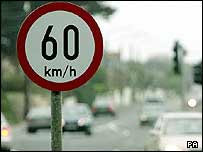 Driving across long distances in Canada I found that kilometres are not particularly difficult to master. Of course, the distances sound very large (the "Calgary 470" sign makes it seem a longer drive than "Calgary 294"). But the good news is you make much quicker progress in kilometres as the numbers go down much faster.
Some people regard the imperial units as more intuitive than the metric system: the number twelve for example, has a particular appeal for those dealing in small, whole integer quantities because you can divide it by 2,3,4 and 6 and easily multiply it by 2 or 3.
Which is why we sell eggs in dozens or half dozens. And in fact that's why the French sell eggs in dozens and half dozens too (as they do snails, I'm told) despite their long metric history.
But 12 is a not a very good way of talking about units that are broken into fractions, where the advantages of base 10 assert themselves more strongly.
 Anyway, the intuitive appeal of the number 12 would only be a strong argument for the non-metric system if most non-metric units were built around the number 12. But they are not. And even in the most striking case where they once were, the 12 penny shilling, few people yearn for a return to it.
As it happens, when it comes to distance, both systems have a similar-ish short measure (inch or centimetre); a medium measure (yard or metre) and a distance measure (mile or kilometre).
But the overriding advantage of the metric system is that its three measures all build on each other in a simple way, whereas there's really no logical connection between the three non-metric measures at all. A yard is 36 inches; a mile is 1,760 yards.
The non-metric answer is to have an intermediate unit, the foot, which sort of works in tying inches to yards, but doesn't help tie yards to miles.
All in all, it's pretty obvious that the metric system is easier once you've mastered it.
And as an example of its simplicity, take the hectare. Few of my generation seem to know that this basic unit of area is defined as 100 metres by 100 metres. It couldn't be clearer once its been explained, and then you can work out there are 100 to the square kilometre.
 Instead, we persevere with the acre, which most of us have a vague sense of, but few of us can properly define as 69.6 yards by 69.6 yards. (If they ran a 70 yard race in the Olympics, we would all have a more precise idea of the area embraced within an acre - but unfortunately they don't.)
I wouldn't want to exaggerate the benefits of having basic units and sub-units of a measurement system that relate to each other in consistent ways. We can express time in days or years, and there is no simple conversion between the two. And we can talk of area in square yards, or in acres making no attempt at all to flip between one and other.
And using imperial units doesn't stop us using base ten or sub-units of tenths. We can use calculators to add up miles with decimal places, as easily as we can kilometres. It is more common to talk of a marathon as being 26.2 miles than 26 miles, 385 yards. In fact, we can deal with inches or miles in 10ths and 100ths without relating them to each other at all. Why not?
But it is clearly more helpful if the different units we use for short and long distances lock together for one good reason - the fractions of the bigger unit then have an obvious natural interpretation in terms of the smaller unit. And we don't need to grasp as many units at all. And we can convert between different units without using a calculator.
This is all obvious really. So why do we not make the change to kilometres right now?
First, there's obviously a bit of admirable British scepticism of grand, idealistic designs. Metrication is perhaps seen by some as another kind of worthy and impractical initiative like Esperanto. Good idea but we can get on with real life now.
But that's not stopped the old empire dumping imperial measures, and moving to the de facto global standard: metric units.
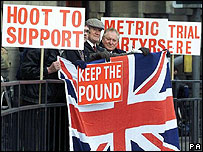
 Perhaps more significant in our reticence to finish the metrication job is a bit of "not-invented here" syndrome in our view of these things, exacerbated by our suspicion of too many things being imposed on us by Brussels.
Ironically, though, in many respects our view of metrication provides the best example of the British not rejecting a French imposition, but imitating French attitudes towards globalisation. Holding out against global norms and insisting on doing things our way, however inconvenient it is to ourselves.
Given that our language has done us so proud in this latest era of globalisation, it's odd that when it comes to numbers, we have such an anti-globalist view of things.
As it happens, I think the real reason we don't change is not that we dislike the fact the French invented it, nor that we have a tendency to behave like the French in facing globalisation. It is that in any given year, heaving ourselves through the transition to metrication is a difficult process.
It was jokingly argued when we switched to decimal currency, that as the change is most confusing for older people, we should wait until they die before proceeding. We can delay and delay as long as want on this count.
But it really comes down to a basic question - whether the cost of a switch-over is more than outweighed by the long term benefits of moving to the new system.
Upfront cost versus longer term benefits.
Economists are pretty familiar with this kind of choice: any investment has this basic structure. And economists have the tools to take a detailed look at investment proposals to decide whether the long term benefits are large enough to justify the initial payment. Some investments are worth proceeding with. Others are not.
So, if we view metrication as an investment, should we not take just such a detailed look?
Before we decide to stick in perpetuity to the system we've got, would it not be a good idea for someone to take a close look at really how costly it would be to switchover and what the benefits are, rather than leaving it to the mere default choice of doing what we always do?
The BBC is not responsible for the content of external internet sites
I'm Evan Davis, the former BBC economics editor.
I've now moved on to a new job, presenting Radio 4's Today programme. Evanomics will continue to exist in some form, as yet undecided.
Evan's categories
- (Latest entries, and comments)
- Notes on Real Life
| Are we stupid? (63) Central banks get together (32) Flat market (55) |
Small Change
 | Taboo of nationalisation (11) Chancing it (10) Shrinking economy (3) |
Vital Statistics
 | Setting prices (17) Unsustainable deficit (68) The first quarter... (20) |
Stars and strife
 | Dollar thrill (13) Prompts v causes (9) Dow vs ABX (11) |
Evan's Reading List
 | Irrationality (72) |
Archive
« January 2008
| Sun | Mon | Tue | Wed | Thu | Fri | Sat |
|---|---|---|---|---|---|---|
| 1 | 2 | 3 | 4 | 5 | ||
| 6 | 7 | 8 | 9 | 10 | 11 | 12 |
| 13 | 14 | 15 | 16 | 17 | 18 | 19 |
| 20 | 21 | 22 | 23 | 24 | 25 | 26 |
| 27 | 28 | 29 | 30 | 31 |
Evan's TV/Radio reports
- Banks' share trading probed
Broadcast: 19 Mar 2008 - Evan Davis on the economy
Broadcast: 18 Mar 2008 - Banks unite on credit crisis
Broadcast: 11 Mar 2008 - Housing slump hits flat prices
Broadcast: 29 Feb 2008 - Bank predicts soaring inflation
Broadcast: 13 Feb 2008
- The above links are to some of Evan's recent TV & Radio reports.
You will need Windows Media or Real Player to watch/listen (help).
Feeds

- News Editors
- Sport Editors
- Journalism Labs
- BBC Internet Blog
- Radio 4 Blog
- Peston's Picks
- Nick Robinson's Newslog
- Stephanomics
- Mark Easton's UK
- Mark Mardell's America
- Nick Bryant's Australia
- Andrew Harding on Africa
- Gavin Hewitt's Europe
- Soutik Biswas' India
- dot.Rory
- Science: Jonathan Amos
- Richard Black on environment
- Today: Tom Feilden
- Fergus Walsh's medical files
- Newsnight: Paul Mason
- Newsnight: Mark Urban
- Torin Douglas
- Will Gompertz's arts
- Phil Coomes on photojournalism
- Magazine Monitor
- Mark D'Arcy in Westminster
- NI: Mark Devenport
- Scotland: Brian Taylor
- Scotland: Douglas Fraser
- Wales: Betsan Powys
- Martin Rosenbaum on FOI
- 5 Live Breakfast
- Newsnight
- PM programme (iPM)
- World Tonight: Robin Lustig
