


New alignment
- 21 Mar 07, 04:27 PM
One more thing about this budget... we shouldn't underestimate a significant point being reached: the alignment of the national insurance and income tax systems... under the old system, you didn't pay national insurance on income over about £35,000 a year. Then you started to pay top rate income tax on income over about £38,000. Now we know that the NI will stop where the higher rates starts.
It was a point that then shadow chancellor John Smith wanted to reach 15 years ago, going into the 1992 election. (People thought the idea lost Labour that election!)
In addition, we also lose the 10p band of income tax, so the tax system does look a bit simpler and more logical.
UPDATE 2100: One clued up reader points out that I'm wrong to say that Gordon Brown has done what John Smith proposed in 1992. Smith actually proposed scrapping the upper earnings limit on an employee's national insurance contributions, whereas Brown has just brought them into line with the top tax rate - a slightly different thing. I stand corrected.
Six Budget thoughts
- 21 Mar 07, 03:12 PM
1. There will be losers - even if we can't identify them easily, as it's a complicated package.
2. It is a watered down version of the Tory and Labour strategies for greenifying the tax system. By 2010, green taxes rise by £1.4bn, which is used to pay for other personal tax cuts. All three parties now have policies to take us in that direction.
3. It's a substantial budget. Many of the tax measures have been announced over a three-year period. There will be no need for the next chancellor to have a budget for a while!
4. It is the umpteenth budget in a row, in which the chancellor has had to confess that his public finance projections are worse than he thought they'd be! For yet another time, getting his key measure of borrowing - the current balance - into surplus has been postponed until next year. It always seems to be next year.
5. The spending side is tough, as expected. Gordon Brown will see spending grow at about 2% above inflation, instead of the 3.6% they've been used to in the last seven years. It'll feel like a cut.
6. The chancellor does now find himself reforming his own reforms of the tax system. The 10p income tax rate was his idea, he took credit for introducing it, and now takes credit for abolishing it and using the money to cut the basic rate of income tax.
Overall though, this was an ingenious and mega-package of measures, with huge political impact, that managed to use no new resources at all.
Who's paying for it?
- 21 Mar 07, 01:48 PM
This is a complicated package of national insurance and income tax changes - whopping changes in fact.
Gordon Brown has abolished the lower starting rate of income tax - 10p rate - that’ll raise him eight and a half billion pounds which he uses to cut the basic rate of income tax and this costs him nine and a half billion So, effectively he’s a billion adrift... This will have a huge political impact but it’s only cost him a billion pounds to cut the basic rate of income tax by two pence.
At the upper end, who's paying for it? Better off people, basically. He implements this alignment of the top rate of income tax with where you stop paying national insurance.

Burying the Lyons review?
- 21 Mar 07, 09:00 AM
When I heard that the Lyons review was to be published today, I wondered whether they were trying to bury the Budget with the Lyons review, or bury the Lyons review with the Budget.
I think I know the answer. Whitehall loves reviews of local government - but hates them to go anywhere.
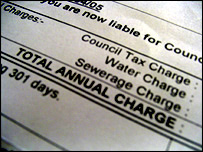 Indeed, a little known fact, the Lyons review itself was launched the day the last big review of council tax ended. Which was just ahead of the last election.
If politicians duck the issues of local government finance, it's because the public appear to scream more loudly when changes in council tax affect them, than with other taxes.
Which is a bit odd, as council tax raises less than 5% of the total tax take, and housing is not exactly overtaxed compared to other things we buy. And at least houses can't escape tax - we know exactly which council they sit in.
So why do we hate it? Probably because it's the only tax sent to us with an annual bill. So it's very visible.
Plus, having any tax on property allows newspapers to run lurid headlines - "Now they want to tax home improvements."... "They're taxing you for living in a good neighbourhood"… "They're taxing your beautiful view... "
Of course, taxing all these things that make up the value of a property, is kind of what property taxes do. But it sounds awfully unappealing.
But above all, we appear to dislike taxes that are not related to cash. We know we can pay income tax, cos it's taken out of some income. Or VAT, cos we're at the shops spending money. But council tax gets levied on people even if they have only a modest amount of cash to pay it.
This mostly affects elderly people living in large houses, and it's never seemed much consolation that they can trade down to smaller places, or claim council tax benefits.
So, for all these reasons, the unpopular tax gets ignored. In the hope it'll go away. We shy away from even having a revaluation, evidently preferring to not to tax your scenic view, but to tax the scenic view you had in 1991.
We're not alone: Famously, Ireland was using 100-year-old property values into the late 20th century. Holding out that long just makes the eventual revaluation all the more painful.
Which is why our local property tax in one form or another is reviewed, re-assessed, occasionally replaced, only to find itself back, and unreconstructed.
Can the Lyons review do any better than those that have gone before?
End of an era...
- 21 Mar 07, 07:33 AM
This is a more important Budget than usual.
Not just for the obvious reason, that it probably marks the end of an unprecedented ten year reign at Number 11. But also because it shapes the rest of the parliament. A three year comprehensive spending review is underway, and the chancellor has to reveal now the total amount the government intends to spend right up to 2011.
And all the evidence is that the squeeze starts here. Unless the chancellor wants a significant rise in taxes in the next few years, which he doesn't, the growth of public spending looks set to be held back, well below the growth rate of the economy.
In the Pre-Budget Report, Mr Brown pencilled in spending growth for the three years 2008/09 to 2010/11 of 2.0%, 1.9% and 1.9% respectively. He's bound to confirm figures close to that tomorrow, when the policy is set.
It'll probably feel like a cut in spending, certainly relative to the last few years.
It means that in his last Budget, the chancellor looks likely to revert to his earliest form - because before "Brown the munificant" handed out big doses of cash to public services, he was "Brown the Iron Chancellor", tough on spending. A form he is now trying to rediscover.
On one issue at least, Mr Brown will be able to make a boast. Over his ten years, he has met his famous Golden Rule, only to borrow for investment spending.
Sure, he wouldn't have met the rule without fiddling a bit with the timing of the economic cycle, (or without measuring his borrowing not in billions of pounds, but as a percentage of GDP, which gives more weight to the early years of surplus).
But at least he will be able to say that on his definition, over one complete economic cycle that coincides with his period in office, he invested about six billion more pounds than he borrowed.
Mind you: that is running it pretty close to the wire. Over the ten years he has spent 4.3 trillion pounds.
The BBC is not responsible for the content of external internet sites
I'm Evan Davis, the former BBC economics editor.
I've now moved on to a new job, presenting Radio 4's Today programme. Evanomics will continue to exist in some form, as yet undecided.
Evan's categories
- (Latest entries, and comments)
- Notes on Real Life
| Are we stupid? (63) Central banks get together (32) Flat market (55) |
Small Change
| Taboo of nationalisation (11) Chancing it (10) Shrinking economy (3) |
Vital Statistics
 | Setting prices (17) Unsustainable deficit (68) The first quarter... (20) |
Stars and strife
 | Dollar thrill (13) Prompts v causes (9) Dow vs ABX (11) |
Evan's Reading List
 | Irrationality (72) |
Archive
« January 2008
| Sun | Mon | Tue | Wed | Thu | Fri | Sat |
|---|---|---|---|---|---|---|
| 1 | 2 | 3 | 4 | 5 | ||
| 6 | 7 | 8 | 9 | 10 | 11 | 12 |
| 13 | 14 | 15 | 16 | 17 | 18 | 19 |
| 20 | 21 | 22 | 23 | 24 | 25 | 26 |
| 27 | 28 | 29 | 30 | 31 |
Evan's TV/Radio reports
- Banks' share trading probed
Broadcast: 19 Mar 2008 - Evan Davis on the economy
Broadcast: 18 Mar 2008 - Banks unite on credit crisis
Broadcast: 11 Mar 2008 - Housing slump hits flat prices
Broadcast: 29 Feb 2008 - Bank predicts soaring inflation
Broadcast: 13 Feb 2008
- The above links are to some of Evan's recent TV & Radio reports.
You will need Windows Media or Real Player to watch/listen (help).
Feeds

- News Editors
- Sport Editors
- Journalism Labs
- BBC Internet Blog
- Radio 4 Blog
- Peston's Picks
- Nick Robinson's Newslog
- Stephanomics
- Mark Easton's UK
- Mark Mardell's America
- Nick Bryant's Australia
- Andrew Harding on Africa
- Gavin Hewitt's Europe
- Soutik Biswas' India
- dot.Rory
- Science: Jonathan Amos
- Richard Black on environment
- Today: Tom Feilden
- Fergus Walsh's medical files
- Newsnight: Paul Mason
- Newsnight: Mark Urban
- Torin Douglas
- Will Gompertz's arts
- Phil Coomes on photojournalism
- Magazine Monitor
- Mark D'Arcy in Westminster
- NI: Mark Devenport
- Scotland: Brian Taylor
- Scotland: Douglas Fraser
- Wales: Betsan Powys
- Martin Rosenbaum on FOI
- 5 Live Breakfast
- Newsnight
- PM programme (iPM)
- World Tonight: Robin Lustig
