

Compensating Bernard Matthews
- 8 Feb 07, 11:25 AM
Should the taxpayer compensate Bernard Matthews for the culling of his diseased turkeys?
This is part two of a two-part mini-series. Part one below looks at whether the taxpayer should compensate people who have lost their company pensions through no fault of their own.
But what about the turkeys?
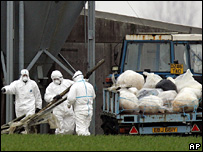
One of the surprising features of the debate over the bird flu-infected turkey stock this week, is that few people seem to have questioned the idea that the government should offer compensation.
 I haven’t even heard vegetarians grumble that their tax-pounds might be spent on supporting an industry which they would rather didn’t exist.
Well, I’m not going to take a view on whether that is the right thing to do or not, but let me at least raise the question as no one else seems to have done so.
As I understand it, the government offers compensation for the healthy birds culled in the interests of preventing further spread of the virus.
The principle was followed during foot and mouth, where you might remember farmers were compensated for the farm stock they lost, while other suffering businesses like hotels received nothing.
Is this fair?
The first thing to note is that Bernard Matthews is in business. He is more or less obliged to cover the costs of turkey production, and in return he enjoys most of the profits he earns.
(There are little deviations from this simple picture - things like taxes and farm subsidies, and his use of roads and educated workers to make it happen, but for sake of argument, let’s assume he covers his costs and keeps his profits.)
Now if Mr Matthews loses some turkeys, he must surely expect to bear that cost like he does most others. End of story.
And under the British government arrangements, Mr Matthews does have to bear the cost of the diseased turkeys who die on his watch.
So why single out the cost of the healthy birds that are culled for special treatment and give Mr Matthews compensation for those?
After all, is it not just a normal professional hazard in the apparently lucrative business of turkey farming, that sometimes there are culls necessary to prevent diseases?
Mr Matthews stands to gain by other farmers culling their stock sometimes, as they stand to gain when his flock is culled. It seems like a private matter for the farmers to sort out between themselves, not one for the taxpayer.
Now when you look at the total support for farmers through BSE and foot and mouth, hazards of this kind seem a) pretty expensive and b) not infrequent.
It might be that with all this compensation, we are using taxpayers’ money to make the meat industry bigger and more viable than it would otherwise be.
If farmers believe that they will be compensated for much of the inevitable cost arising from occasional disease outbreaks, they will allow themselves to select too many activities that are prone to disease. It’s a form of moral hazard.
If farmers had had to bear the costs of their own problems, we would have fewer meat producers, marginally more expensive meat, and marginally lower taxes.
As it happens, the government seems to accept this argument and is apparently trying to promote some kind of cost-sharing for this insurance scheme. It wants the industry to foot the bill to some degree.
But I’ve struggled to think of a good economic reason for the taxpayer to offer any support at all.
In the logic of economics, all the taxpayer needs to do is help the farmers organise their own arrangements.
Is that argument right?
It can’t be.
So what is the economic case for helping farmers in these situations, other than the mere fact we like animals and we want to help them?
Who deserves compensation?
- 8 Feb 07, 10:21 AM
Who should the taxpayer help? Which innocent victims of mis-fortune should we compensate?
In part two of this mini-series, I’ll talk about Bernard Matthews - the wealthy turkey farmer whose birds have been culled and who stands to be compensated (reported in one newspaper to be at least £2.5 million). But before that, here in part one, let me talk about pensioners.
I’ve been outside Parliament today, reporting on the predicament of a group of demonstrators.
They were there, because they had saved in their company pension schemes, had believed (partly on the basis of falsely-reassuring government literature) that their pension was “guaranteed”, and had found that when their company went insolvent, they were left with a fraction of what they thought they were going to get.
There has been a small amount of compensation for them, but nothing like enough for them to live life as they had reasonably expected to live it.
A legal obligation?
They want government to do more – and argue that it has a duty to help, as maladministration was to blame for their position. In particular, as government leaflets had mis-advised them on the safety of their pension, and as the Parliamentary Ombudsman has ruled that they should get help, they argue the government has a legal obligation to sort the problem out.
I’m not sure.
Suppose the government issued a leaflet telling us “It’s always safer to wear a seat-belt”, when in fact very occasionally wearing a seat belt causes injury. Would we expect the government to “compensate” the small number of victims for whom the seat-belt was a problem? Probably not.
It might help them, but not because the road safety information was flawed.
A moral obligation?
But even if one does dismiss the idea there’s a legal case for support – and it’s the high court judges who will ultimately decide the merits on that score – you can still make a case for more government help anyway.
After all, wouldn’t we want that help if the same misfortune befell the rest of us? Would taxpayers really resent spending money on a pensions bail-out?
Indeed, to reinforce this view, one can even view the state as a kind of giant insurance policy to help people out in the event of mis-fortunes that were not easily insurable privately. That’s a lot of what the state does. Indeed, it’s why we have a benefits system.
Why not extend that to some ad hoc help for people suffering such a drop in expected income?
Moral hazard
The counter-argument says that if we go round helping people too much, then they become careless about looking after themselves. In other words, you can screw up people’s incentives, by giving them too much insurance.
In economics jargon, the problem is called moral hazard. People who are helped in the event of mis-fortune take less care to prevent themselves being unfortunate. It’s a ubiquitous phenomenon.
- People (like me) ride motorbikes in the knowledge that our hospital bills will be paid by someone else.
- Teenagers allow themselves to miss the last train home, knowing that mum or dad can pick them up.
- Americans build coastal cities below sea-level in the knowledge that the government will help them when the flood protection breaks. (er, this may not be such a good example.. ED).
You get the idea.
Moral hazard is a a real issue in the design of public policy.
But it pretty clearly doesn’t arise in the case of the unlucky pensioners - who did after all, not behave recklessly in saving for themselves. They behaved responsibly.
And that’s why it is important that in this case that government leaflets told them they were doing the right thing.
It’s not that everything said in a leaflet immediately imposes on the taxpayer an obligation to underwrite the full losses incurred from a mistake. It’s that the leaflet proves the victims were not to be blamed in any way at all. The leaflets prove they were doing the “right thing”.
It’s thus hard to argue that bailing them out would discourage people from being prudent in future.
And so, what is normally an important argument against government reaching out and helping people all over the place, does not appear to apply in this case.
The BBC is not responsible for the content of external internet sites
I'm Evan Davis, the former BBC economics editor.
I've now moved on to a new job, presenting Radio 4's Today programme. Evanomics will continue to exist in some form, as yet undecided.
Evan's categories
- (Latest entries, and comments)
- Notes on Real Life
| Are we stupid? (63) Central banks get together (32) Flat market (55) |
Small Change
 | Taboo of nationalisation (11) Chancing it (10) Shrinking economy (3) |
Vital Statistics
 | Setting prices (17) Unsustainable deficit (68) The first quarter... (20) |
Stars and strife
 | Dollar thrill (13) Prompts v causes (9) Dow vs ABX (11) |
Evan's Reading List
 | Irrationality (72) |
Archive
« January 2008
| Sun | Mon | Tue | Wed | Thu | Fri | Sat |
|---|---|---|---|---|---|---|
| 1 | 2 | 3 | 4 | 5 | ||
| 6 | 7 | 8 | 9 | 10 | 11 | 12 |
| 13 | 14 | 15 | 16 | 17 | 18 | 19 |
| 20 | 21 | 22 | 23 | 24 | 25 | 26 |
| 27 | 28 | 29 | 30 | 31 |
Evan's TV/Radio reports
- Banks' share trading probed
Broadcast: 19 Mar 2008 - Evan Davis on the economy
Broadcast: 18 Mar 2008 - Banks unite on credit crisis
Broadcast: 11 Mar 2008 - Housing slump hits flat prices
Broadcast: 29 Feb 2008 - Bank predicts soaring inflation
Broadcast: 13 Feb 2008
- The above links are to some of Evan's recent TV & Radio reports.
You will need Windows Media or Real Player to watch/listen (help).
Feeds

- News Editors
- Sport Editors
- Journalism Labs
- BBC Internet Blog
- Radio 4 Blog
- Peston's Picks
- Nick Robinson's Newslog
- Stephanomics
- Mark Easton's UK
- Mark Mardell's America
- Nick Bryant's Australia
- Andrew Harding on Africa
- Gavin Hewitt's Europe
- Soutik Biswas' India
- dot.Rory
- Science: Jonathan Amos
- Richard Black on environment
- Today: Tom Feilden
- Fergus Walsh's medical files
- Newsnight: Paul Mason
- Newsnight: Mark Urban
- Torin Douglas
- Will Gompertz's arts
- Phil Coomes on photojournalism
- Magazine Monitor
- Mark D'Arcy in Westminster
- NI: Mark Devenport
- Scotland: Brian Taylor
- Scotland: Douglas Fraser
- Wales: Betsan Powys
- Martin Rosenbaum on FOI
- 5 Live Breakfast
- Newsnight
- PM programme (iPM)
- World Tonight: Robin Lustig
