


Welcome to Evanomics
- 5 Feb 07, 11:43 AM
Does the world really need yet another blog?
Good question.
The cost of creating a blog is relatively small, so there are already a lot of blogs out there.
Indeed, there are arguably too many for the good of the blog-economy, because the true cost of a new blog is not the time spent by the blogger. It's the time devoted by bloggees ascertaining that it is right for them.
By my experience it takes at least 20 seconds to discover that something is not worth reading, by which time you have wasted 20 seconds. (If you want to experiment with this claim, try looking at this randomly selected account of someone re-arranging their books on their shelves over the Christmas holiday on the Bibliophile Bullpen blog: )
So given all this, does the world really need a new economics blog?
Well: no but yeah but yeah but no, as Vicky Pollard would undoubtedly write if she had a blog of her own.
For one thing, Evanomics is not quite a blog. I'm not intending to make entries every day, or to update you with my views on every twist and turn in the financial pages.
But Evanomics is designed to have some blog-like characteristics. A place where you'll find a variety of material, frequently updated, and with plenty of opportunity to comment or contribute.
Secondly, Evanomics is not quite the same as economics. At least, not quite the same as the conventional stuff you find in the business pages of the newspapers. It is not a running macro-economic commentary.
Instead, this aims to be a location for economic insights. The focus is on economics as a way of thinking about issues, and as a tool kit of useful concepts and statistical techniques that can say a lot about the world. If you've read the book Freakonomics, you'll know what I mean.
So in Evanomics you'll find a mix: bits of personal finance, some statistics, and some academic research findings. You'll find some questions and issues for discussion and lots of brief personal thoughts on the news too. You'll find some short notes, and some long articles. And you'll find things by me, and hopefully, by some others.
Ideally, teachers and students can find some useful stuff here as well.
We'll see how it evolves.
And of course, I should stress there will be some of the familiar macro-economics we all know and love . Not the minute-by-minute reaction to data that you get on the city wire services, but the underlying story of the economy as it affects the public.
Or to put it another way, I'll always be happy to write about house prices when the Evanomics hit rate goes too low.
How to choose wine
- 5 Feb 07, 11:36 AM
I'm not very good at selecting wines.
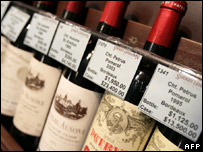 Frankly, there are far too many confusing labels to choose from, and my taste buds are not sophisticated enough for me to remember particular flavours and associate them with particular vineyards.
To make it even worse, most of my friends seem to be strangely knowledgeable about wine. They gaze at the bottles on the restaurant wine list as though it means something, and then make a careful choice, usually after a brief consultation.. "are you all right with a recent Bordeaux?"
However, despite my ignorance, I have a technique for buying wine that seems to me as effective as that employed by my mates. I use the power of economics to help me.
All I do is buy on the basis of price and make the assumption that there is a more or less direct link between the quality of the wine and the price I pay. Quite simply, I assume I'll get what I pay for.
As the price of a bottle of wine is normally well-marked and easy to comprehend, comparison between wines of all grape varieties and vintages is easy.
So all I have to do on any occasion is decide how much I want to splash out, which in my book is more or less the same as asking how nice a wine I want to pay for and consume that day.
If I choose to pay £7.95 for a bottle, it'll be better than if I choose to pay £5.95, and not as special as if I pay £9.95. If there are several wines at my chosen price, then it probably doesn't much matter which one I buy because they'll be about the same quality.
It's a rather obvious technique I know. Indeed, the old adage (passed down to me by my father) that "you always should buy the second least expensive bottle available", is a crude application of the same idea.
Now the big and obvious question is, does my wine-buying technique succeed in selecting wines efficiently?
I think it probably does, but only because I believe two basic assumptions. If you drop the assumptions, the economists' way of selecting wine won't work.
The first assumption is that most of us have a very similar taste in wine.
If we don't have similar tastes - if some like it smooth, some like it sharp, some like it fruity others like it musty - then price will not be a guide to quality, as the word "quality" ceases to have a shared meaning at all.
That's the case with music, for example, where we very obviously have very different tastes. And it is no surprise that if you look at the market for music downloads, the prices charged per track are almost uniform, and are useless in guiding us to what to buy. No-one says "This track must be ok, because it costs 79p and you get what you pay for."
As it happens, when it comes to wine, my experience is that we do generally have fairly similar tastes. Sure, we sometimes want white, sometimes red; sometimes sweet, sometimes dry. And sure there are some people who have their own little idiosyncracies.
But beyond some crude and obvious categories, I'm amazed at how little disagreement there is among ordinary folk, at the wines they drink. Even the experts have a measure of agreement about what is good and what is not, and that is why they can be snobbish about other people's tastes.
However, even accepting we all share the same taste, if you want to believe in my technique for buying wine, you also have to believe a second assumption: that the wine market is efficient.
What I mean by that is, that you don't find bargains and you don't find rip-offs. Loosely speaking, a market is efficient if the buyers are so effective at boycotting over-priced products they don't sell until their price falls into line. And the sellers find they quickly run out of stock if they under-price an item, until they raise the price into line.
So on any given day, all wines on the shelf are priced in line with quality.
Is the wine market efficient in this way?
Probably not exactly - there are some undoubted bargains, and some rip-offs. But as a rough approximation, it is reasonable to assume that if a wine is priced above comparable quality bottles, it will fail to sell and will thus fall in price. The people setting the prices kind of know where their wine fits into the great scheme of things, and price accordingly.
In addition, the professional wine-buyers - in the shops and restaurants - are expert at understanding wines, and are careful not to pay prices that deviate far from the going rate.
If the two assumptions are right, then my method of wine-buying works fine. And even if the assumptions are not perfect and the theory is flawed - believe me, so are the wine-selecting skills of my friends.
So now, you've read the theory. First, ask yourself whether you agree with me that price is as good a guide to buying wine as your wine-afficionado friends. And then ask yourself whether you think the following markets are efficient or not:
The market for football players.
The market for company shares.
I'd be interested to hear your views.
The BBC is not responsible for the content of external internet sites
I'm Evan Davis, the former BBC economics editor.
I've now moved on to a new job, presenting Radio 4's Today programme. Evanomics will continue to exist in some form, as yet undecided.
Evan's categories
- (Latest entries, and comments)
- Notes on Real Life
| Are we stupid? (63) Central banks get together (32) Flat market (55) |
Small Change
 | Taboo of nationalisation (11) Chancing it (10) Shrinking economy (3) |
Vital Statistics
 | Setting prices (17) Unsustainable deficit (68) The first quarter... (20) |
Stars and strife
 | Dollar thrill (13) Prompts v causes (9) Dow vs ABX (11) |
Evan's Reading List
 | Irrationality (72) |
Archive
« March 2008
| Sun | Mon | Tue | Wed | Thu | Fri | Sat |
|---|---|---|---|---|---|---|
| 1 | ||||||
| 2 | 3 | 4 | 5 | 6 | 7 | 8 |
| 9 | 10 | 11 | 12 | 13 | 14 | 15 |
| 16 | 17 | 18 | 19 | 20 | 21 | 22 |
| 23 | 24 | 25 | 26 | 27 | 28 | 29 |
| 30 | 31 |
Evan's TV/Radio reports
- Banks' share trading probed
Broadcast: 19 Mar 2008 - Evan Davis on the economy
Broadcast: 18 Mar 2008 - Banks unite on credit crisis
Broadcast: 11 Mar 2008 - Housing slump hits flat prices
Broadcast: 29 Feb 2008 - Bank predicts soaring inflation
Broadcast: 13 Feb 2008
- The above links are to some of Evan's recent TV & Radio reports.
You will need Windows Media or Real Player to watch/listen (help).
Feeds

- News Editors
- Sport Editors
- Journalism Labs
- BBC Internet Blog
- Radio 4 Blog
- Peston's Picks
- Nick Robinson's Newslog
- Stephanomics
- Mark Easton's UK
- Mark Mardell's America
- Nick Bryant's Australia
- Andrew Harding on Africa
- Gavin Hewitt's Europe
- Soutik Biswas' India
- dot.Rory
- Science: Jonathan Amos
- Richard Black on environment
- Today: Tom Feilden
- Fergus Walsh's medical files
- Newsnight: Paul Mason
- Newsnight: Mark Urban
- Torin Douglas
- Will Gompertz's arts
- Phil Coomes on photojournalism
- Magazine Monitor
- Mark D'Arcy in Westminster
- NI: Mark Devenport
- Scotland: Brian Taylor
- Scotland: Douglas Fraser
- Wales: Betsan Powys
- Martin Rosenbaum on FOI
- 5 Live Breakfast
- Newsnight
- PM programme (iPM)
- World Tonight: Robin Lustig
