- Kevin Marsh
- 6 Jun 06, 04:23 PM
The Governors are funky dudes. Or their programme complaints committee is, at least.
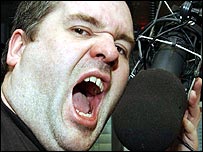
Their latest complaints bulletin rules that Radio 1's Chris Moyles wasn't being homophobic when he called a ringtone "gay". Young people - apparently - now routinely say "gay" when they mean "rubbish". And the complaints committee is "familiar with hearing this word in this context".
Coo.
That's the problem though. Keeping up with the latest street argot. Is "bollocks" now OK or not? I have to say, I thought it had been since the Sex Pistols won their case back in 1977. You'll remember it. The title of their album was "Never mind the bollocks, here's the Sex Pistols". A policewoman in Nottingham complained. M'learned friends got involved... and it was decided that "bollocks" was OK following the intervention of a linguist from the local university.
 Some 30 years later, it's still not a unanimous view. When Today referred on-air to those rather popular "Bollocks to Blair" T-shirts that were doing the rounds after the hunting vote, sensitivities were aroused. We argued - successfully - that the word, while clearly abusive, wasn't necessarily offensive.
It's not always that simple. I used to receive two or three letters a month complaining that once again Brian Widlake - when he was one of the presenters of The World at One - had used the phrase "cock-up" to describe some public figure's minor oversight. I decided to settle it once and for all and started to compose a well-researched letter showing how the complainant was flat wrong and an idiot to boot - but no slang dictionary could help. In fact they made it worse, linking the phrase to a very dubious practice at a minor public school.
There is a very useful chart which, sadly, was last updated some time ago. Even so, it's re-assuring to know that you can say "peace off", "wear the fox hat" or call someone a "salad tosser" with relative impunity. In the intervening six years, it seems that "shag" has moved down a peg or two and - if Chris Moyles is now our arbiter in this - so has "slag".
Context is all ... as those funky dudes on the Governors' committee explained when they reviewed a deluge of complaints over the film Robin Hood: Prince of Thieves back in 2005. The Committee noted the words ‘bastard’, ‘bollocks’, ‘piss’, ‘bugger’ and ‘bloody’ and "after careful consideration given to the context" decided that "the language was part of the rough-and-tumble of the story, appropriate to the rough and coarse characters depicted and the age they lived in".
Maybe that's what got Moyles off the hook this time.
Kevin Marsh is editor of the BBC College of Journalism

- Fran Unsworth
- 6 Jun 06, 03:12 PM
The issue of how broadcasters deal with the huge increase in "user generated content" or "citizen newsgathering" has been highligted again by the Forest Gate incident. It has been sniffily reported that some TV producers (apparently working for rival broadcasters) were offering members of the public cash and contracts for their mobile phone clips. People are obviously getting wise to the notion that their material could earn them a bob or two.
This is not a new occurance however. Newsgatherers have always been prepared to pay money for what we formerly termed "amateur video". It has netted us crucial pictures which we have used in the coverage of stories such as ferry disasters, the aftermath of explosions etc. As we wish to be able to hold the copyright for such pictures in order to be able to cut them into packages which are then passed on to our partners, we tie the deal down with a contract.
Along came the BBC News website which made a point of asking the public to send in their pictures, for which they were quite clear they would not be paying. Apart from anything else, they didn't have the budget, but in addition it didn't really fit the spirit of the new medium with its greater emphasis on interaction with the audience. So in effect we had two different systems for handling material provided by the public.
What has significantly changed the way we deal with these issues is the enormous growth in UGC content. With so many digital cameras and mobile phones out there it provides us with a huge increase in picture gathering capability and has proved enormously valuable: the 7/7 London bombs, the Buncefield fire and the recent Cleveland Explosion are the most notable recent examples.
We cannot be in the business of buying all the content provided by the public. There is simply now too much of it and most of it is not worth the expenditure. But there is nonetheless still a competitive market for really special material and the BBC should be part of that market in order for our journalism to remain of the highest quality.
Whether we pay the public for the material, and how much, is up to the judgement of producers on the ground who can see the pictures and the Newsgathering editor at base. Their decision would be based on the value of the shots as far as telling the story is concerned, the price, and how much we think it appropriate for a publicly funded broadcaster to pay.
A major consideration when dealing with this material though are the safety issues around it, and our responsibilities to the public. Our professional crews are fully safety-trained and have an understanding of the risks and precautions that need to be taken when covering stories such as oil depot explosions. The public might not. When appealing for this material from our audience, we need to ensure we are not encouraging them to put themselves in any danger.
Fran Unsworth is head of Newsgathering

- Richard Porter
- 6 Jun 06, 10:52 AM
Last time I wrote about a BBC World publicity campaign, I was told it wasn't the sort of thing we should be reading on The Editors. It didn't involve an editorial dilemma, or an explanation of a controversial decision.
 So I'm treading a little carefully this time. You see, we've been getting ourselves noticed again. This time in the USA - the big one, the one we've wanted to crack for years, the original home of the news channel. At long last, BBC World has some full-time distribution there. Everybody involved in the channel is very exicted about it...and I just wanted to explain why.
Why so significant? Because until now, you can only watch BBC World either through the half-hour bulletins shown by PBS stations in the States, or through our morning transmissions on BBC America (recently extended to a full three hours). But now, if you live in New York, you can watch the channel 24 hours a day. I'm not sure I'd recommend that to anyone (although my colleague Steve Williams, recently the father of twins, is doing his best to maintain a viewing marathon while he feeds his babies night after night).
 It's taken many years to get this far. The cable networks in the US took the view that they didn't need any more news networks. But our PBS broadcasts have been attracting very healthy audiences - more than CNN can claim for almost all of their programmes. And it's maybe a sign of the times that some American audiences want to see a channel which has a serious commitment to international news, and which doesn't see everything from a Washington or New York perspective. We don't profess to replace any other network, but we think we can offer something extra to the market. And we hope the New York deal is the first of many.
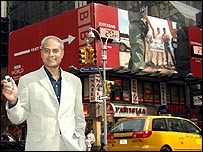
George Alagiah was in Times Square promoting the channel and his new news hour last week. World News Today will air from 0700-0800 EST (ie midday here) every weekday, and we intend to showcase the extraordinary range and depth of BBC Newsgathering resources. The hour will be targeted towards America, but that doesn't mean its agenda will be American - because that's not why people will be watching us. Equally, however, it would be daft to miss opportunities to explain how the world sees America - but that's not difficult when you consider the current news agenda. And, as ever with BBC World, we'll have to remember that while it's the morning for one audience, it's the middle of the evening for another.
Distribution in the US is the last big link in the chain. You can currently see the channel 24 hours a day in around 140 million homes around the globe, but until now all that growth has been outside the biggest TV market in the world. In terms of profile and revenue (because don't forget, we are commercially funded), this is the one we've been waiting for. So yes, we're very excited.
Richard Porter is head of BBC World News

The Times: The word "gay" now means "rubbish" in modern playground-speak and need not be offensive to homosexuals, the BBC Board of Governors has ruled. (link)
The Independent: "Channel 4 has launched a bid to become a national radio broadcaster to rival the BBC." (link)
The Telegraph: Interview with former BBC News chief Tony Hall: "The Royal Opera House is very like the BBC in being "creative, passionate, chaotic,'' he says. And full of prima donnas? He nods." (link)