


Google throws down open source gauntlet
- 22 Sep 08, 13:26 GMT
Google founder Larry Page wants the world to know that he and the company are serious about open source, unlike others who shall remain nameless. Alas for this reporter all I got for my attempts to dare the man to out any of these companies was a stare and a hint of a "Yeah right!" But if you don't ask...
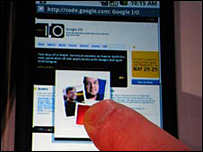 The issue came up at a "round table" meeting he, CEO Eric Schmidt and fellow co-founder Sergey Brin held with reporters at the firm's Mountain View offices.
"They are not serious about it from our perspective," said Mr Page about other companies who declare the code behind their products as truly open source but limit access via a "variety of licensing terms".
"We are actually serious about it," stressed Mr Page.
"We like Linux. We use Linux to build our products and [it] has been a great high for us that they can be adapted and used."
The reason the issue came up was because of chatter about Google's new Android phone which gets released in New York on Tuesday.
The phone, which is rumoured to have a touch screen and a trackball, has been created using code which is open source.
Google is throwing a lot of support behind third party developers who want to create applications for the phone and is sponsoring a developer challenge with a total of $10m (£5.5m) in prizes for the best apps.
The hot favourites are said to include cab4me which lets users order taxis with a single click on their phones and Ecorio which automatically tracks a user's carbon footprint. Both have just scooped $275,000 (£153,000) in the second heat of the contest.
The founders have said the way they have approached the Android project is proof positive of their open source credentials. And Sergey Brin said that commitment has resulted in others following in their footsteps.
"Another effect of Android is with the Nokia announcement with Symbian. They're going to 'open source' that. That's already progress from our point of view."
(I am sure there are some who would like the company to be as open when it comes to the issue of privacy, for which they have long been lambasted.)
But Mr Brin believes this is a train that will have more companies climbing on board. "I expect there will be others taking that code and producing phones without us."
Mr Page sees things in slightly loftier terms.
"With Android and Chrome we really are trying to do things differently that will be good for the world and good for technology in general and get a lot more innovation."
While there will be a fair bit of attention on the Android phone this week, those with eagle eyes at the round table got the chance to have a very quick peek when Larry flashed his phone briefly.
The tease!

Freeserve and ten years of boom and bust
- 22 Sep 08, 10:50 GMT
In Bradford today the National Media Museum is holding a little party to celebrate the tenth birthday of an Internet Service Provider. Why is that interesting? Well this particular ISP can lay claim to have brought the web to the mass market in Britain. What's more, in its rapid rise to fame and then back to obscurity, you can read much of the history of boom, bust and technological change in Britain.
 It was on 22 September 1998 that the high street electrical chain Dixons announced that it was launching a free internet provider called Freeserve. The existing players - Virgin, AOL, Compuserve and so on - scoffed at the idea that you could run an ISP without a subscription fee. But the people behind Freeserve reckoned they could build a profitable business if they could grab a share of the telephone charges.
Success has many fathers - but three people have substantial claims to have come up with the idea. Ajaz Ahmed, a PC World store manager in Leeds who lobbied his Dixons bosses for years to start an ISP, John Pluthero, a bright young Dixons executive who was put in charge of the project, and the Yorkshire-based entrepreneur Peter Wilkinson, whose Planet Online business was a partner in the project, and who scribbled on a paper napkin the sums which showed that Freeserve could make money from those dial-up charges.
Within six months, Freeserve had a million subscribers, and the other ISPs were scrambling to replicate its model. By the summer of 1999 it had become Britain's first dot com to float on the stock market. In the spring of 2000 it had two million subscribers - compared to BT's 400,000 - and it entered the FTSE 100. At that stage Freeserve was still making big losses but its value climbed to an extraordinary £9bn - more than its parent company Dixons. More even than the Bank of Scotland, which in the year before it joined Halifax to form HBOS, made a profit of more than a billion pounds.
The world appeared to have gone mad but Freeserve's executives and its stock market followers insisted that "a new paradigm" had been created, where "eyeballs" on your home page were a more important measure of success than profits in the bank. "Beg, steal or borrow - but get your hands on some of those dot com shares" seemed to be the message from the stock market analysts.
The year 2000 also brought even more frenzied competition between ISPs offering customers even more for even less. In March that year I took a call from a PR man explaining that Alta Vista was about to unveil a deal which promised unmetered internet access for an annual charge of just £20. I was sceptical but we covered the story on the BBC and it ended up on the front of the Sun, under the headline "Free Internet".
It never happened. Alta Vista's service - immediately copied by others including Freeserve - was never launched. The whole dot com bubble began to deflate. By December, Freeserve's shares which had reached £10, had fallen below the £1.50 issue price. Then Dixons sold the business to France Telecom for £1.25bn. In retrospect that looks a fantastic deal - because in 2008 what is left of Freeserve? The brand has now disappeared under the Orange banner, which, I notice, is plugging "free broadband" on its site.
And what of Freeserve's founders? Ajaz Ahmed still lives in Huddersfield where he grew up, and has started a number of internet businesses, including Browzar, which claims to allow users to surf the web without leaving traces of their activities. It's he who's organised today's party in Bradford. John Pluthero runs Cable and Wireless in the UK, where he has built a reputation as a frank-speaking boss who doesn't suffer fools gladly as he tries to invigorate a lumbering telecoms giant. And the equally blunt Peter Wilkinson - one of the very few to make serious money out of the dot com bubble - is still running technology businesses from his Yorkshire base.
What is amazing, looking back ten years, is how much has changed - and how little. Back in 1998, one million UK households had internet access, for which they paid around £10 a month for a 56k dial-up connection. Those households spent around £10m a year on online shopping. Now around 17 million homes have a broadband connection, often paying not much more than £10 for up to 8Mbps, and it's forecast that internet retailing will take revenues of £60bn this year.
But in the space of ten years we have also been through two bouts of speculative madness - the dot com boom followed by the credit and housing bubble. Each time, clever people in businesses and investment banks have told us that they have invented brilliant new products that can defy the old rules of financial gravity, from "free" internet providers to complex ways of repackaging mortgage debt. So next time someone comes along promising you a free lunch, remember that someone is going to end up paying the bill. And it could just be you.
The BBC is not responsible for the content of external internet sites
This is dot.life - a blog about technology from BBC News.
Rory Cellan-Jones is the BBC's technology correspondent.
Maggie Shiels is the BBC's tech reporter based in Silicon Valley.
Archive
« January 2010
| Sun | Mon | Tue | Wed | Thu | Fri | Sat |
|---|---|---|---|---|---|---|
| 1 | 2 | |||||
| 3 | 4 | 5 | 6 | 7 | 8 | 9 |
| 10 | 11 | 12 | 13 | 14 | 15 | 16 |
| 17 | 18 | 19 | 20 | 21 | 22 | 23 |
| 24 | 25 | 26 | 27 | 28 |
Being Discussed Now
- Logging out... and straight back in(3)
- Gadgets of the Noughties(20)
- Plastic Logic's long journey to Vegas(21)
- Sexting teens(17)
- Wikipedia on the wane?(49)
- 'Cooling-off' for mobile phones? Not on the High Street(37)
- 2009 - the social year(36)
- Twitter, Iran and #uksnow(25)
- Broadband Britain - how far down the league?(55)
- Microsoft and Murdoch: Teaming up to bash Google?(34)
BBC Technology Headlines
- %28none%29
%28none%29 - %28none%29
%28none%29 - %28none%29
%28none%29
Visit the Technology index
Visit the BBC News website
Rory's TV/Radio reports
- Residents block Google car
Broadcast: 3 April 2009 - New adverts to tackle film piracy
Broadcast: 2 April 2009 - Call to scrap 'illegal databases'
Broadcast: 23 March 2009 - Female robot takes to the catwalk
Broadcast: 16 March 2009 - Super-charged battery breakthrough
Broadcast: 12 March 2009

- News Editors
- Sport Editors
- Journalism Labs
- BBC Internet Blog
- Radio 4 Blog
- Peston's Picks
- Nick Robinson's Newslog
- Stephanomics
- Mark Easton's UK
- Mark Mardell's America
- Nick Bryant's Australia
- Andrew Harding on Africa
- Gavin Hewitt's Europe
- Soutik Biswas' India
- dot.Rory
- Science: Jonathan Amos
- Richard Black on environment
- Today: Tom Feilden
- Fergus Walsh's medical files
- Newsnight: Paul Mason
- Newsnight: Mark Urban
- Torin Douglas
- Will Gompertz's arts
- Phil Coomes on photojournalism
- Magazine Monitor
- Mark D'Arcy in Westminster
- NI: Mark Devenport
- Scotland: Brian Taylor
- Scotland: Douglas Fraser
- Wales: Betsan Powys
- Martin Rosenbaum on FOI
- 5 Live Breakfast
- Newsnight
- PM programme (iPM)
- World Tonight: Robin Lustig
