


Digital music - who can beat iTunes?
- 16 Sep 08, 15:12 GMT
Every day seems to bring a new announcement from the world of digital music. Yesterday it was the ailing Napster subscription service being bought by Best Buy (sorry, too much alliteration).
 Today it's the UK's 7digital trumpeting deals with the record labels which it says make it Europe's biggest purveyor of DRM-free music. And next month sees the arrival of "Comes With Music", Nokia's new service promising free music downloads with a handset contract. What they are all attempting to do is loosen the extraordinary stranglehold that Apple's iTunes has over the market.
It's going to be tough. The subscription model favoured by the likes of Napster and eMusic was one strategy, which now seems to be fading, just as the talk of an iTunes subscription service gets louder. Napster gathered around 700,000 subscribers but still ended up making a big loss. I've recently tried out another service eMusic, and am wondering why - it is hard to navigate, and appears to have a limited library for a £10 a month subscription.
7Digital appears to offer a more compelling proposition - a straightforward download store with a wide range of music from the four big labels, and at prices that look very competitive. But having tried it once a few months ago, I haven't returned. Why - the i word. No not iTunes, but inertia. What Apple has achieved is to make millions of computer users extremely comfortable with the whole concept of downloading and paying for music. That is a big - and lazy - crowd and having got into the habit of using iTunes, many will take a lot of persuading to move elsewhere.
But it's the mobile market that could prove the chink in Apple's armour. There are far more people using Nokia mobile phones than iPods, and in the coming months they're going to be asked a simple question. Do you want to get "free" music with your mobile - or would you prefer to pay for every track from iTunes? Now of course there are plenty of other questions to be answered about the nature of "free" (just how much more am I going to pay for this handset than one without music?) but you can see the appeal of Nokia's proposition.
And it won't be alone. Best Buy didn't snaffle up Napster for its subscription service, but for its mobile platform, which could end up on phones sold in stores across the US and the UK. So the battle for the digital music market is about to get a whole lot hotter.
TV - looking forward and back
- 16 Sep 08, 08:01 GMT
I'd come to the IBC conference in Amsterdam to film a story about the future of television. If what's on display at the broadcasting industry's annual shindig provides a true picture, we'll all eventually be watching in Super Hi-Vision (yes, there's something else after HD), and in 3-D, and we will be getting more and more of our TV via the internet and on our mobile phones.
In order to see this content you need to have both Javascript enabled and Flash installed. Visit BBC Webwise for full instructions. If you're reading via RSS, you'll need to visit the blog to access this content.
But our incredibly compact BBC team ended up talking more about the past than the future.
That team consisted of me and a cameraman, Dave Skerry, and between us we had over 60 years in the industry. Dave started in television in 1968, at a time when it was all still in black and white, and his training was heavy on the engineering: "I almost got chucked out because I couldn't get the hang of valves," he remembered.
Those were the days of film, when videotape - even as a recording medium - was still in its infancy. Even by 1981, the regional newsroom where I began my TV career was still shooting news stories on film. You had to wait for 45 minutes while it went through "the bath", and then it was rapidly chopped up and assembled by an editor.
When I came to London a couple of years later, the TV newsroom was getting to grips with ENG - Electronic News Gathering. A news crew consisted of a cameraman, wielding a very heavy video camera delivering poor quality pictures, linked by an umbilical cord to a sound recordist. They carried an even heavier unit which recorded sound and pictures onto a chunky 3/4 inch U-Matic tape cassette.
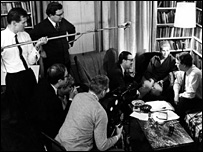 Then there was the lighting man who turned up with a heavy bag full of "redheads" and "blondes". The whole kit cost about £30,000. Back at the office, former film editors were now involved in the expensive process of video tape editing, and complaining, with some justification, that it was a step backward, as they laboriously copied shots from the rushes tape to the final version.
Over the next couple of decades, the cameras got lighter and cheaper, with the recorder soon incorporated into the main unit, the tapes got smaller and smaller, and the cameramen - and women - eventually found they were on their own, doing pictures, sound and lights. And then they had to learn to edit too, now assembling stories with a digital editing package, much closer to the original non-linear film method.
Oh, and instead of using a satellite truck to send the pictures back, the modern camera operator has to send it over the internet, perhaps from a hotel's dodgy wi-fi network, as we did in Amsterdam at 0230 the other morning.
As the process of gathering television pictures has got cheaper, it has been democratised. The kind of camera Dave Skerry was using in Amsterdam costs about £3,000 - chuck in a laptop with an editing package, and for under £5,000 you have the kind of production set-up that would have cost close to £100,000 20 years ago.
What's more, the modern kit delivers a better product - HD if you want it. The result - as we see every time we look at YouTube - is that just about anyone who wants to have a go can make television.
Which makes it somewhat surprising to wander around the vast halls at IBC, finding an apparently thriving professional broadcast industry examining the latest kit, pushed at visitors by the likes of Sony, Panasonic and Philips. The industry seems to have decided that in the future there will be two kinds of television - the cheap and democratic stuff, and the ultra high-quality version which only the professionals can afford to make.
Hence Super Hi-Vision. This is a futuristic project, collaboration between Japan's NHK, Italy's RAI and the BBC, which promises 16 times the resolution of HDTV and 80 times what standard definition offers. We sat in an auditorium watching a live feed in Super Hi-Vision from the roof of London's City Hall, with the sound of the city swirling around us.
As well as extraordinary pictures, the new standard offers "22.2 channel immersive audio", though as one sceptical journalist pointed out, who's going to install 22 speakers in the front room - and then find room for another .2? All of this is a long way from reaching our homes. There's talk of huge open-air screens using the technology at the London 2012 Olympics, but I got the impression that even that was optimistic. Right now, there are only a couple of giant Super Hi-Vision cameras in existence.
So my career in television - which began with film - may well be over before Super Hi-Vision becomes a reality. And do you know what, I'm not really sorry. I've always considered myself an enthusiastic early adopter, but I think I may have had just about as much change as I can handle.
The BBC is not responsible for the content of external internet sites
This is dot.life - a blog about technology from BBC News.
Rory Cellan-Jones is the BBC's technology correspondent.
Maggie Shiels is the BBC's tech reporter based in Silicon Valley.
Archive
« January 2010
| Sun | Mon | Tue | Wed | Thu | Fri | Sat |
|---|---|---|---|---|---|---|
| 1 | 2 | |||||
| 3 | 4 | 5 | 6 | 7 | 8 | 9 |
| 10 | 11 | 12 | 13 | 14 | 15 | 16 |
| 17 | 18 | 19 | 20 | 21 | 22 | 23 |
| 24 | 25 | 26 | 27 | 28 |
Being Discussed Now
- Logging out... and straight back in(3)
- Gadgets of the Noughties(20)
- Plastic Logic's long journey to Vegas(21)
- Sexting teens(17)
- Wikipedia on the wane?(49)
- 'Cooling-off' for mobile phones? Not on the High Street(37)
- 2009 - the social year(36)
- Twitter, Iran and #uksnow(25)
- Broadband Britain - how far down the league?(55)
- Microsoft and Murdoch: Teaming up to bash Google?(34)
BBC Technology Headlines
- %28none%29
%28none%29 - %28none%29
%28none%29 - %28none%29
%28none%29
Visit the Technology index
Visit the BBC News website
Rory's TV/Radio reports
- Residents block Google car
Broadcast: 3 April 2009 - New adverts to tackle film piracy
Broadcast: 2 April 2009 - Call to scrap 'illegal databases'
Broadcast: 23 March 2009 - Female robot takes to the catwalk
Broadcast: 16 March 2009 - Super-charged battery breakthrough
Broadcast: 12 March 2009

- News Editors
- Sport Editors
- Journalism Labs
- BBC Internet Blog
- Radio 4 Blog
- Peston's Picks
- Nick Robinson's Newslog
- Stephanomics
- Mark Easton's UK
- Mark Mardell's America
- Nick Bryant's Australia
- Andrew Harding on Africa
- Gavin Hewitt's Europe
- Soutik Biswas' India
- dot.Rory
- Science: Jonathan Amos
- Richard Black on environment
- Today: Tom Feilden
- Fergus Walsh's medical files
- Newsnight: Paul Mason
- Newsnight: Mark Urban
- Torin Douglas
- Will Gompertz's arts
- Phil Coomes on photojournalism
- Magazine Monitor
- Mark D'Arcy in Westminster
- NI: Mark Devenport
- Scotland: Brian Taylor
- Scotland: Douglas Fraser
- Wales: Betsan Powys
- Martin Rosenbaum on FOI
- 5 Live Breakfast
- Newsnight
- PM programme (iPM)
- World Tonight: Robin Lustig
