


Yahoo - what's their game?
- 25 Mar 08, 18:52 GMT
“I wonder what he meant by that?” is what the German statesman Metternich is supposed to have said on hearing of the death of the wily French diplomat Talleyrand.
That was much my reaction when I heard today’s news that the not quite so comatose Yahoo had joined the OpenSocial platform. Both Yahoo and Google seemed to want to make an awful lot of noise about this not particularly stunning event.
After all, Yahoo had stood aside last October when Google launched a platform designed to help developers create applications that would work on any social networking site. But now it’s plunging in, and also collaborating with Google and MySpace to form what they call “The OpenSocial Foundation,” a kind of United Nations to guide the new platform.
In the joint press conference the three partners have just held there was heady talk of collaboration, of “going far by going together”, and of making OpenSocial “forever free and open”.
But guess who wasn’t mentioned? That’s right – Facebook and Microsoft. They have both kept well clear of the OpenSocial initiative, while insisting that they are both committed to various forms of openness.
So what Yahoo really means by this initiative is “Hey, we’re not like those guys in Redmond who want to swallow us up - we are really, really sincere about collaboration.” Or, in the words of one of Google’s spinners, “openness is closer to some hearts than others.”
It’s another round in the phoney war between Yahoo and Microsoft, while we wait to see if Bill Gates will increase his bid. Yahoo and Google are saying they, not Microsoft, embody the future of the internet. The trouble is, while Google makes ever friendlier noises about the ailing search firm, it s not offering Yahoo shareholders a tangible alternative to Microsoft’s cash.

BBC unblocked in China
- 25 Mar 08, 09:23 GMT
We're getting reports that the BBC News website is now accessible to people in China.
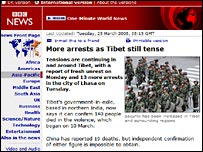 BBC staff have said they can access the website, and I've seen sporadic reports on Twitter, saying the same thing. In fact, I've seen one five-day old report on Twitter from a user saying he can access the BBC site inside China.
Until now people in China have only been able to access BBC News, as well as other restricted sites, by using a proxy server.
So the big question then is: Is this by design or by accident?
Commonsense would dictate that this is a deliberate unblocking of the domain, especially given the site appears to have been accessible for some time.
But why? Given the recent unrest in Tibet one would expect a tightening of control, not a loosening.
Is this the much anticipated opening up of China? It's far too early to say.
The BBC is not responsible for the content of external internet sites
This is dot.life - a blog about technology from BBC News.
Rory Cellan-Jones is the BBC's technology correspondent.
Maggie Shiels is the BBC's tech reporter based in Silicon Valley.
Archive
« January 2010
| Sun | Mon | Tue | Wed | Thu | Fri | Sat |
|---|---|---|---|---|---|---|
| 1 | 2 | |||||
| 3 | 4 | 5 | 6 | 7 | 8 | 9 |
| 10 | 11 | 12 | 13 | 14 | 15 | 16 |
| 17 | 18 | 19 | 20 | 21 | 22 | 23 |
| 24 | 25 | 26 | 27 | 28 |
Being Discussed Now
- Logging out... and straight back in(3)
- Gadgets of the Noughties(20)
- Plastic Logic's long journey to Vegas(21)
- Sexting teens(17)
- Wikipedia on the wane?(49)
- 'Cooling-off' for mobile phones? Not on the High Street(37)
- 2009 - the social year(36)
- Twitter, Iran and #uksnow(25)
- Broadband Britain - how far down the league?(55)
- Microsoft and Murdoch: Teaming up to bash Google?(34)
BBC Technology Headlines
- %28none%29
%28none%29 - %28none%29
%28none%29 - %28none%29
%28none%29
Visit the Technology index
Visit the BBC News website
Rory's TV/Radio reports
- Residents block Google car
Broadcast: 3 April 2009 - New adverts to tackle film piracy
Broadcast: 2 April 2009 - Call to scrap 'illegal databases'
Broadcast: 23 March 2009 - Female robot takes to the catwalk
Broadcast: 16 March 2009 - Super-charged battery breakthrough
Broadcast: 12 March 2009

- News Editors
- Sport Editors
- Journalism Labs
- BBC Internet Blog
- Radio 4 Blog
- Peston's Picks
- Nick Robinson's Newslog
- Stephanomics
- Mark Easton's UK
- Mark Mardell's America
- Nick Bryant's Australia
- Andrew Harding on Africa
- Gavin Hewitt's Europe
- Soutik Biswas' India
- dot.Rory
- Science: Jonathan Amos
- Richard Black on environment
- Today: Tom Feilden
- Fergus Walsh's medical files
- Newsnight: Paul Mason
- Newsnight: Mark Urban
- Torin Douglas
- Will Gompertz's arts
- Phil Coomes on photojournalism
- Magazine Monitor
- Mark D'Arcy in Westminster
- NI: Mark Devenport
- Scotland: Brian Taylor
- Scotland: Douglas Fraser
- Wales: Betsan Powys
- Martin Rosenbaum on FOI
- 5 Live Breakfast
- Newsnight
- PM programme (iPM)
- World Tonight: Robin Lustig
