On hearing the news that Russia and China have vetoed the UK/US sanctions resolution at the United Nations I recalled the question I put at the Prime Minister's news conference at the end of the G8 summit.
I wanted to check what I was being told off the record - namely that the Russians would abstain and that any suggestion otherwise was due simply to a timelag between what their President had signed upto in Japan and the Russian Ambassador to the UN getting the word in New York.
I asked Gordon Brown :
"Prime Minister did the President of Russia tell the G8 that his country would back sanctions at the United Nations targeted at Zimbabwe, and if so why did his Ambassador at the UN describe the sanctions as quite excessive and in conflict with the notion of sovereignty?"
He replied :
"For the first time the G8, including every country within the G8, has come out in favour of sanctions against Zimbabwe and it is clear in the script that was issued last night by the G8 about our views about the deteriorating situation in Zimbabwe".
To be fair he did go on to say that
"the G8 resolution is about the general approach to sanctions, agreed by all members of the G8, the UN resolution proposed by the United Kingdom and the USA takes that forward with very specific proposals about sanctions against named individuals and about the arms embargo, and I hope people in the UN Security Council will find it possible to support this resolution"
Incidentally, we were also briefed that the Chinese would not risk a veto on an issue marginal to their interests so close to the Olympics.
So, reporters were briefed wrongly. Was the PM? And, if so, why did the diplomats get it so wrong?
When David Davis shocked Westminster by resigning his seat I reported the fury within Team Cameron which led them to describe his decision as "personal" - meaning taken without consultation with his leader or other colleagues - and "courageous" - which I translated as political code for "mad".
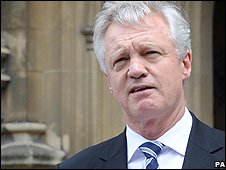 I predicted that whatever happened it would damage the Tories since the man who was defeated for the Tory leadership would be able to claim his own electoral mandate and thus have an independent status on the backbenches if he won his by-election.
Never before have my predictions provoked such anger or such a flurry of complaints. I was accused both of mis-representing David Cameron's real views and of under-estimating the public's support for David Davis.
In short I was told repeatedly that I was prisoner of the Westminster village who "just didn't get it". So, on the morning after the by-election night before what's my verdict now?
I'm sorry to disappoint my critics - or perhaps confirm them in their view - but I've not changed my mind. Except, that is, on one point. I did under-estimate the extent to which the act of resigning on an issue of principle would elevate David Davis in the eyes of many in this profoundly anti-political age. The turnout and majority he got, in what turned out to be a non-election, was a reflection of the high status he has in his constituency.
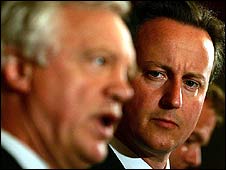 However, I hold to the view that, whether he means to be or not, he will be a destabilising presence for David Cameron whether he stays on the backbenches or is eventually given another job.
The last time I faced such flak for a prediction was a long time ago - when Clare Short attacked Tony Blair's spindoctors as "men in the dark" when Labour were still in opposition. When Blair and Short cobbled together a statement saying they agreed with each other I described them as "like a married couple" who'd stayed together for the sake of the children or, in this case, the Labour Party.
The problem, I continued with my over-extended metaphor, was that if you invited them for dinner they'd end up having a row and throwing the crockery at each other.
This prediction led Peter Mandelson to try to have me sacked. For years afterwards as Short sat, apparently comfortably, in Blair's Cabinet I worried that I'd got it wrong. Then, along came the Iraq war...
Perhaps the diplomatic thing to say to minimise the risk of triggering yet more complaints is, as Deng Xiaioping once famously remarked when asked for his view of the French Revolution, "It's too early to tell".