“Yuck”. “Ew”.
It may sound like the noises you make when eating cold leftovers, but it’s actually some of the responses on socials to the new Spotify logo (although to be fair, other people think it’s pretty cool).
To mark the 20th anniversary of the music streaming platform, the usual solid green of the app icon has been turned into a disco ball of a similar colour. After all, nothing says music is fun more than a disco ball, right?
Reports online suggest this new look is only with us for a while anyway, as part of the birthday celebrations. But why have people reacted in this way. BBC Bitesize Other Side of the Story switched on its favourite playlist and took a closer look.
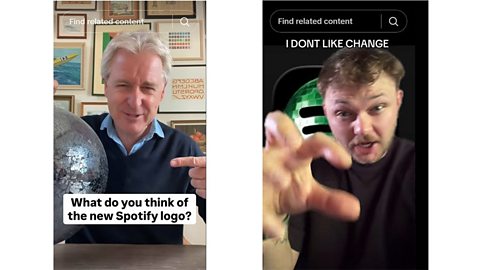
Spotify: The polarisation remix
When something new pops up - like a redesigned logo - there is always some sort of reaction. On our socials, this reaction can be extremely positive or extremely negative with not much middle ground. This is called polarisation and we see it more on social platforms because many, like X, have a limited amount of character per post. You’re more likely to say you like or don’t like something in the space available - and not have enough words left to add more context, such as explaining why you don’t think something works or how it can be improved.
Why it’s important to debate
You may not like something, such as a new logo, but that doesn’t mean everyone thinks the same. It’s useful to hear other people’s point of view on a subject as it can challenge your own beliefs and ideas and perhaps make you see a story from a different angle.
For example, while some people don’t like the new Spotify logo, other X users have reacted with a simple flame emoji to show their appreciation while someone else said it was “exactly the kind of whimsy I need in my life [right now]”.
If you only follow people who have the same opinions as you then you may fall into an echo chamber where you only ever see one side of a topic. The algorithm this creates will feed you information from that viewpoint all the time, and this makes it more likely you’ll receive false information and fake news.
Separating fact from opinion
Somebody saying that a new design is rubbish doesn’t mean that it’s true. It’s purely somebody’s opinion and remember that there’s no rule or test which says that a piece of art - or a book or a video game - is good or bad. We will all have our own immediate thoughts on an issue, but it's a good idea to get as much information as possible about it before making what is called an informed opinion.
When journalists work on a story, they have to separate truth from fiction and fact from opinion. Their job is to present someone with the facts, so that people can form their own opinion based on many different factors, such as their own beliefs and background. Everyone is entitled to their own opinion, but their opinion isn’t a fact.
So when you see someone giving their opinion on a subject - such as the new Spotify logo - don’t take it as a fact. If you consider what they have to say, and then form your own ideas on the topic, it can help give you a broader, more rounded view on something that everyone is talking about.
It might even make you mix up your playlist a little - add some country in with the r’n’b and dance.
This article was published in May 2026

Not sure if the news you’re seeing on social media is true or false? Can you always tell if the things you see online are real or fake?
Learn how to get the other side of the story with our quizzes, videos and explainers about media skills and viral trends including popular food myths.
Why can fans be so negative about the thing they love?
How bias, gatekeeping and rosy retrospection can reveal itself
Other Side of the Story
Back to our homepage for more quizzes and explainers about fake news, viral trends and media skills.