It’s one of the most gruelling sporting events in the world – and far from just as easy as riding a bike.
The Tour de France is cycling’s most iconic race, with the sport’s greatest athletes facing three weeks in the saddle for the right to wear the legendary leader’s yellow jersey.
But away from the climbs, sprints and crashes, there have been plenty of more unusual moments on the French roads over the years.
BBC Bitesize takes a look at four of the strangest moments in Tour de France history.
Off your bike…
Thanks to the efforts of the Brownlee brothers, and other British triathlete stars like Alex Yee, Jess Learmonth and Beth Potter, we’ve become very familiar with the sight of athletes hopping off their bike to go for a run.
Less so in the Tour de France. But that’s exactly what happened to Chris Froome in the 2016 Tour.
The British rider, then leading the overall general classification for the Tour, was in a chasing group that crashed into a support motorbike on the climb up the formidable Mont Ventoux. The security vehicle had been forced to stop suddenly because of heavy crowds of supporters on the course.
While teams will carry spare bikes in case of mechanical failures, Froome’s team car was several minutes behind because of the volume of spectators. With rivals passing him, he took drastic action – and started to run, albeit quite slowly because he’d been on his bike for over four hours and was wearing cycling shoes.
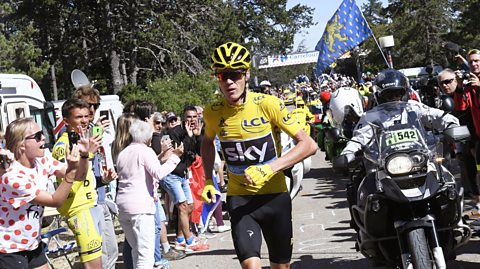
He was given a neutral service bike – a generic bike available to all riders in case of emergency – but struggled to get set on it, before eventually being handed a spare by his team. By this point, he’d lost valuable time on his rivals and was set to lose the yellow jersey. However – organisers deemed the crash to be nobody’s fault and that Froome shouldn’t suffer because of the issues caused by the crowds, so he was given the same time as the others who crashed.
The grateful British rider retained the lead – and went on to win the Tour for the second year in a row. Froome has won the Tour de France on four occasions now, making him the most successful British general classification rider in history.
Bus stop
Cyclists and bus drivers are used to sharing the same stretches of road – with cyclists allowed to use bus lanes in the majority of UK towns and cities.
The same technically happens on the Tour de France, where it nearly ruined one stage in 2013.
Team buses travel along the route in advance to the riders, from stage to stage. On the opening day of 2013’s Tour, which took place on the French island of Corsica, the Orica-GreenEDGE team’s luxury coach made it all the way to the finish line before becoming stuck under the sponsor’s branding.
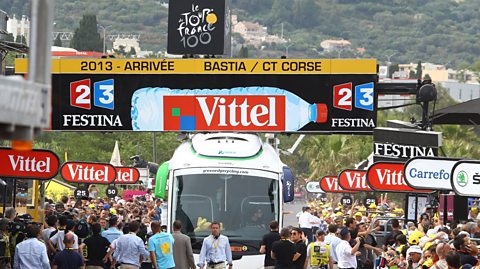
This would have been a major problem at any point, but the leading group of riders were only 10km (6.2 miles) away. Organisers hurriedly decided to bring the finish of the race forward by 3km – and riders duly started planning their moves.
The bus driver then finally managed to clear his vehicle – at the point the riders were only 2km away from the new finish line. The organisers then decided to switch back to the original race end, but many of the riders had already begun to attack and the confusion led to chaos and multiple crashes.
A deflating crash
More drama with a sponsor’s branding came in the 2016 Tour de France.
On the seventh stage – from L’Isle Jourdain to Lac de Payolle in the Pyrenees, British rider Steve Cummings launched a solo attack to claim the stage win.
Further behind him, another Brit – Adam Yates – was trying to open up a gap between himself and other riders in a bid to claim the white jersey, for best young rider.
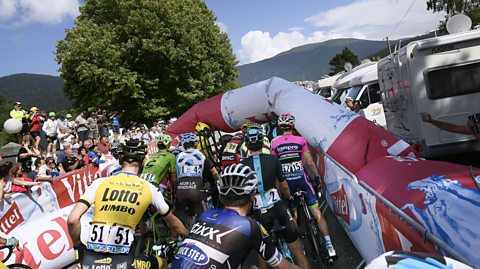
As he approached the final part of the race, an inflatable arch known as the flammé rouge signalled 1km to go. Unfortunately for Yates, the arch collapsed on top of him as he rode through, causing him to crash and holding up all the riders behind him.
Organisers later discovered that a fan nearby caught his belt in the cable linking the arch to a generator, which led to it deflating and obstructing riders.
Yates got back on his bike and gamely made it to the finish line, where he and the other affected riders were given adjusted times. This earned Yates the white jersey, which he held onto for the rest of the Tour.
Two tyres or too tired?
While the Tour de France has been held for men since 1903, female cyclists have not been given the same opportunities.
A one-off race was held in 1955, before annual stage races took place in France between 1984 and 2009. These events were often poorly funded and forced to be named differently to the Tour, who didn’t support the events.
Following a campaign for equality, Tour organisers held a one or two day race known as La Course by Le Tour de France between 2014 and 2021, before introducing a multi-day Tour de France Femmes in 2022.
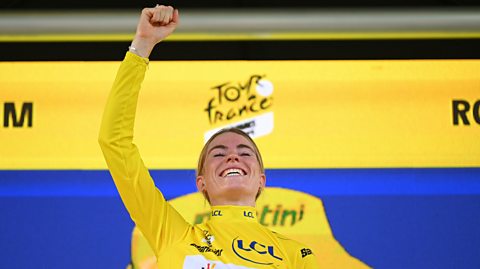
The 2024 edition was the first to have a Grand Depart (the opening stage or stages) outside of France, with riders beginning in the Netherlands. The event was shifted to August because of the Olympics in Paris. As a result and in order to fit the competition between the Olympics and Paralympics, organisers also chose to make one day of the race a double stage day – meaning two diiferent events in one day. The second day of the Tour saw a race in the morning, followed by individual time trials in the afternoon.
This led to the rather unique situation of Dutch rider Demi Vollering preparing for the time trial in bed. Exhausted from the morning efforts, Vollering went to her hotel and had a power nap. She woke up, set to do some meditation, and promptly fell back asleep again.
40 winks worked out for her – she went on to win the stage and claim the yellow jersey, ultimately finishing second overall in the general classification.
This article was published in July 2025
The cycling jargon you need to know about
Why you need to worry about bonking if you leave the peloton - and others.
Conquering the impossible in sport
A look at some of the teams and individuals who achieved what many said could never be done.
How four of the world’s most famous stadiums opened their doors
The first days of the Macarana, Camp Nou, Hampden and Madison Square Garden