Sport has an amazing ability to create great stories, especially when things come down to a photo finish, the last kick of the ball or a sudden-death tie break.
BBC Bitesize finds those real edge-of-your-seat moments as we explore four of the most down to the wire finishes in sport.
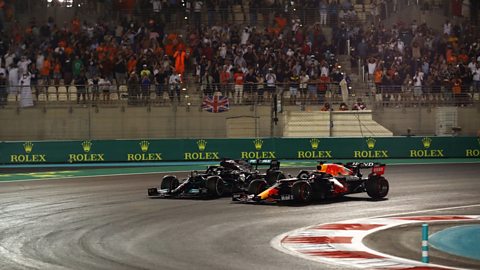
The Formula One Driver’s Championship, December 2021
Formula One has had some epic rivalries over the years but 2021’s duel between Dutchman Max Verstappen and Brit Lewis Hamilton is a classic.
The whole season was full of dramatic twists and turns. Verstappen was chasing his first ever Formula One title, while Hamilton was looking for a record-breaking eighth.
They went into the final race equal on points, but Verstappen had the advantage of being in pole position at Abu Dhabi’s Yas Marina Circuit.
Hamilton quickly overtook him on the first lap. He then led for the majority of the race. However, a crash with just five full laps to go changed everything.
The safety car came out, slowing the field. Hamilton’s team decided not to make a pit stop and change tyres. Verstappen’s team took the opposite approach.
Then, amidst some chaos involving ‘lapped cars’ and other racing rules, the duo found themselves with just one lap to go.
With quicker and gripper tyres, Verstappen soon moved past Hamilton before pulling away to take the chequered flag, and the championship. Cue absolute scenes for the Dutchman and his Redbull team, and dismay for Hamilton and Mercedes.
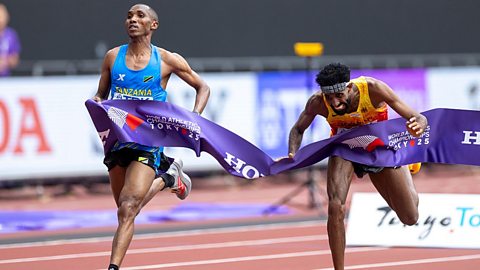
Men’s marathon, World Athletics Championships, September 2025
A photo finish after a marathon seems unlikely – yes after the 100m sprints, but surely not after 26 and a bit miles? However, at the World Athletics Championships in Tokyo in 2025 that’s exactly what happened.
The race had to be started early and finish inside the national stadium because of extreme heat in Tokyo.
Quite a few runners were forced to bow out because of the heat, but German distance runner Amanal Petros and Alphonce Simbu, running for Tanzania both made it to the final stretch.
Petros had led the field for the entire race and looked certain to take gold but Simbu, in second place, had other ideas and despite having run over 40km he kicked for the line, catching Petros in the process. The pair crossed the finish at pretty much the exact same time.
The only way to separate them was with a photo-finish - the first time the technology was needed for a marathon at a major championship. To his absolute delight, first place was awarded to Simbu.
Although both official finishing times were listed as two hours, nine minutes and forty-eight seconds the photo-finish judged that Simbu had crossed the line just three-hundredths of a second ahead of Petros. That’s less than the gap between first and second place in the men’s 100-metre final at the same championships.

Why do commentators say “down to the wire”?
Last minute goals, final laps, break-points and epic photo finishes – but not a wire to be seen. So why do we use the term “down to the wire”?
The phrase is believed by some to come from horse racing. In the 19th Century, before photo finish cameras were in use, racetracks often had wire strung above the finish. This helped race stewards to determine which horse had crossed the line first.
Races that didn’t have an obvious winner until the last moment were often described as having “gone down to the wire”.
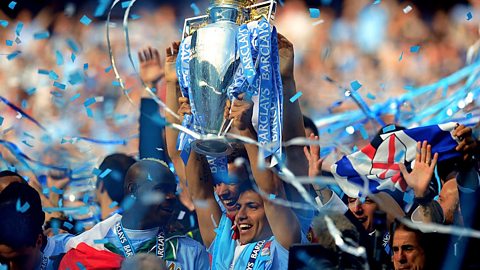
Manchester City win the Premier League title in extra time, May 2012.
“Agueroooooooooooooo” - Martin Tyler’s iconic line, delivered on Sunday May 13th 2012 captured a moment in football history.
That season the title race went down to the final game. Both Manchester teams were hoping to come out on top. City looking for a first ever Premier League trophy (and first in top-flight football for 44 years). United were defending champions.
City had topped the table for large parts of the season. United then went ahead with six games to go but City found form and the teams went into the final round of matches equal on 86 points. But crucially City had a better goal difference.
As ever on the last day of the season, all the matches kicked off at the same time. United were away to Sunderland, City at home to QPR. United needed all three points – and for City to drop points to take back the title.
Both teams were ahead at half time – but the drama really unfolded in the final 45 minutes. QPR equalised shortly after half-time, and then took the lead. In Sunderland United wrapped up a win and were poised to celebrate.
But the final whistle had not gone at the Ethiad Stadium in Manchester. Edin Dzeko found an equaliser in the second minute of stoppage time. City needed one more goal to take the title. Then, with less than two minutes of the match remaining, Sergio Aguero found a winner, securing the title for City on goal-difference (64 to 56).
The news quickly found it’s way to Sunderland. United and their fans were devastated, barely believing the Premier League title had been ripped from their grasp in the very last moments of an incredible day of footie.
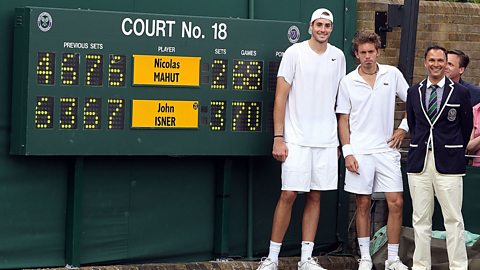
John Isner vs Nicholas Mahut, Wimbledon, June 2010
Tuesday June 22nd was the second day of the 2010 championships, not much out of the ordinary had happened. Andy Murray had won, Serena Williams and Rafael Nadal too. All routine stuff.
Then at 18:13 two unseeded players took to Court 18. American John Isner and the French player Nicholas Mahut. With big serving from both players, the sets rumbled on, but at 21:07 with the score at two sets all, play was suspended due to bad light.
The pair came back to court 18 the following day, for the final set with play starting at 14:05. Three hours and 40 minutes later the pair were still playing that fifth set, and locked at 32-32. At this point the match became the longest in tennis history - but there was still no winner.
The games continued to fly-by, with neither player able to break the deadlock. At 47-47 the scoreboard temporarily broke – and then just after 21:00 - with the score at 59-59, play was once again suspended.
In what must have felt like a severe case of déjà vu, Isner and Mahut returned to the court for a third consecutive day. Something had to give, and eventually it did. Isner seized his opportunity to break serve in the 138th game of the final set, and with it took the win.
The match had lasted a total of eleven hours and five minutes. Impressive stuff. But perhaps even more impressive is the fact that Mahut went to play a doubles match shortly after.
This article was published in March 2026
Films based on real sporting events
BBC Bitesize takes a look at some blockbuster movies inspired by real-life sporting events and superstars
Four extreme endurance events from across the world
BBC Bitesize takes a look at four unbelievable challenges in the world of endurance sport.
The football rules that drove fans mad
BBC Bitesize explores the laws of the game that annoyed supporters and were quickly scrapped